Your Schengen visa application depends on more than dates and photographs. Article 15 of the Visa Code requires travel medical insurance covering emergency treatment, repatriation, and a minimum of EUR 30,000, valid for every day of your trip and across the territory you plan to visit. Miss any one of those elements and a consulate can refuse your application outright, regardless of how strong the rest of your file looks.
TL;DR:
- Insurance certificates must explicitly name the Schengen area, cover the full duration of stay, and display a minimum of EUR 30,000 for emergency treatment and repatriation.
- Insurers must have claims capacity within the EU, and policies should confirm recoverability in Member States to meet consulate requirements.
- Mistakes in documentation, such as vague wording or missing explicit EUR 30,000 coverage details, are common causes of visa refusals and are easily avoidable.
- Multiple‑entry and transit visas require precise alignment of policy cover dates with travel plans, and applicants must understand that later visits need separate compliant insurance.
- Consulting official checklists and requesting the exact policy certificate before submission significantly reduces the risk of document-based visa rejections.
Table of Contents
- Why visa insurance must be EU approved: what Article 15 actually demands
- Why the rule exists: protecting travellers and host states
- Certificate checklist: what to check before your appointment
- How to buy insurance the consulate will accept
- Multiple‑entry and transit: timing and declaration rules
- If the consulate queries or refuses a certificate: how to respond
- Author’s note: what most applicants get wrong
- Getting a visa‑compliant certificate without the guesswork
- Sources
- FAQ
Why visa insurance must be EU approved: what Article 15 actually demands
Consulates are not being fussy when they scrutinise your insurance certificate. Article 15 sets out a precise list, and every item on it exists to close a specific gap.
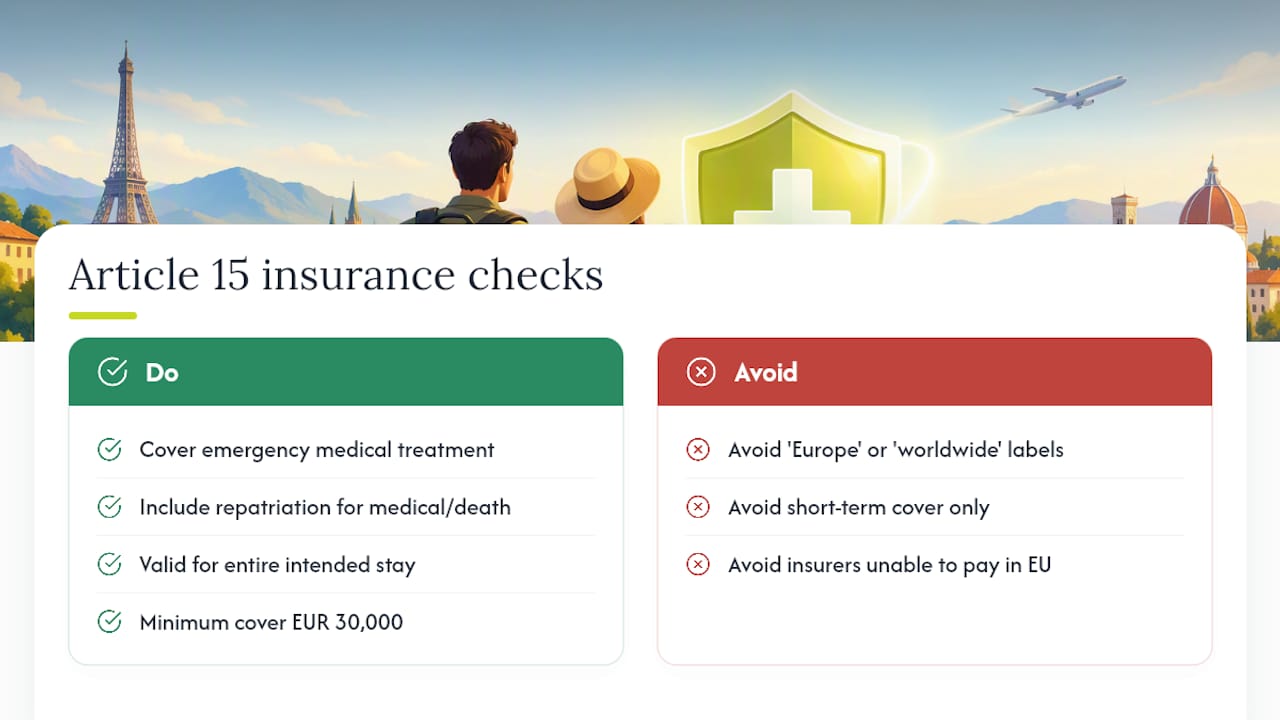
The policy must cover emergency medical treatment and urgent hospital care, plus repatriation for medical reasons or in the event of death. It must run for the entire length of your intended stay, not just the first week or the return flight. And it must show a minimum cover figure of EUR 30,000, a number that has not moved since the regulation was written.
Territorial validity matters just as much as the amount. A certificate that says “Europe” or “worldwide” without naming the Schengen area invites questions, because Schengen membership and EU membership are not the same thing, as the European Commission’s visa policy pages make clear. Consulates also check whether a claim against your insurer could actually be paid out, or “recovered,” inside a Member State. This is why the Visa Code’s own summary guidance advises applicants to buy insurance in their country of residence wherever that is practical. It shortens the chain between you, your insurer, and the money.
Why the rule exists: protecting travellers and host states
The EUR 30,000 threshold is not arbitrary bureaucracy. It is a public health safeguard built around a genuine problem: travellers who fall seriously ill abroad without cover, and hospitals that are left absorbing the bill.
A 2024 European Commission study on travel medical insurance confirms the rationale behind the requirement while also noting that implementation differs from one Member State to another. That single point explains most of the confusion applicants feel. There is no single “EU‑approved” stamp that a policy either has or lacks. What “EU approved” really means, in practice, is that the insurer can pay claims inside the Schengen area and the policy wording proves it. A cheap policy from an insurer with no claims presence in Europe can look compliant on paper and still fail at the consulate desk, or worse, fail you when you actually need care.
Certificate checklist: what to check before your appointment
Before you print anything for your appointment, read your certificate the way a visa officer will. A handful of documentary slips cause a disproportionate number of refusals, and every one of them is preventable.
- Your name matches your passport exactly, including middle names and diacritics.
- Start and end dates cover your full intended stay, with no gap at either end.
- Territorial wording explicitly names the Schengen area, or the specific Member States on a limited‑validity visa.
- The EUR 30,000 figure appears in clear text, ideally in euros rather than converted from another currency.
- Repatriation and emergency hospitalisation are named, not implied.
- Insurer contact details and a recoverability statement confirming claims can be settled in a Member State.
Keep your payment receipt and any email confirmation from the insurer. If something on the certificate looks off, ask for a written correction rather than a verbal reassurance, before you submit your application.
Pro Tip: Ask your insurer for the exact PDF certificate you intend to hand over, not a generic policy summary. Consulates read certificates literally, and a mismatch between your summary document and your actual policy wording is one of the most common, and most avoidable, causes of a query.
How to buy insurance the consulate will accept
Buying the right policy is less about price and more about verification. Follow a short sequence and you avoid most of the common traps.
- Check territorial scope first. Confirm the certificate names all Schengen States, or the specific states listed on a limited‑validity visa, not a vague “Europe” label.
- Ask about recoverability directly. Contact the insurer and ask whether claims are recoverable in an EU or Schengen Member State, and request the claims unit’s contact details in writing.
- Compare the wording, not just the price. A minimum-cover policy that names every required element beats a cheaper one that leaves gaps.
Watch for three red flags. A coverage amount shown only in a non‑EUR currency with no conversion. Missing or vague repatriation wording. An insurer with no EU claims presence, meaning your money would have to travel further than you would if something went wrong.
Multiple‑entry and transit: timing and declaration rules
Multiple‑entry visas have a specific nuance worth understanding before you apply. Under the Visa Code’s multiple‑entry provisions, your insurance only needs to cover your first intended visit at the point of application. You then sign a declaration acknowledging that you understand later visits need their own compliant cover.
Transit visas carry the same underlying logic but a tighter focus. The policy dates must match your actual transit window and itinerary precisely, not a rounded‑up estimate. When any of this feels ambiguous, the safest move is always to follow the responsible consulate’s published checklist rather than assume every mission applies the rule identically.
If the consulate queries or refuses a certificate: how to respond
Most documentary refusals are fixable within days, not weeks. The usual fault is a missing phrase, not a missing policy.
Ask your insurer for a corrected certificate that explicitly states the EUR 30,000 figure, territorial scope, and repatriation cover. Keep your payment receipt, the full policy wording, and any email confirmations as proof that cover existed before the refusal. Some missions maintain their own approved‑insurer lists, so a query is sometimes about local practice rather than the policy itself. If the issue persists, ask the consulate directly what wording they need, or seek independent advice before resubmitting.
Author’s note: what most applicants get wrong
Most documentary rejections have nothing to do with weak coverage and everything to do with weak paperwork. An insurer with genuinely strong claims capacity in Europe can still cost you a visa if the certificate you hand over uses vague language instead of the exact phrases Article 15 demands.
My practical habit for anyone applying: request the finished certificate before your appointment, not the sales brochure, and keep both a printed copy and a digital backup. Consulates read documents literally. A five‑minute check against the checklist above catches almost every avoidable refusal before it happens.
— Coert
Getting a visa‑compliant certificate without the guesswork
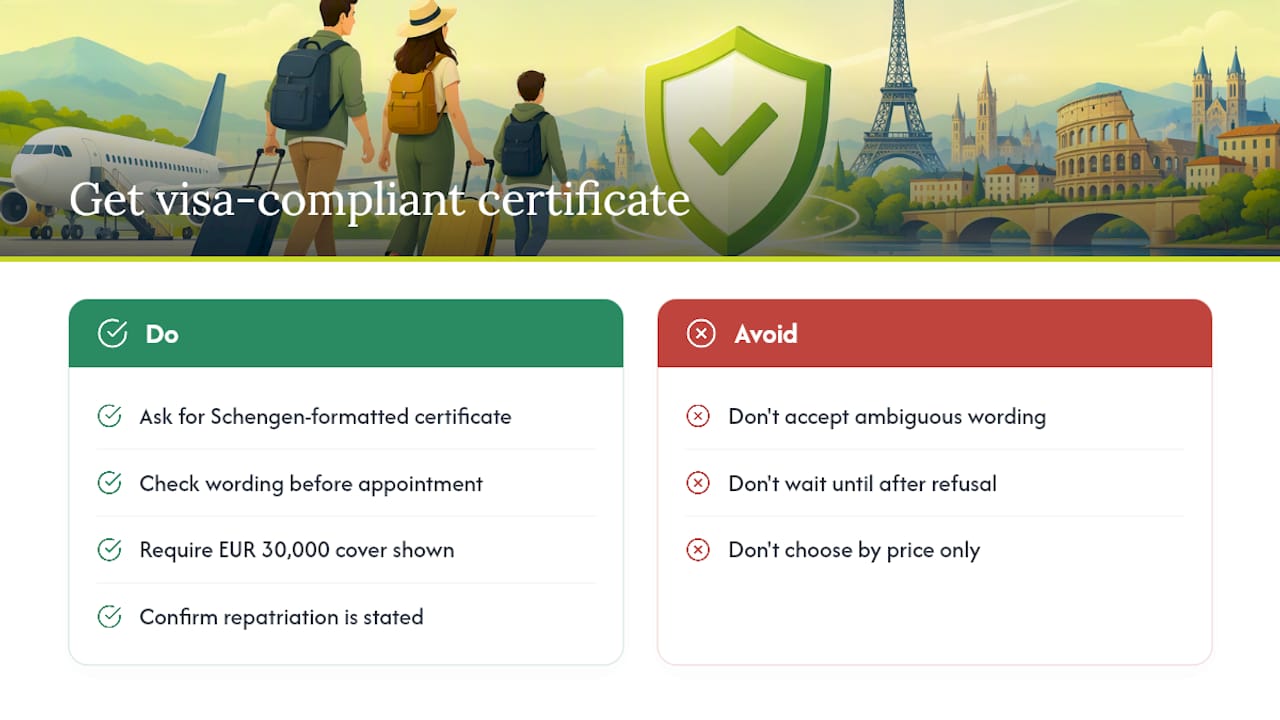
Some insurers arrange travel medical insurance built around the exact wording consulates look for: EUR 30,000 minimum cover, Schengen territorial scope, and repatriation stated plainly, with certificates formatted so a visa officer can verify every element at a glance. That matters more than price alone, because a policy that reads ambiguously on paper can cost you a visa even when the cover itself is sound.
Watch this short explainer on how Schengen insurance requirements work in practice:
Planning a trip for yourself, a resident, or visiting family? UGB + Ekta can arrange travel insurance for seniors up to 100 years old. Just click here: https://ektatraveling.com/?partner_uid=808 and add the promo code “UGB” to receive an additional 10% discount.
If you are preparing a visa application now, request a quote through Unparalleledglobalbenefits and ask specifically for a certificate formatted for Schengen submission, so you can check the wording yourself before your appointment rather than after a refusal.
Sources
Verify the rules yourself before relying on any summary, including this one. Article 15 of the Visa Code sets the legal minimum. The EEAS Schengen MTI form shows accepted policy wording. The European Commission’s visa policy pages explain territorial scope, and the 2024 EU study confirms why practice varies by consulate.
This article is general information, not a substitute for advice from a qualified lawyer. Consult a qualified legal professional about your own circumstances before acting on anything here.
- Regulation (EC) No 810/2009 (Visa Code) — Article 15 travel medical insurance
- Study on the travel medical insurance used by visa holders during their stay in the territory of the Member States (2024)
- Visa policy — Migration and Home Affairs — European Commission (2025)
FAQ
Is travel insurance mandatory in the EU?
Travel medical insurance is not a general EU requirement for all travel, but it is mandatory for anyone applying for a Schengen visa under Article 15 of the Visa Code. EU and EEA citizens travelling within the bloc rely on different arrangements, such as the EHIC, rather than this visa requirement.
What happens if I don’t have an EHIC card?
An EHIC has nothing to do with your Schengen visa application. It is a reciprocal healthcare arrangement for EU and EEA citizens travelling within the bloc, while a Schengen visa applicant from outside that area must instead show compliant private travel medical insurance meeting the EUR 30,000 minimum.
Is it mandatory to have travel insurance for a Schengen visa?
Yes. It is one of the express documentary requirements under Article 15, and insufficient or non‑compliant insurance is a recognised ground for visa refusal. The policy must show emergency cover, repatriation, correct Schengen territorial wording, and the EUR 30,000 minimum.
Is travel insurance mandatory for a UK visa application?
This article covers Schengen area visas issued under EU rules, which is a separate system from UK visas. UK visa requirements are set by the UK government and do not follow the EUR 30,000 Schengen threshold described here, so applicants should check the relevant UK Home Office guidance directly.
Where can I get a Schengen‑compliant insurance certificate?
Unparalleledglobalbenefits arranges travel medical insurance with certificates formatted to show the required Article 15 elements clearly, including territorial scope and the EUR 30,000 minimum. Current plan pricing and quote requests are available directly on the Unparalleledglobalbenefits site.