

Permanent residency is a formal, indefinite legal status that grants you the right to live and work in a country without a time limit. Expat status is a social or occupational label, usually tied to a temporary visa or an employer’s overseas assignment, with no independent legal meaning of its own. The practical gap between them shows up in three places: your route to citizenship, your entitlement to public benefits, and how exposed you are if a visa expires or a job ends.
TL;DR:
- Permanent residency grants an indefinite right to stay, work, and access public services, unlike expat visas which have fixed durations and renewal requirements.
- Long residence pathways for residency, such as in the UK, typically require five to ten years of continuous lawful stay, with strict absence limits often around 180 days annually.
- Employment and healthcare rights significantly differ, as permanent residents can change jobs freely and access public benefits, while expats are usually tied to their sponsoring employer and rely on private or employer-provided coverage.
- Maintaining detailed travel, work, and insurance records from day one is crucial to support a successful settlement or residency application, especially after years of mobility.
- Immigration authorities prioritize visa categories and lawful residence history over labels like expat or immigrant, making proper documentation and legal compliance essential.
Table of Contents
- Key differences at a glance
- What each term means legally and socially
- How permanent residency works in practice: the UK example
- Practical implications: work, healthcare, tax and travel
- If you’re an expat and want permanent residency: a practical checklist
- How good documentation and insurance support a residency claim
- Focus on legal status and planning, not labels
- How Unparalleled Global Benefits can help
- Sources
- FAQ
Key differences at a glance
Once you strip away the labels, the two statuses sit at opposite ends of a spectrum. One is a legal entitlement recognised by immigration law, the other is a lifestyle description that immigration officers do not act on. Comparing them side by side makes the practical stakes clearer.
- Duration and permanence: permanent residency has no expiry date attached to your right to stay, while expat arrangements are almost always linked to a visa with a fixed end date.
- Legal rights: permanent residents can usually work for any employer and access most public services, though voting and standing for public office typically remain reserved for citizens.
- Documentation: permanent residents renew an identity card periodically but keep their underlying status, whereas expats must renew or replace the visa itself, often through their employer.
- Tax and travel: both can trigger tax residency rules and reentry requirements, though the consequences of getting them wrong are usually more serious for someone whose right to stay depends on a specific visa.
What each term means legally and socially
Permanent residency is defined by law. According to the immigration rules on continuous residence, it is a formal status that grants an individual an indefinite right to live and work in a host country, with entitlements similar to a citizen’s in most day-to-day respects, aside from certain political rights. Expat, by contrast, carries no such definition. It describes someone living outside their home country, usually by choice or through a work assignment, and says nothing about their legal footing there.

Immigration authorities do not process applications based on how someone describes themselves. What matters is the visa category and the intent behind it: temporary or settled. An OECD analysis of skilled worker mobility notes that many people who start out as temporary expats later shift towards permanent residency as their circumstances change, which is a reminder that “expat” is often a cultural description rather than a fixed category. As Investopedia explains, an expatriate typically keeps their home-country citizenship and financial ties, and secures whatever local visa their situation requires, without that visa necessarily leading anywhere permanent.
How permanent residency works in practice: the UK example
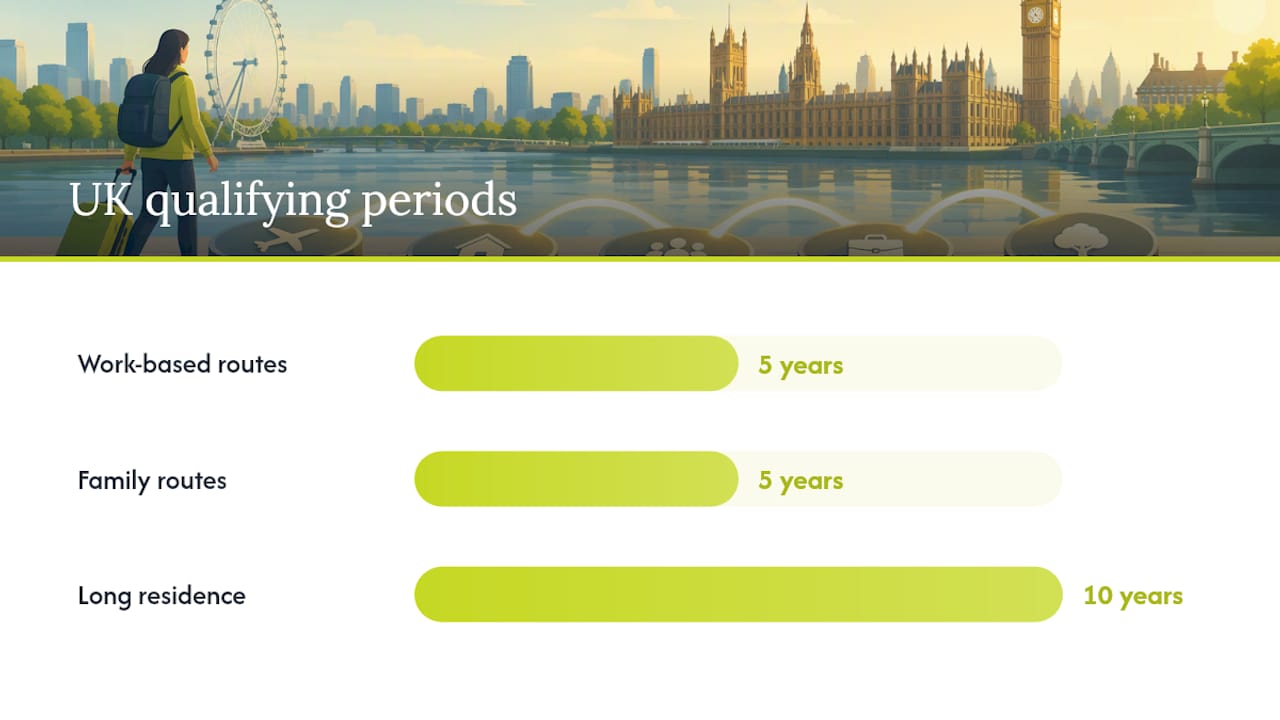
The UK offers one of the clearest illustrations of how settlement actually works, because its rules are unusually well documented. Indefinite Leave to Remain, commonly known as settlement or ILR, is the UK’s version of permanent residency, and most applicants reach it through one of three main paths.
- Work-based routes: typically five years of continuous lawful residence on a qualifying work visa.
- Family routes: often five years, depending on the specific route and relationship.
- Long residence: ten years of continuous lawful residence in the UK, regardless of visa category, as set out in the long residence appendix.
A qualifying period commonly runs to five years for many work and family routes, or ten years under long residence, and losing that continuity resets the clock in ways that are hard to undo.
Continuity is the part people underestimate. Continuous residence guidance from GOV.UK sets out absence limits that typically bar more than around 180 days out of any rolling 12-month period for many routes, alongside transitional rules for absences that occurred before current guidance took effect. National rules differ significantly by country, so treat the UK figures as an illustration rather than a template, and check the primary source for your own case.
Practical implications: work, healthcare, tax and travel
The legal distinction between the two statuses translates into everyday consequences that shape how secure your life abroad actually is.
- Employment: expats on sponsored visas are usually tied to the employer who sponsored them, while permanent residents can generally change jobs freely.
- Healthcare and benefits: access to public healthcare and welfare support tends to expand once someone holds permanent residency, whereas expats often rely on employer-provided or private cover during the visa period.
- Tax residency: both statuses can trigger tax obligations, and the rules vary enormously by country. As LegalClarity notes, some countries, including the United States, tax their citizens and permanent residents on worldwide income regardless of where they actually live, which is a different exposure to what a short-term expat assignment usually creates.
- Travel and reentry: long absences can put permanent residency at risk of being treated as abandoned, while expats risk their visa lapsing if they overstay a permitted absence window.
- Family sponsorship: permanent residents generally have broader rights to sponsor family members than someone on a temporary work visa, and their route to citizenship runs on a clearer, fixed timeline once settlement is granted.
Some work visas fall into what LegalClarity calls dual-intent categories, which allow the holder to actively pursue permanent residence while still on a temporary visa, without jeopardising their current status.
If you’re an expat and want permanent residency: a practical checklist
Moving from a temporary visa to settled status is largely a paperwork exercise, and the paperwork has to exist before you need it. You cannot reliably reconstruct years of travel and residency history after the fact.
- Keep every entry and exit stamp, boarding pass and travel itinerary that shows where you were and when.
- Log each absence from the country with its dates and reason, alongside supporting evidence such as flight bookings or hotel receipts.
- Retain employment contracts, payslips, rental agreements, utility bills and tax returns as a continuous paper trail.
- Start assembling your evidence package well before your qualifying period ends, not in the weeks beforehand.
- Get formal immigration advice early if your history includes gaps, multiple visa categories or time spent in more than one country.
Pro Tip: Keep a single running spreadsheet of every trip abroad from day one; reconstructing five or ten years of travel history from memory rarely holds up under scrutiny.
How good documentation and insurance support a residency claim
Continuous health or travel insurance does more than cover emergencies. Dated policy schedules, premium receipts and claims correspondence create a timestamped record of where you were living and how you accessed healthcare, which can support the kind of residence narrative that settlement applications rely on.
- Keep your full policy schedule, renewal confirmations and any claims correspondence in one place.
- Store digital copies of every document with clear timestamps rather than relying on paper originals.
- Choose visa-compliant expat insurance that matches the requirements of your specific visa category from the outset.
- Understand how your healthcare access changes as you move from a temporary visa towards settled status.
Focus on legal status and planning, not labels
Whether you call yourself an expat or not makes no difference to an immigration officer. What matters is the paperwork behind your visa and whether you can prove continuous, lawful residence when the time comes. Start your recordkeeping the day you arrive, check the official guidance for your specific route, and speak to a specialist adviser the moment your situation gets complicated.
— Coert
How Unparalleled Global Benefits can help
Whichever stage you’re at, arranging visa-compliant expat insurance is one practical way to build the kind of continuous documentation a settlement application benefits from. The site provides access to a network of insurers offering expat medical, travel and visa-specific cover with direct billing and flexible options for pre-existing conditions.

Request a quote through the main insurance plans page to compare cover suited to your visa category and start building your own paper trail today. Planning a trip for yourself, a resident, or visiting family? UGB + Ekta can arrange travel insurance for seniors up to 100 years old. Just click here: https://ektatraveling.com/?partner_uid=808 and add the promo code “UGB” to receive an additional 10% discount. For a broader look at how expat cover works day to day, watch this:
This article is general information, not a substitute for advice from a qualified lawyer. Consult a qualified legal professional about your own circumstances before acting on anything here.
Sources
- Gov
- International mobility of highly skilled workers (OECD)
- Expatriate definition and considerations (Investopedia)
FAQ
Are expats basically immigrants?
Not in a legal sense. “Expat” and “immigrant” are cultural labels rather than legal categories, and immigration authorities assess your visa type and intent instead of either term, as Investopedia notes.
Who is considered a permanent resident in the UK?
In the UK, permanent residency is granted through Indefinite Leave to Remain, which gives someone an ongoing right to live and work without a visa expiry date, subject to the continuous residence rules set out by GOV.UK.
What does a permanent resident status mean?
Permanent resident status means you hold an indefinite, formally recognised right to live and work in a country, with entitlements close to a citizen’s aside from certain political rights such as voting, according to GOV.UK’s immigration rules.
Why are British immigrants called expats?
The term is a matter of social convention rather than law: people from wealthier countries living abroad are often described as expats, while others in similar circumstances are called immigrants, even though immigration authorities apply the same visa rules regardless of the label used.