
Yes, you can insure your work equipment while working abroad, and the right route depends on your kit and how you travel. A travel insurance add-on suits short trips with modest gear, standalone or professional equipment cover fits high-value kit and income-dependent work, and expat or long-term international policies suit those based overseas most of the year. The catch: many standard policies exclude ‘business equipment’ outright, and an ATA Carnet, while useful at customs, is not insurance at all.
TL;DR:
- Standard travel policies often exclude business equipment, requiring specific declarations and documentation for high-value gear.
- Many policies limit electronics coverage per item and overall baggage caps, with higher-value items needing independent valuation.
- An ATA Carnet facilitates temporary customs clearance but does not cover theft or damage, making separate insurance essential for ongoing protection.
- Long-term expat or international policies are better suited for those living overseas most of the year, as they can bundle property, medical, and liability coverage without strict trip limits.
- Prioritizing the primary purpose of equipment and reviewing policy exclusions in writing help avoid claim rejections based on misclassified business gear or overlooked coverages.
Table of Contents
- What equipment cover usually includes and typical policy limits
- Why many standard travel or home policies exclude ‘business equipment’
- Practical options to insure your kit while working abroad
- Customs, temporary export and the ATA Carnet: what nomads must know
- Buying and claims checklist for nomads
- How Unparalleled Global Benefits supports nomads and next practical steps
- What nomads get wrong about equipment cover
- Get a quote and cover your equipment properly
- Sources
- FAQ
What equipment cover usually includes and typical policy limits
Most travel and equipment policies cover a familiar list of gear: laptops, phones, cameras, camera lenses, backup drives, headphones, and chargers. What varies enormously is how much protection you actually get for each item.
Insurers typically apply two layers of limits: a per-item cap and a total baggage or personal property cap for the whole policy. A cheap travel plan might cap electronics at a modest sum per item regardless of what you paid, while a dedicated equipment policy lets you declare actual values and insure closer to replacement cost. Excesses (the amount you pay before the insurer contributes) also apply per claim, and a higher excess usually buys a lower premium.
- Laptops, cameras and lenses are the items most often flagged for separate declaration.
- Per-item limits are frequently far below the total baggage cap, so one expensive item can exhaust its own limit while leaving the rest of the cap untouched.
- Items above a certain value generally need itemised declaration, receipts, and sometimes an independent valuation before the insurer will cover them properly.
If your kit is genuinely valuable, treat “covered” and “covered for what it’s worth” as two different questions.
Why many standard travel or home policies exclude ‘business equipment’
This is where nomads most often get caught out. A Financial Ombudsman decision found that an insurer fairly declined a claim after determining the item in question was ‘business equipment’, which the policy excluded while it was away from home.
An insurer fairly declined a claim where an item was defined as ‘business equipment’ and excluded while away from home.
The decision illustrates how insurers judge these cases. They look at the item’s primary purpose, not just whether you sometimes use it personally. A laptop used daily for client work, even if you also stream films on it in the evening, is likely to be classed as business equipment because that is what it is predominantly for. This “primary purpose” test is the crux of most rejected claims.
It connects to a wider gap that official foreign travel insurance guidance flags directly: travel insurance is not designed for people who have relocated abroad long-term to work or study. If you are living and working overseas rather than travelling through it, a standard travel policy was never built for your situation, and the exclusions tend to reflect that.
Practical options to insure your kit while working abroad
Once you know the exclusion trap exists, the choice becomes about matching the policy type to how you actually live and work.
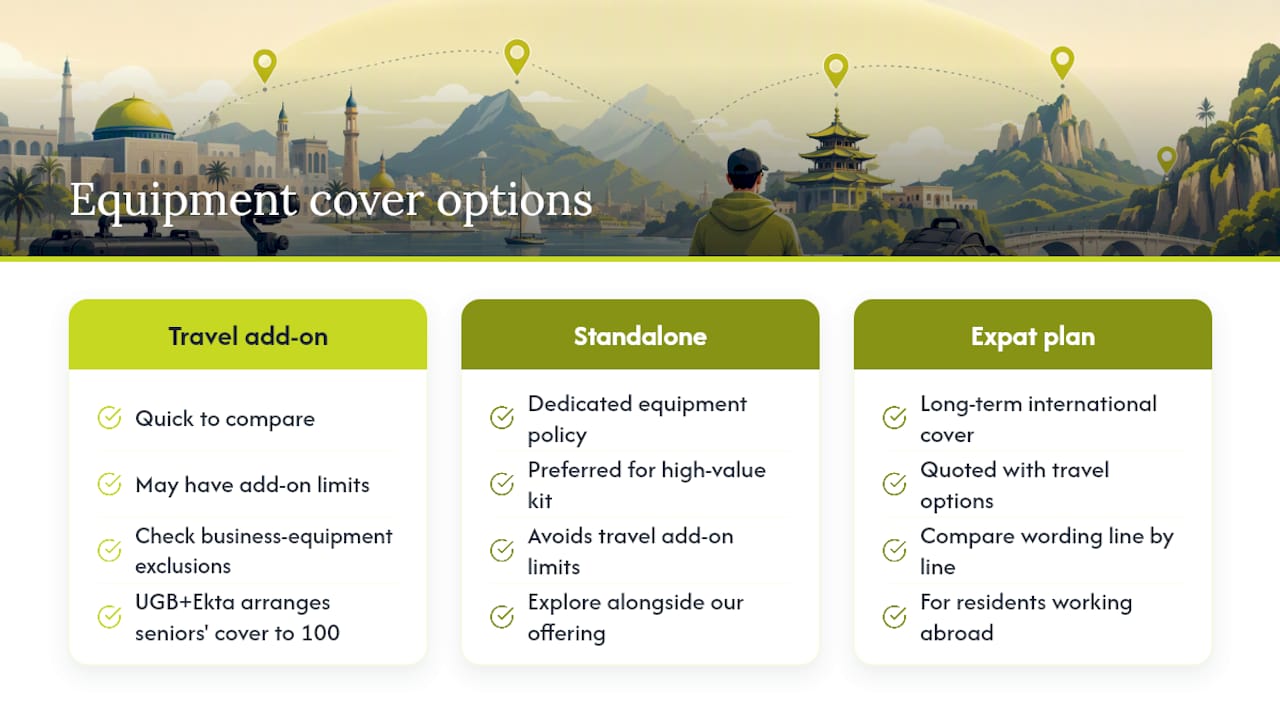
- Travel insurance add-on: works for short trips and lower-value kit, but usually carries tight per-item limits and a business equipment exclusion you need to check line by line.
- Standalone or professional equipment insurance: suits high-value gear and anyone whose income depends on that gear, since it lets you declare individual items, insure closer to real value, and sometimes add rental replacement while a claim is processed.
- Home-contents policy with a worldwide rider: a reasonable option if you keep a home base and want continuity of cover without buying a separate policy, though limits abroad are often lower than at home.
- Expat or long-term international policy: fits people based overseas most of the year, since these plans are built around extended stays rather than short trips, and can bundle personal property alongside medical and liability cover. Our types of expat insurance guide breaks down how these plans differ from travel cover.
The deciding factors are simple: how often you travel, what your kit is worth, and how much risk of loss you are realistically carrying. Someone hopping between three countries a year with a laptop and a phone has very different needs from a photographer carrying several thousand pounds of lenses through airports monthly.
Pro Tip: If you travel continuously rather than in occasional trips, price an annual or continuous policy against several single-trip plans before you buy: the gaps between trips are exactly when uninsured losses happen.
Customs, temporary export and the ATA Carnet: what nomads must know
An ATA Carnet is a customs document, not an insurance policy. It lets you temporarily import professional equipment into participating countries without paying import duties, and it works by using vouchers tied to a general list of the goods you are carrying, backed by a guarantee, according to guidance on applying for an ATA Carnet. None of that protects you if the equipment is stolen or damaged.
Guidance on taking goods overseas for work explains when a Carnet actually helps: trade shows, film shoots, and other situations where you are bringing professional kit into a country temporarily and taking it out again within the agreed time limit.
- A Carnet smooths customs but leaves you fully exposed to theft or accidental damage.
- Check which countries participate before you travel, since coverage is not universal.
- Keep every voucher and stick to the time limits stated on the Carnet, or you risk duty claims on your return.
Nomads carrying professional gear across borders regularly often need both: a Carnet for customs, and a proper insurance policy for the equipment itself.
Buying and claims checklist for nomads
Getting the right policy is only half the job. What you do before and after a loss shapes whether a claim actually pays out.
- Build an inventory with serial numbers, receipts, and photos of every significant item, and keep valuations current for anything high-value.
- Ask any insurer directly about per-item limits, the exact wording around business equipment, geographic restrictions, duration limits, and the excess on each claim type.
- Choose a continuous or annual policy over a string of single-trip plans if you travel constantly, since gaps between trips are when losses go uncovered.
- Declare valuable items at the point of purchase rather than after the fact, and use whatever digital policy management tools your insurer offers to keep documents accessible while abroad.
- If something is lost or stolen, report it to local police or customs immediately, preserve any evidence such as photos of the scene, and contact your insurer before doing anything else.
None of this guarantees a payout, but it removes the most common reasons insurers give for refusing one.
How Unparalleled Global Benefits supports nomads and next practical steps
Unparalleled Global Benefits offers international insurance solutions for expats, travellers, and nomads, and publishes detailed guidance on the coverage gaps this lifestyle creates, including our earlier piece on insurance for digital nomads.
A recurring finding worth remembering: the Financial Ombudsman decision shows that business equipment exclusions are enforced in practice, not just written in the small print.
Some providers offer assistance to compare add-on, standalone, and long-term expat options, explain how each treats business equipment, and support the paperwork needed for claims or visa-linked cover requirements. If your work and medical needs overlap, our guide to medical insurance for digital nomads covers the health side separately.
What nomads get wrong about equipment cover
The conventional advice, buy travel insurance and add baggage cover, is not wrong, but it quietly assumes your laptop is a holiday item rather than a livelihood. That assumption is where most claims fail.
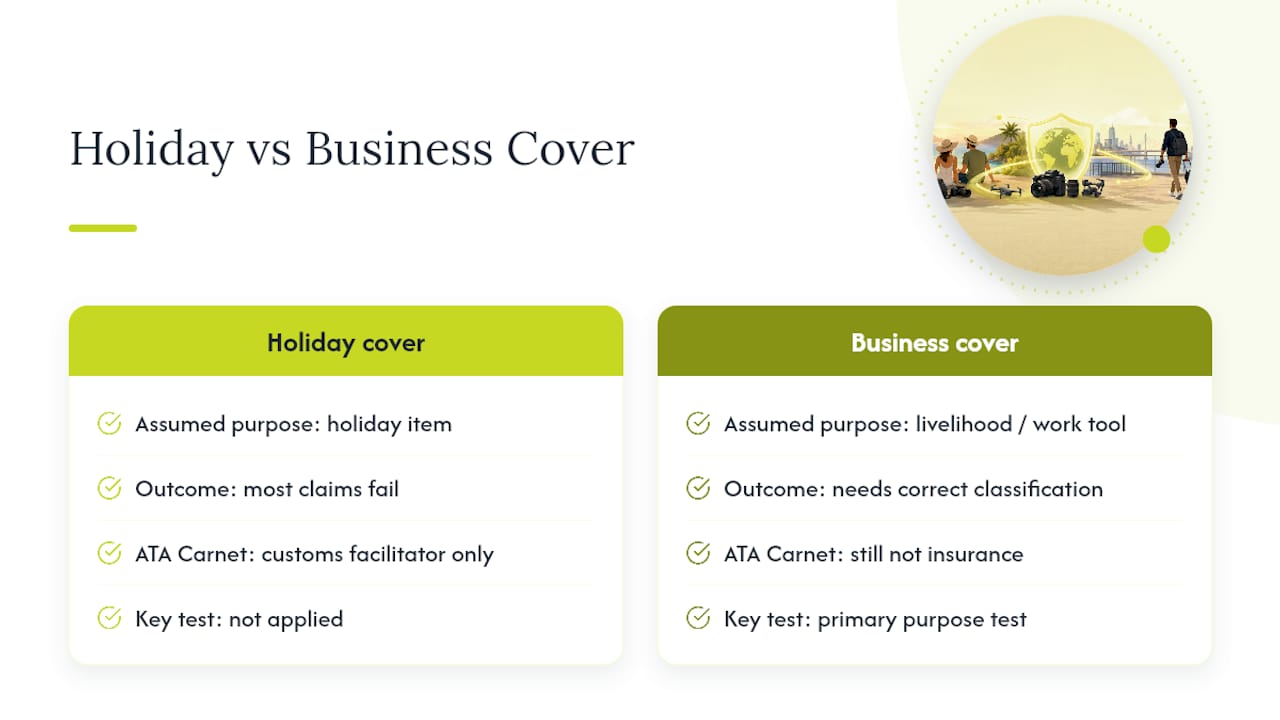
The bigger error is treating the ATA Carnet as some kind of protection. It is a customs facilitator, useful and sometimes essential, but it does nothing if your camera gets stolen from a hotel room. Conflating the two leaves people carrying valuable kit across borders with a false sense of security.
If you take one thing from this article, prioritise the primary purpose test before you buy anything. Read the exact wording on business equipment, ask the insurer directly how they would classify your main device, and get that answer in writing. Everything else, per-item limits, excesses, geographic scope, matters less than getting past that first exclusion.
— Coert
Get a quote and cover your equipment properly
Comparing add-on limits, standalone equipment policies, and expat plans line by line takes time you would rather spend working. Some insurance platforms arrange quotes across travel, expat, and long-term international cover so buyers can review the exact wording on business equipment exclusions before purchase.
Some professionals with high-value kit prefer a dedicated standalone equipment insurer rather than a travel add-on, and that is a reasonable path to explore alongside what we offer. Start by comparing your options on our main insurance page, and see our travel insurance overview for how basic cover works before you decide what you actually need.
For a practical walkthrough of these considerations, watch this video:
Planning a trip for yourself, a resident, or visiting family? UGB + Ekta can arrange travel insurance for seniors up to 100 years old. Just click here: https://ektatraveling.com/?partner_uid=808 and add the promo code “UGB” to receive an additional 10% discount.
This article is general information, not a substitute for advice from a qualified financial advisor. Consult a qualified financial professional about your own circumstances before acting on anything here.
Sources
FAQ
How does insurance work when you are abroad?
Insurance abroad works much like it does at home: you pay a premium for a policy that covers specified risks, subject to limits, excesses, and exclusions written into the policy wording. The key difference is scope: check whether your policy covers the specific countries, duration, and type of use (personal or business) that applies to your trip.
What are the limitations of nomad insurance?
Nomad and travel policies commonly exclude business equipment, cap per-item and total baggage values well below replacement cost, and are not designed for permanent relocation, according to gov.uk guidance. They may also restrict cover to a maximum number of days per trip or per year.
Is nomad insurance good value?
Nomad insurance can be good value for the right profile: someone with modest kit moving between countries occasionally. For anyone with high-value equipment or income-dependent gear, standalone equipment cover or an expat policy tends to fit better, since travel add-ons rarely insure business items adequately.
Is nomad insurance the same as travel insurance?
Nomad insurance and travel insurance overlap but are not identical. Travel insurance is generally built for shorter trips and holidays, while nomad-focused or expat policies are designed for extended stays abroad and often include broader personal property and medical options suited to a working lifestyle overseas.