
Political evacuation for students is the organised, non-medical removal of a student from a country or region when civil unrest, a coup, terrorism, or the collapse of public order makes staying unsafe. Universities and insurance assistance providers typically coordinate the move, with government evacuation acting only as a fallback. If you are a student reading this because things feel uncertain where you are, the first move is simple: register with your university’s emergency system and your embassy or consulate, then wait for official instructions.
TL;DR:
- Students must register with their university’s emergency system and their embassy or consulate to qualify for evacuation support, as support depends on prior approval and documentation.
- Avoid self-arranged transport during evacuation, because only authorized transport arranged through assistance providers is typically reimbursed; speed and following official instructions are crucial.
- Assistance services may be suspended in active conflict zones or war-risk areas, and government help is limited, often limited to nationals and sometimes requiring repayment.
- Preparing essential documents, medical supplies, and contact information in advance significantly increases safety and efficiency during a crisis.
- Universities should plan ahead by defining authority, establishing safe havens, and addressing academic and disability needs to ensure a smooth evacuation process.
Table of Contents
- What counts as a political evacuation, and how it differs from other evacuations
- How does a political evacuation for students actually unfold?
- Who authorises, organises and pays for a political evacuation?
- What should students prepare now, before anything happens?
- What should university administrators prepare in advance?
- What are the limits, exclusions and practical caveats?
- Why the paperwork matters more than the panic
- How Unparalleledglobalbenefits supports students facing political risk abroad
- Where to check for official guidance right now
- Sources
- FAQ
What counts as a political evacuation, and how it differs from other evacuations
Universities and insurers separate emergencies into distinct categories, and knowing which one applies to you determines who calls the shots and what gets covered. Political or security evacuation is triggered by human events, not by fires or floods, and it is handled very differently from a routine drill.
- Political/security evacuation: triggered by civil unrest, a coup, terrorism, or a breakdown in government control, and coordinated through university or insurer channels.
- Medical evacuation: moves a patient to adequate care after illness or injury, entirely separate from political conditions.
- Building or campus evacuation: a short-term, local response to an on-site hazard such as a fire alarm.
- Area or community evacuation: a wider but usually short-lived move away from a localised threat, such as a chemical spill.
Insurers and universities sometimes label political evacuation “non-medical evacuation” or use shorthand terms such as PEND in their policy wording. These four broad evacuation categories rarely overlap in practice, which is exactly why reading your specific policy wording matters more than assuming general emergency cover applies.
How does a political evacuation for students actually unfold?
Most political evacuations follow a recognisable sequence, even though the pace and pressure vary enormously depending on how fast the situation deteriorates. Universities that manage this well have rehearsed it; ones that have not tend to improvise badly under pressure.
- Monitor official alerts. Watch university communications and government travel advisories continuously once tension rises.
- Register your presence. Confirm you are logged with your university’s travel registry and your embassy or consulate.
- Shelter or move, as instructed. Follow direction on whether to stay put or relocate to a designated safe haven.
- Contact your assistance provider. Call your insurer’s assistance line or your university’s emergency staff, not a general customer service number.
- Check in at departure points. Attend the exact location and time you are told, because designated departure points can change with little notice.
- Travel only via authorised transport. Self-arranged flights or overland routes can void reimbursement and put you outside the safety net entirely.
- Follow housing and academic instructions. Once at the safe destination, wait for guidance on lodging, coursework continuity, or repatriation.
Skipping step six is the mistake that costs students the most. Universities treat evacuation as a coordinated service delivered through an authorised assistance provider, and students who arrange their own transport risk losing reimbursement even when the underlying policy would otherwise have covered them.
Pro Tip: Call the assistance number on your policy card before you book anything yourself. Once an evacuation window closes, the provider may no longer be able to arrange transport at all, so speed matters more than independence here.
Who authorises, organises and pays for a political evacuation?
Coverage is not automatic, and this is where most confusion sits. Three parties can be involved, each with different obligations and limits.
- Universities often require students to register travel and secure prior approval before visiting restricted or high-risk destinations, which affects whether support kicks in at all.
- Assistance providers set the real terms: war-risk exclusions and active conflict zones can suspend service, and availability depends on the exact wording of the policy triggering the response.
- Governments step in as a limited contingency, usually reserved for their own nationals, and assistance may be repayable rather than free.
Ignoring a required evacuation instruction carries real consequences beyond physical risk. Universities can treat non-compliance as a conduct matter, and it can also disrupt funding, academic credit, or continued enrolment, depending on institutional policy.
What should students prepare now, before anything happens?
Preparation is the part most students skip, right up until they need it. A short checklist, sorted and ready, turns a chaotic evacuation into a manageable one.
- Passport, visa documents, and printed copies of both, stored separately from the originals.
- University and insurer contact numbers, plus your embassy or consulate’s local emergency line.
- Prescription medicines and copies of prescriptions, kept in hand luggage rather than checked bags.
- Digital and paper copies of transcripts, enrolment confirmation, and other essential academic files.
- A payment card with available credit, some local cash, and a backup card on a different account.
- Phone, charger, and a power bank, plus two realistic destination options if you need to move quickly.
Registering your travel and sharing your itinerary with someone outside the affected country takes minutes and matters enormously once communications get patchy. The Northwestern global safety office recommends knowing local emergency numbers before you need them, not while you are dialling them under pressure.
Pro Tip: Photograph every important document and email the images to yourself. If your bag is lost during a rushed departure, you will still have access from any device with internet.

What should university administrators prepare in advance?
Institutions carry a heavier operational burden, and the gap between a well-drilled response and a chaotic one usually comes down to decisions made months earlier, not hours earlier.
- Define authorisation authority. Decide in advance exactly who can declare an evacuation and activate the response chain.
- Build accurate headcounts. Maintain a live system for counting and contacting every student in the affected area.
- Pre-identify safe havens and transport. Have backup transport arrangements ready if commercial travel options collapse entirely.
- Plan for disability and safeguarding needs. Build individualised arrangements for students with disabilities or chronic conditions, since generic plans often fail them.
- Address academic continuity and refunds. Set clear policy on coursework, credit, and tuition adjustments before a crisis, not during one.
- Liaise with insurers directly. Keep consented emergency contact records secure and immediately accessible to the assistance provider.
Downloading syllabi and core course materials in advance is a small step that protects academic continuity if communications drop out during the evacuation itself.
What are the limits, exclusions and practical caveats?
Cover for political evacuation is never unlimited, and the gap between what students assume and what a policy actually promises catches people out constantly.
- War-risk and territory exclusions can suspend assistance entirely in active conflict zones, regardless of how the policy reads elsewhere.
- Unauthorised self-evacuation risks non-reimbursement, so call the assistance line first even when a self-arranged option looks faster.
- Government assistance is a genuine contingency, not a first resort. It’s usually limited and sometimes repayable, and non-citizens may not qualify at all.
- Closed assistance windows mean a provider that could help yesterday may be unable to arrange transport today.
- Disability, dependants, and prescription needs require individual planning; a generic evacuation plan rarely covers them adequately.
Buying insurance after a crisis has already started will not secure evacuation. Policy triggers, registration status, and exclusions are usually locked in before the situation escalates, which is exactly why the registration step matters so much earlier in this guide.
Why the paperwork matters more than the panic
The instinct in a crisis is to act fast and worry about the fine print later. That instinct is understandable, and it is also precisely what causes students to lose reimbursement, miss evacuation windows, or end up stranded without support they assumed they had.
The uncomfortable truth is that political evacuation cover rewards administration, not adrenaline. A student who registered travel, confirmed prior approval for a restricted destination, and knows the assistance provider’s phone number by heart will move through a crisis faster than one relying on instinct and a government hotline that may or may not answer. Some providers see this gap between assumption and policy wording constantly, and closing it before departure is the whole point of reading a guide like this one rather than after the fact.
Our recommendation for parents and administrators reading this: treat the registration and prior-approval step as non-optional homework, not paperwork to get around to later. It is the single detail that determines whether an evacuation goes smoothly or badly.
— Coert
How Unparalleledglobalbenefits supports students facing political risk abroad
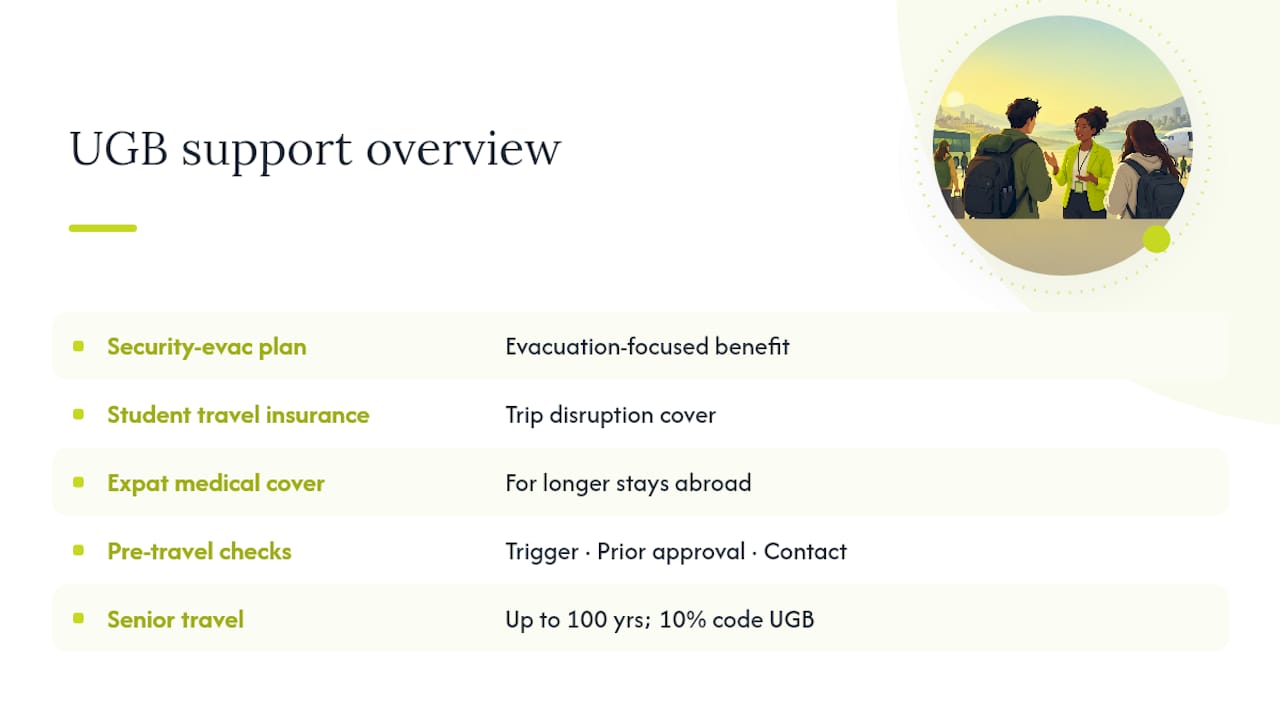
Some insurance platforms work with a global network of insurers to match students, families, and expats with plans that address exactly this kind of risk. A student plan built around security-evacuation benefits, general travel insurance covering trip disruption, or broader expat medical cover for longer stays abroad can all play a part depending on how long you are away and where.

Before you travel, check three things on any policy you are considering: what triggers the security-evacuation benefit, whether prior approval is needed for your destination, and the assistance provider’s direct contact number. Insurance providers can walk you through these details and help you compare plan types side by side, with support in multiple languages and flexible options if you have pre-existing conditions to declare. Request a quote to see which plan fits your situation, or explore the full range of travel and student cover before you book your next trip abroad.
And if you are planning travel for yourself, a resident, or visiting family, Unparalleledglobalbenefits and Ekta can arrange travel insurance for seniors up to 100 years old. Just click here to get a quote through Ekta and add the promo code “UGB” to receive an additional 10% discount.
For a practical walkthrough of what evacuation actually looks like on the ground, this video is worth watching:
Where to check for official guidance right now
For live alerts, consult your government’s travel advisory, your university’s emergency office, and your insurer’s assistance FAQ directly.
Sources
- Evacuation (Political or Natural Disaster) – Northwestern University
- Emergency preparation for global experiences – University of Nebraska-Lincoln
- Crisis response and evacuations – U.S. Department of State
FAQ
What does evacuation mean for students?
Evacuation for students means an organised, temporary or permanent removal from an unsafe location, coordinated by a university, insurer, or government. In the political context, it specifically covers non-medical removal due to civil unrest, conflict, or governmental collapse, distinct from a medical evacuation.
What are the stages of the evacuation process?
The process generally runs through monitoring alerts, registering with the university and embassy, sheltering or relocating as instructed, contacting the assistance provider, and following authorised transport to a safe destination. Full detail on this step-by-step sequence appears earlier in this guide.
What are the four types of evacuations relevant to students?
The four broad categories are building or campus evacuation, area or community evacuation, political or security evacuation, and medical evacuation. Universities and insurers sometimes use different labels for the same categories, so check your specific policy wording.
What does “school evacuation” mean in a political context?
For a university, a political evacuation means moving students out of a country or region when unrest or conflict makes staying unsafe, coordinated through the institution’s emergency system rather than a fire alarm response. It typically requires prior registration and is separate from a routine campus evacuation drill.
Does travel insurance cover political evacuation costs?
Some travel and student insurance plans include security-evacuation benefits, but coverage depends on prior registration, approval for the destination, and the absence of war-risk exclusions. Unparalleledglobalbenefits can help you compare student and travel plans that address this specific risk before you travel.