
“Hardship post insurance” is not a single insurance product. It normally describes an employer allowance, the post hardship differential paid by the U.S. Department of State or the hardship allowance administered under ICSC and UN rules. Medical evacuation, life and property cover sit in separate insurance policies that you need to check independently.
TL;DR:
- Hardship allowances are fixed percentage pay increases based on the duty station’s classification, not linked to actual risks or coverage.
- Insurance policies for evacuation, medical, and property are separate and often exclude risks associated with hardship conditions, even if pay reflects them.
- Eligibility for the hardship allowance typically requires full-time international staff at classified hardship posts, with family allowances being partial or dependent on specific schemes.
- The hardship differential rate is calculated through surveys or classifications and may not be up-to-date or reflect the current on-ground situation.
- Confirming current classification, reading insurance policies carefully, and considering supplementary coverage are essential before accepting a hardship post.
Table of Contents
- What is hardship post insurance, really?
- Who actually qualifies for the allowance?
- How is your hardship differential rate actually calculated?
- Why hardship pay and insurance are not the same thing
- A practical checklist before you accept a hardship posting
- Hardship compensation and insurance cover different risks entirely
- How danger pay, evacuation, and R&R connect to your hardship allowance
- What hardship post insurance gaps look like in practice
- When hardship allowances and insurance claims meet
- Common exclusions to check in any hardship posting policy
- How local laws and international agreements shape your entitlements
- Verify the classification before you rely on the percentage
- Closing coverage gaps with Unparalleledglobalbenefits
- Sources
- FAQ
What is hardship post insurance, really?
The phrase confuses two entirely different things. On one side sits compensation: extra pay for serving somewhere with genuinely difficult conditions. On the other sits insurance: a contract that pays out if something specific and bad happens to you, your health, or your belongings. “Hardship post insurance” gets used loosely for both, and that loose usage causes real problems when someone assumes their hardship differential somehow doubles as medical or evacuation cover.
The U.S. Department of State calls its version the post hardship differential, additional compensation of 5%, 10%, 15%, 20%, 25%, 30% or 35% above basic compensation for service at locations where living conditions differ substantially from the continental United States. The UN system runs a parallel but separate scheme through the International Civil Service Commission, paying hardship allowance automatically through payroll for staff at duty stations classed B through E.
Assessment factors behind both schemes cover similar ground:
- Healthcare access and quality, including availability of emergency treatment
- Security conditions, crime levels, and political stability
- Climate, pollution, and general environmental hardship
- Isolation, transport links, and availability of basic goods and services
- Housing quality and utility reliability
Duty stations get scored against these factors and slotted into a classification, from the easiest postings (Category A, no hardship allowance) through to the toughest (Category E and H, the highest banding). The U.S. Government Accountability Office frames the whole exercise plainly: hardship compensation exists to help recruit and retain staff willing to serve in tough locations, not to promise that every resulting loss gets automatically covered. A general definition on Wikipedia captures the everyday meaning well: a hardship post is simply a diplomatic assignment where climate, crime, healthcare access or pollution make daily life noticeably harder than at a standard posting.
Who actually qualifies for the allowance?
Eligibility rules differ between systems, but the underlying logic is consistent: pay follows the posting, not the person.
- Full-time internationally recruited staff assigned to a classified hardship post typically qualify automatically once their assignment begins, with no separate application needed in most cases.
- Spouses and eligible family members sometimes attract a partial allowance under UN-system rules, though this depends on the specific organisation’s scheme and the family member’s own employment status.
- Part-time or short-term staff often face reduced or prorated entitlements, and some schemes exclude staff on very short assignments entirely.
- Locally recruited staff are usually excluded from hardship differentials designed for internationally recruited personnel, since the rationale (relocation hardship) does not apply in the same way.
Entitlement starts when the assignment officially begins and stops when it ends, is suspended, or when the employee moves to non-pay status. The U.S. Foreign Affairs Manual sets out these administrative triggers in detail, including how post hardship differential interacts with danger pay when both apply to the same posting. A practical point that catches people out: differential is paid only for days on which basic pay is also received, so unpaid leave or a break in service can quietly reduce your allowance for that pay period. Tax treatment varies by employer and jurisdiction, so check your specific payroll guidance rather than assuming your differential is treated the same way as base salary everywhere.
How is your hardship differential rate actually calculated?
The rate is not decided by a manager’s gut feeling. For State Department postings, it flows from Form DS-267, the Post Hardship Differential Questionnaire, which scores each post against eleven general categories, covering areas such as political violence, medical facilities, social isolation, sanitation, and infrastructure quality. Posts must resubmit this survey every four years or whenever conditions change significantly enough to warrant a fresh look.
Pro Tip: If your assignment notice lists a hardship percentage without a survey date attached, ask HR when that post was last scored under DS-267 or its equivalent. A rating from six years ago may no longer reflect current conditions on the ground.
The UN/ICSC approach works differently in mechanics but similarly in spirit: duty stations get classified into bands (A through E and H), and the amount paid depends on the specific UN organisation’s own hardship scheme, which means two UN agencies at the same duty station can, in principle, apply different amounts.
Two quick examples show how this plays out:
- A diplomat posted somewhere scored at 20% receives that percentage of basic compensation, not of total compensation including housing or other allowances. A common error is assuming the differential applies to gross package value.
- A UN staff member moving from a Category A post to a Category D post sees their hardship allowance begin automatically through payroll from the assignment start date, calculated on the applicable UN scale rather than a US-style flat percentage table.
The scoring’s category-by-category weighting explains why two posts with superficially similar problems, say both facing power cuts and limited healthcare, can land on different bands. One post might score worse on isolation and transport, pulling its total differently than a post with better connectivity but worse security.
Why hardship pay and insurance are not the same thing
Confusing the two is where real financial exposure creeps in. Hardship differential compensates you for enduring difficult conditions. It does nothing, contractually, to pay a hospital bill, fund an evacuation flight, or replace stolen property. Insurance is the instrument that actually pays out against a defined loss, and only if your policy wording covers that specific loss.
Employer-provided insurance schemes vary considerably in what they include:
- Emergency medical treatment and hospitalisation, often with territory and network restrictions
- Medical evacuation to a suitable facility, sometimes limited to specific approved providers
- Life and accidental death cover, typically with separate limits from medical benefits
- Property or belongings cover, frequently excluded or capped very low
Common exclusions catch people off guard: pre-existing conditions often need separate disclosure or attract waiting periods, riot and civil commotion cover is frequently excluded or restricted, and cover for travel on non-commercial or military aircraft is a routine exclusion in commercial policies. A notice for group medical insurance procurement illustrates how granular these terms get in practice, spelling out eligible persons, deductibles, and territorial limits line by line.
Pro Tip: Never assume your hardship differential implies your insurance automatically upgrades to match the danger level of your post. Read the policy wording for your specific assignment, every time you move.
Where private insurance genuinely cannot cover a loss, some employers step in with ex-gratia payments, discretionary, one-off awards rather than a contractual entitlement. Do not plan your finances around receiving one.
A practical checklist before you accept a hardship posting
Work through this before you sign, not after you arrive.
- Read your assignment letter carefully for the stated hardship classification, its effective date, and whether it references a specific payroll table.
- Cross-check the classification against the current ICSC or State Department list rather than trusting the number in a job advert, since classifications and danger-pay lists change with effective dates that older postings may not reflect.
- Ask HR directly when your differential starts and stops, whether family members receive any portion of it, and how evacuation decisions get made and funded.
- Request the exact insurance policy wording, not just a benefits summary, and check exclusions for pre-existing conditions, riot cover, and evacuation triggers.
- Compare limits across evacuation, medical, and life cover side by side, since employer defaults are frequently adequate for routine care but thin for major medical events or family cover.
- Keep every document: assignment letters, payroll confirmations, and policy schedules, since claims disputes often hinge on exactly what was promised and when.
Pro Tip: Confirming your post’s current classification, checking your employer’s specific payroll table, and reading the group insurance wording for evacuation and family cover are the three checks that catch most gaps quickly, before you need to rely on any of it.
If your employer’s cover looks thin on family accompaniment or evacuation limits, a supplementary expat medical policy is worth pricing separately rather than assuming the gap will never matter.
Hardship compensation and insurance cover different risks entirely
Hardship compensation rewards you for tolerating conditions; insurance pays you when a defined event actually happens. A posting scored at 25% hardship tells you the environment is difficult. It tells you nothing about whether your medical policy covers a specific hospital, whether evacuation applies to your family members, or whether your belongings are protected if your accommodation is looted.
This distinction matters most at claim time. An insurer will not pay simply because your post carries a high hardship percentage; it pays only if the event falls within the policy’s defined terms. Conversely, your hardship allowance keeps arriving through payroll regardless of whether you ever file an insurance claim, since it is compensation for the assignment itself, not a reward tied to any loss event.
Employers sometimes bundle explanations of both together in onboarding packs, which is precisely where confusion sets in. Treat the hardship percentage as a pay calculation and the insurance policy as a completely separate legal contract, then read each on its own terms. If you are relocating with dependants, checking family cover terms specifically, rather than assuming a headline hardship figure implies broad family protection, avoids an unpleasant surprise later.
How danger pay, evacuation, and R&R connect to your hardship allowance
Danger pay and hardship differential can apply simultaneously but are calculated and triggered independently. The Foreign Affairs Manual sets out how the two interact administratively, including situations where both allowances apply to the same post because it is both physically dangerous and generally difficult to live in.
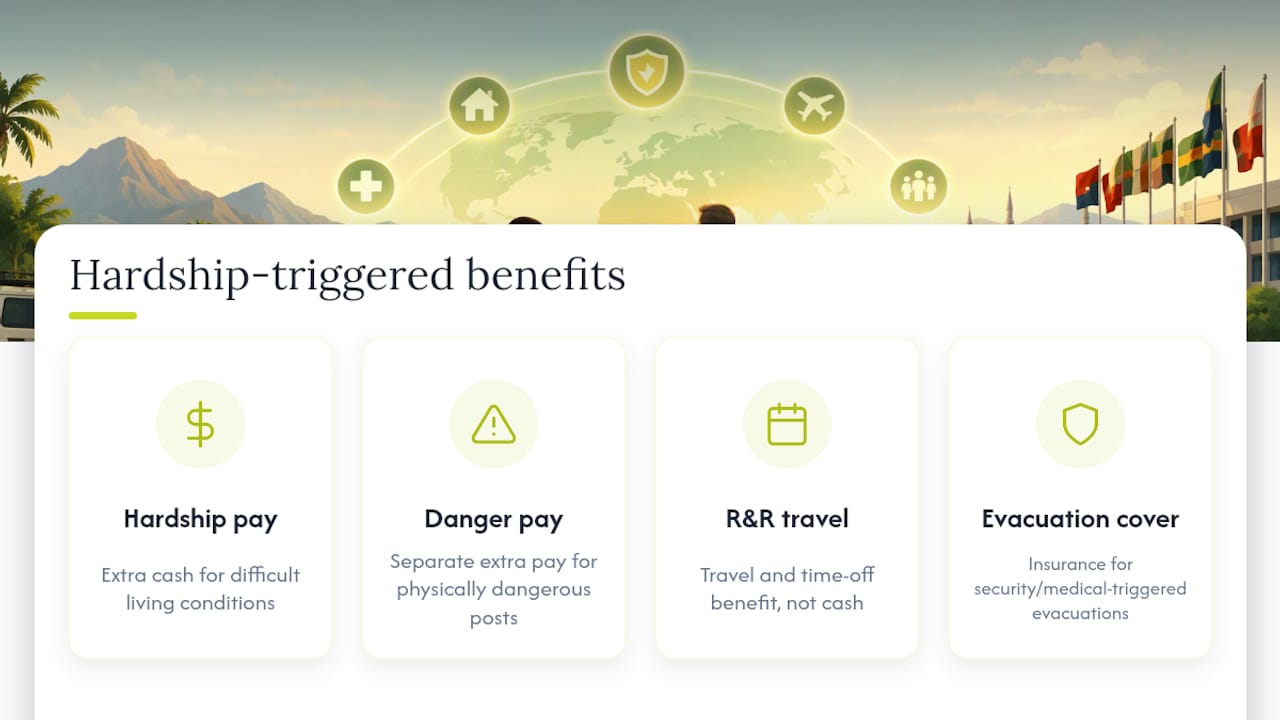
Evacuation is a distinct, separate mechanism again. It is triggered by a security or medical decision, not by your hardship percentage, and the costs are typically covered under insurance or specific evacuation provisions rather than paid from the hardship differential itself. Rest and recuperation (R&R) travel, meanwhile, is usually offered as a benefit tied to a post’s hardship or danger classification, giving staff periodic breaks away from the location, but the R&R benefit itself is a travel and time-off provision, not a cash payment or insurance policy.
The practical takeaway: a single hardship classification can trigger three entirely different benefits, extra pay, R&R travel, and potentially danger pay, while insurance coverage for the actual evacuation event sits on a fourth, separate track. Assuming one covers the others is the most common mistake staff make when reading their assignment terms for the first time.
What hardship post insurance gaps look like in practice
Picture a diplomat posted somewhere newly classified at a high hardship band following a security deterioration. The hardship differential rises to reflect the new classification, arriving as extra pay each period. Meanwhile, the employer’s standard medical policy may still list an evacuation provider network drawn up before the security situation changed, leaving a real gap between the risk level implied by the hardship percentage and what the insurance policy would actually fund if evacuation became necessary.
Another common scenario: a staff member relocates with a spouse and two children. The hardship allowance calculation may include a modest addition for family members under some UN-system schemes, but the employer’s group medical policy caps dependant cover at a level that barely touches the cost of paediatric emergency care in that particular country.
A third scenario involves property. Civil unrest damages a diplomat’s rented accommodation and personal belongings. The hardship differential was already reflecting the security risk that led to the unrest, but most employer group policies specifically exclude riot and civil commotion damage from standard cover, leaving the individual to absorb the loss unless they arranged separate property protection beforehand.
None of these scenarios are unusual. They are the predictable result of treating a pay classification as though it were a coverage guarantee.
When hardship allowances and insurance claims meet
Insurance claims proceed independently of your hardship pay status, but hardship classification data sometimes becomes relevant evidence within a claim. If you are disputing an insurer’s decision on an evacuation claim, for instance, your post’s official hardship or danger classification can support an argument that the risk was foreseeable and should have triggered evacuation cover under the policy’s terms.
Claims adjusters generally do not ask what hardship percentage you received; they ask whether the specific event falls within the policy wording. A medical claim succeeds or fails on medical necessity and policy terms, not on your pay grade. However, keeping records of your official classification, and any change notices from ICSC or your employer, gives you a documented timeline that can strengthen a dispute if an insurer questions whether a risk was known and insurable at the time you took out cover.
One area where the two genuinely intersect is disclosure. Some insurers ask applicants to disclose known risk factors at their duty station when underwriting a policy, particularly for evacuation and war-risk extensions. Your post’s official hardship or danger classification is a reasonable, documented answer to that question, and misrepresenting it, deliberately or through oversight, can jeopardise a future claim.
Common exclusions to check in any hardship posting policy
Exclusions are where policies quietly narrow what looks like broad cover on the surface. Pre-existing medical conditions are the most frequent culprit, often requiring separate disclosure, a waiting period, or an outright exclusion unless specifically underwritten. Riot, civil commotion, and war-risk exclusions appear routinely in standard commercial policies, precisely the risks most associated with genuinely hard posts, which is an uncomfortable irony worth flagging to HR directly.
Travel on non-commercial or military aircraft is commonly excluded from standard medical and life policies, which matters in postings where evacuation realistically means a military or chartered flight rather than a scheduled airline route. Policies may also cap evacuation cover geographically, funding transport only to a designated regional hub rather than to a home country or specialist facility.
Family and dependant cover often carries its own separate exclusions and lower limits than the primary policyholder’s cover, so check dependant terms individually rather than assuming they mirror your own. Property and belongings cover, where offered at all, typically excludes damage from civil unrest, confiscation by authorities, or war, which are exactly the scenarios that drive higher hardship classifications in the first place.
Given how often these gaps show up, it is worth reviewing dedicated guidance on what basic travel and expat policies typically exclude before assuming your standard cover extends to hardship-specific risks.
How local laws and international agreements shape your entitlements
Hardship allowances and their related insurance arrangements do not exist in a vacuum. Local labour law in the host country can affect what an employer is obliged to provide, particularly around mandatory local social insurance schemes that may run alongside, or occasionally overlap with, an employer’s international policy.
International agreements matter too. Status of Forces Agreements, headquarters agreements between international organisations and host governments, and bilateral diplomatic arrangements can affect which country’s law governs a dispute over pay or insurance, and sometimes affect tax treatment of the hardship differential itself. UN staff, for example, typically benefit from privileges and immunities agreements that shape how disputes are resolved differently from a private-sector expatriate posting.
For diplomats specifically, host-country recognition of diplomatic status can affect practical access to local emergency services, which in turn affects how much weight your insurance policy’s local network actually carries in an emergency. A policy that looks comprehensive on paper may perform very differently in a country where local hospitals are unfamiliar with dealing with foreign insurers or diplomatic staff.
None of this is reason for alarm, but it is reason to ask specific questions about which jurisdiction’s law governs your specific contract and insurance policy before you rely on either in an emergency.
Verify the classification before you rely on the percentage
The single most useful habit for anyone heading to a hardship post is scepticism about round numbers. A hardship percentage quoted in a job advert or an old briefing pack may not reflect the current ICSC or State Department classification, and classifications genuinely do change, sometimes within a single posting cycle.
Check the primary source directly rather than trusting a secondary summary, then read your employer’s actual insurance policy wording rather than the benefits leaflet. The gap between a hardship percentage and real insurance protection is where financial exposure hides, and it is entirely avoidable with a few direct questions to HR before you travel.
If you want a broader look at how expat cover options compare across different postings, our comparison of insurance for working abroad is a reasonable starting point for benchmarking what your employer offers against what is generally available.
— Coert
Closing coverage gaps with Unparalleledglobalbenefits
Hardship differential arrives through your employer’s payroll. The insurance that actually pays out when something goes wrong is usually a separate decision, and one you are often free to strengthen yourself. The site offers expat medical, travel, and related covers suitable for people living and working through difficult overseas assignments, working alongside a network of insurers rather than tying you to a single rigid product.
The categories most relevant to a hardship posting include expat medical cover for ongoing treatment, trip cancellation protection for the disruptions that hard postings often bring, and family-focused travel cover if you are relocating with dependants. To request a quote, have your assignment dates, host country, and family members’ details ready, along with a note of what your employer’s existing policy already covers, so any gap analysis is accurate rather than guesswork. Start by browsing the current plan options on the main site and requesting a quote for the categories that match your posting.
Planning a trip for yourself, a resident, or visiting family? UGB + Ekta can arrange travel insurance for seniors up to 100 years old. Just click here: https://ektatraveling.com/?partner_uid=808 and add the promo code “UGB” to receive an additional 10% discount.
For a broader walkthrough of how evacuation and travel protections actually function once you are on the ground, this short explainer is worth five minutes:

This article is general information, not a substitute for advice from a qualified financial advisor. Consult a qualified financial professional about your own circumstances before acting on anything here.
Sources
- Post Hardship Differential (U.S. Department of State)
- Hardship allowance | United Nations Development Programme (UNDP)
- 3 FAM 3261.1 Post hardship differential (U.S. Foreign Affairs Manual)
- ICSC / UN memorandum on danger pay and hardship classification (Jan–Mar 2026)
FAQ
Who qualifies for a hardship allowance?
Full-time internationally recruited staff assigned to a post classified as hardship typically qualify automatically once their assignment begins, under both U.S. State Department and UN/ICSC systems. Locally recruited staff and, in many schemes, short-term or part-time staff are usually excluded or receive reduced entitlements.
How much will my hardship payment actually be?
Under U.S. rules, post hardship differential falls into fixed bands of 5%, 10%, 15%, 20%, 25%, 30% or 35% above basic compensation, set by scoring the post against multiple hardship categories. UN-system amounts depend on the specific organisation’s own scheme and the duty station’s classification, so the exact figure varies between agencies even at the same location.
Who is entitled to hardship allowance under UN rules?
Staff assigned to UN duty stations classified B, C, D or E receive hardship allowance automatically through payroll, with the amount and eligibility rules set by ICSC and the employing organisation. Category A postings, the easiest classification, do not attract hardship allowance at all.
How is hardship allowance calculated?
U.S. postings use the DS-267 questionnaire, scoring posts across eleven categories that map to the percentage bands, with surveys resubmitted every four years or after significant change. UN-system amounts follow ICSC’s duty-station classification and each organisation’s own hardship pay scale, so calculation mechanics differ by employer.
Is hardship insurance necessary if I already receive a hardship allowance?
Yes, a hardship allowance is compensation for difficult conditions, not a guarantee that medical, evacuation, or property losses are covered. Reviewing your employer’s actual insurance wording, and considering supplementary expat medical or family cover through Unparalleledglobalbenefits where gaps appear, is the only way to confirm genuine protection.