
Coordination of benefits decides which insurer pays first when you receive care abroad, and which one pays second, so you are never paid twice for the same bill. The moment you leave a clinic or hospital overseas, contact your primary insurer or assistance line and keep every Explanation of Benefits (EOB) or written denial. This article covers private international and travel health insurance rules only, not state social security coordination between countries.
TL;DR:
- The primary insurer generally pays first based on rules like employee status, active versus retiree coverage, or the parent’s birthday, with the secondary covering remaining costs up to its limits.
- Timely contact with your insurers and thorough documentation, including itemized invoices and discharge notes, are crucial to avoid delays in claims processing abroad.
- Different countries’ healthcare systems affect COB mechanics, with some requiring deposits or authorizations before treatment, and local laws influencing claim handling timeframes.
- Claims involving multiple insurers often take two to three months for complete processing; speed improves with complete initial documentation and awareness of policy deadlines.
- Currency exchange rate fluctuations between treatment and claim processing can impact your reimbursement amount, so keep original receipts and verify exchange rates used by insurers.
Table of Contents
- What is the role of coordination of benefits abroad?
- Which order-of-benefit rules decide who pays first?
- What should you do immediately after treatment abroad?
- Which documents speed up an overseas claim?
- Why do COB claims get denied, and how do you contest them?
- How should COB shape the travel or expat cover you buy?
- How do different countries’ healthcare systems affect coordination of benefits?
- How long does a coordinated claim across insurers actually take?
- How do currency exchange rates affect your reimbursement?
- How do you handle emergency care abroad correctly under COB?
- A note from Unparalleled Global Benefits on avoiding COB delays
- Get help arranging cover and managing claims with Unparalleled Global Benefits
- Where to check the rules governing your own policy
- Sources
- FAQ
What is the role of coordination of benefits abroad?
Coordination of benefits, or COB, is the mechanism insurers use to sort out who pays first when you are covered by more than one policy. Note that this is entirely different from state social security coordination rules that govern portable public benefits between countries. Here, we mean private policy mechanics only: your travel insurer, your expat medical plan, or your home country health cover working out payment order between themselves.
The primary plan pays its benefits as though no other coverage existed. The secondary plan then covers eligible remaining costs, but only up to what it would have paid had it been primary, and only after crediting whatever the first insurer already paid. This is the indemnity principle at work: insurers combine to cover your actual loss, never more. The NAIC’s Coordination of Benefits Model Regulation sets out exactly how secondary plans calculate their share and credit amounts toward your deductible.
Picture a British expat who breaks an ankle skiing in Austria. Her home private health plan technically still applies but caps overseas emergency treatment at a low limit. Her separate travel medical policy, bought specifically for the trip, is designated primary for foreign emergencies. The travel insurer pays the bulk of the bill directly to the Austrian clinic; her home plan, as secondary, tops up any allowable expense the travel policy did not cover, once it sees the primary insurer’s EOB.
What this means in practice:
- The primary insurer’s decision almost always has to arrive before the secondary insurer will move.
- Deductibles do not reset between plans. A secondary insurer credits what you already paid towards its own deductible rather than charging it twice.
- Coverage limits still apply. Two policies rarely mean unlimited money. Dual travel insurance is legal, but you generally cannot claim twice for the same loss, aside from certain non-overlapping benefits such as accidental death and dismemberment.
Which order-of-benefit rules decide who pays first?
Most private plans use a short set of standard tests, borrowed loosely from the NAIC model regulation, to work out the payment order before anyone even looks at your claim. Run through these in sequence, because the first one that applies usually settles it.
- Employee versus dependent. The plan covering you as the policyholder or employee typically pays before a plan covering you as someone else’s dependant.
- Active employee versus retiree or COBRA continuation. Cover tied to current active employment usually outranks continuation cover such as COBRA in the United States, or a retiree health scheme.
- The birthday rule for children. When two parents’ plans both cover a child, the plan belonging to whichever parent has the earlier birthday in the calendar year (not the older parent) usually pays first.
- Length of coverage. If none of the above settle it, the plan that has covered you longest often takes priority.
- Fallback sharing. When none of these rules resolve the order, plans may split allowable expenses equally, and no single plan pays more than it would have paid as primary.
Your policy wording or Summary of Benefits will name its own order-of-benefit clause, usually just a paragraph, often titled “Coordination of Benefits” or “Other Insurance.” Read it before you travel, not after a claim stalls.
What should you do immediately after treatment abroad?
The sequence you follow in the first days after treatment shapes how quickly, or slowly, you get reimbursed. Insurers are far more forgiving of a well-documented claim than a late one.
- Call the emergency assistance line on your policy card first, before or as soon as possible after treatment. Many plans require pre-authorisation for anything beyond minor outpatient care, and skipping this step is a common, avoidable reason for reduced payment.
- Contact whichever insurer is designated primary for this claim. If you are unsure which plan that is, call both and ask; a quick phone call now saves weeks later.
- Collect every document before you leave the facility: itemised invoices, discharge summary or clinical notes, the provider’s registration details, and all receipts.
- Wait for the primary insurer’s EOB or a formal written denial before submitting anything to a secondary insurer. Most secondary plans, including many travel medical policies, will not process a claim without it.
- Submit the secondary claim with the primary EOB attached, and keep dated copies of everything you send, along with confirmation of receipt.
Pro Tip: Photograph every document on your phone the moment you receive it, before you even leave the hospital reception desk. Lost paperwork abroad is far more common than lost claims, and a photo timestamp also proves when treatment happened, which matters if a deadline is later disputed.
Which documents speed up an overseas claim?
Assembling the right paperwork the first time round is the single biggest lever you have over how fast a COB claim clears. Insurers processing cross-border claims are working with unfamiliar providers, unfamiliar formats, and often another language, so anything you can standardise helps.
- An itemised invoice showing individual charges, not a single lump total.
- The discharge summary or clinical notes describing the diagnosis and treatment given.
- Original receipts for anything you paid out of pocket, including pharmacy costs.
- Your policy number and the specific page of your plan document containing the coordination of benefits clause.
- The primary insurer’s EOB or written denial letter, once issued.
- The treating provider’s registration or licence number, which many insurers now require verifying legitimacy.
Documents in a language other than the insurer’s working language often need a certified translation, which can add days. Scan everything, label files clearly by date and provider, and keep them in one digital folder rather than scattered across email threads; adjusters working through a stack of claims move fastest through the ones they do not have to chase.
Why do COB claims get denied, and how do you contest them?
Three causes account for most avoidable COB denials abroad, according to industry claims analysis from Experian: failing to disclose another active policy, a secondary insurer simply mirroring the primary’s denial without running its own calculation, and treatment received outside a plan’s approved provider network.
That second cause is worth knowing in detail, because it is the most contestable. Secondary insurers are generally required to determine their own liability independently rather than rubber-stamp whatever the primary insurer decided, even a claim denial. If a secondary plan denies your claim purely because “the primary plan denied it,” you are entitled to ask that insurer to show its own calculation of what it would owe under its own policy terms.
To contest a denial:
- Request the denial reason in writing, specifically, not a generic rejection letter.
- Submit any document the denial cites as missing, even if you believe you already sent it.
- Ask explicitly for independent adjudication if a secondary insurer has simply copied a primary refusal.
- Escalate through the insurer’s internal complaints procedure if the response still does not satisfy you, then to the relevant insurance ombudsman or regulator in the plan’s licensing jurisdiction.
How should COB shape the travel or expat cover you buy?
Buying decisions get easier once you think of COB as a design question rather than paperwork you deal with later. If your home health plan offers little or no overseas benefit, look for a travel or expat medical plan that functions as primary abroad rather than one written as purely secondary top-up cover; that single distinction determines whether a foreign hospital gets paid directly and quickly, or whether you are fronting the bill while two insurers argue over sequence.
- Multi-trip annual policies suit frequent short trips but usually cap emergency treatment tightly; single-trip cover often has higher limits for one journey.
- A dedicated expat medical plan behaves more like comprehensive health insurance, covering routine and ongoing care, not just emergencies, which changes how COB interacts with any residual home cover.
- Confirm whether the plan offers direct billing to providers, what its evacuation benefit actually covers, and what your realistic out-of-pocket exposure is if you are running two policies at once.
Comprehensive travel insurance bundling trip cancellation, baggage, and medical benefits differs from a standalone travel medical policy, and COB generally only touches the health portion that behaves like major medical cover.
How do different countries’ healthcare systems affect coordination of benefits?
The country where you fall ill changes the mechanics of COB more than most travellers expect. A private hospital in Thailand or the United Arab Emirates will typically want a guarantee of payment, or a deposit, before treating you, which means your primary insurer’s authorisation speed matters as much as its coverage limit. In countries with strong public healthcare, such as much of Western Europe, emergency treatment may run through a public system first, and your private plan then coordinates around whatever the public system already covered, or declined to cover for a non-resident.
Legal frameworks differ too. Some jurisdictions require insurers licensed there to follow specific claims-handling timeframes or disclosure rules that a foreign insurer paying a claim from abroad is not bound by, which can create a mismatch in expectations between you and two insurers operating under different regulatory regimes. Network and panel arrangements complicate things further: a closed-panel plan may simply decline to pay anything for treatment received outside its approved provider list, which can mean COB never comes into play between that plan and another, because one side has already excluded itself from the claim entirely. Always check your policy’s network and panel clauses before travel, not during a medical emergency.
The practical takeaway is not to assume every country’s healthcare system will interact with your cover the same way. A plan that performs smoothly in one country can behave very differently in another, depending on local hospital billing customs, whether direct billing agreements exist there, and how quickly local providers are used to working with international insurers.
How long does a coordinated claim across insurers actually take?
Claims involving two insurers rarely move at the speed of a single domestic claim, and setting realistic expectations avoids a lot of frustration. A primary insurer typically takes anywhere from a few days for straightforward emergency claims to several weeks for more complex treatment, before issuing its EOB or a denial. Only once that document exists can the secondary insurer’s clock genuinely start, because most secondary plans will not open a file, let alone process one, without it.
Complex overseas claims, involving translated documents, multiple providers, or a contested denial, commonly stretch to two or three months from treatment date to final reimbursement. Straightforward single-provider emergency claims with complete paperwork submitted promptly often clear faster, sometimes within two to four weeks per insurer.
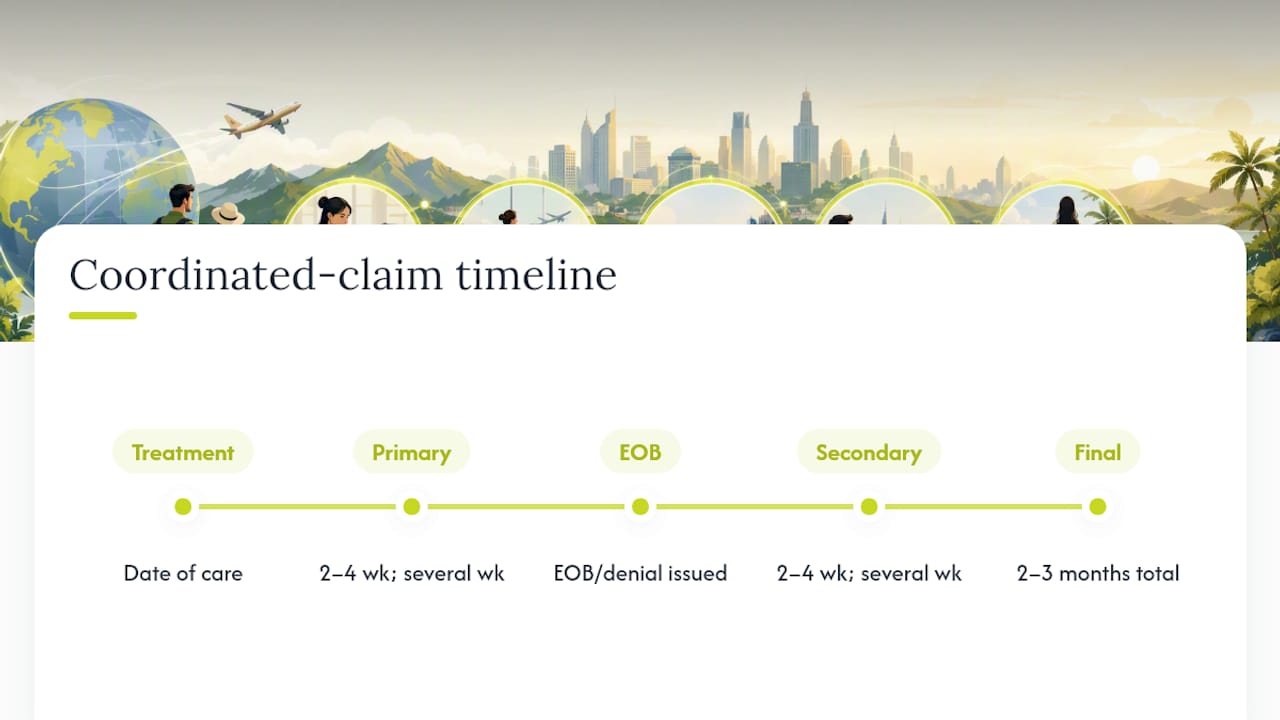
Two things speed the process meaningfully: submitting complete documentation the first time, since every missing item triggers a request-and-wait cycle that can add another one to two weeks per round trip, and knowing your policy’s own claims deadline. Many travel and expat policies require notification within a set window, sometimes as short as 30 days from treatment, so check yours before you assume you have unlimited time to gather paperwork.
How do currency exchange rates affect your reimbursement?
Getting treated in one currency and reimbursed in another introduces a variable most travellers never think about until their payout looks smaller than expected. Insurers typically convert foreign medical bills into the currency your policy is denominated in using the exchange rate on the date of treatment, the date the invoice was submitted, or the date the claim was processed, and which date applies depends entirely on your policy wording.
That timing gap matters more than it sounds. If a currency moves meaningfully between the date you paid a foreign clinic and the date your insurer processes the claim weeks later, your reimbursement in your home currency can come out noticeably higher or lower than what you actually paid, purely because of exchange rate movement rather than anything the insurer did wrong. When two insurers are coordinating a single claim, this can get more complicated still, because the primary insurer’s EOB may state amounts in one currency while the secondary insurer converts to another, and each conversion point can use a different rate.
Keep the original receipt showing the currency and amount you were actually charged, not just a converted total, since insurers generally want to see the source figure before applying their own conversion methodology. If a conversion looks wrong, ask the insurer which specific date and rate source it used. It is a fair question, and one they should be able to answer directly rather than leaving you to guess.
How do you handle emergency care abroad correctly under COB?
Emergency treatment abroad is the one situation where speed matters more than paperwork perfection, and most insurers build their assistance protocols around that reality. The immediate priority is getting treated; the immediate second priority is calling the emergency assistance number on your insurance card, ideally before treatment begins, or as soon as medically possible afterwards, because pre-authorisation calls trigger direct billing arrangements that spare you from paying large sums upfront.
If you cannot call before treatment because the situation is genuinely life-threatening, most insurers accept retrospective notification, typically within 24 to 48 hours, without penalising the claim, provided you can show why an immediate call was not possible. Once stabilised, ask the treating facility for an itemised bill and clinical notes before you leave, since emergency departments in some countries are slower to release records once a patient has been discharged and moved on.

From there, the COB sequence runs exactly as it would for a planned treatment claim: the insurer designated primary for emergencies handles the claim first, issues its EOB, and only then does a secondary policy, if you have one, review what remains payable. The one meaningful difference with emergencies is evacuation. If a case requires transfer to a better-equipped facility or repatriation home, that benefit usually sits with whichever insurer’s policy explicitly covers evacuation, which is not always the same insurer handling your medical treatment costs, so it pays to know both numbers before you ever need them.
A note from Unparalleled Global Benefits on avoiding COB delays
The claims we see stall are almost never about coverage disputes. They stall because someone submitted a secondary claim before the primary insurer had finished, or discarded a discharge summary they thought they would not need. Unparalleled Global Benefits’ guides and claim-support materials exist for exactly this gap. If there is one habit worth building now: request the EOB in writing the moment your primary insurer issues a decision, even if the letter feels redundant. You will need it for everything that follows.
— Coert
Get help arranging cover and managing claims with Unparalleled Global Benefits
Some insurance providers work differently from piecing together cover yourself and hoping the primary and secondary designations line up when you actually need them. Rather than guessing which of your policies pays first, they help you choose plans built to coordinate cleanly from the outset, then support you with the documentation and insurer liaison that a COB claim actually requires. That practical, hands-on approach to claims, not just policy sales, can make a difference when dealing with a foreign hospital, a language barrier, and a claims deadline at the same time.
Whether you need travel medical cover that works as primary abroad, an expat medical plan that layers sensibly with existing cover, or au pair or student insurance with clear primary designation from day one, request a quote directly through Unparalleledglobalbenefits and ask specifically how your chosen plan handles coordination with any cover you already hold.
Planning a trip for yourself, a resident, or visiting family? UGB + Ekta can arrange travel insurance for seniors up to 100 years old. Just click here: Ektatraveling and add the promo code “UGB” to receive an additional 10% discount.
Watch this short explainer for a practical walkthrough:
Where to check the rules governing your own policy
For the underlying legal framework private insurers reference, read the NAIC Coordination of Benefits Model Regulation directly. Beyond that, your own EOBs, denial letters, and the Summary of Benefits attached to your policy are the primary documents that actually govern your claim, and they outrank any general guide, including this one.
This article is general information, not a substitute for advice from a qualified financial advisor. Consult a qualified financial professional about your own circumstances before acting on anything here.
Sources
- COORDINATION OF BENEFITS MODEL REGULATION
- How travel medical insurance works — NerdWallet
- Streamline coordination of benefits (COB) for fewer claim denials — Experian
- Is it possible to have dual travel insurance coverage? — OurInsuranceWorld
FAQ
What does coordination of benefits mean for travel insurance?
Coordination of benefits is the process insurers use to decide which policy pays first when you hold more than one plan covering the same treatment abroad. The primary plan pays as though it were your only cover, and the secondary plan tops up any remaining allowable expense, as outlined in the NAIC’s model regulation.
Can I get paid twice if I have two travel insurance policies?
No. Dual travel insurance is legal, but you generally cannot claim twice for the same loss. Some non-overlapping benefits, such as accidental death and dismemberment cover, may still pay independently of medical claims.
Which insurer pays first when I’m treated abroad?
It depends on your policy’s own order-of-benefit clause, but common tests include whether you are the policyholder or a dependant, whether your cover comes from active employment or continuation cover, and how long each plan has covered you. Your Summary of Benefits will state which rule your plan applies.
What happens if my secondary insurer denies a claim because my primary insurer denied it?
That is often contestable. Secondary insurers are generally expected to adjudicate independently rather than simply repeat a primary denial, so you can ask for the secondary insurer’s own calculation and reasoning.
How does Unparalleledglobalbenefits help with COB claims?
Unparalleledglobalbenefits helps you choose travel and expat policies designed to coordinate cleanly with existing cover, and supports you through the documentation and insurer liaison a COB claim requires. Current plan options and pricing are available directly through Unparalleledglobalbenefits.