
If you move between countries often, start with a nomad friendly international health plan that offers routine care and direct billing, then add liability cover and income protection for your business risks. Visa applicants need a different starting point: a plan with $0 deductible that names “primary coverage” explicitly, because that is what most consulates check first. Confirm your zone, your deductible, and your pre-existing condition terms before you pay for anything.
TL;DR:
- Choosing a worldwide-excluding-US health plan can significantly reduce premiums if you rarely work in the United States, based on zone impact.
- For visa applicants, select an IPMI plan with a $0 deductible and explicit primary coverage wording to meet consulate requirements and avoid rejection.
- Staying covered during country switches requires overlapping policies and obtaining hospital guarantee letters to maintain continuity and prevent exclusion of pre-existing conditions.
- Insurers’ zone designations influence both cost and policy purpose, with regional plans suited for single-continent freelancers and Schengen plans for visa-specific requirements.
- Demonstrating compliance with official consulate wording is crucial, as many reject insurance certificates that lack specific language like “primary coverage” or appropriate deductible terms.
Table of Contents
- Freelancer international insurance options explained: a quick map
- International health insurance deep dive: IPMI, travel medical and local systems compared
- Business insurance essentials for freelancers
- Visa, consular and regulatory requirements that affect freelancers
- How to choose the right plan: a practical checklist
- Common pitfalls and continuity risks when moving countries
- Why Unparalleled Global Benefits can help freelancers get this right
- Author perspective: sequencing your cover when mobility and continuity pull in different directions
- How Unparalleled Global Benefits can help you get covered
- Sources
- FAQ
Freelancer international insurance options explained: a quick map
Working for yourself across borders means no employer is choosing your benefits package, so the decision sits entirely with you. That is either a burden or a genuine advantage, depending on how you approach it.
Here is the shortest version of what each category actually does:
- International Private Medical Insurance (IPMI): routine and chronic care, ongoing prescriptions, specialist visits, usually valid for a full year and renewable.
- Travel medical insurance: emergency only, time limited, built for a trip rather than a life abroad.
- Local national health systems: available to residents or those with the right visa status, quality varies enormously by country and by whether you’re contributing into the system.
- Professional indemnity: protects you if a client claims your advice or work caused them financial loss.
- Public liability: covers third party injury or property damage, often demanded by venues or corporate clients.
- Income protection: replaces a portion of earnings if illness or injury stops you working.
- Equipment cover: protects laptops, cameras and other tools of the trade, ideally with a travel extension.
- Life and critical illness cover: less urgent day to day, but worth prioritising once you have dependants or debt tied to your name.
Each of these has a rough price signal. IPMI for a healthy freelancer in their 30s tends to sit in a wideband depending on zone and deductible; professional indemnity is usually priced per profession and claim limit rather than by age. Equipment cover is often the cheapest line item, and income protection the one most freelancers underestimate until they actually need it.
The single biggest lever on price is zone. Excluding the United States from your coverage area often cuts the premium dramatically compared with a worldwide plan that includes it, according to GlobalMedPlan’s guidance on choosing an international plan. If you rarely work from American soil, a worldwide-excluding-US plan is usually the smarter buy.
Pro Tip: Before comparing quotes, write down every country you expect to spend more than two weeks in over the next 12 months. That list decides your zone, and your zone decides most of your premium.
International health insurance deep dive: IPMI, travel medical and local systems compared
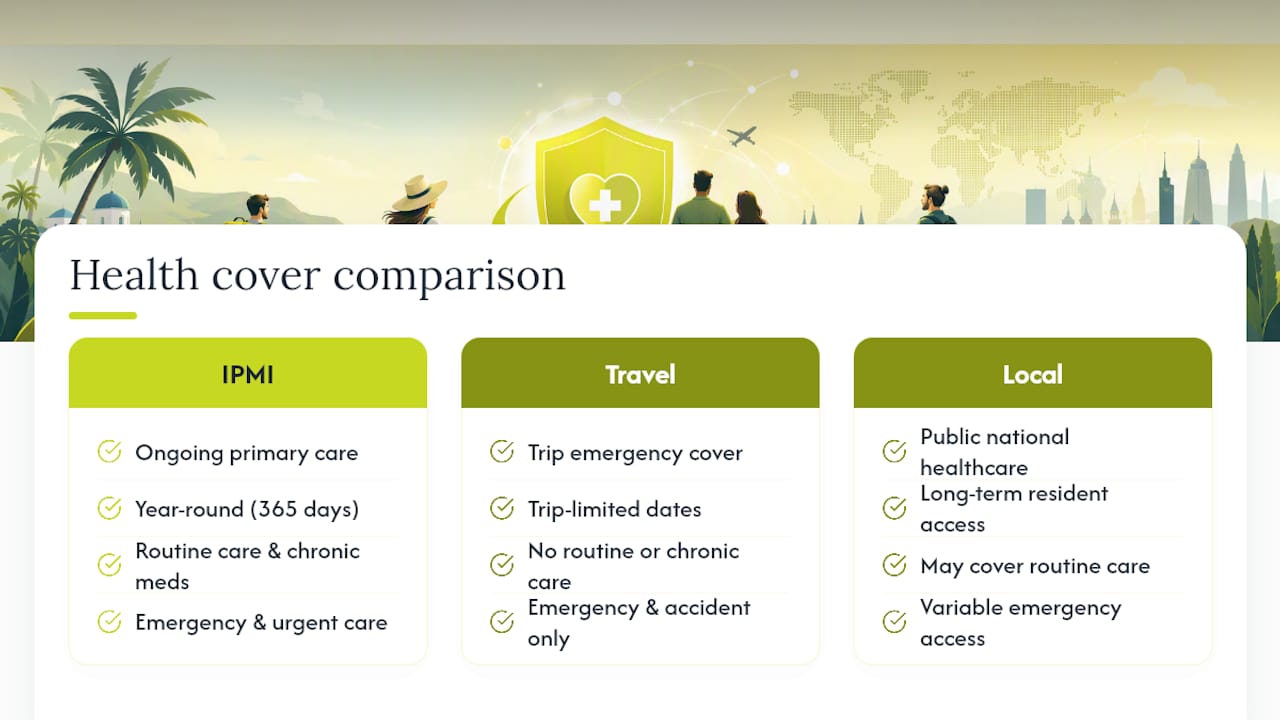
The three main routes to health cover abroad solve different problems, and confusing them is the most expensive mistake a freelancer can make.
IPMI is built for people who live abroad, not just visit. It typically covers outpatient visits, prescriptions, maternity, mental health support on higher tiers, and chronic condition management, running on 365 day terms rather than trip dates. Waysafe’s explainer on international health insurance draws this distinction clearly: IPMI is designed as your ongoing healthcare system, not a safety net for one journey.
Travel medical insurance is cheaper and narrower. It handles emergencies, accidents, and sudden illness during a defined trip window, but it will not pay for your annual check up, your asthma medication refill, or a pregnancy. If you’re settling somewhere for six months or more, travel medical alone leaves you exposed the moment anything routine comes up.
Local national systems sit at the third corner. Some countries let long-term visa holders or residents into public healthcare, sometimes through mandatory contributions, sometimes through a hybrid private-public model. Quality and wait times swing wildly by country, and in several places you cannot access the system at all until your residency status is confirmed, which can take months.
Underwriting models, explained simply
How an insurer decides what to cover, and for how much, comes down to three underwriting approaches:
- No underwriting (open enrolment): everyone pays the same rate for their age band regardless of medical history, but pre-existing conditions may be excluded or capped.
- Moratorium underwriting: pre-existing conditions get automatically excluded for a set period (commonly two years), then may be covered if symptom-free.
- Full medical underwriting: you disclose your full history upfront, and the insurer prices or excludes based on that disclosure, often giving broader eventual cover for chronic conditions once accepted.
No underwriting suits younger, healthier freelancers who want speed. Full underwriting suits someone with a known condition who wants certainty about what is and isn’t covered, rather than a moving target.
How zones change both price and suitability
Coverage zones aren’t just a pricing dial, they change what the policy is actually for:
- Worldwide: the broadest and most expensive, useful if you split time between the US, Asia and Europe unpredictably.
- Worldwide excluding US: the most popular middle ground for genuinely global freelancers who avoid American healthcare costs.
- Regional plans: cheaper again, built for people who stay within one continent, such as Southeast Asia or Latin America.
- Schengen area: the narrowest and usually the cheapest, built specifically to satisfy Schengen visa insurance requirements.
A rough statistic worth remembering: broker comparisons consistently show that dropping US coverage from a worldwide plan is the single change most likely to bring your premium down by a meaningful margin, more than adjusting the deductible or trimming outpatient limits, per GlobalMedPlan’s zone analysis.
Matching your profile to a product class
- Budget fast-moving nomad (new country every few weeks): a lean IPMI plan, worldwide-excluding-US zone, higher deductible to keep monthly cost down.
- Visa applicant: an IPMI plan with $0 deductible and explicit “primary coverage” wording, because consulates rarely accept high deductible plans as sufficient.
- Long-term expat settling in one place: a comprehensive IPMI plan with lower deductible, maternity and mental health add-ons if relevant, and direct billing with local hospitals.
- Family unit travelling together: worldwide or regional IPMI with dependant coverage bundled in, prioritising direct billing over reimbursement to avoid large upfront family medical bills.
If you’re weighing this up in more detail, our guide to insurance for digital nomads walks through how relocation frequency should shape the plan you pick.
Business insurance essentials for freelancers
Health cover protects you. Business insurance protects your income and your relationship with clients, and skipping it tends to bite at the worst possible moment.
Professional indemnity covers claims that your advice, design, code or consultancy caused a client financial loss. Many corporate clients now write a minimum cover level, often in the low hundreds of thousands, into their contract terms before they will even engage you. If you’ve never checked your own contracts for this clause, do it today.
Public liability covers third party injury or property damage, and it comes up more than freelancers expect. Photographers working events, tutors visiting client homes, and anyone running in person workshops will often find a venue or corporate client demanding proof of public liability before they’re allowed on site.
Income protection replaces a slice of your earnings if illness or injury stops you working. The two numbers that matter here are the waiting period (how long before payments start, commonly 30 to 90 days) and the benefit period (how long payments continue, from a set number of months up to age 65 on some policies). A freelancer with no savings buffer should lean toward a shorter waiting period even if the premium rises slightly.
Equipment cover differs from a standard home contents policy in one crucial way: it needs a travel extension if your laptop, camera or audio kit leaves the house regularly. Standard home insurance often voids cover for business equipment used commercially, which catches people out after a laptop theft abroad.
Life and critical illness cover rarely feels urgent to a freelancer without dependants, but the moment you have a mortgage, a partner relying on your income, or children, it moves up the priority list fast.
- Check your client contracts today for any minimum indemnity or liability requirement you may already be breaching.
- Match income protection waiting periods to your actual emergency fund, not to the cheapest premium on offer.
- Add a travel extension to equipment cover before your next trip, not after a claim.
Pro Tip: Ask any insurer for their claims-paid ratio or average claim turnaround time before signing. A cheap policy that pays slowly is more expensive than an honest one that pays fast.
Visa, consular and regulatory requirements that affect freelancers
Consulates and immigration offices use the phrase “primary coverage” to mean something specific: the policy must pay first, directly, without you having to rely on a home country system or a secondary reimbursement claim. Emergency-only travel insurance almost never satisfies this, no matter how comprehensive it looks on paper. Broker guides for digital nomad visas repeatedly flag this as the top rejection reason for insurance documents, per Freaking Nomads’ guide to nomad health insurance.
Spain’s Digital Nomad Visa guidance, published through its consular network, sets out exactly this kind of wording requirement, and it’s worth reading the official page rather than trusting a third party summary, per Spain’s consular guidance. Portugal, Greece and other Schengen countries publish similar but not identical rules, so treat each consulate’s own page as the final word rather than assuming one country’s requirements transfer to another.
Verify compliance before you pay for anything, in this order:
- Find the specific consulate page for your visa category and read the exact insurance wording they use.
- Ask the insurer directly whether their certificate uses that same wording, or close to it. A “certificate of insurance” is not automatically the same as a letter confirming “primary coverage with no deductible.”
- Request the certificate in writing before purchase, not after, so you can check it against the consulate’s checklist.
- Confirm the policy’s start date lines up with your visa application timeline, since some consulates want proof of a full year’s cover from the application date.
Documents worth requesting from any insurer before you commit:
- A signed certificate of insurance naming the specific visa or country requirement.
- Written confirmation of the deductible amount, ideally $0 if the visa demands it.
- Confirmation of the coverage zone and that it includes the destination country by name.
- An emergency contact number for the insurer that works internationally, not just a domestic line.
If you’re also navigating UK immigration health surcharges alongside a private plan, Gov explains how the two systems interact, since a private IPMI policy doesn’t automatically exempt you from a national health surcharge.
How to choose the right plan: a practical checklist
Comparing quotes side by side only works if you’re asking the same questions of every insurer. Run through this list before you commit to anything:
- Coverage zone: does it name your actual destination countries, not just a broad region?
- Direct billing vs reimbursement: direct billing means the hospital bills the insurer directly; reimbursement means you pay first and claim later, which can mean weeks without your money.
- Annual and per-condition limits: check whether outpatient and inpatient limits are separate, and whether either feels low for your risk profile.
- Deductible amount: a lower deductible costs more monthly but matters enormously if a visa requires $0.
- Underwriting model: no underwriting, moratorium, or full underwriting, and how that treats any condition you already have.
- Age caps: some plans stop accepting new applicants past a certain age or raise premiums sharply at set birthdays.
- Maternity and mental health inclusion: often excluded on entry-level tiers and added only on mid or top tiers.
- Medevac and repatriation: confirm the policy pays to fly you home or to the nearest adequate facility in a genuine emergency.
When you call an insurer or broker, ask for the exact wording you’d need to show a consulate, and ask whether they can issue a hospital guarantee letter on request rather than only after a claim is filed. Those two questions filter out insurers who talk a good game but can’t back it up on paper.
Pro Tip: Some freelancers structure health premiums as a deductible business expense by holding the policy through a company or captive arrangement rather than personally. This needs proper local tax advice, since the rules vary sharply by country and business structure, so treat it as a conversation with a tax professional rather than a DIY decision.
Common pitfalls and continuity risks when moving countries
The most expensive mistake in international insurance isn’t picking the wrong plan, it’s the gap between plans.
Freelancers who buy a short travel policy while waiting for an IPMI start date often discover the two don’t overlap cleanly, leaving days or weeks with no cover at all. Switching insurers entirely, rather than staying with one and upgrading tiers, can also reset your pre-existing condition clock: a condition that was covered under a moratorium period with insurer A may go back to square one, excluded for another two years, under insurer B.
Direct billing networks matter more than most people realise until they’re standing in a foreign hospital with a card that doesn’t work. Confirm in writing, before you travel, that your specific card or policy number is recognised by hospitals in your destination, not just that the insurer “has a network there.”
Mitigations that actually work:
- Buy short-term overlap cover deliberately rather than assuming your new policy starts the day the old one ends.
- Keep an emergency fund equivalent to at least one deductible’s worth, in case reimbursement rather than direct billing applies.
- Request a hospital guarantee letter and save the insurer’s emergency contact number offline before you fly, not after you land.
- Keep PDF copies of every policy document, certificate and claims history on your phone and in cloud storage, since switching insurers often means proving your prior coverage history to avoid losing continuity credit.
Our piece on typical exclusions in expat insurance goes deeper into exactly which clauses tend to catch people out when they switch plans mid-move.
Why Unparalleled Global Benefits can help freelancers get this right
The site works with a global network of insurers to compare plans against the specific wording freelancers may need, such as a $0 deductible for a visa file or direct billing for a family move.
Practically, that means help comparing zone options side by side, support requesting the exact certificate wording a consulate asks for, and multilingual assistance when you’re dealing with paperwork in a language you don’t speak fluently. You can start by browsing Unparalleledglobalbenefits’ top insurers page to see plan categories mapped against freelancer profiles.
Author perspective: sequencing your cover when mobility and continuity pull in different directions
Buy health cover first, always, regardless of profile. A visa applicant needs the $0 deductible plan before anything else; a settled expat needs comprehensive IPMI with direct billing before topping up liability. Income protection comes second for anyone without three months of savings; professional indemnity comes second for anyone with corporate clients who’ll demand proof of it anyway.
One thing I’d push back on: treating a broker call as optional once your situation gets complicated (family, pre-existing condition, multi-country work) is a false economy. Buying directly is fine for simple, single-country cases. It stops being fine the moment your case has more than one moving part.
— Coert
How Unparalleled Global Benefits can help you get covered
This service offers an alternative to piecing together your own patchwork of travel and health policies across different countries by providing help comparing plans side by side, with support checking that the certificate wording matches consulate requirements.
That matters most at the exact moment things get complicated: a visa deadline, a family move, or a switch between insurers that risks resetting your pre-existing condition terms. Unparalleledglobalbenefits’ team can help you request a quote, check policy documents before you commit, and get multilingual support if paperwork isn’t in your first language. Start by requesting a quote through the Unparalleledglobalbenefits homepage, where you can compare categories including Expat Medical, Basic-Visum and Travel Insurance side by side.
For a practical look at how this plays out for people who never stop moving, this short video is worth five minutes:
.
Planning a trip for yourself, a resident, or visiting family? UGB + Ekta can arrange travel insurance for seniors up to 100 years old. Just click here: https://ektatraveling.com/?partner_uid=808 and add the promo code “UGB” to receive an additional 10% discount.
Sources
Consulate pages change their exact wording requirements without much notice, so verify directly rather than relying on secondhand summaries. Start with your destination’s own consular site for visa insurance wording, check GlobalMedPlan’s guide to choosing an international plan for zone and deductible rules, and read Freelancers Union’s health insurance resources if you’re structuring cover through a US-based freelance business entity.
This article is general information, not a substitute for advice from a qualified doctor. Consult a qualified healthcare professional about your own circumstances before acting on anything here.
FAQ
What is the best type of insurance for freelancers?
There isn’t one single best type, since it depends on how you work. Most mobile freelancers should prioritise an IPMI plan with direct billing first, then add professional indemnity and income protection based on their client contracts and savings buffer.
What insurance should a freelancer have?
At minimum, a freelancer working internationally needs health cover suited to their zone (IPMI or travel medical depending on trip length), professional indemnity if clients require it, and equipment cover with a travel extension. Income protection and life or critical illness cover become priorities once you have dependants or no savings cushion.
How does international insurance work?
International health plans like IPMI cover you across multiple countries under one policy, typically with direct billing at partner hospitals so you don’t pay large sums upfront. Underwriting model, zone, and deductible together decide both price and what’s actually covered, which is why comparing those three factors matters more than comparing headline premiums.
What are the 7 main types of insurance freelancers typically need?
The commonly cited seven are IPMI or travel medical, professional indemnity, public liability, income protection, equipment cover, life cover, and critical illness cover. Not every freelancer needs all seven at once, health and professional indemnity tend to come first, with the rest added as your business and personal circumstances grow.
How do freelancers handle insurance when working in multiple countries at once?
Choose a zone that names every country you actually spend time in, rather than assuming a regional plan covers occasional detours elsewhere. Unparalleledglobalbenefits can help you compare worldwide and worldwide-excluding-US options against your real travel pattern through the top insurers page.