
An international medical mission trip is a short-term or long-term placement where volunteers deliver clinical care or public-health support alongside local teams in another country. It suits qualified clinicians, students on supervised electives, and non-clinical volunteers handling logistics. Before you commit to any programme, confirm exactly who supervises your work, whether you need a temporary practising licence, and that your travel insurance actually covers volunteer medical work.
TL;DR:
- Fully qualified clinicians generally require a temporary practising license, which can take weeks to obtain, so plan licensing well in advance.
- Most mission trip costs cover local logistics and supplies, but international travel, vaccinations, and insurance are usually your responsibility and should be clarified beforehand.
- Short-term clinics and surgical camps typically demand higher time commitment and certification than public health or capacity-building projects, which focus on training and sustainable impact.
- Verify that organizations have clear local partnerships, supervision ratios, transparent costs, and documented safety protocols before committing financially or logistically.
- Insurance should include medical evacuation coverage specialized for clinical volunteering activities, as standard policies often exclude such risks.
Table of Contents
- What are the main types of international medical mission trips?
- Who can join a medical mission, and what does supervision look like?
- What do medical mission trips cost, and where does the money go?
- What visas, licences and paperwork do you need before departure?
- How should you prepare for health risks and travel insurance?
- How do you know if a mission trip actually helps the community?
- How do you vet an organisation before you sign up?
- What does a typical mission trip week actually involve?
- A practitioner’s quick lessons from missions
- How specialised travel and expat medical insurance protects volunteers
- Verified resources and primary sources to plan responsibly
- Sources
- FAQ
What are the main types of international medical mission trips?
Not every mission trip looks the same, and picking the wrong format for your experience level is one of the most common mistakes volunteers make. The structure of the trip determines what you’ll actually be doing, how much autonomy you’ll have, and how much support surrounds you.
Short-term clinics run for one to three weeks and usually involve mobile or pop-up services in underserved areas. Volunteers see high patient volumes, often working from morning until early evening, treating everything from skin infections to chronic hypertension.
Surgical camps concentrate on procedures like cataract removal, cleft palate repair, or hernia surgery. These need qualified surgeons, anaesthetists, and theatre nurses, and typically run alongside pre-op and post-op wards staffed by broader teams.
Student electives place undergraduate or postgraduate trainees into hospitals or clinics under direct supervision, closer to an observed placement than independent practice. Project C.U.R.E.’s trip listings note that many programmes accept a wide range of participants, including students, provided supervision arrangements are clear from the outset.
Capacity-building and public-health projects focus less on direct treatment and more on training local health workers, running vaccination drives, or supporting maternal health education. These tend to have the most durable impact because the skills stay behind after the team leaves.
Long-term partnerships commit volunteers to months or years in one location, working inside an existing health system rather than visiting it. Peace Corps health assignments follow this model, prioritising continuity over quick turnaround.
Beyond frontline clinical roles, most organisations also need:
- Logistics coordinators managing supplies, transport, and scheduling
- Interpreters and cultural liaisons bridging language gaps
- Administrative volunteers handling patient records and intake
- Family members or observers on some programmes, usually restricted to non-clinical areas
Who can join a medical mission, and what does supervision look like?
Eligibility depends heavily on your role, your qualifications, and the specific programme’s risk tolerance. Organisations vary widely in how strictly they check credentials, so don’t assume acceptance onto one programme means you’d qualify for another.
- Fully qualified doctors, nurses, dentists, and pharmacists can usually work independently within their registered scope of practice, though many host countries still require a temporary practising licence.
- Allied health professionals (physiotherapists, EMTs, radiographers) typically work under a supervising physician, even if they’d operate autonomously at home.
- Medical and nursing students generally need direct, in-person supervision at all times. Project C.U.R.E.’s programme details confirm that roles span professionals, students, and non-medical support staff, but supervision ratios differ between trips.
- Non-medical volunteers (logistics, admin, translation) face the fewest restrictions but still need background checks on many programmes.
Supervision models range from one supervisor per two or three students on surgical camps, to looser oversight on large public-health campaigns where a single physician might check in with multiple stations across a day. This matters ethically as much as legally: a student practising beyond their competence risks patient harm and undermines the trust host communities place in visiting teams. Vine Trust’s medical expeditions require proof of current professional registration for clinical roles, sometimes restricting placements to qualified or final-year trainees only.
Temporary practising licences are the part most volunteers underestimate. Some countries issue them quickly through a reciprocal arrangement with your home regulator; others require notarised documents, translated transcripts, and a processing window that can run into weeks. Reputable programmes usually manage this administratively, but you remain responsible for supplying accurate documentation on time.
What do medical mission trips cost, and where does the money go?
Programme fees generally range from a few hundred to a few thousand pounds depending on trip length, destination, and whether the programme includes accommodation and in-country transport. What that fee actually buys varies more than most volunteers expect.
Most fees cover local logistics: accommodation, ground transport, translators, and a contribution towards medical supplies used in clinics. International flights, vaccinations, and visa fees are almost always excluded, and Project C.U.R.E.’s listings make this exclusion explicit, along with the expectation that volunteers arrange their own travel insurance. Larger expedition-style programmes add complexity: Vine Trust’s medical expeditions structure costs as project contributions covering onboard clinics, domestic transfers, and shared logistics, rather than a simple volunteer fee, and these published costs typically still exclude flights and some vaccinations.
Common ways to reduce your outlay without cutting corners on programme quality:
- University elective bursaries or hospital trust education funds
- Professional body grants (many royal colleges offer small travel bursaries)
- Crowdfunding through platforms aimed specifically at medical electives
- Employer sponsorship, particularly for staff taking annual leave to volunteer
Pro Tip: Ask any organisation for a full cost breakdown before you pay a deposit. A programme that can’t clearly explain what proportion of your fee funds local services versus administrative overheads is a warning sign worth taking seriously.
Be wary of fees that seem disproportionately high relative to what’s included, or organisations that pressure you to pay in full months before departure with no cancellation flexibility. Transparency about where donations and fees go is one of the clearest markers of a well-run programme.
What visas, licences and paperwork do you need before departure?
Documentation requirements depend on your nationality, your destination, and your professional role, and there’s no universal rule that applies across every country. Start checking this at least two to three months before travel.
- Visa type: some countries permit short-term clinical volunteering on a standard tourist visa for certain passport holders; others require a specific volunteer or work visa. Project C.U.R.E.’s programme information confirms these rules vary by destination and nationality, and volunteers should verify requirements directly rather than assume their organisation has covered every scenario.
- Embassy guidance: check the destination country’s embassy website directly, since visa rules change and third-party blogs are frequently out of date.
- Temporary practising licences: registration checks and licence processing can take a genuine amount of time. Allow at least four to six weeks for document submission and approval where a licence is required.
- Professional registration proof: bring certified copies of your registration or licence, not just digital scans, since some immigration and health authorities still expect physical documentation.
- Consent forms and indemnity: your sending organisation should provide clear indemnity cover and require signed consent forms covering scope of practice.
- Criminal-record checks: increasingly standard for any role involving contact with children or vulnerable patients.
- Institutional approvals: if you’re a student, your university or training body may require formal sign-off before granting elective credit.
Understanding immigration medical requirements ahead of your visa application helps you avoid last-minute surprises, particularly where health declarations are part of the entry process.
How should you prepare for health risks and travel insurance?
Vaccination and prophylaxis planning needs to start earlier than most volunteers realise, ideally two months before departure, since some vaccines need multiple doses spaced weeks apart. Country-specific requirements differ enormously, and national health agencies publish detailed, destination-specific vaccine and health advisories that should be your first reference point rather than a general travel blog.
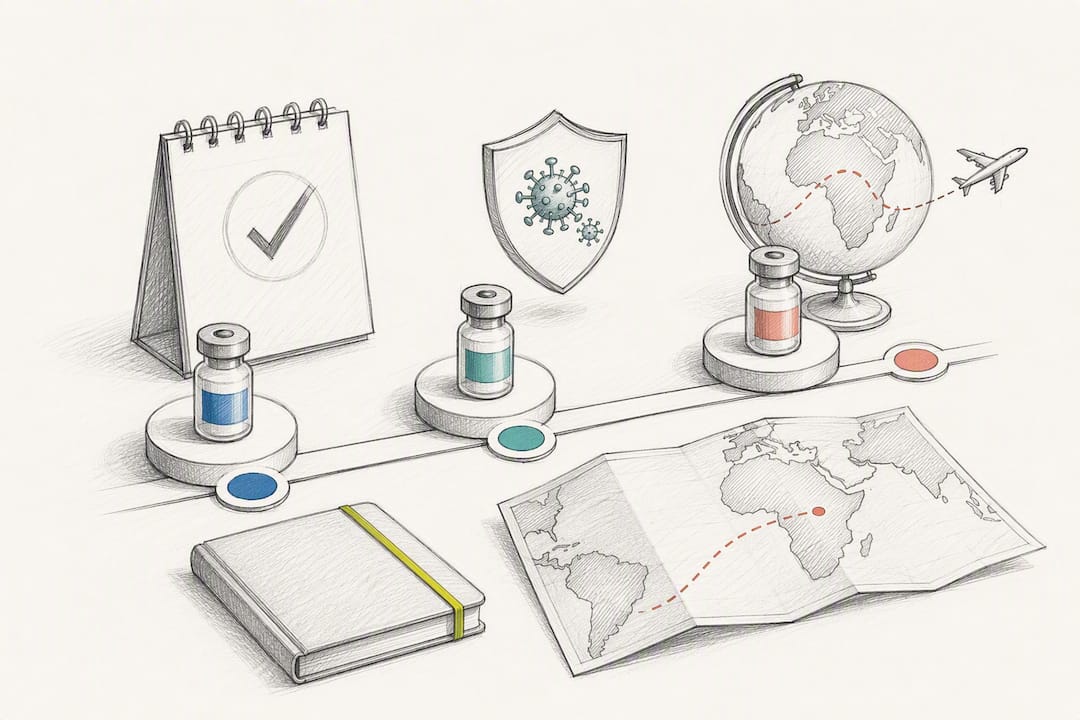
Malaria prophylaxis deserves particular attention. The right regimen depends on the region, local drug-resistance patterns, and how long you’ll be there, so this is a conversation for a travel health clinic rather than a guess based on what a previous volunteer took. An international travel vaccine clinic can help time your appointments correctly against your departure date.
A few essentials to arrange before you fly:
- Confirm your standard vaccinations are current (tetanus, hepatitis A and B, typhoid where relevant)
- Book a travel health consultation at least six to eight weeks before departure
- Check whether yellow fever vaccination is a legal entry requirement for your destination
- Pack a basic personal medical kit including rehydration salts and any personal prescriptions
Here’s the detail many volunteers miss entirely: standard travel insurance policies routinely exclude clinical volunteering. Project C.U.R.E.’s trip guidance explicitly flags that volunteers are typically responsible for arranging their own vaccinations and insurance, and recommends specialist cover precisely because ordinary holiday policies weren’t written with clinical work, needle exposure, or remote evacuation in mind.
Medical evacuation cover matters more on a mission trip than on almost any other kind of travel. You may be working hours from the nearest trauma centre, and a policy without medevac provision leaves you exposed if something goes wrong. Comparing travel and expat medical plans built for this kind of exposure, rather than a generic holiday policy, is worth the extra half hour it takes.
If you’re arranging cover for someone else joining you, or a family member visiting while you volunteer, it’s also worth knowing what to do in medical emergencies abroad before you leave, not after something happens.
How do you know if a mission trip actually helps the community?
Good intentions don’t guarantee good outcomes, and the medical mission sector has a well-documented history of programmes that unintentionally caused harm. Knowing what separates a genuinely useful trip from a well-meaning but disruptive one is essential before you sign up.
- Watch for short-termism. A team that flies in, treats a queue of patients, and leaves without any handover to local providers risks creating dependency rather than capacity. International Medical Relief’s programme model is built around the opposite approach, integrating with local healthcare systems and prioritising training local staff over one-off treatment.
- Check for inappropriate scope-of-practice. If a programme lets students or junior volunteers perform procedures they wouldn’t be permitted to do at home, that’s a serious red flag regardless of how it’s framed as “hands-on experience.”
- Look for genuine local invitation. Programmes invited by a host ministry of health, hospital, or community organisation tend to align better with actual local priorities than those designed entirely from abroad.
- Ask how donations are tracked. A credible organisation can tell you what percentage of donated funds reaches direct patient care versus administrative cost, and can point to measurable follow-up data from previous trips.
- Consider the continuity model. Long-term, in-country programmes such as Peace Corps placements generally integrate more deeply with national health priorities than a team that visits once a year.
Pro Tip: Ask any organisation directly: “What happens in this community the week after your team leaves?” A confident, specific answer is a good sign. A vague answer about “raising awareness” usually isn’t.
Cultural sensitivity is inseparable from ethical practice. Learning basic greetings, understanding local norms around eye contact or physical examination, and working through a trained interpreter rather than a fellow volunteer’s rough translation all signal respect that patients notice.
How do you vet an organisation before you sign up?
A short checklist, applied consistently, filters out most poorly run programmes before you’ve paid a deposit.
- Is the organisation formally registered as a charity or nonprofit in its home country?
- Does it have a named, verifiable local partner (hospital, ministry, or community health body)?
- Is the supervision ratio for students or trainees stated explicitly in writing?
- Are safety protocols and in-country emergency support clearly documented? International Medical Relief treats explicit safety protocols and scope-of-practice rules as standard practice before volunteers travel.
- Is the full cost breakdown available before you commit financially?
- Does the organisation publish any monitoring or follow-up data from past trips?
- Are insurance and evacuation arrangements spelled out, or left to the volunteer entirely?
- Is patient consent and data handling addressed anywhere in their materials?
Ask organisers directly: who supervises clinical work day to day, what happens if a volunteer is injured or falls ill, and what percentage of your fee reaches direct patient services. If the answers are vague, evasive, or contradict the website, treat that as your answer.
| Vetting signal | What to look for |
|---|---|
| Local partnership | Named hospital, ministry, or community body, not just “local staff” |
| Supervision clarity | Written ratio and named supervising clinician for student roles |
| Cost transparency | Itemised breakdown covering what’s included and excluded |
| Safety and insurance | Documented evacuation plan and insurance requirements stated upfront |
If red flags surface after you’ve paid, request the answers in writing, involve your university or professional body if you’re a student, and be prepared to withdraw rather than travel into a poorly supervised placement. Our guide to finding volunteering opportunities overseas covers more groundwork for this stage.
What does a typical mission trip week actually involve?
Expect structure, fatigue, and considerably less downtime than the photos on recruitment pages suggest.
- Days 1 to 2: arrival, orientation, safety briefing, and clinic setup. Expect jet lag and a packed induction covering local customs, emergency contacts, and scope-of-practice reminders.
- Days 3 to 10: full clinical days, typically 7am to 5pm, seeing dozens of patients per volunteer depending on role. HELPS International’s larger surgical campaigns have reported hundreds of volunteers treating thousands of patients across a single campaign, giving a sense of the scale some programmes operate at.
- Rest and admin days: most itineraries build in at least one lighter day for restocking supplies, team debriefs, and recovery.
- Final days: handover notes for local staff, closing debrief, and departure logistics.
Accommodation ranges from dormitory-style rooms to basic guesthouses, and hygiene standards will likely be more variable than at home. Personal safety basics matter more than volunteers expect: travelling in groups after dark, keeping valuables secure, and following local guidance on areas to avoid.
Post-trip, reputable organisations expect a debrief and often a written reflection, both for your own learning and for programme evaluation. Staying involved afterwards, through fundraising, mentoring the next cohort, or returning for a longer placement, is often where the real long-term relationship with a host community begins.
A practitioner’s quick lessons from missions
Preparation beats enthusiasm every time. Volunteers who arrive having read up on local disease patterns, confirmed their supervision arrangements in writing, and packed for the actual clinical conditions consistently outperform those relying on goodwill alone.
Humility matters more than skill level. The most useful volunteers, regardless of seniority, defer to local staff on how things actually work in that setting rather than importing assumptions from home.
Measuring impact honestly is uncomfortable but necessary. Ask what changed after your team left, not just how many patients you saw while you were there. And treat insurance as clinical preparation, not paperwork. A missing evacuation clause is the kind of gap you only discover at the worst possible moment.
— Coert
How specialised travel and expat medical insurance protects volunteers
Specialised insurance works as the practical layer underneath everything covered above. Once you’ve confirmed supervision and licensing, the next non-negotiable step is cover that actually recognises clinical volunteering as what it is, rather than treating it like a beach holiday. Standard travel policies routinely exclude the exact activities mission volunteers do, which is exactly the gap Project C.U.R.E.’s guidance warns about when it flags insurance as the volunteer’s own responsibility.
When comparing policies, prioritise medical evacuation cover, clear wording on volunteer or clinical activity exclusions, and how the policy handles pre-existing conditions if you’re travelling with ongoing health needs. Direct billing with in-country hospitals, where available, saves enormous stress if you need treatment yourself while abroad. Unparalleledglobalbenefits partners with a network of insurers offering customised expat medical and travel plans, with 24/7 multilingual support and flexible options across nationalities and age groups, so you can compare volunteer-appropriate cover rather than guessing whether a generic policy will actually pay out. Start by requesting a quote to see plans built for exactly this kind of travel.
Planning a trip for yourself, a resident, or visiting family? UGB + Ekta can arrange travel insurance for seniors up to 100 years old. Just click here: https://ektatraveling.com/?partner_uid=808 and add the promo code “UGB” to receive an additional 10% discount.
For a broader look at how evacuation and emergency cover actually works in practice, this explainer on travel insurance and this video guide are worth ten minutes before you buy anything:
Verified resources and primary sources to plan responsibly
Cross-check anything an organiser tells you against a primary source before you commit.
- CDC travel for country-specific vaccination and health advisories
- Peace Corps for long-term, in-country placement models
- Project C.U.R.E. for short-term trip logistics and documentation examples
- International Medical Relief for programmes built around local capacity building
- Vine Trust for expedition-style medical campaigns and registration requirements
- HELPS International for large-scale surgical campaign examples
Your destination’s ministry of health and your own professional regulator’s website remain the final word on licence checks. No third-party guide, including this one, should replace that step.
This article is general information, not a substitute for advice from a qualified doctor. Consult a qualified healthcare professional about your own circumstances before acting on anything here.
Sources
- Project C.U.R.E. — Guatemala trip listing
- International Medical Relief — programme overview
- Vine Trust — medical expeditions
- CDC travel
FAQ
Which countries are good for medical mission trips?
Guatemala, Kenya, and parts of Southeast Asia host well-established programmes with organisations like Project C.U.R.E., largely because they’ve built long-running local partnerships rather than one-off visits. The best destination for you depends more on the specific organisation’s supervision and local integration than the country itself.
What are the best medical mission trips for nurses?
Nurses generally find the strongest fit with programmes that clearly define scope of practice and pair them with a supervising physician where local regulations require it. Checking that an organisation like Vine Trust confirms professional registration before departure is a reliable sign the placement takes clinical safety seriously.
What is the best country to get medical treatment while volunteering?
This depends entirely on where your programme operates and what emergency infrastructure exists nearby, which is precisely why medical evacuation cover matters more on a mission trip than ordinary travel. A volunteer-appropriate insurance plan that includes evacuation to a suitable facility is more important than any ranking of countries.
What is the safest country to volunteer in?
Safety depends more on the specific programme’s protocols, its local partnerships, and its in-country support than on any single country-level ranking. Organisations that clearly document safety procedures and emergency support, as International Medical Relief does, tend to offer safer placements regardless of destination.
Do I need a temporary practising licence for a medical mission trip?
It depends on your destination, your profession, and the length of your placement, since requirements vary by country and nationality. Where a licence is needed, allow four to six weeks for processing and always verify directly with the host country’s regulator rather than relying solely on your organiser.