
Campus health centres abroad are outpatient primary-care services, not hospitals. They will handle a chest infection or a repeat prescription review, but they will not manage a broken leg, an emergency admission, or ongoing specialist treatment at 2am. Before you fly, check your vaccination and clearance requirements, arrange proper international insurance with evacuation cover, and get any long-term prescriptions documented in a doctor’s letter.
TL;DR:
- Campus health centers abroad mainly provide outpatient care and are not equipped for emergencies, inpatient hospitalizations, or complex specialist treatments.
- Students must arrange for evacuation coverage, verify prescription transfer policies, and understand local restrictions before traveling internationally.
- Pre-travel vaccinations should be scheduled at least eight weeks in advance, and long-term medical clearances can take several weeks to process.
- Insurance plans offered by universities often exclude inpatient, evacuation, and mental health coverage, making dedicated international student insurance essential.
- Relying on campus clinics for continuity of care abroad is a mistake, as they serve only basic needs and refer serious cases to local hospitals.
Table of Contents
- What university health centres usually offer
- Core limitations to expect when you’re abroad
- Prepare before you go: your pre-departure checklist
- How to access care while overseas: your realistic options
- Insurance and coverage gaps: what the evidence actually shows
- What actually trips students up
- Closing the coverage gap with the right insurance
- Authoritative pages to consult next
- Sources
- FAQ
What university health centres usually offer
Most campus clinics are built around routine, weekday, low-acuity care. They cover the everyday problems a student population generates rather than the full range of what illness or injury can throw at you.
Typical services include:
- General consultations for colds, infections, and minor injuries
- Urgent outpatient care during clinic hours
- Routine vaccinations and some travel-health advice
- Sexual health screening and contraception services
- Initial triage and referral for mental health concerns
The catch sits in the constraints around these services. Most clinics run standard weekday hours, appointments are often capped per student per term, and anything beyond primary care gets referred out to local hospitals or specialists. Some centres also issue the health clearances programmes require before departure, but University Health Services at UW-Madison notes these clinics operate on standard hours and refer inpatient and emergency cases elsewhere. That referral pathway is the whole system working as intended. It is also the point where students without a backup plan get stuck.
Core limitations to expect when you’re abroad
The single biggest misunderstanding students carry abroad is assuming the campus clinic is a smaller version of a hospital. It isn’t. UW-Madison’s own international health guidance confirms campus centres are not equipped for inpatient hospitalisation, complex specialist care, or 24/7 emergency response — those cases go straight to the local hospital system, on the local system’s terms.
Pro Tip: Save the nearest hospital’s address and emergency number in your phone before term starts, not after something goes wrong.
Four gaps matter most once you’re actually overseas:
- No emergency or inpatient capacity. Anything beyond outpatient care means a trip to a local hospital, often without the campus clinic coordinating your care once you’re there.
- Thin travel-clinic stock. Smaller institutions frequently cannot stock specialised travel vaccines like yellow fever, and a study of travel-health practices at institutions of higher education found vaccine availability and pre-travel counselling vary widely from campus to campus.
- Prescriptions rarely transfer directly. A prescription written at home usually needs a local equivalent before a pharmacy abroad will fill it, and some medications routine in one country are restricted or banned in another.
- Mental health support has real ceilings. Continuity of care is hard to maintain across borders, and some student insurance plans limit mental health visits or exclude pre-existing conditions entirely.
None of this means campus care is useless. It means it’s the first stop, not the last one.
Prepare before you go: your pre-departure checklist
The work that actually protects you happens weeks before you board a flight, not after you land feeling unwell. Public-health guidance from CDC-aligned sources recommends building an individual care plan and starting vaccine series with enough lead time to be effective before departure.
- Book a full pre-travel health check at least eight weeks out. Some vaccines need multiple doses spaced weeks apart, and leaving it until the month before means you may travel only partially protected.
- Get a signed doctor’s letter for any ongoing prescriptions. Note the generic (not just brand) name of each medication, and check your destination’s rules before packing supply quantities, since some countries restrict what you can legally bring in.
- Confirm your university’s insurance requirement and read the exclusions. Many programmes require enrolment in an approved international student insurance plan unless you can prove comparable cover, and pre-existing conditions or mental health treatment are common exclusion points worth checking twice.
- Build a one-page emergency plan. List your host institution’s emergency contact, the nearest hospital, your embassy or consulate details, and keep a translated copy of key medical information in the local language.
Programmes running 15 days or longer often require a formal medical exam or clearance, and that approval process can take several weeks to complete, so start early rather than assuming it’s a formality.
How to access care while overseas: your realistic options
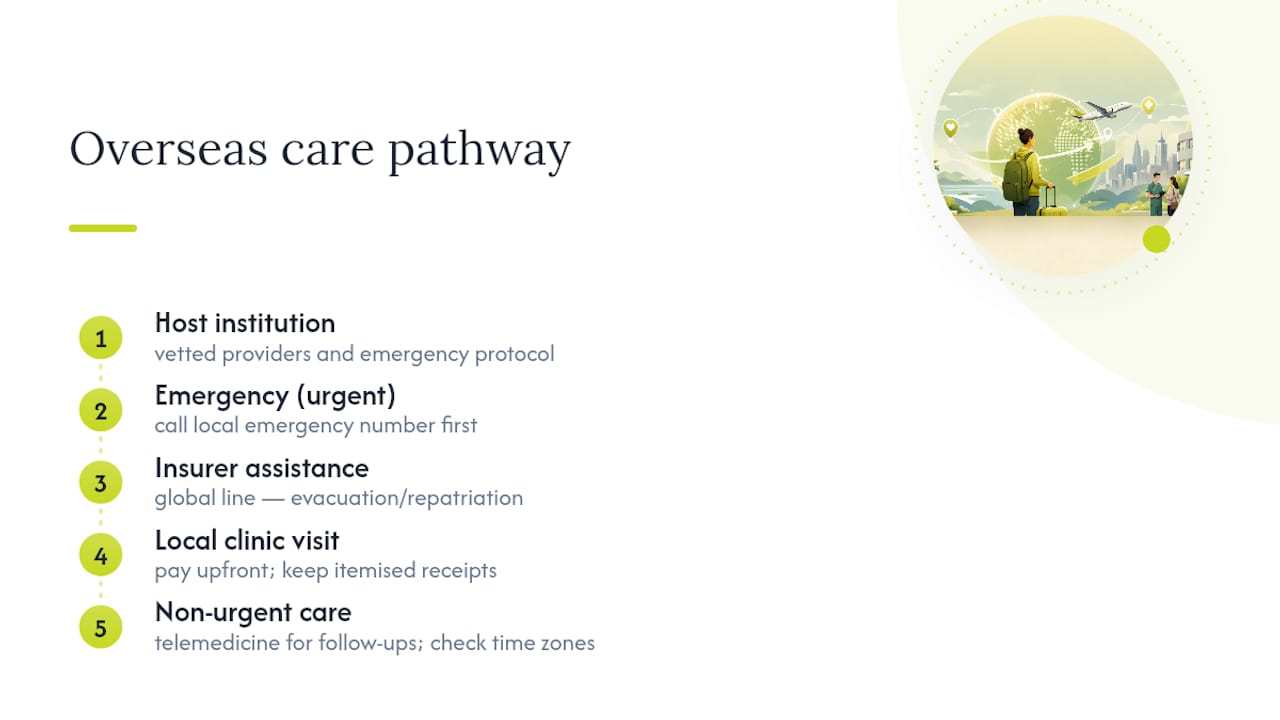
When something does go wrong abroad, the order you contact people in matters more than most students expect.
Start with your host institution’s health or study-abroad office. They typically hold a list of vetted local providers and know the emergency protocol for your specific location, which is far more useful than searching blind. If you end up at a local clinic or hospital, be ready to pay upfront in most countries. Keep every receipt, and ask for an itemised bill with an English translation if you plan to claim it back, since insurers generally require original documentation before processing a claim.
For genuine emergencies, call the local emergency number first, then contact your insurer’s global assistance line. Reputable international plans can arrange evacuation or repatriation when local facilities can’t manage your condition, which is precisely the gap a domestic-only policy leaves open. For anything non-urgent, such as a medication review or a follow-up consultation, telemedicine can bridge the distance when local access is difficult. Just check the time zone difference before booking, since emergency planning resources consistently flag scheduling mismatches as a source of delay.
Insurance and coverage gaps: what the evidence actually shows
University policy pages are surprisingly candid about where their own coverage stops. Case Western Reserve’s education abroad guidance tells students to carry an insurance ID card and claim forms at all times while overseas, which only makes sense if the university expects students to need outside care regularly.
Travel health-related preparation across institutions of higher education is inconsistent: many student health centres offer limited routine mental-health counselling during pre-travel visits, and travel vaccine stock varies significantly between campuses.
That finding, from a study of travel-health preparation practices at institutions of higher education, matters because it shows the gap isn’t isolated to one unlucky university. It’s structural. Mandated or recommended student health plans typically cover routine outpatient visits well, but evacuation cover, chronic condition management, and mental health support are the three areas where coverage most often falls short or requires an add-on. Waiver deadlines and enrolment cut-offs add another layer of administrative risk. Miss the window and you may be automatically enrolled in the university’s default plan regardless of what you already hold.
What actually trips students up
Most of the mistakes I see aren’t about ignorance of risk. They’re about assuming continuity that doesn’t exist. Students carry the quiet belief that campus care “follows” them abroad, or that a home prescription will simply transfer. Neither is true.
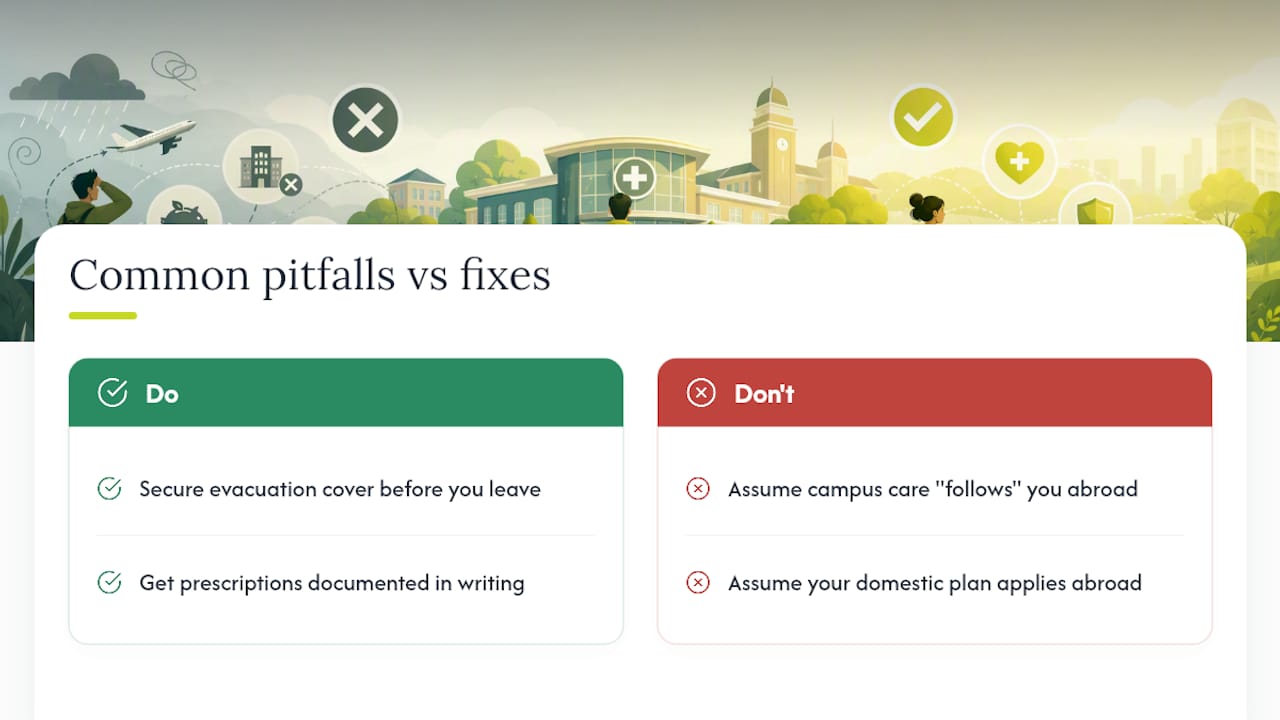
Do secure evacuation cover and get prescriptions documented in writing before you leave. Don’t assume your domestic health plan, or the coverage that felt automatic at home, applies once you cross a border. That single assumption causes more mid-term scrambling than any other single factor.
— Coert
Closing the coverage gap with the right insurance
A dedicated international student plan works as a practical alternative to piecing together cover yourself from separate domestic and travel policies. Rather than discovering mid-trip that your home insurer won’t touch a hospital bill in another country, a dedicated international student plan is built to address exactly the gaps this article has covered: medical evacuation, inpatient care abroad, and claims assistance when you’re dealing with paperwork in a language you don’t speak.
You can compare student health insurance options and request a quote directly through Unparalleledglobalbenefits, with plans structured around the realities of studying abroad rather than a generic travel policy. If you’re also arranging cover for a parent or grandparent visiting you overseas, or planning your own trip home, UGB has partnered with Ekta to arrange travel insurance for seniors up to 100 years old. Just click here and add the promo code “UGB” for an additional 10% discount. For a fuller picture of how international medical cover works before you commit, this
is worth ten minutes of your time.
Authoritative pages to consult next
For destination-specific rules, start with your university’s international health services page, your programme’s health clearance office, and your host country’s official public health portal.
This article is general information, not a substitute for advice from a qualified doctor. Consult a qualified healthcare professional about your own circumstances before acting on anything here.
Sources
- University Health Services – International (UW–Madison)
- Travel health-related preparation practices of institutions of higher education (Frontiers)
- Health Clearances | Texas Global
- Health and safety | Education Abroad (Case Western Reserve University)
- CDC travel-health guidance / institutional planning (NCBI Bookshelf)
FAQ
Do I lose access to my home country’s healthcare system while studying abroad?
That depends entirely on your home country’s rules, not your host university. UK students, for example, typically remain entitled to NHS-funded treatment if they retain ordinary residence status, but routine care abroad still needs to be arranged through the host country’s own system or private insurance.
Can international students use free public healthcare systems abroad?
Usually not without meeting specific residency, visa, or reciprocal-agreement conditions set by that country. Most international students need private international health insurance to access non-emergency care affordably while studying overseas.
Can I claim back the cost of treatment I paid for abroad?
Only if you have insurance that specifically allows overseas claims, and only with proper documentation. Keep every receipt and itemised bill, since insurers require original paperwork to process a claim, and translated copies speed things up considerably.
What’s the single biggest gap in university health centre coverage abroad?
The lack of 24/7 emergency and inpatient care is the most consequential limitation, since campus clinics run standard hours and refer serious cases to local hospitals. Evacuation cover and pre-existing condition exclusions in student insurance plans are the two areas most likely to catch students off guard financially.
How early should I arrange vaccines and medical clearances before studying abroad?
Start at least eight weeks before departure, since some vaccine series require multiple spaced doses to be fully effective. Programmes of 15 days or longer often require a separate medical clearance that can itself take several weeks to process.