
Access to a host country’s public health system depends on residency status, registration, and sometimes a reciprocal agreement or insurance arrangement, not on nationality alone. Most systems draw the line at “ordinary residence” or formal registration, though refugees and asylum seekers are usually covered through separate inclusion schemes. If you’re unsure where you stand, check the host government’s official health or migration page today, keep your ID and insurance documents on hand, and arrange interim medical cover for any gap before you travel.
TL;DR:
- Residency, registration, and insurance membership are key determinants of public healthcare access, not nationality alone, and rules vary significantly by country.
- Emergency care is almost universally available regardless of status, but primary and elective care often require formal registration or insurance proof.
- Reciprocal arrangements like EHIC or GHIC cover temporary EU stays but exclude planned treatments and private healthcare, which are often charged separately.
- Short-term visitors and new residents should carry necessary documents, register promptly, and consider interim insurance to avoid delays or unexpected costs.
- International organizations recommend integrating refugees into national systems to improve sustainability and health outcomes, but bureaucratic, linguistic, and financial barriers often impede access.
Table of Contents
- How entitlement is defined: residence, registration and insurance membership
- Common pathways to access public care for visitors, expats and refugees
- Costs, surcharges and what public systems often do not cover
- How to register and get care in a host country’s public system
- What barriers stop people from accessing care, and how to get past them
- Country models: how the UK, Denmark and Spain handle access
- What do WHO and UNHCR say about migrant health access?
- Practical checklist: what to do before you need care
- What advising international clients has taught us about access
- How international insurance can cover the gap while you confirm your entitlement
- Authoritative pages to check for country-specific rules
- Sources
- FAQ
How entitlement is defined: residence, registration and insurance membership
Every country decides who gets free or subsidised public healthcare using its own legal test, and the tests fall into a handful of recognisable patterns. The most common is “ordinary residence”: a legal concept meaning you live in the country lawfully, voluntarily, and for a settled purpose, not just passing through. It’s a judgement call, not a stopwatch. Some countries tie it to time spent (six or twelve months is typical), others to visa category, and a few to registration alone, regardless of how long you plan to stay.
Denmark takes the cleanest approach of the major examples: anyone listed on the national civil registration system gets access to the public system on the same terms as a citizen, full stop. That registry, not a separate health card, is the entitlement mechanism, which is one reason Denmark’s system scores well on straightforward accessibility for people who are formally registered. Asylum seekers and undocumented migrants sit outside that registry and face a narrower, separately administered set of entitlements.
Other systems separate entitlement from delivery entirely, relying on insurance membership as the gatekeeper. Germany and the Netherlands, for instance, require mandatory health insurance membership as the legal basis for access, so your “entitlement” document is effectively your insurer’s card, not a residence permit.
The documents that typically matter across systems include:
- A valid residence permit or visa confirming your immigration category and its conditions
- National ID or population registry number, where the host country issues one
- An S1 form (for state pensioners and some workers moving within the EU/EEA) confirming your home country will fund your healthcare in the host state
- An A1 or S2 form for posted workers or planned treatment abroad
- An EHIC or GHIC card for temporary stays within the EU or from the UK
- A provisional replacement certificate (PRC) if you’ve lost your EHIC before travelling
Entitlement rarely applies uniformly across every type of care. Emergency treatment is almost always available regardless of status, because most systems treat immediate risk to life as a separate, near-universal category. Primary care, GP registration, and elective or planned procedures are where residency and registration tests actually bite.
Common pathways to access public care for visitors, expats and refugees
Four broad routes cover most people trying to work out how host country public health system access applies to their situation, and each has firm limits worth knowing before you rely on it.
- Reciprocal and EU arrangements. The EHIC (issued by EU member states) and GHIC (its UK equivalent) entitle you to medically necessary care during a temporary stay in another EU country, on the same terms as a local. Crucially, these cards do not cover planned treatment or private healthcare, so a scheduled operation booked in advance isn’t included, and neither is a private clinic visit. The S1 and S2 forms serve a different purpose: S1 shifts long-term healthcare funding responsibility to the host state for pensioners and certain workers, while S2 authorises planned treatment abroad with home-country funding.
- Visitor charging regimes. Countries that don’t automatically extend free care to non-residents often run a parallel charging system for visitors who don’t qualify. England’s NHS is the clearest working example: overseas visitors who don’t meet residency requirements can be charged 150% of the standard national tariff for hospital treatment, calculated to reflect the true cost of delivering care without the cross-subsidy built into the wider system. Emergency department treatment stays free at the point of use for everyone, but admission afterwards can trigger the charge.
- Refugee inclusion and asylum reception services. Most host states run a separate track for people seeking protection, often starting with reception-centre medical screening and basic care, then widening as asylum status progresses. UNHCR’s tracking shows more countries folding refugees into national health systems rather than running parallel refugee-only services, largely because integrated systems prove more sustainable once donor funding tapers off.
- Donor-supported transitional coverage. Where reception systems are underfunded, international organisations and NGOs often bridge the gap with targeted clinics, particularly for maternal health, vaccination, and mental health support, until formal entitlement catches up with need.
Costs, surcharges and what public systems often do not cover
Free at the point of use rarely means free of every cost, and assuming otherwise is one of the most common planning mistakes among new arrivals. Even fully entitled residents in universal systems typically face out-of-pocket costs for specific categories of care.
Items commonly excluded or charged separately include:
- Prescription medicines, often subject to a fixed dispensing charge regardless of the drug’s actual cost
- Dental treatment, which sits outside many “universal” systems entirely or covers only emergency extractions
- Eye tests and glasses, usually a private-market purchase everywhere
- Some outpatient specialist consultations, particularly where a private referral route exists alongside the public one
- Ambulance transport in countries where this isn’t bundled into general taxation-funded care
Statistic Callout: Visitors to England who don’t meet NHS residency rules face hospital charges set at 150% of the standard national tariff, a deliberate loading designed to cover the full cost of treatment without the subsidy built into domestically funded care.
Surcharges typically work one of two ways. Some hospitals bill upfront and expect payment before non-emergency treatment proceeds; others treat first, then invoice afterwards, particularly in emergency settings where refusing care isn’t an option. Reimbursement is possible in reciprocal-arrangement cases, where your home country’s scheme repays the host provider directly, but it’s rarely instant, and gaps of several weeks between treatment and settlement aren’t unusual.
It’s also worth knowing that consular assistance from your embassy won’t plug these gaps. Embassies can locate providers and help with communication, but they don’t pay medical bills or override local triage decisions, so budgeting for the excluded categories, or holding insurance that covers them, matters more than many travellers expect.
How to register and get care in a host country’s public system
Getting from “technically entitled” to “actually treated” is a procedural problem as much as a legal one. The steps below apply broadly, though the exact office names and forms vary by country.
- Carry the right documents from day one. Passport, visa or residence permit, any national ID issued locally, and your insurance card or EHIC/GHIC if applicable. Keep physical and digital copies; some registration desks still won’t accept a phone screenshot.
- Register with the local civil or population authority first, if one exists. In registry-based systems like Denmark’s, this single step is often what unlocks everything else, GP registration, pharmacy access, hospital referral, so it comes before anything health-specific.
- Register with a GP or primary care provider. Most systems route non-emergency care through a named GP or health centre, and you’ll typically need proof of address and residency status to register. This step is also usually the prerequisite for a hospital referral, so delaying it delays everything downstream.
- Request an S1, S2, or provisional replacement certificate if your situation calls for one. Pensioners moving within the EU/EEA need an S1 from their home authority before registering locally; anyone needing planned treatment abroad needs an S2 authorised in advance, not after the fact.
- Know the payment and reimbursement route before you need it. If a system charges upfront, ask what documentation you need to claim back later, and keep every receipt regardless of how the invoice is phrased.
Pro Tip: Photograph every document the moment you receive it, including the back of cards and any reference numbers on registration letters. Lost paperwork is the single biggest cause of delayed access reported by people navigating an unfamiliar system for the first time.
What barriers stop people from accessing care, and how to get past them
Legal entitlement and actual access are not the same thing, and the gap between them is usually administrative, linguistic, or psychological rather than legal. The World Health Organization is explicit that institutional, administrative and financial barriers routinely block people who are technically entitled to care from ever receiving it.
The barriers that come up most often include:
- Language gaps that make registration forms, appointment systems, and even triage conversations difficult to navigate confidently
- Low health literacy about how an unfamiliar system is structured, particularly the difference between emergency and primary care routes
- Fear of contact with immigration enforcement, especially among undocumented migrants who may avoid care entirely rather than risk being reported
- Cost and transport barriers, particularly in rural areas or where the nearest registered provider is some distance away
Some countries address the enforcement fear directly through “firewall” policies, formal separation between health services and immigration authorities, so that seeking treatment doesn’t trigger a status check. Coverage of these protections is inconsistent: comparative research across 41 countries finds emergency care access converges fairly well internationally, while firewall protections and preventive-care inclusion remain patchy from one country to the next.
Community clinics, migrant health NGOs, and interpretation services fill much of the practical gap that policy alone leaves open. Research on immigrant-serving healthcare navigation points to the same conclusion: having a right on paper rarely matters unless someone helps you actually use it.
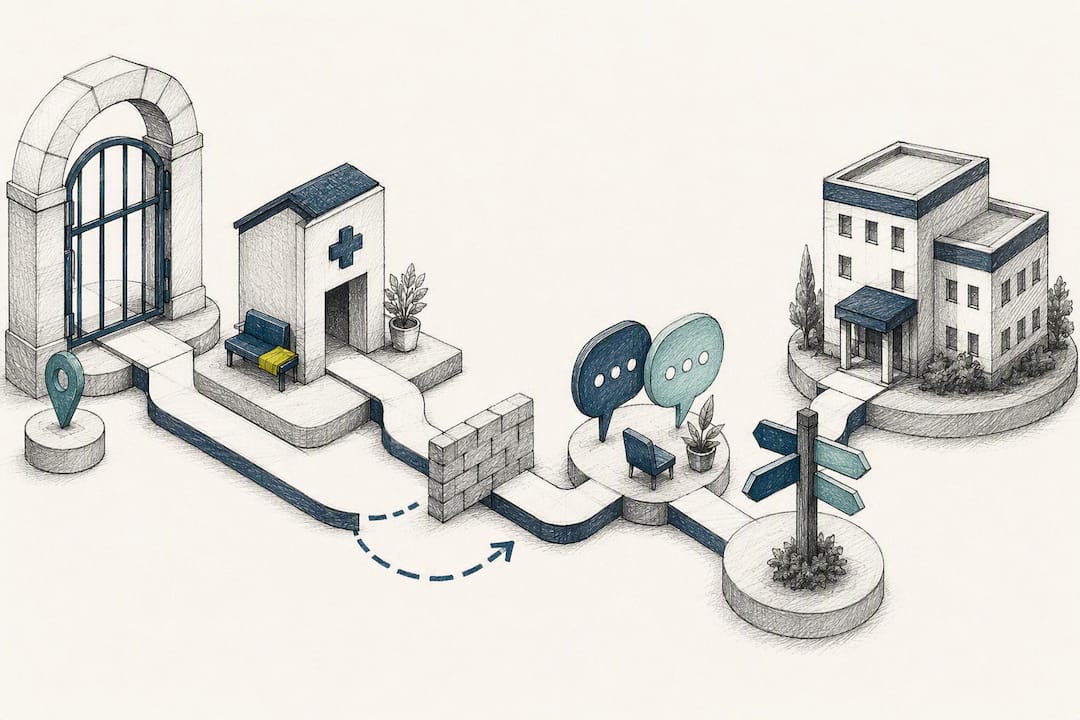
Pro Tip: Ask your local council, a resettlement charity, or even your host country’s embassy in your home country for a list of migrant health clinics before you arrive, not after a problem emerges. Many operate on a walk-in basis and don’t require proof of status.
Country models: how the UK, Denmark and Spain handle access
Three systems illustrate three genuinely different design philosophies, and recognising which model your host country resembles helps you predict how it will treat you.
England’s NHS runs on the ordinary residence principle. If you live in the UK lawfully, voluntarily, and with a settled purpose, you’re generally entitled to free NHS care on the same basis as a citizen. Visitors who don’t meet that test face the visitor charging regime described earlier, with hospital treatment billed at 150% of the standard tariff. EU/EEA and Swiss visitors, plus UK residents travelling in Europe, can use GHIC or EHIC for medically necessary treatment during a temporary stay, though planned procedures and private care fall outside that cover entirely.
Denmark takes the registry route described earlier. Once you’re on the civil registration system, healthcare access follows automatically, no separate application, no health-specific card. The WHO/European Observatory’s assessment of Denmark’s system confirms this simplicity for registered residents, but also flags that asylum seekers and undocumented migrants sit outside the registry and depend on a narrower entitlement plus NGO-run clinics for gaps the formal system doesn’t reach.
Spain’s 2026 decree widens access for a specific group: some non-resident migrants can now apply for coverage under the Ministry of Health’s universal access provisions if they meet defined conditions, including having no third party legally liable for the cost of their care. It’s not blanket universal coverage for every non-resident, but a conditional route that didn’t exist in the same form before, and it’s worth checking directly if you’re a long-term resident without formal status in Spain.
Beyond these three, most other systems fall into recognisable families:
- Social insurance models (Germany, France, the Netherlands) tie entitlement to mandatory insurance fund membership rather than residence status alone
- National health service models (UK, Spain, Italy, the Nordics broadly) fund care through taxation and define entitlement through residence or registration
- Mixed or fragmented systems, common in parts of the Americas and Asia, where public coverage exists but private insurance fills substantial gaps even for citizens
Government guidance pages typically spell out which model applies to you and what documentation to bring. New Zealand’s official guidance, for example, is unusually direct about tying eligibility to resident visa category, a pattern worth checking for wherever you’re headed, since the exact wording differs by country but the underlying logic, residence or registration as the gateway, repeats itself almost everywhere.
What do WHO and UNHCR say about migrant health access?
International guidance treats inclusive access less as a courtesy and more as a public-health necessity, and the rationale is worth understanding even if you never need to cite it yourself.
Access to health services for refugees and migrants is not simply a humanitarian gesture; institutional, administrative, and financial barriers that block that access carry consequences for entire host populations, not just the individuals turned away. Excluding a population from care doesn’t remove disease risk from a country, it just removes visibility of it.
That framing comes from the World Health Organization’s fact sheet on refugee and migrant health, which treats inclusive service design as central to functioning public-health systems, not a peripheral add-on for humanitarian budgets.
UNHCR’s more recent tracking backs this up with a trend line: more countries are folding refugees into their existing national health systems rather than running separate parallel services, largely because integration tends to be more cost-effective over the medium term, provided it’s paired with sustained development financing rather than short-term emergency funding alone. The main obstacle isn’t political will so much as economic sustainability, funding integration long enough for it to become self-sufficient.
Comparative academic evidence supports the same conclusion from a different angle. The Health Entitlement Index research across 41 countries links stronger statutory entitlement design to measurably better outcomes, including lower preventable hospitalisation rates, though a country’s overall wealth and health spending still shape how much of that effect actually materialises in practice.
Practical checklist: what to do before you need care
Your starting checklist depends on which category best describes your situation, so pick the one that matches and work through it before you actually need treatment.
If you’re a short-term visitor:
- Buy travel insurance covering medical emergencies before you depart
- Carry a GHIC or EHIC if you’re eligible, alongside your regular insurance, not instead of it
- Save local emergency numbers and your insurer’s 24/7 contact line to your phone
- Keep every medical receipt; reimbursement claims almost always require originals
If you’re a new resident:
- Register with the local civil, population, or municipal authority as your first move
- Register with a GP or primary care provider once your address is confirmed
- Check whether an immigration health surcharge applies to your visa category
- Confirm S1 eligibility with your home country’s authority if you’re a pensioner or posted worker
If you’re seeking asylum or newly arrived as a refugee:
- Ask reception-centre staff directly what medical screening and services are included from day one
- Get contact details for local NGO or migrant health clinics as a backup, not a last resort
- Request written confirmation of what your asylum status includes for health coverage, and keep it
| Situation | First action | Key document to secure |
|---|---|---|
| Short-term visitor | Buy travel medical insurance | GHIC/EHIC (if eligible) |
| New resident | Register with local/civil authority | Residence permit or national ID |
| Refugee/asylum seeker | Ask reception centre about included services | Written confirmation of coverage |
For families travelling together, cover for dependants is worth arranging as its own line item rather than assuming a single policy stretches to cover everyone; family travel insurance built for this purpose is generally simpler to manage than adding people ad hoc.
What advising international clients has taught us about access
The clients who struggle most aren’t the ones facing the hardest legal cases, they’re the ones who assumed entitlement would sort itself out once they arrived. It doesn’t. Registration deadlines slip, GP surgeries have waiting lists for new patients, and reciprocal cards get left in a drawer at home more often than you’d expect.
The pattern worth learning from is preparation, not luck. People who arrive with copies of every document, a registered address ready to prove, and short-term insurance covering the gap before local entitlement kicks in, consistently navigate the system faster than people who don’t. The biggest mistake isn’t misunderstanding the law; it’s assuming the paperwork will wait until you’re settled enough to deal with it. It won’t, and the countries with the cleanest systems on paper are often the ones where a missed registration step causes the longest delay.
Working with an advisor who understands both the legal entitlement side and the practical insurance side tends to shorten that gap considerably, because the two problems are rarely solved by the same document.
— Coert
How international insurance can cover the gap while you confirm your entitlement
There are genuine routes into free public care almost everywhere, registration, reciprocal agreements, refugee inclusion schemes, but every one of them takes time to activate, and none of them retroactively covers a bill from before you were registered. That gap, between arriving and being formally entitled, is exactly where private international insurance can fit, offering a practical, flexible alternative while you sort out the statutory side.
Unparalleledglobalbenefits partners with a global network of insurers to offer highly customised coverage with 24/7 multilingual support, direct billing, and flexible terms for pre-existing conditions, useful precisely because your public entitlement may take weeks to confirm and won’t cover you retroactively. That includes travel medical cover for short visits, expat medical plans for longer stays while registration is pending, and student or visitor-specific plans depending on your circumstances. None of this changes your statutory entitlement under host country law, insurance is a financial safety net, not a legal status, but it does mean an unexpected bill doesn’t derail your move while the paperwork catches up.
Planning a trip for yourself, a resident, or visiting family? UGB + Ekta can arrange travel insurance for seniors up to 100 years old. Just click here: https://ektatraveling.com/?partner_uid=808 and add the promo code “UGB” to receive an additional 10% discount.
If you want to see how the cover options compare for your situation, visit Unparalleledglobalbenefits to request a quote and explore plans built around exactly this transition period.
For a fuller walkthrough of how these video explainers cover the practical side of moving abroad, this guide is worth watching:
Authoritative pages to check for country-specific rules
Policy details change by country and by year, so always verify against the primary source before you rely on any summary, including this one.
- WHO: Refugee and migrant health fact sheet
- UNHCR: refugee inclusion in national health systems
- NHS: accessing services if visiting from abroad
- Your Europe: health cover for temporary EU stays
- New Zealand government: public health service eligibility
Always check your host country’s own health ministry website for the current, locally applicable rules before travelling or relocating.
This article is general information, not a substitute for advice from a qualified doctor. Consult a qualified healthcare professional about your own circumstances before acting on anything here.
Sources
- How to access NHS services in England if you are visiting from abroad – NHS
- Refugee and migrant health — World Health Organization
- Health cover for temporary stays in another EU country – Your Europe
- Denmark: assessment of the health system — WHO/European Observatory
FAQ
Who is eligible for an S1 form?
State pensioners and certain posted or frontier workers moving within the EU/EEA or Switzerland are typically eligible for an S1 form, issued by their home country’s authority to confirm the host state will fund their healthcare.
Which country has the best public healthcare system?
There’s no single agreed ranking, since systems trade off differently across coverage, cost, and outcomes, but Denmark’s registry-based universal access and the UK’s residence-based NHS model are both frequently cited as strong, accessible examples for registered residents.
Is there a country without any universal healthcare?
The United States is commonly cited as the major economy without a single universal public health system, relying instead on a mix of employer insurance, private cover, and targeted public programmes rather than one unified scheme.
Does losing my visa status affect my access to public healthcare?
Yes, in most countries entitlement is tied directly to your immigration status, so a change, expiry, or downgrade in your visa can immediately affect what public care you’re entitled to, which is exactly why interim cover from a provider like Unparalleledglobalbenefits matters during status transitions.
What should I do if I can’t access public healthcare while my status is unresolved?
Contact a local migrant health NGO or community clinic immediately, since many operate without requiring proof of status, and consider short-term medical insurance to cover costs while your entitlement is being confirmed.