

Trip interruption insurance reimburses the unused, prepaid portion of your trip and reasonable extra transport home once a covered event forces you to leave early.
TL;DR:
- Most policies reimburse up to 200% of the trip cost, often covering expensive last-minute flights if the multiplier is sufficient.
- The coverage includes unused prepaid expenses, additional transport home, and related costs like change fees or missed connections.
- Valid reasons for claim acceptance include serious illness, death, severe weather, evacuation, or emergencies verified by official documentation.
- Claims are often denied if the reason for leaving is voluntary, due to war, illegal acts, or routine pregnancy issues, especially without a pre-existing condition waiver.
- Booking a high multiplier policy that explicitly covers last-minute transport costs and understanding specific exclusions are crucial for effective coverage.
Table of Contents
- What does trip interruption insurance cover exactly?
- Typical claims and how insurers calculate the payout
- Which reasons does an insurer typically accept?
- What trip interruption insurance won’t pay for
- How to actually file a trip interruption claim
- Trip interruption vs cancellation vs delay: what’s the real difference?
- How to choose a policy with reliable interruption cover
- Why the fine print matters more than the headline number
- Get help matching a policy to your actual trip
- Sources
- FAQ
What does trip interruption insurance cover exactly?
Once you understand the basic mechanics, the coverage breaks down into three practical categories. The first is the trip you already paid for and never used.
- Unused prepaid costs: the return leg of flights or cruise fares, unused hotel nights, and any tours or excursions you booked and paid for but couldn’t take.
- Extra transport home: a new one-way flight, an upgraded return ticket if that’s all that’s available, taxis, and transfers to get you and your luggage to the airport or port.
- Related costs: airline change fees, missed-connection expenses if the interruption cascades into a rebooking mess, and extra accommodation while you wait for a rerouted flight.
That middle category, transport home, is where most travellers underestimate the exposure. Booking a same-day, one-way international flight from a country you didn’t plan to leave can cost several times what your original return ticket cost. Trip interruption insurance is designed precisely to absorb that gap, provided the multiplier on your policy is generous enough to cover it. This is also where the terminology gets muddled: some travellers search for “travel interruption insurance” or ask what is trip interruption coverage without realising it’s the same product under a slightly different label. It’s not a separate policy type, just inconsistent marketing language across insurers.
Typical claims and how insurers calculate the payout
A common scenario looks like this: you booked a 14-night trip, something happens on night five, and you fly home early. The insurer totals the unused nine nights of prepaid accommodation, any airline change fees, and the difference between your original return fare and the last-minute one-way ticket you had to buy.
How the multiplier changes the outcome: many policies reimburse amounts around the insured trip cost and may offer additional coverage to help with expensive last-minute return flights.. A 200% policy on the same trip gives you up to $6,000 of headroom, which matters enormously on long-haul international routes where last-minute fares spike hard.
Expect to submit:
- Original booking confirmations and receipts for every prepaid item.
- Proof you first sought a refund or credit from the airline or cruise line.
- Medical or hospital records, a death certificate, or an official notice, whichever fits the reason for the claim.
Which reasons does an insurer typically accept?
Insurers publish a specific list of covered reasons, and your claim lives or dies by whether your situation matches one of the precisely. Chase’s overview of trip interruption cover lists the reasons that show up across most standard policies:
- Serious illness or injury to you, a travelling companion, or an immediate family member back home, backed by medical or hospital documentation.
- Death of a family member or travelling companion, verified with a death certificate or official notice.
- Severe weather, natural disaster, or a mandatory government evacuation order, supported by official advisories or carrier notices confirming the disruption.
- Military orders, an airline strike, or a sudden emergency at home such as a burst pipe or a break-in, verified with official orders or an incident report.
If your reason for leaving isn’t on that list, and this is where trip cancellation insurance covered reason wording matters just as much for interruptions as it does for cancellations, you’re likely looking at a denied claim rather than a reduced one.
What trip interruption insurance won’t pay for
Every policy excludes a fairly consistent set of situations, and knowing them before you travel saves a lot of disappointment at claim time. NerdWallet’s breakdown of standard exclusions flags these as the usual suspects:
- Voluntary changes of plan, meaning you simply decided to leave early with no covered reason behind it.
- Illegal acts, acts of war, and self-inflicted injury.
- Hazardous pursuits not listed as covered activities, and travel taken against explicit medical advice.
- Routine pregnancy events rather than pregnancy complications, which is a distinction worth checking carefully if trip cancellation insurance pregnancy cover matters to your trip.
Pre-existing medical conditions carry their own clause. Most insurers apply a look-back period before your policy purchase date, and flare-ups of a condition diagnosed within this period are typically excluded unless you bought a medical waiver in time. That waiver usually has to be purchased within a set number of days of your initial trip deposit, so it’s not something you can add later once symptoms appear.
Pro Tip: *Check the multiplier before you check the headline coverage amount.
How to actually file a trip interruption claim
Filing correctly, and quickly, is what separates a smooth payout from a drawn-out dispute. Follow this order:
- Contact the common carrier first. Call the airline or cruise line to request a refund, credit, or rebooking, and note the reference number they give you.
- Notify your insurer as soon as reasonably possible. Most policies expect notification within a set window from the interruption, though this varies by insurer.
- Collect every piece of paperwork. Original receipts, booking confirmations, boarding passes, medical or official reports, and written confirmation of whatever the carrier refunded or denied.
- Submit within the filing deadline, which is commonly 90 days from the date the trip ended, though you should always check your specific policy wording.
- Wait for the insurer’s assessment, and if the payout looks short or gets denied, ask for the specific clause cited and file an appeal with any additional documentation that closes the gap.
Skipping step one is the single most common reason a claim gets reduced rather than paid in full, since insurers routinely deduct or net out whatever the carrier already refunded before calculating what they owe you.
Trip interruption vs cancellation vs delay: what’s the real difference?
The three terms get used interchangeably by travellers, but insurers draw a hard line based on timing alone.
- Trip cancellation applies before you leave. Something happens ahead of your scheduled departure, and you never start the trip.
- Trip interruption applies after you’ve departed. Coverage begins on your scheduled departure date and runs through your scheduled return date, and it kicks in when you have to end the trip early once it’s already under way.
- Trip delay covers temporary hold-ups, a missed connection, a mechanical fault, that cost you money in meals or an extra hotel night without ending the trip altogether.
A trip cancellation and interruption insurance bundle, which most comprehensive policies now sell as a single package, covers you across the whole timeline rather than forcing you to guess which single product you need before you travel.
How to choose a policy with reliable interruption cover
Not every plan handles interruption the same way, and the clauses that look identical on a comparison table can produce wildly different payouts in practice. Before buying, check:
- The full list of covered reasons and the specific limit for return transport, not just the headline trip protection figure.
- The benefit multiplier, prioritising 150% to 200% plans if your itinerary includes long-haul or last-minute international routes.
- How the insurer treats airline refunds or credits, since some net your payout against whatever the carrier already gave you while others require documented proof before adding the benefit on top.
- Filing windows, pre-existing condition waiver deadlines, and how the interruption benefit interacts with emergency medical evacuation or repatriation cover on the same policy.
Pro Tip: If you’re an expat with a known health condition, prioritise policies that explicitly name a pre-existing condition waiver rather than assuming general “trip interruption insurance benefits” language covers you automatically. It rarely does.
Why the fine print matters more than the headline number
Most travellers shop trip interruption cover the way they shop trip cancellation cover, by glancing at the total protection figure and assuming bigger is better. That’s a mistake. The multiplier clause does more real work than the headline limit ever will, because insurers calculate your insured trip cost from your original itinerary, not from what it actually costs to fly home in an emergency three days before your scheduled return.
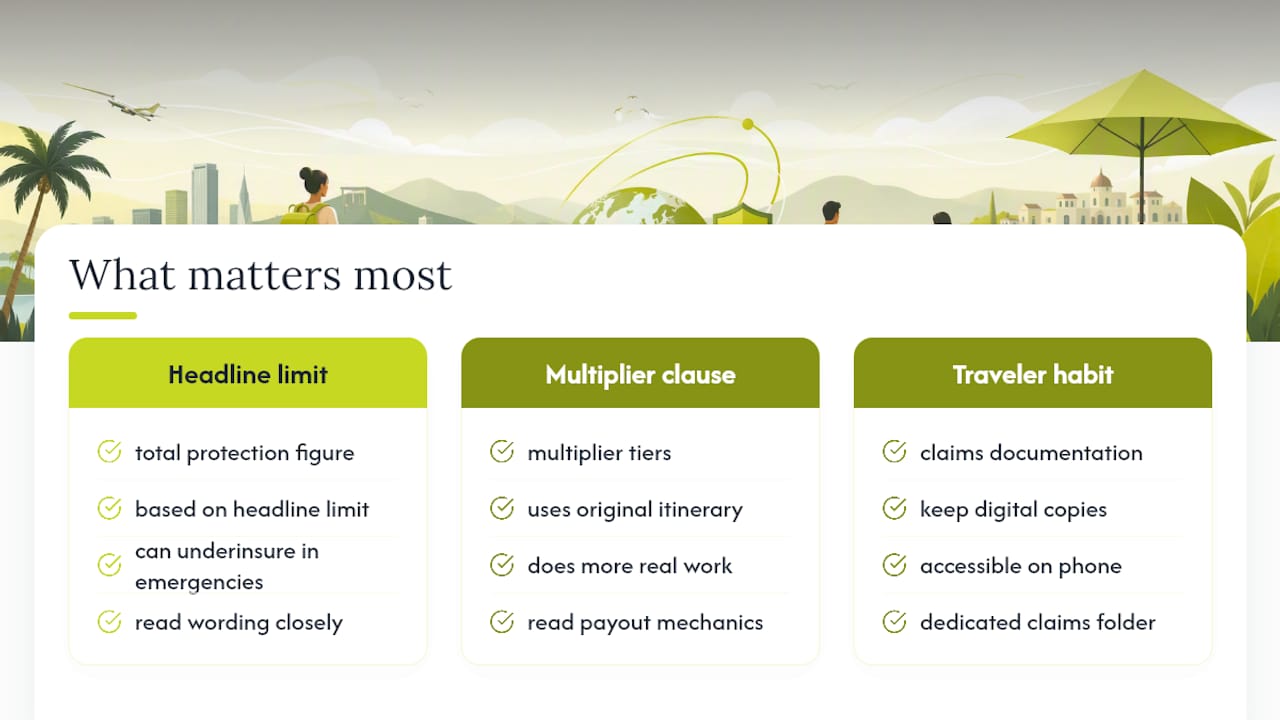
The gap between those two numbers is where most underinsured claims fall apart. Nobody reads policy wording that closely until they need it, which is exactly when it’s too late to fix.
For expats and long-term international travellers, this matters even more, because the reasons you’d interrupt a trip abroad, a family emergency, a sudden hospitalisation, a home country crisis, tend to arrive with less warning and less flexibility than a domestic traveller’s equivalent. Unparalleled Global Benefits’ expat-focused trip interruption resources go into the healthcare-specific triggers that come up more often for people living overseas, and the payout mechanics behind multiplier tiers are worth a closer read before you book anything expensive. One practical habit worth building regardless of policy: keep digital copies of every booking, and a dedicated claims folder, accessible on your phone while you travel, not just saved on a laptop back home.
— Coert
Get help matching a policy to your actual trip
You shouldn’t have to decode multiplier tables and exclusion clauses alone to know whether you’re properly covered. There are services that arrange international travel and expat insurance and can compare trip interruption options side by side, so you’re choosing based on the multiplier and covered-reasons list that actually fit your itinerary, rather than the plan with the flashiest headline number.

Whether you’re insuring a single trip abroad, arranging cover for a relative, or sorting protection for an older family member, the right plan depends on details most comparison sites skip over entirely. Planning a trip for yourself, a resident, or visiting family? UGB + Ekta can arrange travel insurance for seniors up to 100 years old. Just click here: Ektatraveling and add the promo code “UGB” to receive an additional 10% discount. If you want a broader view of how trip protection fits alongside health cover, Unparalleledglobalbenefits’ travel health insurance guide is a solid next stop, and for seniors specifically, the travel insurance tips for older travellers page is worth a look before you book. For a visual walkthrough of how trip interruption cover works in practice, this video breaks it down clearly:
. Request a quote today and get a plan matched to your actual travel dates and destinations.
This article is general information, not a substitute for advice from a qualified financial advisor. Consult a qualified financial professional about your own circumstances before acting on anything here.
Sources
- Trip Interruption Insurance Explained – Forbes Advisor
- Trip Interruption Insurance Explained – NerdWallet
- What Is Trip Interruption Insurance? | Chase
- What is trip interruption insurance coverage? – Progressive
FAQ
What is covered under trip interruption insurance?
It covers unused, prepaid, non-refundable trip costs, flights, hotels, tours, cruises, plus reasonable extra transport to get you home early when a covered reason like illness, death of a family member, severe weather, or a strike forces you to cut the trip short.
What is the difference between trip cancellation and trip interruption insurance?
Trip cancellation applies before you depart and reimburses your prepaid costs if you never start the trip; trip interruption applies after departure and reimburses unused costs plus extra transport when you have to end the trip early.