
Mauritius, Botswana, Namibia, Seychelles and Rwanda are often ranked among the safest places in Africa, with Ghana, Senegal and The Gambia also considered stable and welcoming West African options. These destinations combine low Global Peace Index scores, established tourism infrastructure and low violent crime in the zones visitors actually use. Before booking, check current travel advisories for your specific destination and arrange proper travel and medical insurance.
TL;DR:
- Mauritius and Seychelles have the lowest violent crime rates, with Mauritius being especially safe for beaches and low petty theft risks.
- Botswana, Namibia, and Rwanda offer well-regulated safaris and urban areas with low crime, but travelers should remain cautious about wildlife and infrastructure challenges.
- Many countries face natural hazards such as drought, flooding, or cyclones, requiring travelers to check seasonal risks and be flexible with plans.
- Using licensed guides, booking airport transfers early, and obtaining appropriate travel and medical insurance significantly reduce safety risks during trips.
- Destination-specific advice and region-level advisories are essential, as national safety rankings do not reflect variations within countries or local hotspots.
Table of Contents
- Which are the safest places in Africa? A ranked shortlist
- How we defined “safest”: data sources and key caveats
- Practical safety advice for travellers and solo female visitors
- Natural disaster risks by region
- What I’ve learnt travelling safely across Africa
- Arranging cover before you go
- Sources
- FAQ
Which are the safest places in Africa? A ranked shortlist
Safety across Africa varies enormously by country, and even more so within them. A capital city’s crime statistics can tell you almost nothing about the safari lodge three hundred kilometres away. Still, some nations pull consistently ahead on the metrics that matter to travellers: peace indices, tourism-sector crime rates, political stability and the practical experience of visitors on the ground.
The following shortlist draws on the Global Peace Index, which measures societal safety, ongoing conflict and militarisation across 163 countries, cross-referenced against government travel advisories and destination-specific realities. Mauritius and Botswana appear near the top of most recent African safety rankings, and both feature heavily in aggregated country comparisons.
1. Mauritius
Mauritius tops most African peace rankings and holds that position for good reason: it is an island nation with no land borders, a mature tourism economy, and violent crime rates that barely register outside isolated incidents. It is best for beach holidays, honeymoons and slower-paced island exploring rather than adventure travel. The main risks worth noting are opportunistic theft from unattended bags on beaches and occasional overcharging by unlicensed taxi operators. Petty crime spikes slightly during peak season around Port Louis markets, so keep valuables close. There is no malaria risk on the island, which simplifies pre-trip health planning considerably.
2. Botswana
Botswana’s safety record inside its safari corridors and national parks is exceptional, largely because tourism is tightly regulated and lodges operate with professional guides. It is best for wildlife safaris, particularly in the Okavango Delta and Chobe National Park. The main risk to note is not crime but wildlife: unguided walks near camps or ignoring ranger instructions cause most incidents. Roads outside main tourist routes can be poor, so self-drive travellers need real off-road experience. Malaria prophylaxis is recommended for the northern regions, so check Fit for Travel’s country guidance before departure.
3. Namibia
Namibia offers some of the lowest population density and lowest crime rates on the continent, making it a favourite for self-drive road trips through dramatic desert landscapes. It is best for independent touring, from Sossusvlei’s dunes to Etosha’s game drives. The main risks are practical rather than criminal: long distances between fuel stops, limited mobile signal, and the genuine danger of driving at dusk when wildlife crosses rural roads. Windhoek itself is calm by regional standards, though standard urban precautions still apply after dark. Southern African safari nations like Namibia, Botswana and Zambia show strong safety records within tourist corridors specifically, according to safari-industry guidance, even where city-centre risks differ.
4. Seychelles
Seychelles pairs an island setting with some of the highest per-capita tourism income on the continent, and that economic stability translates into low crime against visitors. It is best for luxury beach breaks, diving and honeymoon travel rather than budget backpacking, since costs run high across the board. The main risk to note is isolation itself: medical facilities on outer islands are limited, so anything beyond routine care usually means transfer to Mahé or evacuation. Petty theft from beach bags remains the most common complaint. Book accommodation with secure storage rather than relying on beach-side vigilance alone.
5. Rwanda
Rwanda’s transformation since the 1990s is genuinely remarkable, and it now ranks among the cleanest and best-organised capitals on the continent, with Kigali frequently cited for orderly streets and low street crime. It is best for gorilla trekking in Volcanoes National Park and increasingly for conference and business travel. The main risk to note is regional: the border areas near the Democratic Republic of Congo carry different risk levels than the capital, so check the latest Foreign Travel Advice for specific border guidance before planning cross-border trips. Trekking permits are strictly controlled, which also keeps group sizes and safety standards consistent.
6. Ghana
Ghana is often overlooked next to the safari giants, but it offers one of West Africa’s most stable and welcoming environments for first-time visitors, according to regional safety comparisons. It is best for cultural travel, coastal history sites like Cape Coast Castle, and travellers wanting an accessible introduction to West Africa. The main risks are standard urban ones: pickpocketing in busy markets like Accra’s Makola, and scams targeting tourists near tourist landmarks. Malaria risk exists year-round, so prophylaxis is essential rather than optional. English is the official language, which eases communication for many international visitors.
7. Senegal
Senegal combines political stability with a strong tourism sector centred on Dakar, the Pink Lake, and the historic Île de Gorée. It is best for culture, music and coastal city breaks. The main risks to note are petty theft in crowded areas and occasional aggressive street vendors near tourist sites, rather than anything more serious. Taxi fares should always be negotiated or fixed before the journey starts. Yellow fever vaccination is typically required for entry, so confirm certificate requirements well ahead of travel.
8. The Gambia
The Gambia’s small size and heavy reliance on tourism revenue mean the sector is well protected and closely monitored. It is best for beach holidays and birdwatching along the Gambia River, and it is a popular choice for first-time solo travellers to West Africa given the relatively compact, well-trodden tourist circuit. The main risk to note is the “bumster” phenomenon: persistent unofficial guides offering unsolicited services, which is an annoyance rather than a danger. Malaria prophylaxis is recommended, and most resorts sit along a coastline that keeps transport simple.
9. Sierra Leone
Sierra Leone has rebuilt substantially since its civil war ended, and Freetown and the beaches south of it now see a small but growing number of visitors drawn by pristine coastline and low tourist density. It is best for travellers seeking beaches without crowds and a genuine off-the-beaten-track feel. The main risks are related to infrastructure rather than crime: poor road conditions, limited medical facilities outside the capital, and patchy mobile coverage in rural areas. Vaccination requirements are stricter here than in more established destinations, so plan health preparation early.
10. Madagascar
Madagascar’s isolation as an island nation means it avoids many of the regional stability issues affecting parts of mainland Africa, and its unique wildlife draws travellers specifically for nature tourism. It is best for wildlife enthusiasts and hikers exploring national parks like Andasibe and Isalo. The main risks to note are petty theft in Antananarivo and road safety concerns, since many routes between parks are long and poorly maintained. Political demonstrations occur periodically in the capital, so checking advisories close to travel dates matters more here than in some neighbouring island destinations.
11. Zambia
Zambia shares much of Botswana’s safari appeal, with South Luangwa and Lower Zambezi National Parks offering exceptional wildlife viewing under professional guide supervision. It is best for walking safaris and travellers wanting a slightly less commercialised alternative to Botswana. The main risk is again wildlife-related rather than criminal, alongside remote-area medical access limitations. Victoria Falls, shared with Zimbabwe, draws large numbers of day visitors and carries typical tourist-site petty crime risks.
12. Liberia
Liberia is a genuinely emerging destination, still building tourism infrastructure after decades of conflict, but Monrovia has grown noticeably calmer over the past decade. It is best suited to travellers with some Africa travel experience already, rather than absolute first-timers, given the limited tourist services. The main risks are infrastructure gaps: unreliable electricity, limited emergency medical care, and roads that deteriorate badly during the rainy season. Malaria risk is present nationwide.
13. Malawi
Malawi’s nickname, “the warm heart of Africa,” reflects a genuine reputation for friendliness that many long-term visitors and volunteers report firsthand. It is best for budget-conscious travellers, Lake Malawi beach time, and combining wildlife viewing with a slower pace than neighbouring safari destinations. The main risks are petty theft around lakeside backpacker areas and, again, malaria, which requires prophylaxis across most of the country. Minibus travel between towns carries higher accident risk than organised transport.
14. Morocco
Morocco offers one of the continent’s most developed tourism industries, with Marrakech, Fes and the Atlas Mountains drawing large volumes of independent and package travellers alike. It is best for city breaks, desert excursions and travellers wanting strong infrastructure with minimal health preparation, since malaria is not a concern. The main risks are scams and aggressive touting in medinas, plus occasional civil unrest in specific areas, so check advisories for any regional flashpoints. Solo female travellers should expect more persistent street attention than in most other destinations on this list, and dressing modestly reduces unwanted interest considerably.
15. Tanzania
Tanzania pairs the Serengeti and Ngorongoro Crater with Zanzibar’s beaches, giving it one of the widest ranges of experiences on this list. It is best for combined safari-and-beach itineraries. The main risks to note are wildlife encounters on safari, petty theft in Zanzibar’s Stone Town, and road accidents given inconsistent driving standards on rural routes. Yellow fever certificates are sometimes required depending on your prior travel history, and malaria prophylaxis is recommended for mainland travel.
16. South Africa
South Africa has world-class tourism infrastructure and some genuinely safe, well-managed regions, particularly the Western Cape’s wine country and established safari reserves like Kruger’s private lodges. It is best for wine tourism, luxury safari and Cape Town city breaks. The main risk to note is significant urban crime concentrated in specific areas of Johannesburg and parts of Cape Town, which means this is a country where local knowledge about which neighbourhoods to avoid matters enormously. Tourist-focused areas with private security generally see far fewer incidents than the national statistics suggest.
17. Kenya
Kenya remains one of the continent’s most popular safari destinations, with the Maasai Mara and Amboseli drawing repeat visitors for good reason. It is best for classic safari itineraries and beach add-ons along the coast near Diani. The main risks are regional rather than universal: some border areas near Somalia carry advisory warnings, while Nairobi itself requires standard city precautions around certain districts after dark. Malaria prophylaxis is recommended for most regions outside Nairobi’s immediate highlands.
How we defined “safest”: data sources and key caveats
“Safest” is a genuinely slippery word, and any list claiming otherwise is oversimplifying. The Global Peace Index measures 23 indicators across three domains: ongoing domestic and international conflict, societal safety and security, and militarisation. It is a national score, built from things like homicide rates, political terror and access to weapons, not a tourist-crime index.
That distinction matters. National peace scores tell you whether a country’s institutions are broadly functioning and whether conflict is present, but they say very little about whether a specific hotel district or safari lodge is safe for you this month.
Quick fact: Mauritius, Botswana and Namibia appear repeatedly at or near the top of Africa’s GPI rankings, a pattern confirmed across multiple recent comparative country safety analyses.
To build a usable shortlist, this article combined three layers of information:
- Global Peace Index national scores and rankings, showing which countries have stable institutions and low conflict exposure
- Current UK government travel advice and US State Department advisories, which flag region-specific risks that a national score alone cannot capture
Countries experiencing active armed conflict or those carrying the highest advisory warning levels from major governments were excluded from the shortlist entirely, regardless of how they scored on other metrics. The remaining caveat is the most important one: a low national ranking does not mean uniform safety everywhere within that country. South Africa’s peace score sits lower than most countries on this list, yet specific safari lodges and Cape Town neighbourhoods with private security see very few incidents. The reverse is also true. Always check the district-level or region-level advisory for your exact itinerary, not just the country’s overall score.
Practical safety advice for travellers and solo female visitors
Preparation does more for your safety than destination choice alone. Here is what actually reduces risk on the ground, drawn from consistent guidance across the destinations above.
- Book airport transfers in advance and arrive in daylight where possible. Solo female travellers in particular benefit from predictable routines: pre-arranged pickups, daytime arrivals and accommodation with secure, monitored entrances measurably reduce risk exposure.
- Dress with local customs in mind. Modest clothing reduces unwanted attention in Morocco, coastal Tanzania and most West African destinations, and it is a simple, low-cost precaution.
- Use licensed transport and guides, always. Safari operators consistently note that safety on wildlife trips comes down to using regulated lodges, trained rangers and reputable transfer companies rather than informal arrangements.
- Check Fit for Travel for vaccination and malaria guidance specific to your destination, ideally six to eight weeks before departure, since some vaccines need time to take effect.
- Arrange evacuation cover for any safari or remote itinerary. Local medical facilities near national parks are often basic, and a serious injury or illness may require air evacuation to a city hospital. A medical evacuation guide explains how this process typically works in practice.
- Keep valuables split and concealed, using hotel safes for passports and spare cash rather than carrying everything on your person.
- Withdraw cash from ATMs inside banks or malls rather than standalone street machines, particularly in larger cities.
- On safari, follow ranger instructions without exception. Most wildlife-related incidents on tourist itineraries are avoidable simply by staying inside vehicles when instructed and maintaining distance during walking safaris.
- Register with your embassy before departure, photocopy your passport and visa pages, and share your itinerary with someone at home.
- Set up a local emergency contact, whether that is your lodge, tour operator or hotel concierge, so someone nearby knows your plans each day.
Pro Tip: Share your daily itinerary with your accommodation or guide before you head out, even for a short walk. It costs nothing and means someone knows roughly where to start looking if plans change unexpectedly.
If you are managing cash or sending money to family or guides during your trip, using a safe and reputable transfer method rather than carrying large amounts in person reduces both theft risk and the temptation for opportunistic crime.
Natural disaster risks by region
Africa’s natural disaster profile varies sharply by region, and it deserves a place in any safety planning alongside crime statistics. East Africa, particularly Kenya and Tanzania, experiences periodic drought and occasional flash flooding during the rainy seasons of March to May and October to December, which can disrupt rural roads and safari access.
Southern Africa, including Botswana, Namibia and Zambia, faces flooding risk along major river systems like the Zambezi during peak rains, sometimes affecting low-lying camps near Victoria Falls. Madagascar sits directly in the Indian Ocean cyclone belt and experiences tropical storms most severely between November and April, which can ground flights and damage coastal infrastructure with little warning.
North Africa carries a different profile entirely: Morocco sits in a seismically active zone, and earthquake risk, while infrequent, is real. Coastal West African nations like Ghana, Senegal and The Gambia see minimal seismic activity but face flooding during the June to October wet season. Whatever your destination, checking seasonal timing against your travel dates and building flexibility into your itinerary matters more than most travellers realise until they are caught by it.
What I’ve learnt travelling safely across Africa
Nothing on this list felt reckless to visit, provided the basics were handled properly. Mauritius and the Seychelles felt as safe as any European beach town, arguably safer after dark than parts of major Western cities. Rwanda’s capital surprised me most: Kigali’s calm, orderly streets contradict almost every outdated assumption people still carry about the country.
Botswana and Namibia required more deliberate planning, not because they felt unsafe but because remoteness itself is the risk. A flat tyre on an empty desert road matters more than any crime statistic ever will there.
My rule of thumb: join a guided activity whenever wildlife, remote terrain or unfamiliar driving conditions are involved, and travel independently where the risk is closer to what you’d manage at home, like city sightseeing or beach time. Africa is not one place with one risk level. It is dozens of distinct environments, and preparation, not headlines, decides how your trip actually goes.
— Coert
Arranging cover before you go
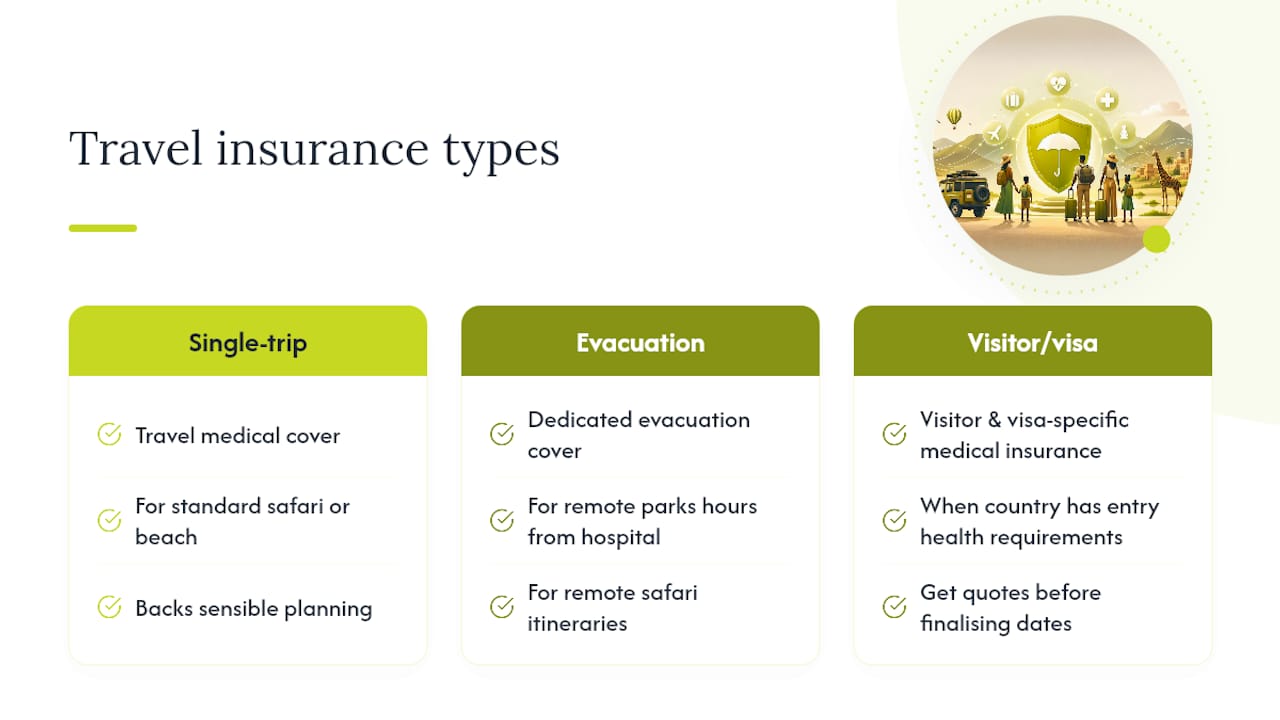
Specialized insurance services exist to fill the gap between choosing a safe destination and actually being covered if something goes wrong there. Most trips to the destinations above call for one of three policy types: single-trip travel medical cover for a standard safari or beach holiday, dedicated evacuation cover for remote parks where the nearest proper hospital might be hours away, or visitor and visa-specific medical insurance if you’re travelling on to a country with entry health requirements.
A good policy does not replace sensible planning; it backs it up when planning alone isn’t enough, whether that’s a twisted ankle on a Rwandan trekking trail or a stomach bug that needs more than the lodge first-aid kit. Unparalleledglobalbenefits helps you compare plans built for exactly this kind of trip, including evacuation cover for remote safari itineraries and a travel medical coverage checklist to help you work out what you actually need before you request a quote.
Planning a trip for yourself, a resident, or visiting family? UGB + Ekta can arrange travel insurance for seniors up to 100 years old. Just click here: https://ektatraveling.com/?partner_uid=808 and add the promo code “UGB” to receive an additional 10% discount.
Get a clear view of what’s available for your specific itinerary through the international health insurance guide, and request a quote before you finalise your dates.
Sources
Before booking anything, run your specific itinerary past these official sources rather than relying on general rankings alone:
- Global Peace Index — Vision of Humanity
- Gov
- Travel Advisories — U.S. Department of State
- Fit for Travel — NHS (UK)
- Safest countries in Africa — WorldPopulationReview
For a deeper look at travel planning and risk management more broadly, this family travel planning guide covers useful groundwork that applies well beyond African itineraries.
Watch this related travel safety video:
FAQ
What are the safest countries in Africa right now?
Mauritius, Botswana, Namibia, Seychelles and Rwanda consistently top African safety rankings, with Ghana, Senegal and The Gambia offering stable, welcoming alternatives in West Africa.
What is the safest and cleanest country in Africa?
Rwanda is widely cited for orderly, litter-free streets and low urban crime, particularly in Kigali, while Mauritius leads on overall peace and safety scores as an island nation.
What part of Africa has the lowest crime rate?
Southern African nations within their tourist corridors, particularly Botswana and Namibia, and island nations like Mauritius and Seychelles, report the lowest violent crime rates affecting visitors.
Where is it safe to go on holiday in Africa?
Island destinations like Mauritius and Seychelles suit beach holidays with minimal risk, while Botswana, Namibia, Rwanda and Tanzania offer well-regulated safari experiences when booked through licensed operators, and always with appropriate travel insurance in place.
Do I need travel insurance for these destinations?
Yes, particularly for safari and remote trips where evacuation may be needed; local medical facilities near national parks are often limited, making dedicated medical and evacuation cover a practical necessity rather than an optional extra.