

Inpatient care means a doctor has formally admitted you to stay in hospital overnight or longer; outpatient care means you receive treatment and go home the same day. That single distinction decides which part of your policy pays, how much you owe before cover kicks in, and whether you need prior approval. Check your Summary of Benefits before you assume either category applies.
TL;DR:
- The formal admission order from a physician determines whether hospital care is billed as inpatient or outpatient, regardless of the actual length of stay.
- Inpatient benefits typically cover hospital room, surgical fees, diagnostics, and follow-up care, often requiring prior authorization for coverage.
- Outpatient benefits include consultations, diagnostics, and same-day procedures, but often come with limits like caps per year or per visit.
- Billing structures differ significantly: inpatient costs usually involve a single deductible or copay per stay, while outpatient costs accrue with each visit and are easier to underestimate.
- Patients should verify their admission status and benefit limits before treatment and keep all documentation to avoid billing disputes.
Table of Contents
- What is an inpatient vs outpatient benefit? Definitions and examples
- What do inpatient benefits typically cover?
- What do outpatient benefits usually include?
- How insurers bill inpatient and outpatient care differently
- Who decides if you’re inpatient or outpatient?
- Checking your plan and questions to ask before you’re treated
- Why the admission order matters more than people realise
- Compare plans that cover both inpatient and outpatient care properly
- Sources
What is an inpatient vs outpatient benefit? Definitions and examples
The line between the two isn’t about how sick you are. It’s about a specific piece of paperwork: the physician’s formal admission order. Once a doctor writes that order, you’re an inpatient, and your insurer applies inpatient rules to the bill, typically because the case needs continuous, higher-level monitoring. Without that order, you’re outpatient, even if you spend hours or an entire night in a hospital bed.
Real-world examples make this clearer:
- Inpatient: major surgery with a planned recovery stay, childbirth, treatment for a serious injury or acute illness requiring 24-hour monitoring.
- Outpatient: an MRI or CT scan, a routine clinic consultation, physiotherapy, and most day surgery, where you’re discharged the same day.
- The grey zone: overnight “observation” in a hospital bed, which frequently gets billed as outpatient despite the overnight stay.
That last point trips up more people than any other part of inpatient benefits explained by insurers. You can be moved into a ward, given a bed, monitored by nurses overnight, and still be classed as outpatient because nobody formally admitted you.
What do inpatient benefits typically cover?
Inpatient cover under most private and international plans is built around the cost of keeping you in a bed and treating you there. Expect it to include:
- Hospital room, board and nursing care for the duration of your stay
- Operating theatre fees and surgeon’s charges
- In-hospital diagnostics, scans and prescribed medicines administered on the ward
- Follow-up care directly tied to the admission
Most comprehensive international plans set generous limits for inpatient treatment, since it’s the costliest category of care. But that generosity usually comes with a condition: prior authorisation. Insurers want to confirm clinical necessity before a planned admission, and skipping that step is one of the fastest ways to have a claim reduced or refused.
Pro Tip: Before any planned hospital stay, call your insurer’s authorisation line yourself, even if the hospital says it will “handle everything.” Get a reference number in writing, not just a verbal confirmation.
Plans vary widely here. Some limit inpatient benefits annually; others cover them more comprehensively once approved. A related read on inpatient hospital treatment walks through what’s typically included at each tier.
What do outpatient benefits usually include?
Outpatient cover pays for the care you receive without ever being admitted. It typically includes:
- GP and specialist consultations
- Physiotherapy, diagnostic imaging and lab tests
- Same-day procedures that don’t require overnight monitoring
Here’s where budget-focused plans and travel policies quietly narrow your protection: annual outpatient maximums and per-visit caps. A policy might cover unlimited inpatient care but cap outpatient physiotherapy at a handful of sessions a year, or charge a fixed amount per consultation regardless of the actual bill. This is a deliberate design choice, because outpatient services are less resource-intensive and cheaper per episode than inpatient care, so insurers price them differently.
Comprehensive expat plans tend to bundle broader outpatient benefits into the base policy. Short-stay travel insurance, by contrast, often treats outpatient care as a secondary benefit with tighter limits, useful for a sprained ankle on holiday, less so for ongoing specialist care.
How insurers bill inpatient and outpatient care differently
Cost-sharing structures diverge sharply between the two categories, and that difference is where most billing surprises come from.
Inpatient claims commonly work on a per-admission deductible or a daily copay that applies once, at the start of the stay. Outpatient claims, on the other hand, tend to charge a copay or percentage co-insurance every single time you use the benefit, whether that’s a $30 GP visit or a $200 scan. ACA-compliant plans in the US illustrate this pattern clearly: a fixed inpatient deductible per admission versus repeated smaller outpatient charges that add up over a policy year.
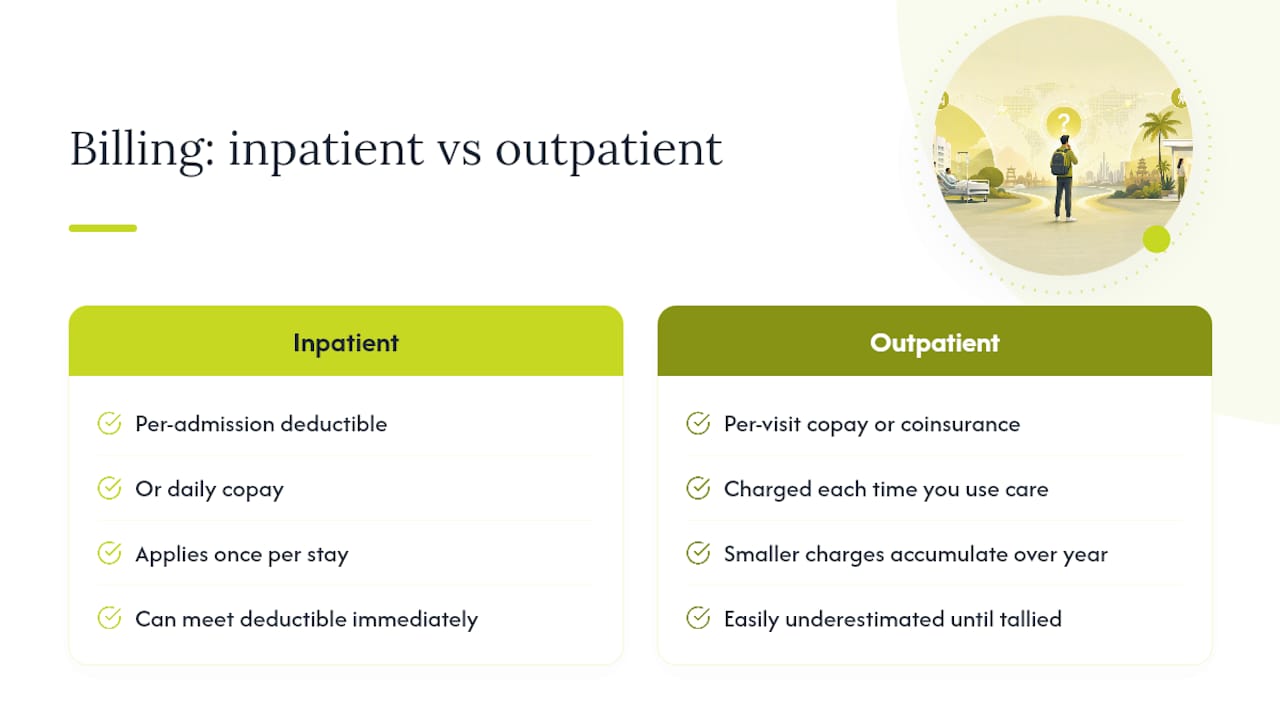
Both types of spending usually count toward your annual out-of-pocket maximum, but the timing and exposure differ. One inpatient admission can hit your deductible in a single bill. Outpatient costs creep up gradually across several smaller visits, which makes them easy to underestimate until you tally the year’s receipts.
Who decides if you’re inpatient or outpatient?
The decision sits with the admitting physician, not with you, the hospital’s front desk, or how long you physically stay. A formal, written admission order is the trigger that shifts billing from outpatient to inpatient rules, and Medicare’s own guidance treats this admission order as the decisive factor in every case it reviews.
Observation status is the practical complication. You can spend a full night under medical supervision and still be billed as outpatient because no admission order was ever issued. Hospitals sometimes screen admissions specifically to control costs, which means the classification isn’t always obvious to the patient in the moment.
- Ask the treating doctor directly: “Have I been formally admitted, or am I under observation?”
- Request written confirmation of your status before you’re discharged.
- Keep any discharge or observation paperwork; it’s your evidence if a claim gets disputed later.
Pro Tip: If your stay crosses a threshold, some hospitals must issue a formal observation notice explaining the outpatient billing consequences. Ask for it by name if it isn’t offered automatically.
Checking your plan and questions to ask before you’re treated
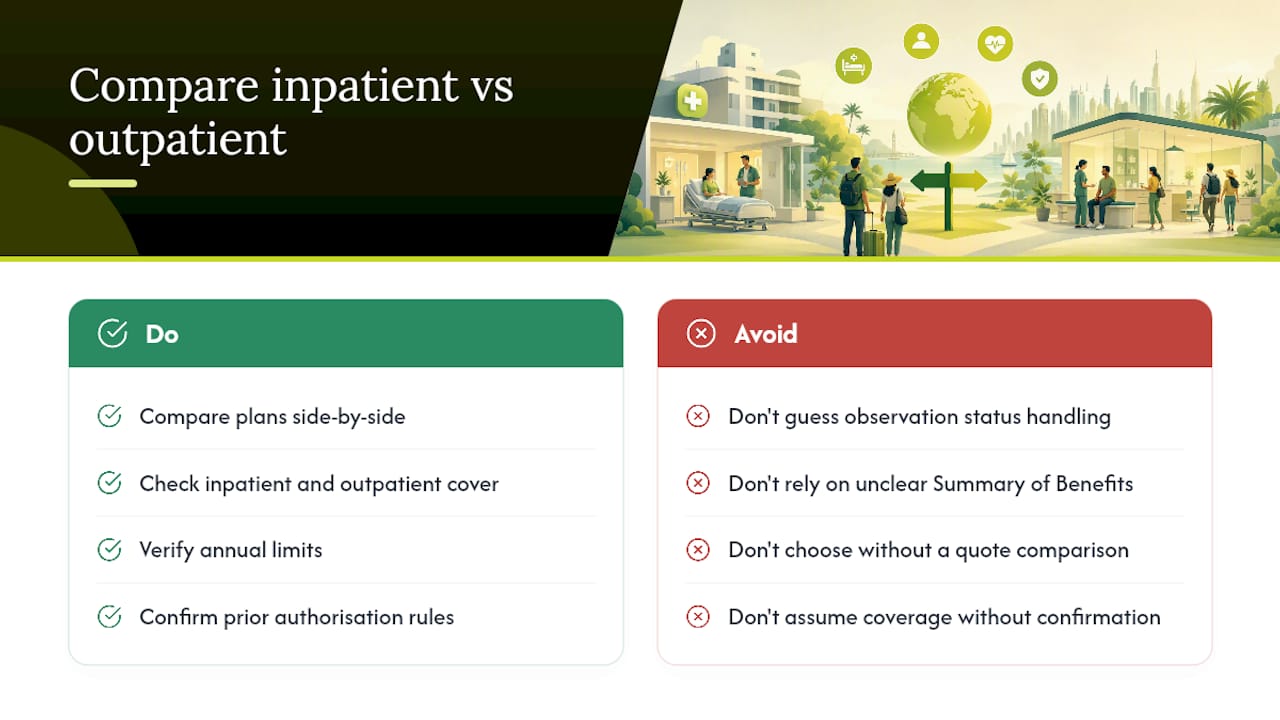
Your Summary of Benefits defines exactly how your insurer draws the inpatient and outpatient line, and it’s worth reading that section before you ever need care, not during a hospital admission.
Before any planned treatment, ask:
- “Am I being formally admitted, or is this an outpatient or observation visit?”
- “Will this procedure be billed as inpatient or outpatient under my policy?”
- “Does this require prior authorisation, and who’s responsible for arranging it?”
- “What’s my deductible or copay for this specific category of care?”
After treatment, record the answers, keep every document, and contact your insurer’s claims team promptly if the billed status doesn’t match what you were told beforehand.
Why the admission order matters more than people realise
Most guidance on inpatient versus outpatient benefits focuses on definitions and stops there. The bigger problem is that the rule sounds simple but the application is genuinely inconsistent between hospitals, and even between departments in the same hospital.
I’d argue the real risk isn’t misunderstanding the categories, it’s assuming your own common sense about “overnight equals inpatient” will hold up at the billing desk. It won’t, reliably. Observation status exists precisely because hospitals and insurers benefit from having a middle category, and the person least equipped to notice the switch is the patient lying in the bed. That’s not a criticism of any single insurer; it’s a structural feature of how modern hospital billing works, and it means the burden of asking the right question, at the right moment, sits with you.
The second underestimated factor is how differently outpatient limits behave across plan types. People shopping on price alone often assume outpatient cover is a minor add-on. For anyone managing a chronic condition, ongoing physiotherapy, or regular specialist reviews abroad, a capped outpatient benefit can end up costing more over a year than the inpatient benefit they never use.
— Coert
Compare plans that cover both inpatient and outpatient care properly
Reading your Summary of Benefits shouldn’t feel like decoding a legal document, and choosing between plans shouldn’t mean guessing which one handles observation status fairly. Our service helps clients compare international plans side by side, so you can see how different policies handle inpatient and outpatient cover, what the annual limits are, and where prior authorisation applies before you ever need to use it.

If you’re weighing up cover for a move abroad, a long-term contract, or extended travel, our International Expat Health Insurance page breaks down plans built to handle both categories without the guesswork. You can also browse expat insurance types if you’re still deciding which level of cover fits your situation, or start with a quote comparison to see options side by side.
Watch this short explainer for a quick visual walkthrough:
Planning a trip for yourself, a resident, or visiting family? UGB + Ekta can arrange travel insurance for seniors up to 100 years old. Just click here: https://ektatraveling.com/?partner_uid=808 and add the promo code “UGB” to receive an additional 10% discount.
This article is general information, not a substitute for advice from a qualified doctor. Consult a qualified healthcare professional about your own circumstances before acting on anything here.
Sources
- Outpatient vs Inpatient Medical Care: Differences, Procedures, More — Healthline
- Inpatient hospital care — Medicare
- Inpatient vs Outpatient hospital status — El Centro Regional Medical Center
- CT scan — Mayo Clinic