
Yes, expats can work in Thailand, but only in employer-sponsored, specialised roles through a Non-Immigrant B visa and work permit. Low-skill and many “protected” occupations remain off-limits to foreigners. Your realistic path is straightforward: target skilled categories where employers actively recruit abroad, confirm your prospective employer can legally sponsor a foreign hire, and search the channels where sponsored vacancies actually appear.
TL;DR:
- Employers must demonstrate compliance with the 4:1 Thai-to-foreign employee ratio and minimum capital requirements for sponsorship, limiting options for small businesses.
- Most in-demand expat roles are in IT, finance, international education, hospitality, healthcare, and senior corporate positions, while low-skill jobs are rarely sponsorable.
- Finding sponsored vacancies requires targeted searches on specialist job boards, recruitment firms, embassy boards, and professional networks, with early sponsorship discussion essential.
- Employer-provided health insurance often lacks portability, so independent expat health plans are recommended to ensure continuous coverage during job changes or for long-term residents.
Table of Contents
- Most in-demand expat jobs in Thailand and who they suit
- Legal requirements: Non-B visa, WP.32 and employer obligations
- Where to find expat jobs in Thailand
- Salary expectations and cost-of-living context
- The employer-sponsorship checklist before you sign
- Why healthcare cover matters once you’re working in Thailand
- What the sponsorship maze actually tells you
- A discreet option for expats sorting out healthcare cover
- Sources
Most in-demand expat jobs in Thailand and who they suit
Thailand’s expat job market rewards specialists, not generalists. Employers hire foreign workers when a role genuinely cannot be filled locally, and the roles that consistently clear that bar cluster into a handful of categories.
- English teaching and international schools. A TEFL certificate or a teaching degree opens doors at international schools and language centres, particularly in Bangkok, Chiang Mai, and coastal tourist hubs. Native-level fluency and a bachelor’s degree are usually the floor requirement.
- IT and software engineering. Bangkok’s tech sector is one of the strongest draws for foreign talent, with demand for developers, cybersecurity specialists, and product managers.
- Finance and accounting. Multinational firms and regional headquarters need qualified accountants, auditors, and finance managers who understand both international standards and Thai regulatory quirks.
- Hospitality and hotel management. International hotel groups recruit experienced general managers, F&B directors, and revenue specialists, especially for five-star properties.
- Healthcare specialists. Clinical roles exist, but they come with a hard requirement: professional licensure and Thai board recognition. A posting for an associate dentist at an expat-focused Bangkok practice makes this explicit, demanding a DMD or DDS plus eligibility for a Thai dental licence before you even apply.
- Senior corporate roles and consultants. Regional director, country manager, and strategy consultant positions are where foreign experience is genuinely valued over local hiring.
- NGOs and embassy posts. Development organisations and diplomatic missions hire foreign staff for programme management, though these roles are competitive and often filled through internal networks.
Key hiring sectors overall include technology, finance, international education, tourism, and manufacturing, according to Michael Page Thailand. Entry-level, unskilled, and clerical roles face a different reality: labour departments reject work permit applications for these categories at a high rate, because the whole point of the sponsorship system is to protect Thai jobs a Thai worker could fill. If your CV doesn’t show a specialised skill, a professional qualification, or years of relevant seniority, expect friction.
Legal requirements: Non-B visa, WP.32 and employer obligations
The legal route into Thai employment runs through the Non-Immigrant B visa combined with a formal work permit. Your employer must sponsor the application and demonstrate the role genuinely cannot be filled by a Thai national. Highly skilled professionals have a second option worth knowing about: the Long-Term Resident (LTR) visa, which offers longer validity and fewer renewal headaches for those who qualify.
The process follows a fixed sequence, and skipping a step simply doesn’t work:
- WP.32 pre-approval. Your employer applies to the Thai labour department for pre-approval before you can even apply for the visa. This is the gatekeeping step, and it’s where most rejections happen.
- Non-B e-visa application. Once WP.32 is approved, you apply for the Non-Immigrant B visa from your home country or a Thai embassy abroad.
- Entry into Thailand. You travel on the Non-B visa, which grants initial entry but not yet the right to work.
- Medical examination. A local medical check is required as part of the work permit process.
- Work permit application. With the medical clearance and Non-B visa in hand, the formal work permit application goes in.
- Visa extension to one year. Once the work permit is issued, your visa status is extended, typically to a one-year renewable period tied to continued employment.
Employers face structural constraints that determine whether they can sponsor you at all. Thai law requires a 4:1 ratio of Thai employees to foreign employees, and the company must hold registered capital of at least 2,000,000 THB per foreign hire, alongside proof of VAT registration and social security contributions. This is why many small businesses, however keen to hire you, simply cannot. Migration specialists note that the primary barrier for most expats isn’t finding an employer who wants to hire them. It’s finding one who is legally structured to sponsor them, according to guidance from Isaacompass.
Rejections at the labour department stage typically trace back to one of two causes: the employer’s paperwork doesn’t meet the ratio or capital thresholds, or the role sits on a list of occupations reserved for Thai nationals. Timing matters too. Because the whole sequence, from WP.32 through to the extended visa, can take several weeks, don’t resign from an existing job or book a one-way flight until the work permit is actually in hand.
Pro Tip: If you lose your job while on a Non-B visa tied to that employer, your legal right to remain is immediately compromised. There’s no grace period built into the system, so you need a new sponsoring employer lined up fast, or you’ll need to change your visa status or leave the country.
Where to find expat jobs in Thailand
Sponsored vacancies don’t advertise themselves the way domestic jobs do, so knowing where to look saves months of dead-end applications.
- Specialist job boards. JobsDB runs a dedicated expat jobs section with many active listings, and it’s among the most reliable starting points for filtering by sector and sponsorship status.
- Global recruiter pages. Recruitment firms with a Thailand presence, such as Michael Page, specialise in placing foreign candidates into finance, tech, and senior corporate roles where employers are already set up to sponsor.
- Expat-focused portals. Sites like Expat Jobs list roles that come with relocation packages, often signalling LTR-eligible positions in Bangkok’s tech and corporate sectors.
- Aggregators for market signals. Checking listings on Glassdoor gives you a rough sense of demand by sector, even when you apply elsewhere.
- LinkedIn. Filtering for Bangkok-based roles and following Thai subsidiaries of multinational firms surfaces postings before they hit general job boards.
- Embassy and consular boards. Many embassies maintain informal job noticeboards or newsletters for their nationals living in Thailand, useful for NGO and diplomatic openings.
- Alumni and professional networks. University alumni groups with a Thailand chapter, and industry associations for teachers, accountants, or healthcare professionals, often circulate sponsored openings before public listings.
When you apply, signal sponsorship readiness early rather than letting it become an awkward late-stage conversation. Mention in your cover letter that you understand the Non-B and work permit process, and ask directly at first contact with HR whether the company has sponsored foreign hires before. A firm that has done it recently will answer that question without hesitation.
Salary expectations and cost-of-living context
Pay varies enormously by sector, and the honest answer to “can I live comfortably in Thailand?” depends heavily on which bracket you land in.
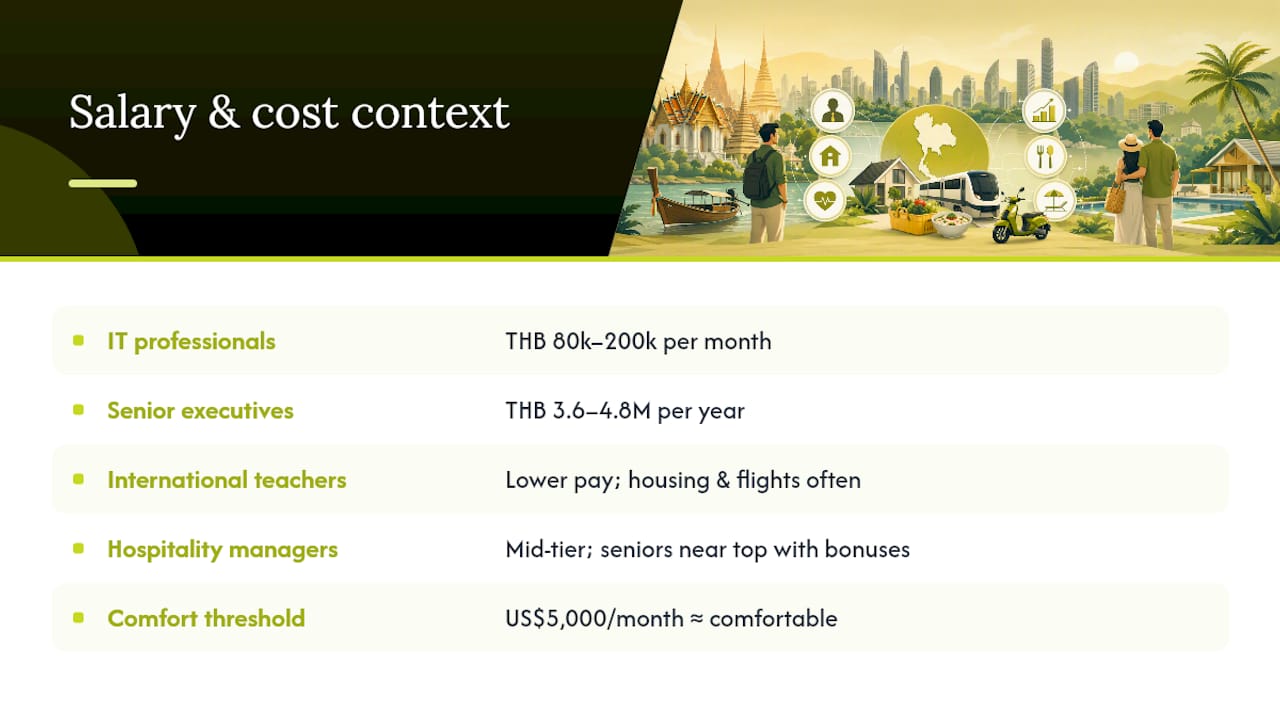
Expat IT professionals in Bangkok typically earn between THB 80,000 and THB 200,000 per month, while senior and executive roles can reach THB 3.6 to 4.8 million per year, according to Michael Page Thailand. Teaching salaries at reputable international schools generally sit lower than corporate roles but often come bundled with housing allowances and flight benefits that offset the gap. Hospitality management pay tracks closer to IT mid-tier, with senior hotel roles pushing toward the top of that range when performance bonuses are included.
A monthly income of $5,000 or its Thai baht equivalent puts you comfortably above the cost of a mid-range Bangkok lifestyle, covering a decent condo, private international school fees for one child if needed, and private healthcare, though international school tuition alone can consume a large share of that budget if you have more than one child. Below that threshold, comfort depends heavily on whether your employer covers housing or health insurance separately, since those two costs move the needle more than any other line item in an expat budget.
Employer benefits change the real value of an offer more than the base salary does. A package with health insurance and a housing allowance can outperform a higher gross salary with none, so ask specifically what’s included before comparing two offers side by side.
The employer-sponsorship checklist before you sign
Before accepting any offer, run through a short verification list. It costs you nothing and it prevents the single most common expat mistake: relocating on the strength of a verbal promise that the paperwork will “sort itself out.”
- Confirm WP.32 readiness. Ask HR directly: has the company obtained WP.32 pre-approval before, and will they handle it for your specific role?
- Verify the 4:1 ratio and capital requirement. A company that’s never sponsored a foreigner may not realise it doesn’t meet the threshold until the application is already filed and rejected.
- Clarify who pays and who processes. Legal fees, agent fees, and the administrative burden should sit with the employer, not you. Get this in writing.
- Prepare your documents early. Degrees, professional licences, references, and a police background check all need certified translation and, in some cases, notarisation before Thai authorities will accept them.
- Raise contract protections in the interview. Ask about probation length, what happens to your visa status if the role ends early, and whether relocation costs are reimbursed if the work permit is delayed or denied.
Pro Tip: Ask for the company’s business registration certificate and its most recent WP.32 approval reference if it has sponsored someone before. A legitimate employer will produce this without pushback, and it’s the fastest way to separate a serious sponsor from one who’s optimistic but unprepared.
For workers in Thailand under alternative arrangements, it’s worth knowing that other countries are experimenting with more flexible options, such as Kuwait’s proposed freelance visa for independent foreign workers. Thailand hasn’t adopted anything equivalent for freelancers, so remote or gig work still typically requires either a separate visa category or working for a foreign employer while physically present on a different visa type, a legal grey area worth discussing with an immigration specialist rather than assuming it’s settled.
Why healthcare cover matters once you’re working in Thailand
Employer-provided health cover in Thailand varies wildly in scope, and it rarely follows you if the job ends or if you need treatment outside the country. That gap is where independent expat health insurance earns its place in your planning, not as a luxury, but as a practical safeguard.
- Portability matters if your contract is short-term. A one-year Non-B visa tied to a single employer means your cover often ends the moment your job does, unless you’ve arranged something independent.
- Pre-existing conditions need checking early. Employer group policies sometimes exclude conditions that a private international plan would cover, so read the fine print before you rely on it.
- Repatriation cover is easy to overlook. Serious illness or injury abroad can require transport home, a cost employer plans frequently don’t include.
- LTR visa holders have different needs than Non-B holders, since longer-term residents often want continuity of cover that survives a job change.
Comparing international expat health insurance options before you relocate, rather than after a claim gets denied, gives you a clearer picture of what your employer’s plan actually covers.
What the sponsorship maze actually tells you
The conventional advice on expat jobs in Thailand tends to overpromise: endless listicles about “dream jobs in paradise” that skip past the part where most applicants get rejected at the WP.32 stage because their prospective employer never checked whether it met the 4:1 ratio. The real bottleneck isn’t your qualifications. It’s whether the company you’re talking to is structurally capable of sponsoring anyone at all.
If there’s one priority worth acting on before anything else, it’s this: ask about sponsorship history in your first conversation with HR, not your final one. A company that has done it before will answer without hesitation. One that hasn’t will start hedging, and that hedge is your warning sign.
Pay yourself a favour, too, and treat the cost-of-living maths honestly. A THB 100,000 salary sounds generous until you’ve priced international school fees and private healthcare into a Bangkok budget. The job market here rewards people who do their homework before they land, not after.
— Coert
A discreet option for expats sorting out healthcare cover
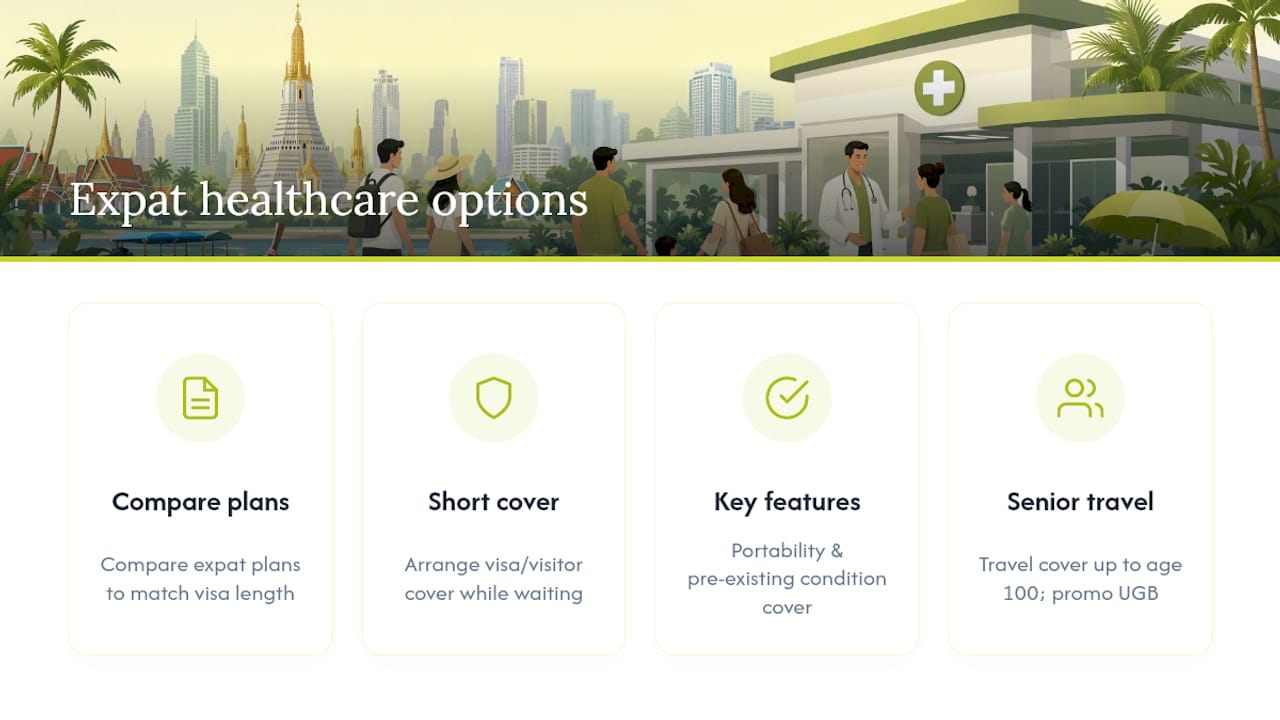
There are practical options available once the visa paperwork is moving and you’re weighing up what your employer’s health plan actually covers versus what you might need to add yourself. Services exist to help you compare international expat health plans side by side and arrange visa-related or visitor cover if you’re still waiting on your work permit to clear.
This isn’t a replacement for your employer’s sponsorship obligations, and it’s entirely optional. But if you want broader protection than a group policy typically offers, particularly around portability and pre-existing conditions, it’s worth a look. Explore the types of expat insurance available and request a comparison of plans that fit your contract length and visa type.
Planning a trip for yourself, a resident, or visiting family? UGB + Ekta can arrange travel insurance for seniors up to 100 years old. Just click here: https://ektatraveling.com/?partner_uid=808 and add the promo code, “UGB”.
For a broader look at the practicalities of relocating and working abroad, this video walks through what to expect:
This article is general information, not a substitute for advice from a qualified lawyer. Consult a qualified legal professional about your own circumstances before acting on anything here.
Sources
- Non-B Visa Thailand 2026: Complete Guide to Work Permits
- Expat jobs in Thailand | Michael Page Thailand
- Expat Jobs in Thailand – Sep 2026 | Jobsdb