
Buy a dental add-on if you have children, need major work like implants or crowns, or live somewhere expensive to treat teeth; otherwise, paying cash abroad is often cheaper. Before you sign anything, check four things: the annual maximum, waiting periods, what’s excluded, and whether pre-authorisation is required.
TL;DR:
- Dental insurance add-ons often have limits on major procedures and exclude cosmetic, orthodontic, and certain implant components, which can impact coverage.
- Comparing policies requires checking the annual maximum, co-insurance impact, waiting periods, pre-authorisation requirements, network rules, and reimbursement timelines for each plan.
- An add-on may only be cost-effective if the total local cash cost of treatments like cleanings and crowns exceeds the annual premium, which can reach several hundred dollars.
- Paying cash is usually cheaper for healthy adults in low-cost countries, short-term visitors, or those comfortable choosing reputable clinics without insurance’s predictability.
- Proper documentation, including written treatment plans, receipts, and clinical notes, is crucial for claim approval, and policies often limit coverage after leaving the treatment country.
Table of Contents
- What does dental cover in an expat health plan actually include?
- A step-by-step checklist for comparing dental add-ons
- Is a dental add-on worth the cost, or should you just pay cash?
- Getting dental care abroad: paperwork that prevents claim denials
- How Unparalleled Global Benefits helps you compare dental add-ons
- Request a personalised dental quote from Unparalleled Global Benefits
- Sources
What does dental cover in an expat health plan actually include?
International plans rarely bundle dental into the base policy. It usually arrives as an optional module, and insurers group benefits into three tiers: preventive (cleanings, check-ups, x-rays), basic (fillings, extractions, root canals), and major (crowns, bridges, implants, dentures). Each tier tends to carry its own limit, and implants and cosmetic procedures are often restricted or excluded entirely, even on plans that otherwise look generous.
Reimbursement mechanics matter as much as the categories themselves. Some insurers pay a flat allowance per procedure; others pay a percentage of an “allowed amount”, which may be lower than what your dentist actually charges. Direct billing, where the clinic invoices the insurer straight away, only works within the insurer’s network. Outside it, you pay upfront and claim later.
Watch for these recurring exclusions when reading a benefits summary:
- Purely cosmetic work (whitening, veneers for appearance rather than function)
- Orthodontics for adults, which many plans exclude or cap heavily
- Implant components split into separate line items (fixture, abutment, crown) that each draw from the same limited pot
Our dedicated piece on dental coverage for expats goes deeper into what specific procedures typically qualify.
A step-by-step checklist for comparing dental add-ons
Reading two policy documents side by side rarely feels like comparing like with like. Insurers use different terms for the same thing, so work through the same six questions for every quote you collect.
- Check the annual maximum and per-procedure sub-limits. A £1,500 annual maximum sounds fine until you learn crowns are capped separately at £300 each.
- Work out how co-insurance affects your bill. If the plan pays 70% of the allowed amount, you’re covering the remaining 30% plus anything above that allowed figure.
- Confirm waiting periods for basic versus major work. Preventive care might be available immediately, while major restorative work often carries a six to twelve month wait, and pre-existing dental issues may be excluded outright.
- Ask exactly when pre-authorisation is required. Most insurers demand it for anything beyond a routine filling, and you’ll usually need a written treatment plan with procedure codes before treatment starts.
- Clarify network rules for your destination country. Direct billing saves you the cash-flow headache of paying a clinic in full and waiting weeks for reimbursement.
- Understand the currency and reimbursement timeline. If your dentist invoices in Thai baht or Mexican pesos, ask whether the insurer converts at the treatment date’s rate and whether certified translations are needed for the paperwork.
Pro Tip: Call the insurer’s claims line before you buy, not after. Ask them to walk you through a hypothetical claim for a crown or filling. How they answer tells you more about the real waiting period and paperwork burden than the policy wording ever will.
Pre-authorisation reduces the risk of denial for costly planned work, though it doesn’t guarantee payment outright. For expats juggling translated documents and unfamiliar procedure codes, that extra step is worth the admin. If you’re also comparing the medical side of your policy at the same time, our guide to comparing medical insurance plans abroad walks through the same logic for hospital and outpatient benefits.
Is a dental add-on worth the cost, or should you just pay cash?
This is where most expats get the decision wrong, usually by assuming insurance is automatically cheaper. It frequently isn’t for routine care.
Dental add-on premiums commonly run tens to low hundreds of dollars a month, depending on the insurer and your region, which puts many plans at several hundred to over a thousand dollars a year before you’ve had a single appointment. Compare that to cash prices in common expat destinations, where a cleaning costs $30 to $70, a crown $250 to $700, and an implant $700 to $1,700.
A useful rule of thumb: if a dental add-on costs $60 a month ($720 a year), price out two cleanings, one filling, and one crown at local cash rates. If that total comes in under $720, the add-on is a poor deal for routine needs alone.
Buying the add-on tends to make sense when:
- You have children who’ll need years of check-ups, sealants, and the occasional filling
- You already know major work (implants, multiple crowns) is coming
- You’re based somewhere genuinely expensive for dental care, or need US-specific coverage
- You want predictable costs rather than a lump-sum bill you’d have to plan around
Paying cash tends to win when:
- You’re a healthy single adult in a lower-cost country
- You’re on a short-term posting and unlikely to need major work
- You’re comfortable researching a reputable clinic and timing routine visits around trips home
Dental tourism sits in between. It can cut costs dramatically, but factor in travel expenses, the risk of needing follow-up care once you’ve left the country, and the time cost of researching a clinic’s credentials properly.
Getting dental care abroad: paperwork that prevents claim denials
The single biggest cause of a rejected dental claim isn’t the treatment itself. It’s missing documentation.
Before you book anything, ask your dentist for a written treatment plan with an itemised estimate: procedure codes, dates, and prices in the local currency. Send that to your insurer and request pre-authorisation in writing, along with a claims checklist so you know exactly what they’ll need afterwards. Ask now whether certified translations are required. Sorting that out after treatment, when you’re also managing recovery, is the wrong time to discover a document needs official translation.
Once treatment is done, keep everything:
- Original receipts and itemised invoices
- Clinical notes, x-rays, and any photos the dentist provides
- The dentist’s full contact details and clinic credentials
Clinics that supply procedure codes, tooth charting, and a narrative treatment rationale alongside the invoice tend to see faster claim approvals, simply because the insurer isn’t left guessing.
Finally, ask what happens if something goes wrong after you’ve returned home. Does the policy cover adjustments, repairs, or a follow-up visit with a different dentist, or does coverage end the moment you leave the treating country? That answer matters more than the premium once you’re actually mid-claim.
How Unparalleled Global Benefits helps you compare dental add-ons
Comparing dental wording across five different insurers by yourself is genuinely tedious, and the stakes are higher than they look. A missed waiting-period clause can mean paying full price for a crown you thought was covered.
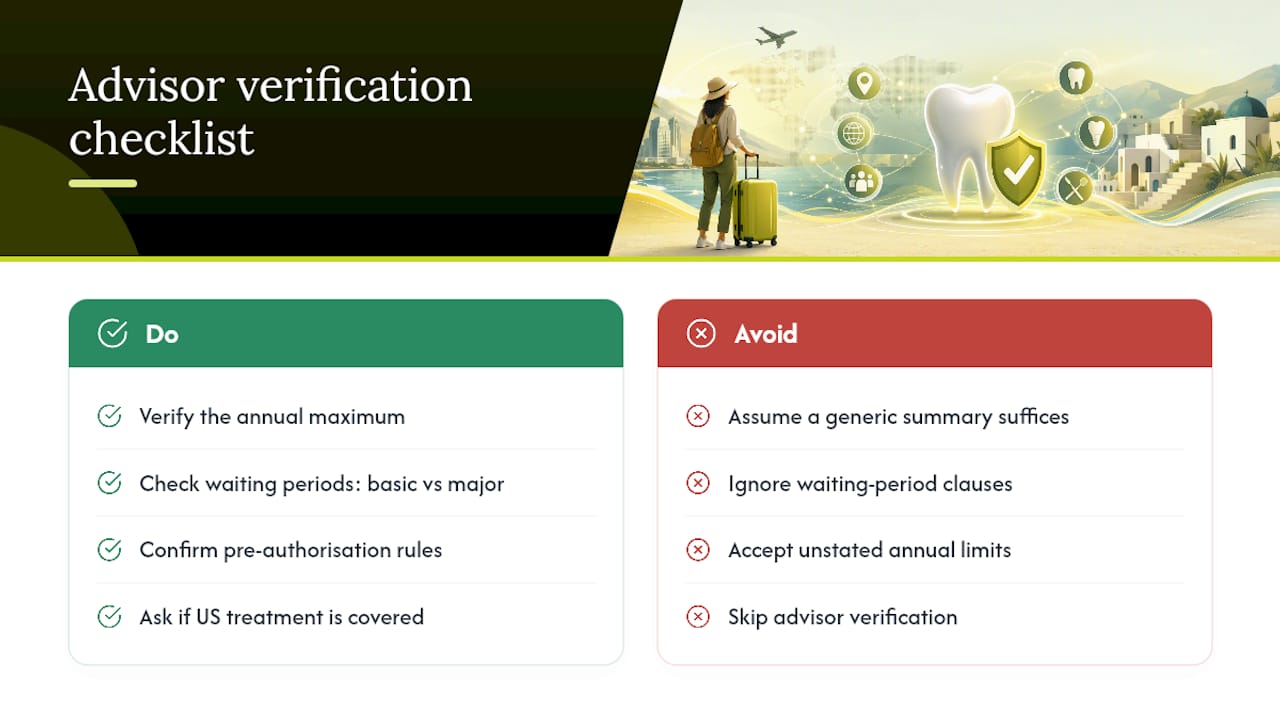
Some companies build guides and comparison support around exactly this problem: dental modules, waiting-period checks, and annual limits, read against your actual situation rather than a generic summary. When you talk to an advisor, they’ll verify the annual maximum, the waiting periods for basic versus major work, the pre-authorisation rules, and whether US treatment is covered if that matters to you.
This short video walks through how expat health plans fit together, including where dental sits in the picture:
.
Planning a trip for yourself, a resident, or visiting family? UGB + Ekta can arrange travel insurance for seniors up to 100 years old. Just click here. https://ektatraveling.com/?partner_uid=808 and add the promo code “UGB” to receive an additional 10% discount.
— Coert
Request a personalised dental quote from Unparalleled Global Benefits
Some services offer an alternative to guessing your way through policy PDFs alone. Instead of cross-referencing five insurers’ dental wording yourself, an advisor checks the module for you: the annual maximum, the waiting periods, the pre-authorisation rules, and whether your destination country has direct billing or requires pay-and-claim.
Have your passport details and, if you already know you need specific treatment, a rough estimate from your dentist ready when you request a quote. That’s enough for an advisor to compare dental add-ons against your actual situation rather than a generic quote. Start with our overview of expat insurance types to see where dental sits among the other modules, then move to international expat health insurance to request a tailored quote and get a straight answer on whether a dental add-on makes sense for you before you commit.
This article is general information, not a substitute for advice from a qualified doctor. Consult a qualified healthcare professional about your own circumstances before acting on anything here.