
Dependent student insurance is coverage that lets a student add a spouse, domestic partner, or child to their university health plan. It is not automatic. Rules on age limits, enrolment timing, and cost vary by institution and country, so the details matter more than the label.
TL;DR:
- Dependents are usually covered under the student’s university plan, and coverage ends if the student drops below enrollment or leaves the program.
- Enrollment and removal of dependents depend on academic calendar deadlines or qualifying life events, such as marriage or birth, which require timely action.
- Coverage often mirrors the student’s benefits but may exclude on-campus clinic access and depend on network restrictions, so checking provider options is crucial.
- Comparing university dependent plans to other options like parental employer plans or private international insurance is essential, especially for portability or special circumstances.
Table of Contents
- What is dependent student insurance, exactly?
- Who typically qualifies as a dependant?
- What does dependent coverage usually include?
- What does dependent coverage actually cost?
- When can you enrol or remove a dependant?
- Should you stay on a parent’s plan instead?
- Your enrolment checklist
- Why families get this wrong more often than you’d expect
- Get a clearer answer on your dependent coverage options
- Where to verify these rules yourself
- Sources
What is dependent student insurance, exactly?
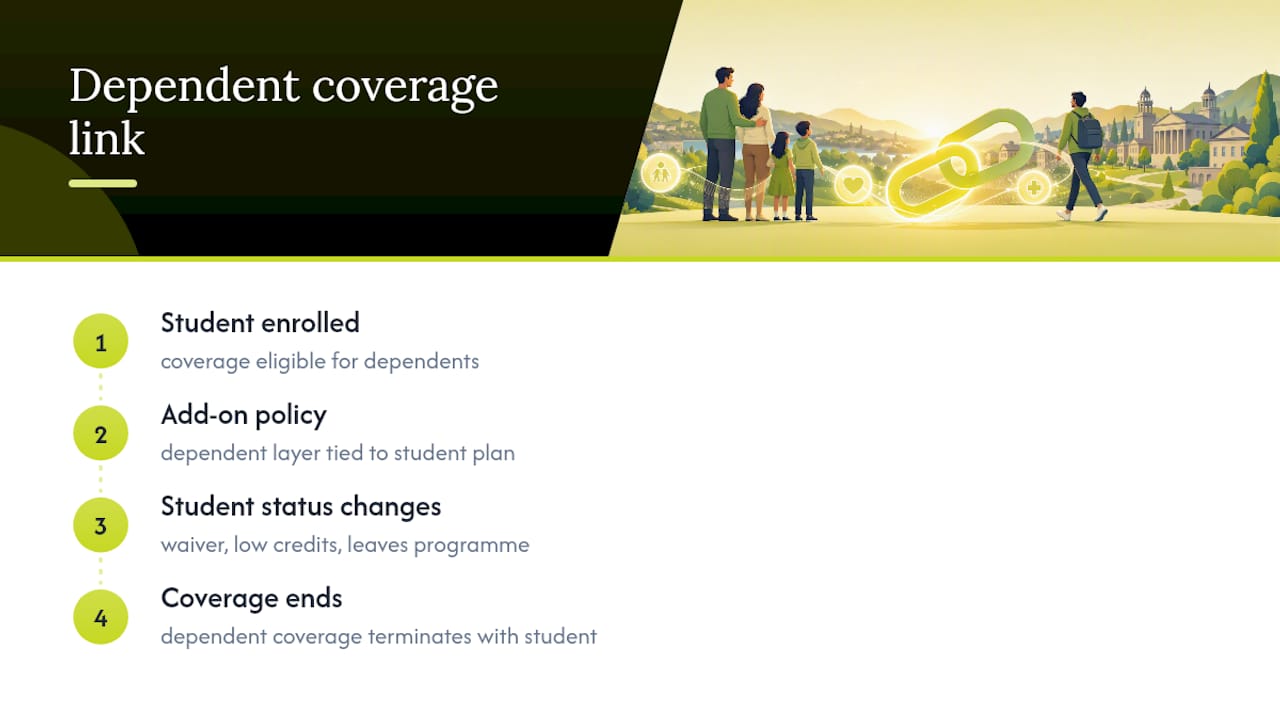
Most university plans treat dependent cover as an add-on layered onto the student’s own policy, not a standalone product a family member can buy alone. In the United States, this arrangement sits within a specific regulatory framework: 45 CFR § 147.145 sets out special rules for group health plans and insurers tied to educational institutions, which is why universities can legally offer coverage linked to enrolment status rather than employment.
That link to enrolment is the part families most often miss. If a student waives their own plan, drops below required credit hours, or leaves the programme, dependent coverage usually ends with it. The dependent policy exists because the student is enrolled, not the other way round. Universities offer these plans partly because federal rules permit the structure and partly because it keeps international and out-of-state students, who often cannot easily access local family cover, from going without insurance while studying.
Who typically qualifies as a dependant?
Eligibility categories are fairly consistent across institutions, though the fine print differs.
- Spouse — a legally married partner, generally with a marriage certificate required at enrolment.
- Registered domestic partner — recognised where the institution or state allows it, typically with a partnership declaration.
- Natural, adopted, or stepchildren — usually covered up to a set age, most commonly 26.
- Disabled adult dependants — some plans extend cover beyond the standard age cut-off with medical documentation.
Age thresholds and paperwork requirements shift between schools, so what applies at one campus will not necessarily apply at another, even within the same country.
What does dependent coverage usually include?
Dependent plans are typically built to mirror the student’s own benefits: inpatient and outpatient care, prescription drugs, and sometimes dental or vision add-ons. On paper, that sounds like full parity. In practice, it rarely is.
- Hospitalisation and outpatient medical visits
- Prescription medication
- Optional dental or vision riders on some plans
- Emergency and urgent care, subject to network rules
Pro Tip: Never assume “same benefits” means “same access.” Check the provider network before you enrol a dependant, not after a claim gets denied.
The gap most families overlook is campus access. Stanford’s plan documentation notes that dependants are expected to use participating network providers and are not eligible for primary care at the on-site Vaden Health Center even though the plan otherwise mirrors student benefits. A dependant covered on paper can still be turned away from the exact clinic the student uses weekly. Read the network and exclusions section of any plan before assuming coverage means access.
What does dependent coverage actually cost?
Dependants are almost always an extra premium the student pays, not a subsidised extension of the student’s own rate. Universities rarely absorb any part of this cost.
Stanford’s 2026–2027 dependent care pricing illustrates the range: roughly $390 a month for a single child, climbing to around $1,514 a month for a spouse plus multiple children. That is not a one-off fee. It repeats every month the dependant stays enrolled, and it is paid directly to the plan administrator rather than bundled into tuition. Duke’s student affairs office publishes similar per-category dependent premiums as another real-world reference point.
Before committing, weigh that monthly figure against what a parent’s employer plan or a private international policy would charge for the same family member. The difference can be substantial.
When can you enrol or remove a dependant?
Enrolment usually follows the academic calendar, not the calendar year, and some systems require re-enrolling dependants every term. UC Berkeley’s health services explain that under its SHIP dependent rules, coverage lapses if not renewed on schedule, and dependants must re-enrol once terminated.
Outside the standard window, a qualifying life event can open a short enrolment period:
- Marriage — typically a 30 to 60 day window to add a spouse after the wedding.
- Birth or adoption — similar short window, often 30 days, to add a new child.
- Loss of other coverage — losing a job-based plan or ageing off a parent’s policy can trigger special enrolment rights.
Pro Tip: Mark the deadline the day the life event happens, not the day you remember it. Missing a qualifying event window usually means waiting until the next open enrolment, sometimes months away.
Should you stay on a parent’s plan instead?
Dependent student insurance is one option among several, and it is not always the cheapest or most practical one.
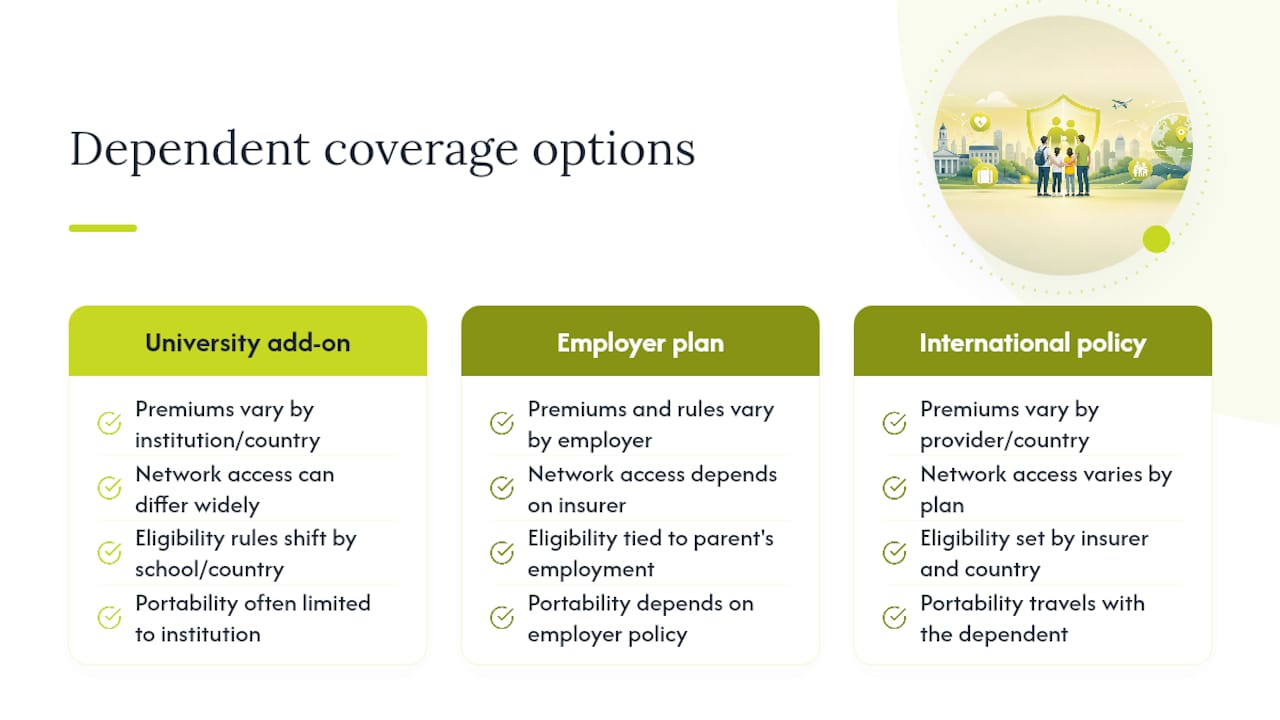
- Parent’s employer plan — often the strongest choice if the network already covers the student’s location and the parent’s employer allows coverage until age 26, as Healthcare is standard for both Marketplace and most employer plans.
- Marketplace or private international cover — better suited when a dependant lives in a different country, needs portability across borders, or the parent’s plan has no network where the student studies.
- University dependent add-on — usually the simplest administratively, since it rides on the same enrolment system as the student’s own policy, though it rarely wins on price.
Decide on cost, network reach, portability, and any visa or residency requirement tied to the dependant’s stay, rather than defaulting to whichever option is easiest to sign up for.
Your enrolment checklist
Before you enrol a dependant or decide against it, work through this shortlist:
- Gather documents — marriage certificate, birth certificate, domestic partnership declaration, or adoption papers, plus government ID, as university offices such as UC Davis commonly require.
- Ask the insurer or administrator three direct questions: What is the enrolment deadline? Can dependants access on-campus clinics? What happens if I waive the student plan?
- Check the deadline, then act — confirm the current open enrolment window or qualifying event deadline, and either enrol the dependant or pursue an alternative such as COBRA continuation if coverage has just lapsed elsewhere.
Why families get this wrong more often than you’d expect
The mistake I see repeated most is treating dependent student insurance as a simple checkbox rather than a contingent, term-by-term commitment. Families enrol a spouse or child assuming the coverage behaves like a normal family policy, then discover mid-year that the student’s own enrolment status controls everything. That is not a hidden trap, it is written into the regulatory structure, but it is buried in plan documents nobody reads until a claim gets denied.
International cases are where this gets genuinely complicated, because currency, visa status, and cross-border network access all stack on top of the usual enrolment rules. That is exactly where a proper comparison against parental cover, Marketplace options, and private international plans pays for itself, and why requesting a personalised quote before enrolment season starts beats reacting after a deadline passes.
— Coert
Get a clearer answer on your dependent coverage options
Comparing a university’s dependent add-on against a parent’s employer plan or a private international policy is not something you can do from a single web page, because premiums, networks, and eligibility rules shift by institution and by country. Some companies work through those comparisons directly with students and families, weighing cost, network access, and portability against specific circumstances rather than a generic template.
If a dependant needs cover that travels with them, whether that is a partner staying behind in another country or a child who needs continuity between terms, selecting the right international insurance provider starts with a proper side-by-side comparison rather than guesswork. Request a personalised quote from providers to see how your options actually compare before an enrolment deadline forces a decision.
Planning a trip for yourself, a resident, or visiting family? UGB + Ekta can arrange travel insurance for seniors up to 100 years old. Just click here : https://ektatraveling.com/?partner_uid=808 and add the promo code “UGB” to receive an additional 10% discount.
Watch this for a broader look at how international cover works:
Where to verify these rules yourself
Plan details change year to year, so verify current figures directly with the source before enrolling. Start with 45 CFR § 147.145 for the regulatory basis, then check your own institution’s published plan page, using Stanford’s, Berkeley’s, or Duke’s as reference formats. Always confirm effective dates, since premium figures and enrolment windows reset annually.
This article is general information, not a substitute for advice from a qualified doctor. Consult a qualified healthcare professional about your own circumstances before acting on anything here.
Sources
- 45 CFR § 147.145 — Special rules for group health plans and health insurance issuers relating to educational institutions
- Healthcare
- SHIP dependents FAQs — University Health Services, UC Berkeley