
Airline ticket insurance typically reimburses your fare when a covered reason, such as illness, a death in the family, or severe weather, stops you flying, and most policies extend that to delay benefits and baggage cover. Standalone travel insurance usually goes further, adding medical treatment and evacuation abroad. Cancel For Any Reason (CFAR) sits on top as an optional upgrade for travellers who want flexibility beyond the named perils. Terms and reimbursement amounts vary sharply between insurers, so read the policy wording before you assume anything is included.
TL;DR:
- Standalone travel insurance generally offers broader coverage, including medical treatment and evacuation, compared to airline-specific protection plans.
- Trip cancellation and interruption benefits only apply to listed reasons, requiring CFAR upgrades for flexible cancellations due to changing plans.
- Exclusions such as known events, geopolitical risks, and pre-existing conditions can significantly limit coverage, especially if not purchased timely or with proper medical disclosures.
- Costs typically range from 4 to 10% of trip expenses, making insurance most worthwhile for trips with substantial deposits, international travel, or limited domestic health coverage.
- Comparing providers and checking policy details before purchase ensures coverage aligns with your specific risks, especially for complex situations or expensive medical needs abroad.
Table of Contents
- What does airline ticket insurance cover in detail?
- Airline add-ons versus standalone travel insurance: which suits your trip?
- What exclusions catch travellers off guard?
- How much does travel insurance cost, and is it worth it?
- Where should you buy cover, and what should you check first?
- What happens when you file a claim?
- Does the policy cover the people travelling with you?
- Are missed connections caused by the airline covered?
- How do policies handle COVID-19 or other contagious illnesses?
- Why does coverage differ so much between insurers and plan types?
- How does your insurance interact with the airline’s own refund policy?
- Can you cancel or get a refund on the insurance policy itself?
- What does Unparalleled Global Benefits bring to this decision?
- Ready to arrange the right cover for your trip?
- Sources
What does airline ticket insurance cover in detail?
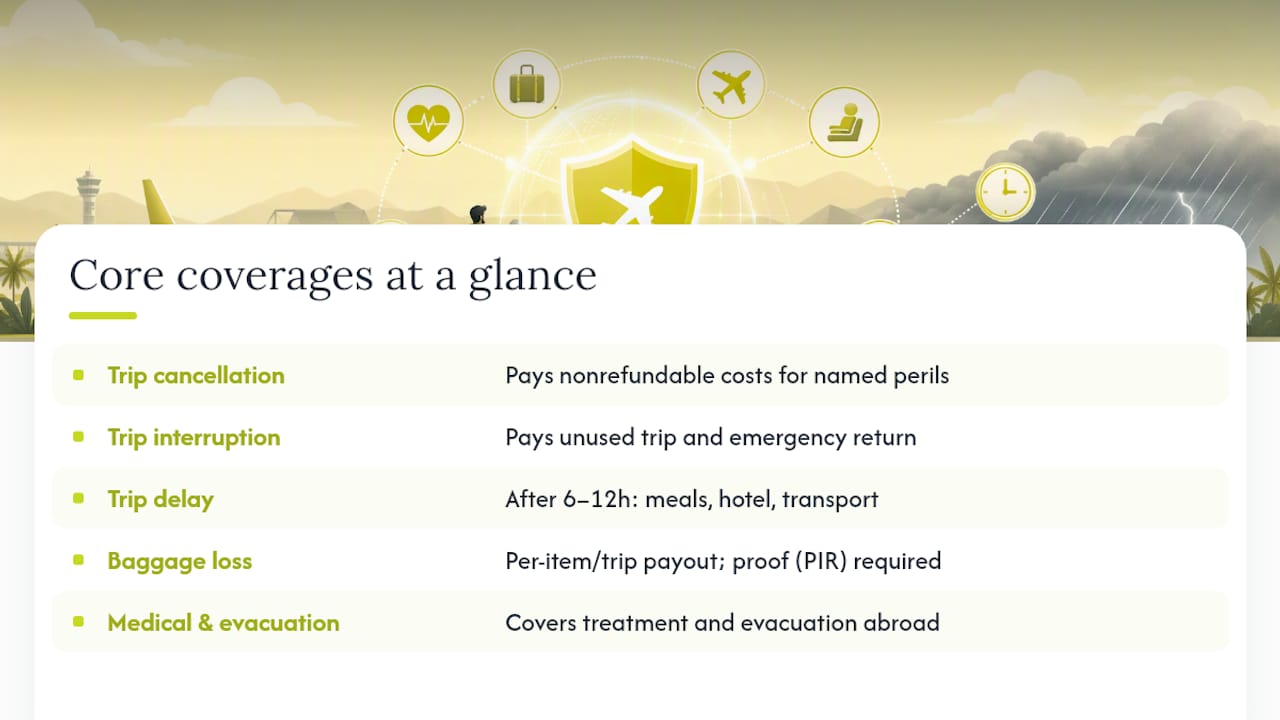
Airline ticket insurance and broader travel insurance policies break down into several distinct benefits, each with its own triggers and payout caps.
Trip cancellation reimburses non-refundable costs when you cancel before departure for a reason the policy lists, such as sudden illness, a family bereavement, or jury duty. This is a named-peril structure: the insurer pays only for the reasons written into the contract, not for a change of heart. If you want to cancel simply because your plans changed, you need a CFAR upgrade, which typically costs more and must be purchased within a tight window of your initial trip deposit.
Trip interruption kicks in once you have already left home. If a covered event cuts your trip short, the policy reimburses the unused portion of your prepaid trip and often covers the cost of an emergency flight home. Imagine you are two days into a ten-day holiday when a parent is hospitalised. Trip interruption cover pays for the unused eight days and the last-minute flight back.
Trip delay benefits activate after a waiting period, commonly between six and twelve hours, and cover reasonable expenses such as meals, a hotel room, and ground transport while you wait. A missed connection that strands you overnight is the classic trigger.
Baggage loss and delay reimburses a set amount per item and per trip once you supply proof, usually a Property Irregularity Report (PIR) filed with the airline. Sentimental items and cash are commonly excluded, and payouts are often depreciated rather than paid at replacement value.
Emergency medical and evacuation cover matters most for international trips, where your domestic health plan may not pay a foreign hospital directly. Evacuation benefits fund transport to the nearest adequate facility, which can run into tens of thousands of dollars without cover. Our guide to emergency medical evacuation explains how these limits work in practice.
Statistic callout: Booking.com’s guidance to travellers notes that trip cancellation, delayed departure, baggage loss or delay, and emergency medical care are the core benefits found across most policies, though the exact scope varies by provider.
Airline add-ons versus standalone travel insurance: which suits your trip?
An airline’s own protection plan and a standalone travel insurance policy solve different problems, even though both get marketed as “flight insurance.”
- Scope: airline add-ons focus on the ticket itself, offering rebooking help or a refund of fare value; standalone policies cover the whole trip, including hotels, tours, and excursions.
- Medical and evacuation: airline plans rarely include either; most standalone policies do, which matters once you leave your home country’s healthcare system.
- Flexibility: airline add-ons are usually cheaper and quicker to buy at checkout, suiting a low-cost domestic flight with little prepaid spend elsewhere.
- Depth of cover: standalone insurance suits international trips with significant non-refundable deposits, where a single cancelled hotel booking could cost more than the flight itself.
Airline protection plans generally focus on the ticket or rebooking support, while standalone travel insurance is built to absorb losses across the entire itinerary. A quick decision rule: if your flight is the only prepaid cost and you are travelling domestically, the airline add-on may be enough. If you have prepaid hotels, tours, or an international itinerary, a standalone policy is the safer bet.
What exclusions catch travellers off guard?
Coverage gaps trip up more claimants than outright denials for fraud. Knowing where the edges of a policy sit saves you a painful surprise later.
- Named-peril timing rules. Insurers only pay for events unforeseen at the time you bought the policy. If a storm is already forecast in the news, buying cover the day before departure will not help; this is the “known event” clause.
- Blanket geopolitical exclusions. War, terrorism, and airspace closures are commonly excluded outright, regardless of how disruptive the event is to your trip.
- Pre-existing condition rules. Chronic illnesses are often excluded unless you buy the policy within a set number of days of your initial deposit and complete a medical questionnaire or waiver.
- CFAR limitations. Cancel For Any Reason riders reimburse only a portion of your trip cost, typically 50 to 75%, and must be bought early, alongside cover for 100% of your prepaid trip.
- Ambiguous wording. Terms like “immediate family” or “reasonable expenses” vary between insurers; some exclude siblings-in-law or cap hotel reimbursement at a low nightly rate.
Pro Tip: Call the insurer’s claims line before you buy and ask them to define one ambiguous term in the policy, such as “immediate family.” Their verbal answer won’t override the contract, but it tells you how strictly they interpret grey areas.
If you have an existing health condition, our guide to travel insurance and medical conditions walks through waiver timing in more detail.
How much does travel insurance cost, and is it worth it?
Premiums typically run 4 to 10% of your total trip cost, influenced by your age, trip length, destination, and whether you add CFAR or a higher medical limit.
It is worth buying when you have substantial non-refundable deposits, you are travelling somewhere your domestic health cover will not follow you, or your credit card’s built-in protection is thin. It is generally not worth it for a fully refundable domestic flight with no other prepaid costs. CFAR sits in between: pricier, but the only route to a partial refund when you simply change your mind.
Where should you buy cover, and what should you check first?
You have four realistic channels: the airline’s checkout add-on, a standalone insurer bought directly, a comparison marketplace, or benefits already bundled into a travel credit card.
- Compare providers before booking. Marketplaces such as Squaremouth let you view covered reasons, limits, and CFAR availability side by side in one search.
- Check the covered-reasons list. Confirm your likely risk, illness, work conflict, family emergency, actually appears.
- Verify medical and evacuation limits. International trips need meaningful figures here, not just trip cancellation.
- Buy early if you want CFAR. Most insurers require purchase within 14 to 21 days of your first trip deposit.
Pro Tip: Save a screenshot of the policy documents the day you buy. Insurers occasionally update wording, and you want proof of what you agreed to.
What happens when you file a claim?
Report a covered event to the airline or provider immediately and get written confirmation, an email counts, a verbal promise does not.
Gather documentation as you go rather than after the trip:
- Original booking receipts and payment confirmation.
- A Property Irregularity Report for any lost or delayed baggage.
- Medical reports or a death certificate for health or bereavement claims.
- Airline delay or cancellation notices with timestamps.
Insurers weight contemporaneous documentation heavily, so a claim filed with receipts and reports from the day of the incident moves faster than one reconstructed weeks later. Most insurers ask for claims within 20 to 90 days of return, with payout decisions taking two to six weeks. If a legitimate claim is denied, ask for the denial reason in writing and escalate to your country’s insurance regulator or ombudsman if the explanation does not match the policy wording.
Does the policy cover the people travelling with you?
Most family or group travel insurance policies extend the same benefits to named companions listed on the same policy, not just the lead traveller who purchased it. That matters because a single triggering event, a child’s fever, a partner’s broken ankle, can cancel or interrupt the trip for everyone booked together.
Check exactly who counts as a covered traveller. Many policies define “family” narrowly: a spouse or partner and dependent children under a set age, often 21 or 26 if in full-time education. Adult siblings, parents, or friends travelling together usually need to be listed individually, each paying their own premium, rather than assumed to be covered under one person’s plan.
Group and family policies typically apply per-person limits within an overall trip cap, so a £10,000 family trip cancellation limit might still cap each traveller’s medical benefit separately. If one family member falls ill and the rest of the group has to cancel as a result, most named-peril policies treat that as a single triggering event covering everyone booked on the same policy number, provided the illness itself is a listed peril. Always confirm this before travelling with extended family or friends, since assuming blanket cover for a large group is, one of the, more common claim disputes insurers report.
Are missed connections caused by the airline covered?
Yes, in most cases, when the missed connection stems from the airline’s own delay rather than your late arrival at the gate. This falls under trip delay or trip interruption benefits, depending on how long the disruption lasts and what it costs you.
If your first flight is delayed and you miss a connecting flight, most travel insurance policies reimburse reasonable costs incurred while you wait for the next available flight, meals, an overnight hotel, and ground transport, once you clear the policy’s waiting period. If the missed connection causes you to lose a portion of your trip entirely, such as a pre-booked tour or the first night of a cruise, trip interruption benefits typically cover that unused, non-refundable cost too.
The distinction that matters is fault. A delay caused by mechanical issues, crew scheduling, or weather affecting the airline’s operations is generally covered. A missed connection caused by your own late arrival at check-in is not. Airlines themselves often provide separate rebooking assistance or minimum connection time guarantees, which can work alongside your insurance rather than instead of it, since the airline’s rebooking help does not typically cover your out-of-pocket meal or hotel costs the way insurance does.
How do policies handle COVID-19 or other contagious illnesses?
Coverage for COVID-19 and similar contagious diseases now varies considerably by insurer and by when the policy was purchased relative to any outbreak. Many insurers added COVID-19 as a named, covered illness following the pandemic, treating a positive test the same way they would treat flu or another qualifying sickness for trip cancellation and interruption purposes.
That said, the details differ. Some policies only pay out if you test positive before departure and can produce a medical certificate; others also cover quarantine costs if you test positive during the trip and must extend your stay. Emergency medical benefits generally extend to COVID-19 treatment abroad the same way they cover any other sudden illness, subject to your policy’s overall medical limit.
Where travellers get caught out is assuming blanket cover for any pandemic-related disruption. Government-ordered border closures or blanket travel bans are often treated under the same geopolitical exclusion language that applies to war and airspace closures, which can leave a gap between “you personally tested positive” (usually covered) and “your destination closed its border to your entire country” (often excluded). Always check the policy’s specific epidemic or pandemic clause rather than assuming COVID-19 is treated identically across every provider.
Why does coverage differ so much between insurers and plan types?
Two policies marketed as “comprehensive travel insurance” can have meaningfully different protections, because insurers set their own named-peril lists, payout caps, and waiting periods independently. There is no single industry standard that forces every provider to cover the same reasons or pay the same amounts.
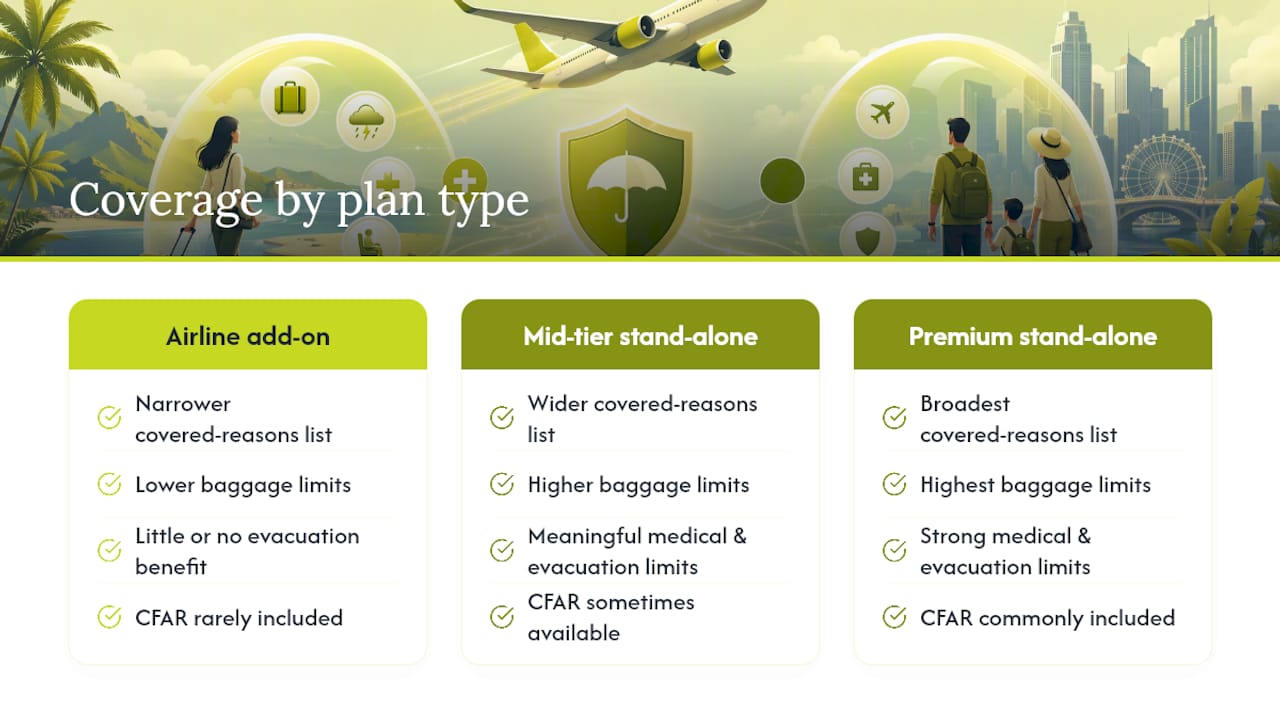
Basic or budget plans, often the ones bundled as airline checkout add-ons, tend to offer narrower covered-reasons lists, lower baggage limits, and little or no medical evacuation benefit. Mid-tier standalone policies typically widen the covered-reasons list and add meaningful medical and evacuation limits. Premium plans add CFAR, higher per-person caps, and sometimes cancel-if-your-workplace-changes-your-leave type clauses that budget plans never include.
Plan type also shifts what counts as a covered reason. Some insurers treat a supplier’s bankruptcy (an airline or tour operator going under) as a covered peril; others exclude it entirely. Some cover rental car damage within the same policy; others sell that separately. This is exactly why comparing the covered-reasons list, not just the headline price, matters more than picking whichever plan appears first in a search result.
How does your insurance interact with the airline’s own refund policy?
Insurance and airline refund policy work as two separate layers, and understanding which one applies first avoids a wasted claim. If the airline cancels your flight outright, most airlines owe you a refund or rebooking directly under their own conditions of carriage, regardless of whether you bought insurance. In that scenario, your travel insurance is not the first line of recourse.
Travel insurance becomes relevant when the airline does not owe you anything: you cancelled for a personal covered reason, the airline only offered a credit rather than cash, or your loss extends beyond the ticket to hotels and tours the airline has no obligation to reimburse. Insurers typically require you to first pursue whatever the airline offers, then claim the remaining, uncovered gap from your policy. Filing an insurance claim without first requesting the airline’s own refund or credit is, one of the, more common reasons a claim gets delayed or reduced.
Where this gets genuinely useful is with credit vouchers. If the airline only offers a future travel credit rather than a cash refund, and your covered reason means you cannot realistically use that credit, some policies will reimburse the difference. Read your policy’s coordination-of-benefits clause carefully here, since it dictates exactly what the insurer expects you to claim from the airline first.
Can you cancel or get a refund on the insurance policy itself?
Most travel insurance policies include a “free look” period, commonly 10 to 15 days after purchase, during which you can cancel for a full refund provided you have not yet started your trip or filed a claim. This exists precisely so you can read the full policy wording after buying it and back out if the covered-reasons list does not match your needs.
Outside that free look window, refunds get harder. If your trip itself is cancelled entirely, and it happens before departure with no claim filed, many insurers will refund the premium or offer a credit toward a future policy, though this is provider-specific rather than guaranteed. Once you have travelled, even partially, or once a claim has been filed, the premium is typically non-refundable regardless of the reason.
This is another area where plan type matters: some premium-tier policies build in more generous cancellation terms for the insurance itself as a selling point, while budget plans and airline add-ons often treat the premium as forfeited the moment you complete the checkout purchase. Read this clause before buying if you tend to book flexible trips that shift dates frequently.
What does Unparalleled Global Benefits bring to this decision?
Choosing the right cover means matching the policy to your actual risk, not the cheapest add-on at checkout. Specialized providers work with travellers who need more than a basic named-peril list: visa-specific requirements, pre-existing condition waivers, and medical evacuation limits that actually match the cost of care abroad.
Complex situations, an expat renewing visa-mandated cover, a traveller managing a chronic condition, a family needing evacuation limits that reflect real hospital costs overseas, deserve more than a checkout tick-box. This short explainer covers how travel medical protection fits into a wider trip plan, and our guide to medical evacuation and repatriation goes further into the limits that matter most.
Planning a trip for yourself, a resident, or visiting family? UGB + Ekta can arrange travel insurance for seniors up to 100 years old. Just click here: https://ektatraveling.com/?partner_uid=808 and add the promo code “UGB” to receive an additional 10% discount.
— Coert
Ready to arrange the right cover for your trip?
Once you know what airline ticket insurance covers and where the gaps sit, the next step is matching a policy to your actual trip risk, not settling for whatever the airline offers at checkout. Some insurance arrangers provide travel and expat medical insurance built around real situations: pre-existing conditions, visa-mandated cover, and medical evacuation limits sized to where you are actually travelling, rather than a generic named-peril list that stops short of what international healthcare really costs.
If your trip involves costly treatment abroad, such as overseas dental work, the gap between an airline add-on and proper medical cover becomes obvious fast. Start by reading our complete guide to international health insurance to see how the coverage tiers compare, then request a quote directly through a specialized service to get limits matched to your itinerary. And if you are arranging cover for a parent or older relative, UGB and Ekta can set up travel insurance for seniors up to 100 years old: use this booking link and apply the promo code “UGB” for an additional 10% off. For a closer look at how this all fits together, this video walkthrough is worth five minutes of your time before you buy.
This article is general information, not a substitute for advice from a qualified financial advisor. Consult a qualified financial professional about your own circumstances before acting on anything here.
Sources
- How to buy travel insurance
- Travel Insurance 101: When It’s Worth Buying and How to Find the Best Policies
- Ultimate guide to travel insurance for complex times
- Travel Insurance vs Airline Protection Plans