
The three non-negotiables for any family heading abroad are these: buy travel medical cover with genuine evacuation limits alongside trip protection, purchase it early enough to secure pre-existing condition waivers, and prepare full medical and policy documentation for every traveller. Get those three right and everything else on this family pre-departure insurance checklist falls into place.
TL;DR:
- Families should buy travel insurance early within 14 to 21 days of the first trip deposit to secure pre-existing condition waivers and certain add-ons.
- Policies must specify high medical and evacuation limits, include air ambulance cover, and be fully disclosed with complete medical documentation for claims.
- Coverage for seniors, long stays, and adventure activities requires tailored plans with explicit activity riders and visa-compliant medical wording.
- Carry printed and digital copies of policy, medical summaries, and travel documents, and report incidents promptly to avoid claim delays and policy voidance.
- Verify destination entry rules and current official guidance, and avoid relying on the cheapest policies or incomplete declarations to prevent claim rejections.
Table of Contents
- Family pre-departure insurance checklist: the one-page summary
- What does each line of family travel insurance actually cover?
- When should you buy family travel insurance to lock in waivers?
- What must you declare, and how do you prepare medical documentation?
- Do seniors, long stays and adventure activities need extra cover?
- What should you carry, and what’s the first move in an emergency?
- What’s left to check in the final 24 to 72 hours before you fly?
- Why families still get this wrong even when they think they’re covered
- How Unparalleledglobalbenefits arranges family and senior travel cover
- Where to check official rules before you travel
- Sources
Family pre-departure insurance checklist: the one-page summary
Print this before you do anything else. It groups the essentials so nothing critical slips through while you’re juggling packing lists and passport renewals.
- Insurance essentials: confirm medical limits are high enough for your destination, evacuation and air ambulance are included, every family member is named on the policy, and there’s a 24/7 emergency helpline number saved in your phone.
- Documents: policy number, insurer PDFs downloaded offline, passports with six months’ validity, and a GHIC or EHIC if you’re travelling in Europe.
- Health: vaccinations up to date, a written medication list per traveller, and translated medical records if you have a chronic condition.
- Timing: buy within 14 to 21 days of your first trip payment to qualify for pre-existing condition waivers, and decide on Cancel For Any Reason cover early.
- Practical tasks: notify your bank of travel dates, photograph or copy every document, and leave your itinerary with someone at home.
What does each line of family travel insurance actually cover?
Travel medical insurance and trip protection solve two different problems, and confusing them is the most common mistake families make. Travel medical pays for emergency treatment, hospital stays, and getting you home safely if something goes wrong physically. Trip protection reimburses money you lose when the trip itself falls apart, cancelled flights, a missed connection, a family member falling ill before departure. Family-focused guides note that most bundled family plans include both, but the limits within each vary enormously between providers.
Evacuation and air ambulance cover deserves specific attention rather than a passing glance. Emergency medical evacuation from a remote region or a country with limited hospital infrastructure can run into tens of thousands of pounds if you’re paying out of pocket. A policy with a low evacuation cap looks fine on paper until you’re the family actually needing the helicopter.
For trip cancellation and interruption, insure the full prepaid cost of the trip, not a rounded-down estimate. Covered reasons typically include illness, a family bereavement, or your airline cancelling a flight outright.
Pro Tip: Check whether your policy allows one parent to remain with a hospitalised child under a single claim. Some family plans build this in explicitly, and it removes one huge logistical headache during an already stressful moment.
Cancel For Any Reason cover helps families who book far in advance and want flexibility beyond the standard list of covered reasons. It typically reimburses 50 to 75% of prepaid costs rather than the full amount, and it costs more, so weigh that trade-off against how likely you are to actually cancel.
Baggage delay and personal liability cover round out a family policy. Expect modest payouts here, often capped per item and per bag, so don’t rely on this line to replace anything genuinely valuable.
When should you buy family travel insurance to lock in waivers?
Buy the moment you make your first non-refundable trip payment. Most insurers set a 14 to 21 day window from that first payment for pre-existing condition waivers to apply, and missing it means any flare-up of an existing condition simply isn’t covered.
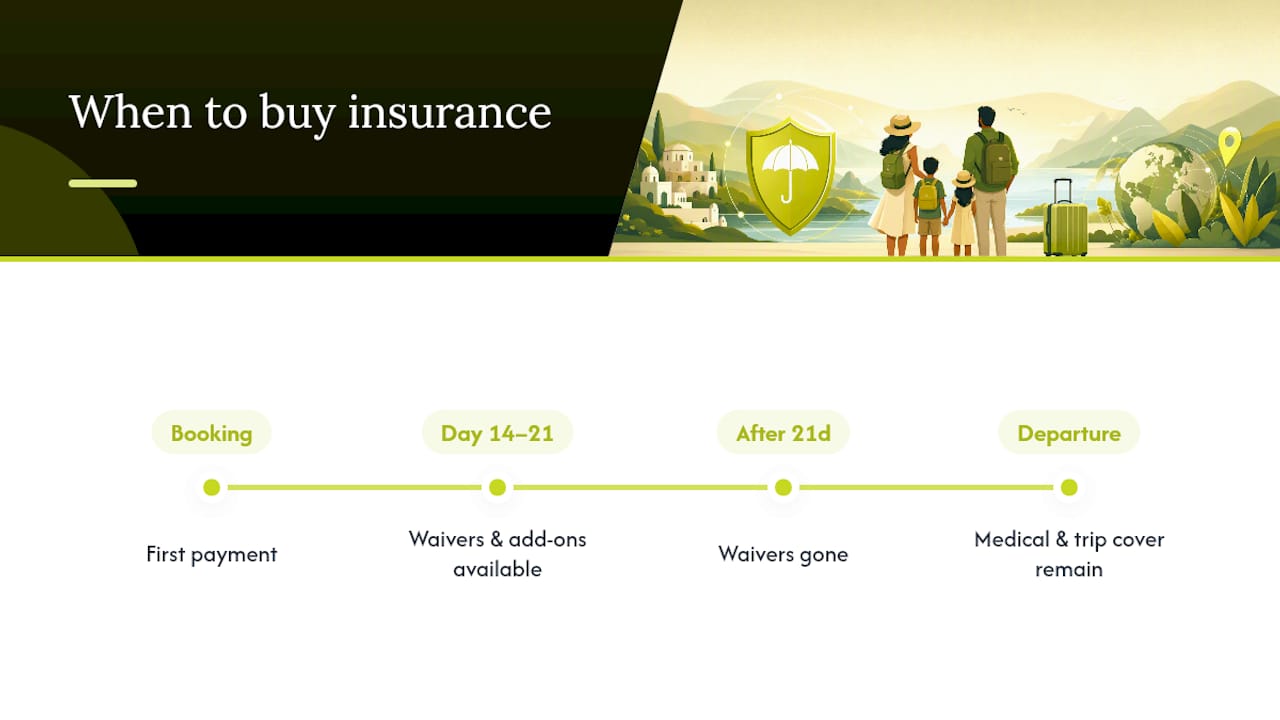
The same early window often protects your access to Cancel For Any Reason add-ons and certain pandemic-related riders, both of which tend to disappear as departure approaches. Buying close to departure isn’t pointless, you can still get solid medical and trip cover, but your choice of add-ons narrows fast. Early buyers simply get the fuller menu.
What must you declare, and how do you prepare medical documentation?
Insurers need full disclosure to honour a claim later, and half-declared conditions are the single biggest reason family claims get contested. Declare these before you buy:
- Chronic illnesses (asthma, diabetes, heart conditions) for every named traveller.
- Recent tests, referrals, or hospital admissions, even ones that seemed minor.
- Current medications and dosages.
- Pregnancies, including expected due date if travelling while pregnant.
- Mental health conditions under active treatment.
Prepare a one-page medical summary per traveller: condition, medication, dosage, GP contact, and allergies. If you’re heading somewhere non-English-speaking, get it translated. A medical records translation service handles this properly, and the NHS guidance on travelling with medicines covers what to carry for prescription items. If you’re claiming, collect receipts, hospital notes, and police reports immediately, and phone your insurer’s helpline before you do anything else.
Do seniors, long stays and adventure activities need extra cover?
Travelling with grandparents, an extended stay, or a day of ziplining all push you outside a standard policy, and each needs its own check.

Seniors typically face medical screening questions and sometimes age-banded limits, though bespoke solutions exist for older travellers, Unparalleledglobalbenefits can arrange cover for seniors up to 100 years old. Long stays or visa-required trips usually demand full medical underwriting and specific wording that satisfies the visa office, so check minimum cover limits against the embassy’s stated figure, not just what feels reasonable. Adventure sports and hiring vehicles abroad are where families get caught out most often. Insurance basics guidance points out that “adventure” isn’t a universal category, scuba diving, skiing, or quad biking might each need a separate rider, so check the insurer’s specific activity list rather than assuming broad wording covers you.
What should you carry, and what’s the first move in an emergency?
Carry printed and digital copies of your policy number, the 24/7 helpline, passports, and each traveller’s medical summary. Store a duplicate set in the cloud, and keep a small folder in your hand luggage, then tell older children where it lives.
If something happens: call local emergency services first, then your insurer’s helpline, then the embassy or consulate if it’s serious. Collect receipts and medical reports as you go, and report the claim to your insurer as early as possible rather than waiting until you’re home.
- Insurers commonly require a police report for theft or traffic incidents within a strict timeframe, and cover can be voided if scene-of-incident requirements, such as a breath test, aren’t completed.
- One overlooked detail costs families more claims delays than any other: reporting late.
What’s left to check in the final 24 to 72 hours before you fly?
Run this sequence the day before departure, not the week before:
- Confirm policy dates, destinations, and every named traveller match your actual itinerary.
- Save the insurer’s helpline and your policy number into every adult’s phone.
- Pack prescription medicines in hand luggage with printed medical summaries.
- Check entry requirements: visas, required vaccines, and your GHIC or EHIC status for the destination.
- Confirm bank cards work abroad and send your itinerary and policy details to someone staying home.
The GOV.UK foreign travel checklist covers the government side of this list well, researching the destination and getting insured before you go sit right at the top of it.
Why families still get this wrong even when they think they’re covered
Most families don’t fail because they skip insurance altogether, they fail because they buy the cheapest bundle, declare nothing, and assume the small print won’t matter. It usually matters most for the family that assumed it wouldn’t. The waiver window is the clearest example: a 14 to 21 day rule sounds bureaucratic until a grandparent’s heart condition flares up on day four of the trip and the claim gets declined for a technicality nobody read.
The other pattern worth naming is that families often buy trip protection generously and medical cover thinly, when it should be the reverse. A cancelled flight is annoying. An uninsured air ambulance bill is financially catastrophic. If Unparalleledglobalbenefits can help with anything beyond the policy paperwork, it’s steering that balance the right way round, alongside sorting waiver timing, senior screening questions, and visa wording that satisfies an embassy rather than just sounding official. Faster claims liaison and straight answers on exclusions matter more than another glossy comparison chart. If this list feels like a lot to manage alone, requesting a tailored quote is a reasonable next move, not an admission of defeat.
— Coert
How Unparalleledglobalbenefits arranges family and senior travel cover
Unparalleledglobalbenefits works as a direct broker rather than a faceless comparison site, meaning you speak to someone who can actually explain why one policy’s evacuation limit beats another’s, not just which one’s cheapest this week. That matters most for the parts of this checklist families find hardest: matching medical limits to a destination, timing a purchase to catch pre-existing waivers, and getting visa-compliant wording right on the first attempt.

Families travelling with elderly relatives get particular attention here. Unparalleledglobalbenefits arranges travel insurance for seniors well beyond the age limits many standard policies impose, and if you’re planning a trip for yourself, a resident, or visiting family, UGB and Ekta can arrange travel insurance for seniors up to 100 years old. Just click here: Ekta Traveling and add the promo code “UGB” to receive an additional 10% discount.
Watch this short explainer for a walk-through of what to check before you buy:
If you’re weighing up whether you need travel medical, trip protection, or both, the travel health insurance guide breaks down the practical differences by trip type. When you’re ready, request a tailored quote directly through Unparalleledglobalbenefits and get a policy matched to your family’s actual itinerary, not a generic bundle.
Where to check official rules before you travel
Verify country-specific advice and entry requirements directly with official sources rather than relying on secondhand summaries:
- Gov for destination warnings and entry rules.
- NHS: Apply for a GHIC for European healthcare access.
- Insurer policy documents for exact waiver windows and exclusions specific to your plan.
This article is general information, not a substitute for advice from a qualified doctor. Consult a qualified healthcare professional about your own circumstances before acting on anything here.
Sources
- The ultimate travel checklist for travel insurance (2026) – Travel Checklist
- The ultimate guide to family travel insurance — The Blonde Abroad