
Some vaccines are legally required for entry into a country; most others are simply recommended to protect your own health. The single most useful thing you can do right now is check your destination’s official rules and book a travel health consultation at least 4 to 6 weeks before you depart, giving multi-dose vaccines time to take effect.
TL;DR:
- Most required vaccines, like yellow fever and meningococcal, need to be booked at least 4 to 6 weeks before travel to ensure full effectiveness and valid proof.
- Yellow fever vaccination becomes valid only 10 days after administration, so early booking is essential for compliance with entry requirements.
- Recommended vaccines such as hepatitis A, typhoid, and rabies require months to complete full courses, but accelerated schedules can sometimes shorten this timeline.
- Always verify country-specific vaccine mandates through official sources like WHO or destination embassies, as rules can change unexpectedly.
- Special considerations apply for pregnant travelers, infants under 6 months, and pilgrims, who may face restrictions or additional requirements for live vaccines and timing.
Table of Contents
- What does “required” actually mean for travel vaccines?
- How far ahead should you book each travel vaccine?
- How do you check country-specific vaccine rules and carry valid proof?
- Where should you get travel vaccines, and how do you book?
- Who needs extra care: pregnancy, infants, and pilgrims
- How Unparalleledglobalbenefits supports your travel health preparation
- A last-minute traveller’s checklist
- Insurance that backs up your vaccine planning
- Where to verify vaccine rules yourself
- Sources
What does “required” actually mean for travel vaccines?
A required vaccine is a legal condition of entry, not a suggestion your GP makes. Fail to show proof, and border officials can turn you away or quarantine you on arrival, regardless of how healthy you feel.

Yellow fever is the clearest example. Numerous countries across sub-Saharan Africa and South America demand proof of vaccination before they will stamp your passport, and that proof only becomes valid 10 days after the jab is administered, not the day you receive it. Meningococcal vaccination works the same way for anyone attending Hajj or Umrah in Saudi Arabia. Polio vaccination certificates are occasionally demanded from travellers who have recently spent time in countries with active transmission.
Recommended vaccines sit in a different category entirely, and dismissing them because they are not compulsory is a mistake. Hepatitis A, typhoid, and rabies protect against genuine risks in many destinations that no immigration officer will ever ask you about.
- Required: yellow fever, meningococcal (Hajj/Umrah), certain polio certificates
- Recommended: hepatitis A, typhoid, rabies pre-exposure, Japanese encephalitis, tick-borne encephalitis
Entry rules tell you what a government demands. They tell you almost nothing about your actual health risk on the ground, which depends on your itinerary, accommodation, and how much time you’ll spend outside tourist areas.
How far ahead should you book each travel vaccine?
Timing is where most travellers come unstuck, usually because they leave everything until the week before departure. Building proper immunity, and completing multi-dose courses, takes longer than most people assume.
Pro Tip: Several travel vaccines can be given at the same appointment, and there’s no medical limit on how many you receive at once, which is exactly why a single consultation 4 to 6 weeks out is usually enough to cover everything.
- Yellow fever: single dose, but proof isn’t valid until 10 days after vaccination
- Hepatitis A: two doses, ideally 6 to 12 months apart, though one dose gives partial short-term protection
- Hepatitis B: standard three-dose course over several months, though accelerated schedules exist
- Typhoid: oral or injectable course, with faster options available for last-minute trips
- Rabies (pre-exposure): two or three doses depending on schedule chosen
- Meningococcal: single dose, required for Hajj/Umrah pilgrims
- Japanese encephalitis: two doses, spaced weeks apart
- Tick-borne encephalitis: multi-dose course, relevant for parts of Europe and Asia
- Polio and influenza: often a single booster, but flu timing matters for pilgrimage travel specifically
The CDC Yellow Book lists minimum intervals for each of these, and accelerated schedules exist for several, including Japanese encephalitis, some rabies courses, and typhoid. Yellow fever is the exception: no accelerated route shortens that fixed 10-day validity window, so it deserves the earliest booking of the lot.
How do you check country-specific vaccine rules and carry valid proof?
Never rely on a travel forum or a booking agent’s blog for entry rules. Vaccine mandates change, sometimes with little warning, and only official sources track those changes reliably.
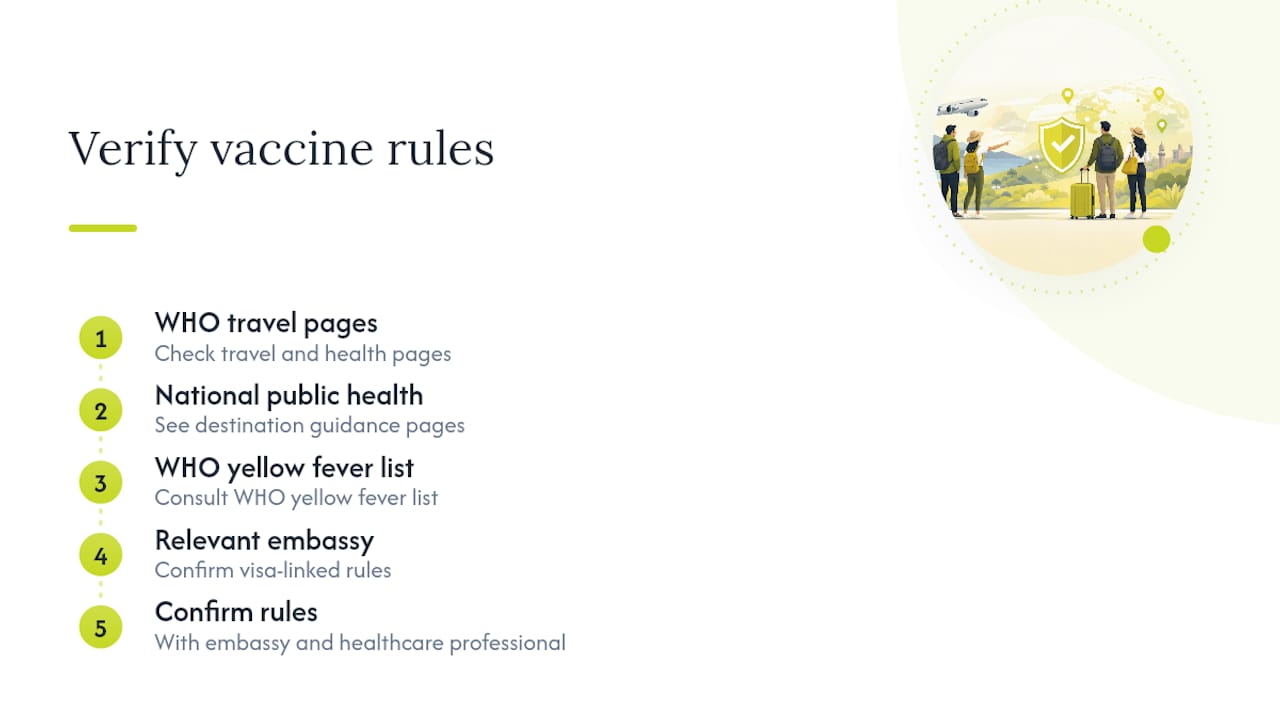
- Start with the WHO’s country-level guidance, which lists yellow fever risk areas and entry mandates by country.
- Cross-check against your national public health authority’s destination pages, since some countries add rules WHO doesn’t track in real time.
- Confirm any visa-linked vaccine conditions directly with the destination’s embassy or consulate, particularly for pilgrimage or work visas.
- Carry your International Certificate of Vaccination or Prophylaxis, the “yellow card”, as physical proof; some border posts still refuse digital copies.
Stopovers catch people out constantly. A layover in a yellow fever risk country, even for a few hours, can trigger an entry requirement at your final destination that wouldn’t apply if you’d flown direct. Check your full routing, not just your final stop.
Where should you get travel vaccines, and how do you book?
Not every vaccine is available everywhere. Your GP can usually handle routine boosters and hepatitis A, but yellow fever can only be administered at an authorised yellow fever vaccination centre, and rabies pre-exposure courses are sometimes restricted to specialist travel clinics that stock the vaccine regularly.
- Book 4 to 6 weeks ahead wherever possible, and call yellow fever centres early since appointment slots fill quickly in peak season
- If you’re travelling within days, ask specifically about accelerated schedules rather than assuming you’ve missed the window entirely
- Bring your immunisation records, full itinerary, and a brief medical history to the appointment so the clinician can tailor recommendations properly
Our guide to finding an authorised travel vaccination centre walks through what to expect at that first appointment, and our travel vaccine clinic guide covers how specialist clinics differ from a standard GP surgery.
Who needs extra care: pregnancy, infants, and pilgrims
Standard timing advice doesn’t apply evenly to everyone, and some groups face real medical restrictions rather than mere caution. Live vaccines carry the most significant limits.
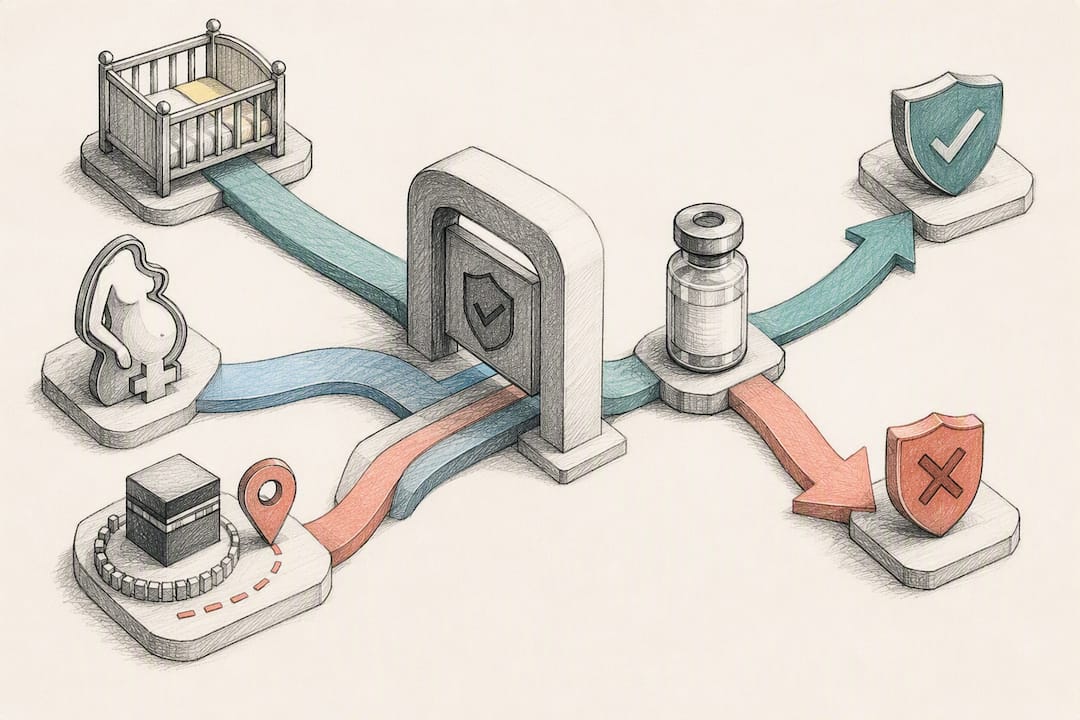
Yellow fever vaccine is contraindicated in infants under 6 months and in people with certain immunocompromised conditions, so a specialist may recommend a medical waiver letter instead of the jab itself when travel to a required-entry country is unavoidable. Pregnant travellers face similar case-by-case decisions on several live vaccines.
Pilgrims heading to Hajj or Umrah face distinct rules: Saudi Arabia requires meningococcal vaccination and recommends seasonal influenza be given at least 10 days before arrival for pilgrims and health workers alike.
- Infants under 6 months: yellow fever contraindicated, seek specialist guidance
- Pregnant travellers: case-by-case decisions on live vaccines
- Immunocompromised travellers: may need waivers or delayed travel
- Hajj/Umrah pilgrims: meningococcal required, influenza timing matters
How Unparalleledglobalbenefits supports your travel health preparation
Vaccines protect your body. Insurance protects your budget when something still goes wrong despite doing everything right, and the two work best planned together, not as an afterthought.
- Guidance on finding authorised vaccination centres and specialist clinics for 2026 travel
- Background reading on routine vaccines and travel planning alongside your itinerary
- Support connecting travellers to insurance that covers treatment and evacuation if illness strikes abroad
Watch this short explainer for a quick overview:
Planning a trip for yourself, a resident, or visiting family? UGB + Ekta can arrange travel insurance for seniors up to 100 years old. Just click here: https://ektatraveling.com/?partner_uid=808 and add the promo code “UGB” to receive an additional 10% discount.
A last-minute traveller’s checklist
If your flight is days away, not weeks, here’s the honest order of operations: check destination rules first, book the nearest travel clinic today, bring your immunisation records, update routine jabs while you’re there, and buy travel medical cover before you board. Ask specifically about accelerated schedules; several vaccines allow them, and a same-day referral to a yellow fever centre can still save your trip.
— Coert
Insurance that backs up your vaccine planning
Vaccines reduce your risk; they don’t eliminate the cost of a hospital stay, a medical evacuation, or a missed connection because you fell ill abroad. Unparalleledglobalbenefits exists for exactly that gap: cover designed for travellers and expats who’ve done the health prep and still want a financial safety net if things go wrong anyway.
Our international health insurance guide breaks down what treatment, repatriation, and evacuation cover typically includes, and how it complements rather than replaces the vaccines you’ve just booked. If you’re heading off soon, request a quote and get a plan matched to your itinerary before you fly, not after something happens.
Where to verify vaccine rules yourself
Check the WHO’s travel and health pages, your national public health authority’s destination pages, and the WHO yellow fever country list. Confirm visa-linked rules with the relevant embassy.
This article is general information, not a substitute for advice from a qualified doctor. Consult a qualified healthcare professional about your own circumstances before acting on anything here.
Sources
- Travel vaccines | CDC
- Yellow fever and travel | CDC Yellow Book
- Saudi Public Health Authority Hajj vaccination requirements