
For most expats settling abroad, appropriately scoped IPMI (international private medical insurance) beats a travel or nomad plan, unless the stay is genuinely short. The single biggest cost lever is whether the policy includes United States treatment, which can raise premiums by 40 to 80 percent. Get at least two quotes built on identical specifications before you decide anything else.
TL;DR:
- Including treatment in the United States significantly raises premiums by 40 to 80 percent, so only add US coverage if necessary for your situation.
- For relocations lasting more than a year, comprehensive IPMI typically offers better value and coverage than travel or hybrid plans, especially for pre-existing conditions.
- Always compare quotes based on identical specifications, focusing on premiums, deductibles, coverage limits, and exclusions to avoid misleading differences in cost.
- Choosing regional or excluding US coverage can save money, but it may limit your options if your travel or work extend beyond your initial area.
- Verifying insurer stability and direct billing networks before purchasing ensures claims are paid promptly and reduces the risk of unexpected bills.
Table of Contents
- How to go compare private health insurance: choosing the right product type
- Eight price and coverage factors to compare on any quote
- What happens if you have a pre-existing condition?
- How direct billing protects you from huge upfront bills
- Step-by-step: how to get comparable quotes
- What mistakes trip people up when comparing plans?
- Worldwide, worldwide excluding US, or regional: which area of cover?
- When should you rely on local public healthcare instead?
- What does private health insurance abroad typically cost?
- How do you check an insurer’s financial stability?
- How good is the insurer’s customer support and claims service?
- How do you tailor coverage to your specific situation?
- A broker’s honest take on comparing cover properly
- How Unparalleledglobalbenefits helps you compare and buy
- Sources
How to go compare private health insurance: choosing the right product type
Comparing quotes only works if you’re comparing the right product in the first place. Three families dominate this market, and mixing them up is the most expensive mistake expats make.
IPMI is the comprehensive option, built for people relocating for a year or more. It typically covers inpatient and outpatient care, ongoing prescriptions, and often maternity or dental as add-ons, with underwriting that follows you across borders. Costs generally sit between US$150 and $600 a month, depending on age and area of cover.
Travel medical insurance exists for trips, not relocations. It’s cheap, fast to buy, and covers emergencies and repatriation, but it rarely extends to routine care, ongoing conditions, or anything resembling a life abroad.
Nomad or hybrid plans, the SafetyWing-style products, sit in between. They’re month-to-month, low-cost, and built for mobility, which suits digital nomads and short-term contractors, but they don’t replace IPMI once you have pre-existing conditions or plan to settle.
The gaps that catch people out are consistent:
- Outpatient consultations excluded or capped low on budget travel plans
- Maternity cover requiring a waiting period most travellers never meet
- Mental health treatment frequently excluded entirely, even on mid-tier IPMI
Eight price and coverage factors to compare on any quote
Two quotes that look similar on price can differ enormously in what they actually pay out. These are the levers that move the number most.
Age band and entry age. Premiums climb sharply after 55, and some insurers cap new entrants at 65 or 70. Applying earlier locks in a lower baseline.
Area of cover. This is the biggest swing factor on the entire quote.
US treatment adds 40 to 80 percent to premiums. Insurers price the United States separately because hospital costs there dwarf the rest of the world. Only pay for it if you actually need it.
Other factors worth lining up side by side:
- Deductible or excess level, which trades a lower monthly premium for higher out-of-pocket risk
- Annual or lifetime claim limits, particularly for cancer treatment or long hospital stays
- Family versus single cover, where bundling children often costs less per head
- Add-ons like dental, maternity and evacuation, priced separately on most plans
- Renewal terms and whether your premium can jump at a set age band
- Entry-age rules that determine whether you can even apply later in life
As a rough guide, annual premiums for a healthy adult expat land somewhere between US$2,500 and $7,000 depending on age, region and whether the US is included. A deductible primer is worth reading before you commit to a figure, since it changes both your premium and your exposure in a bad year.
What happens if you have a pre-existing condition?
Insurers handle prior health conditions through one of three underwriting approaches, and the one your policy uses determines whether an old diagnosis comes back to bite you.
Full medical underwriting asks for your complete history upfront and prices or excludes conditions individually. Moratorium underwriting skips the paperwork but automatically excludes anything treated in the past two or five years until you’ve gone symptom free for a set period, commonly 12 to 24 months. Medical-history-disregarded cover exists but is rare and expensive.
The practical effect: a moratorium clock doesn’t start until the policy does, so a condition flagged in month three of a two-year moratorium still won’t be covered in month eighteen unless you’ve been treatment-free throughout that window.
- Apply for cover while you’re healthy, ideally before symptoms appear on any record
- Disclose everything, even conditions that feel minor or resolved
- Keep copies of treatment dates and outcomes in case an insurer asks later
Pro Tip: Applying for IPMI during an active flare-up almost always results in either a flat exclusion or a declined application. Secure cover in a quiet period and let the moratorium run its course before you actually need it.
How direct billing protects you from huge upfront bills
The clause that matters most in an emergency isn’t the premium. It’s whether your insurer pays the hospital directly or expects you to pay first and claim later.
Direct billing means the insurer settles with the hospital, so you never see a bill for major treatment. Reimbursement means you cover the cost yourself, sometimes tens of thousands of dollars, and wait for repayment. Large IPMI providers typically maintain extensive direct-billing networks with app-based claims submission, and that network strength varies enormously by country.
Before you buy, ask the insurer directly:
- Do you have a direct-billing agreement with hospitals near where I’ll live?
- What’s your average claim turnaround time for reimbursed expenses?
- Is emergency medical evacuation included, and does it require pre-authorisation?
- Can I check network coverage for my specific city before I commit?
A vague answer to any of these is worth treating as a warning sign, not a technicality.
Step-by-step: how to get comparable quotes
Comparing plans only works if every quote answers the same brief. Insurers price wildly different things under the same headline premium unless you force consistency.
- Write down one specification: your age, country of residence, deductible preference, whether you need maternity or dental, and whether the US is included.
- Send that exact specification to at least two providers or brokers, changing nothing between requests.
- Line up four numbers for each quote: monthly premium, deductible, annual limit and the list of exclusions.
- Check waiting periods and moratorium terms against your own health history before ranking anything.
- Score each quote against your own priorities, whether that’s price, network strength or how pre-existing conditions are handled, rather than defaulting to the biggest name.
- Buy directly if the top quote fully matches your needs, or bring in a broker if anything is ambiguous.
Pro Tip: Requesting quotes on a single, identical specification is the one habit that stops you comparing a Range Rover against a bicycle and calling it fair.
For a deeper walk-through of this process, our guide on how to compare medical insurance plans abroad covers sample comparison tables in more detail.
What mistakes trip people up when comparing plans?
The costliest errors are rarely about picking the wrong insurer. They’re about picking the wrong category of plan entirely.
- Buying travel insurance for what is actually a permanent relocation, then discovering it excludes routine care
- Ignoring the moratorium clock and assuming a condition disclosed later will be covered immediately
- Skipping the network check and finding out your nearest direct-billing hospital is three hours away
Red flags to watch for including a claims process nobody can explain clearly, no named hospitals in your area, and premium surcharges that appear suddenly at renewal with no clear justification. If you spot any of these, ask for it in writing before you sign anything, and if the answer doesn’t arrive promptly, treat that silence as your answer.
Worldwide, worldwide excluding US, or regional: which area of cover?
Area of cover is the single biggest structural decision on any policy, and it’s worth understanding before you look at a single price.
Worldwide cover includes the United States and costs the most, reflecting how expensive US hospital treatment is compared with almost anywhere else. Choose this only if you live in the US, visit regularly, or want the flexibility of unrestricted travel there for work or family.
Worldwide excluding US covers you everywhere else on the planet, from Southeast Asia to South America to most of Europe, at a meaningfully lower premium. This is the default choice for the majority of expats who have no regular reason to seek treatment stateside.
Regional cover narrows things further, insuring you within a defined zone such as Europe, Asia or the Americas excluding the US. It’s the cheapest of the three and works well for people whose life is genuinely anchored to one continent, but it becomes a liability the moment your work or family life crosses into a different region without warning.
The mistake here isn’t picking the wrong tier. It’s picking a tier based on where you live today without accounting for where you might travel over the life of the policy. A regional plan bought for convenience now can leave you exposed on a work trip eighteen months later.
When should you rely on local public healthcare instead?
Not every expat needs private cover, and pretending otherwise wastes money. The right call depends on where you live, how long you’re staying, and what your residency status actually entitles you to.
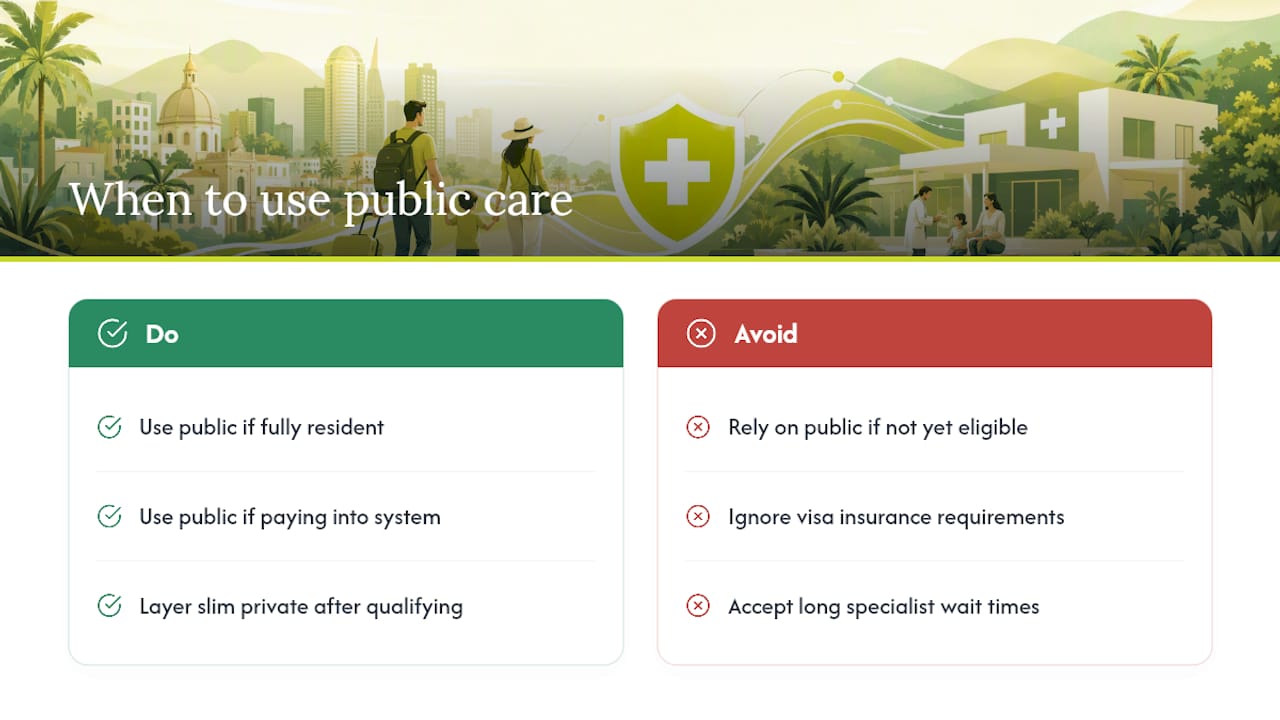
If you’ve secured full residency in a country with a strong public system, such as several in Western Europe, and you’re paying into that system through payroll contributions or local taxes, public cover may genuinely be enough for day-to-day care. The catch is access: many public systems require months of residency before you qualify, and even then, specialist waiting lists can stretch far longer than a private policy would ever allow.
International or private cover becomes the better call in a handful of situations: you’re not yet eligible for the public system, your visa requires proof of private insurance as a condition of entry, you want access to English-speaking doctors or specific specialists, or you simply can’t tolerate the waiting times a public system involves for anything beyond emergencies.
Many long-term expats end up running both: public cover as a baseline once they qualify, with a slimmer private policy layered on top for speed and specialist access. That combination isn’t available to everyone, particularly newer arrivals, but it’s worth asking about once you’ve settled somewhere for a year or two.
What does private health insurance abroad typically cost?
Price bands vary by product family, and the range within IPMI alone is wide enough to catch people off guard.
Nomad and travel medical plans sit at the bottom, often costing under US$100 a month for a young, healthy traveller, but they carry the coverage gaps already outlined for outpatient and ongoing care. Mid-tier IPMI without US cover typically runs US$150 to $400 a month for a working-age adult, while comprehensive plans with maternity, dental and a low deductible push toward the upper end of that range or beyond.
Annually, that translates to roughly US$2,500 to $7,000 a year for most expats on a solid mid-tier plan, before US cover is added. Once US treatment is included, expect premiums to jump by 40 to 80 percent, which can push an otherwise mid-range policy well past US$10,000 annually for older applicants or families.

The value gap between budget and premium plans isn’t constant across age groups either. Pricing differences between providers tend to narrow as applicants get older, which means younger buyers see the widest spread between a bare-bones nomad plan and full IPMI, while those over 50 often find the price difference far less dramatic relative to the coverage gained.
How do you check an insurer’s financial stability?
A cheap premium means nothing if the insurer can’t pay a six-figure hospital bill when it matters. Reputation and financial strength deserve as much scrutiny as price.
Start with how long the insurer has operated in the international market specifically, not just domestically. A provider with a decade or more of expat-focused business has weathered claims cycles that newer entrants haven’t. Independent market comparisons that group providers into premium, mid-tier and budget tiers are a useful starting point, since tier placement usually reflects claims-paying track record as much as price.
Look for publicly available claims-payment ratios or complaint statistics where regulators publish them, and check whether the insurer is regulated in a jurisdiction with real oversight rather than an offshore registration with minimal reporting requirements. Genuine customer reviews, particularly ones describing an actual claim rather than the buying process, tell you more than star ratings alone.
Ask brokers or the insurer directly how claims were handled during a period of unusually high demand, and whether the company has ever failed to pay a legitimate claim on technical grounds. A confident, specific answer is reassuring. A vague one is a reason to keep shopping.
How good is the insurer’s customer support and claims service?
Support quality only reveals itself when something goes wrong, which is exactly when you need it most. Testing it before you buy is worth the ten minutes it takes.
Call or message the insurer’s support line before purchasing, ideally outside standard office hours, and see how long it takes to reach a human. Genuine 24/7 multilingual support is a real differentiator among larger IPMI providers, and it matters enormously if you’re calling from a time zone eight hours removed from head office during a medical emergency.
Ask specifically how claims are submitted, whether through an app, a portal or email, and how long a typical reimbursement takes to process. Providers offering app-based claims submission alongside strong direct-billing networks tend to resolve claims faster and with less paperwork friction than those still relying on scanned forms and postal submissions.
Read recent reviews with an eye specifically for claims disputes rather than sales experience, since a smooth quote process tells you nothing about what happens when you actually need the policy to perform.
How do you tailor coverage to your specific situation?
A generic policy built for an average expat rarely fits your actual life. A few adjustments make the difference between adequate cover and cover that quietly fails you.
Digital nomads moving between countries every few months should prioritise a plan with broad geographic flexibility over one tied to a single country of residence, since visa and tax rules often follow where you spend the most time, not where your policy is registered. Families should check whether newborns are automatically covered from birth or require a separate application within a tight window, a detail that catches new parents abroad more often than it should.
Students on visa-mandated cover need to confirm the policy actually satisfies their specific visa’s insurance requirements, since generic travel plans sometimes fall short of what immigration authorities demand. Au pairs and young professionals on tighter budgets might reasonably start with a nomad-style plan and upgrade to IPMI once income stabilises, a pairing worth discussing directly with a broker rather than assuming one plan must do everything.
Older travellers or those visiting elderly relatives abroad often need cover with a higher entry-age cap and fewer restrictions on pre-existing conditions than a standard traveller policy allows.
A broker’s honest take on comparing cover properly
Most readers overthink the provider and underthink the specification. Get your age, deductible preference, area of cover and family situation locked down first, then request two comparable quotes. If you’re moving for under a year, a nomad plan usually makes more financial sense than IPMI. If you’re settling, buy IPMI before you leave, not after you arrive, because entry ages and moratoria reward early applicants far more than late ones.
— Coert
How Unparalleledglobalbenefits helps you compare and buy
Unparalleledglobalbenefits gives you a genuine shortcut past the specification headache: we build your comparison around one consistent brief, then match it against real IPMI, travel and nomad options rather than pushing a single insurer’s product. That means you see comparable quotes side by side, tailored to your actual move date, age band and area of cover, with straightforward guidance on where the US uplift is worth paying and where it isn’t.
We work on a referral basis, earning a commission from partner insurers when a policy completes, which costs you nothing extra and keeps our recommendations focused on fit rather than upsell. Start by requesting a quote through our international health insurance guide, and our team will walk you through the specification before anything gets sent to insurers.
Planning a trip for yourself, a resident, or visiting family? UGB + Ekta can arrange travel insurance for seniors up to 100 years old. Just click here. ektatraveling.com and add the promo code “UGB”%.
For a closer look at how these plans work day to day, watch this short explainer:
Sources
- International Health Insurance for Expats: Complete Guide (2026) | WhereNext
- International health insurance guide (Expatica)
- International Health Insurance Provider Comparison Matrix (2026) | Compare Expat Plans
This article is general information, not a substitute for advice from a qualified doctor. Consult a qualified healthcare professional about your own circumstances before acting on anything here.