
If you’re heading abroad for a short trip, travel insurance covers you. If you’re relocating for work, study, or family life, you need international private medical insurance (IPMI), which handles ongoing and comprehensive care rather than emergencies alone. Before you compare a single quote, check your visa or university’s insurance minimums and request a compliance letter. Missing that step is the single most common reason applications get rejected.
Here’s where to start:
- Short trip (weeks to a few months)? Travel medical insurance is usually sufficient.
- Moving abroad, studying long-term, or relocating with family? You need IPMI.
- Unsure which your visa or university demands? Ask for written compliance requirements first.
Unparalleledglobalbenefits can help you compare both types side by side and request the compliance documentation your institution or embassy expects.
Key Takeaways
Choosing the right policy comes down to matching product type to trip length, securing visa or university compliance evidence early, and comparing total cost rather than premium alone.
| Point | Details |
|---|---|
| Match product to trip length | Use travel insurance for short stays; switch to IPMI for long-term relocation, study, or family life abroad. |
| Get compliance evidence first | Request a visa or university compliance letter before comparing quotes to avoid rejection at application stage. |
| Watch the USA cost impact | Including the USA in your coverage area can raise premiums by roughly 40 to 80%. |
| Enrol before age cut-offs | Many insurers cap new entry around 65 to 75; renewal is usually guaranteed once you’re enrolled. |
| Compare with Unparalleledglobalbenefits | Unparalleledglobalbenefits arranges tailored quotes and compliance letters across student, expat, nomad, and family plans. |
Table of Contents
- How do you compare medical insurance plans properly?
- What should each type of traveller check first?
- How do you actually buy the right policy, step by step?
- How does Unparalleledglobalbenefits make comparison easier?
- Why does compliance matter more than price?
- Compare your options and get a compliant quote today
- Sources
How do you compare medical insurance plans properly?
Comparing quotes on price alone is how people end up under insured in a country where a single hospital admission can cost more than a year’s premium. Work through these seven checks before you sign anything.
- Coverage type and duration. Match the product to the trip: travel insurance for a defined short stay, IPMI for anything open ended or longer than six to twelve months.
- Coverage area. Decide between worldwide, worldwide excluding the USA, or a regional plan. Including the United States typically adds 40 to 80% to your premium because of the cost of American healthcare, so exclude it if you genuinely don’t need it.
- Pre-existing condition handling. Insurers typically use one of three approaches: a moratorium (conditions covered after a waiting period), permanent exclusion, or individual underwriting.
- Deductible and coinsurance. A lower monthly premium with a high excess can cost more overall if you claim even once.
- Policy maximums. Check the annual and per-condition caps, not just the headline benefit list.
- Network and direct billing. Confirm the insurer has hospitals in the city you’ll actually use, and that they bill the hospital directly rather than making you pay upfront.
- Evacuation and repatriation limits. These matter most in regions with thin local specialist care.
Before locking in a plan, also gather your visa or university’s compliance evidence and confirm the policy start date lines up with your travel or enrolment date. Our seven-factor comparison guide walks through each of these in more depth.
Pro Tip: Ask the insurer, in writing, whether they issue a formal compliance or waiver letter before you pay. Some do it as standard; others treat it as a separate admin request that can take days to process, which is a problem if your visa deadline is close.
What should each type of traveller check first?
The checklist above applies to everyone, but the item that matters most depends entirely on your situation.
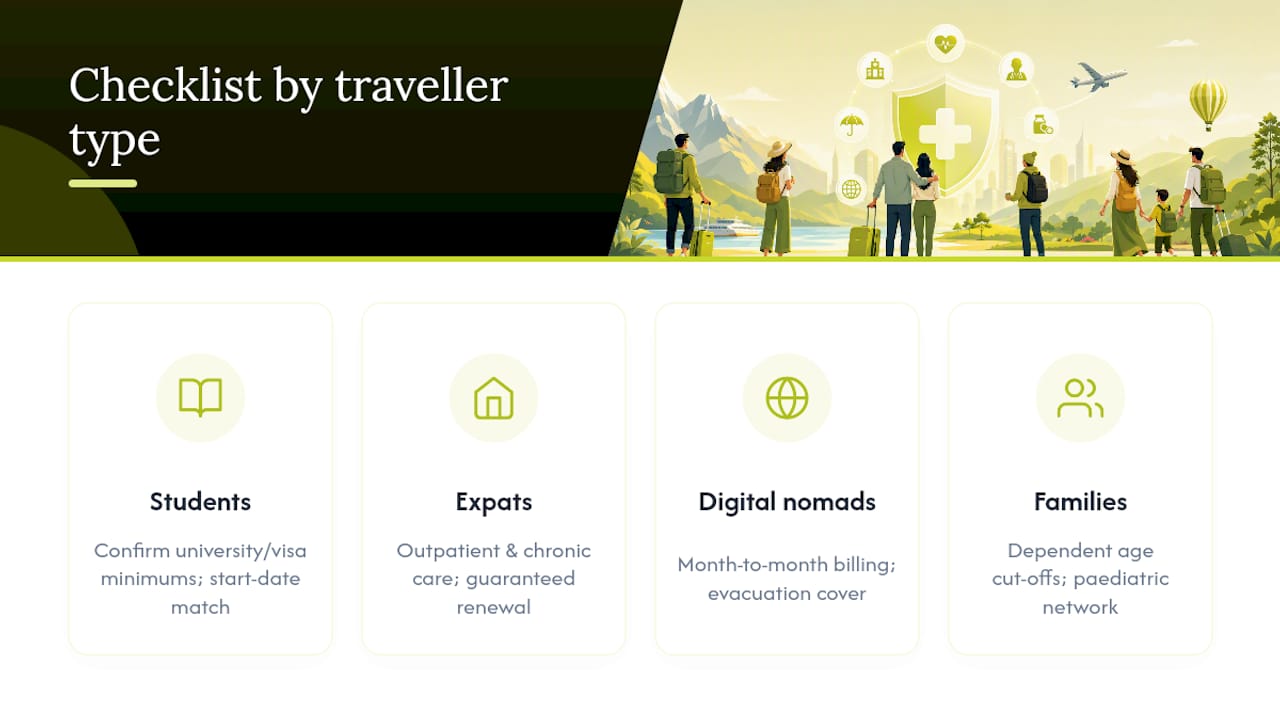
Students need to confirm their university’s minimum coverage levels before shopping anywhere else. Some visa categories, including certain J-1 exchange programmes, set explicit minimums that a generic travel policy won’t meet. University-offered plans are often the lowest-risk route for compliance, and if your school offers one, get a waiver comparison before buying externally. Check that mental health support and prescription cover are included, and that your start date matches your term start, not your flight date.

Expats and long-term residents should prioritise outpatient cover, chronic condition management, and maternity if relevant, plus guaranteed renewal terms once you’re enrolled. Entry-age deadlines matter here: many insurers cap new enrolment around 65 to 75, after which you may be locked out permanently even if you’re healthy.

Digital nomads need flexibility above comprehensiveness. Look for month-to-month billing, straightforward cancellation, and clear limits on how many days you can spend in the US on a plan that excludes it. Evacuation cover matters more than most nomads assume, given how many are working from places with limited emergency care.
Families should check how the plan defines a dependent child (age cut-offs vary widely), whether maternity has a waiting period, and whether the paediatric network actually reaches the city you’ll live in, not just the country.
How do you actually buy the right policy, step by step?
- Gather your documents. Passport details, visa or university requirement letters, a summary of any existing medical conditions, and your planned destinations and dates.
- Request compliance evidence early. Use the checklist above to ask each insurer for a compliance letter and a list of direct-billing hospitals near you.
- Compare total cost of use, not premium. Add the premium to the deductible, coinsurance, and realistic annual maximum. A cheaper premium with a higher excess can cost more the moment you actually need care.
- Ask scripted questions. “How exactly do you handle pre-existing conditions?” “What happens to my premium at renewal?” “Is there a maximum entry age, and what happens if I need to renew after it?”
- Apply early if age or health is a factor. Insurers accept new enrolments up to a fixed age limit, often somewhere between 65 and 75, and renewal is usually guaranteed once you’re in, but getting in after the cut-off may simply not be possible.
If you have a pre-existing condition, declare it upfront rather than hoping it won’t come up. Ask for the exact terms in writing, whether that’s a moratorium period, a permanent exclusion, or an underwriting decision, before you pay. Our guide on travel insurance with medical conditions covers how declarations affect pricing and acceptance.
Pro Tip: If you’re weighing elective treatment abroad as part of your plan, check the hospital’s accreditation against a recognised medical tourism safety checklist before you assume your policy’s network quality matches the marketing.
How does Unparalleledglobalbenefits make comparison easier?
Working through visa minimums, moratorium terms, and network coverage across several insurers is genuinely time-consuming, and that’s precisely the job Unparalleledglobalbenefits exists to shorten.
- We arrange tailored quotes across expat, student, family, nomad, and visitor medical insurance, matched to your actual destination and length of stay.
- We can request compliance or waiver letters on your behalf, which matters when a university or embassy needs specific written proof before your deadline.
- Our student health insurance guide and J-1 visa insurance resource go deeper into the documentation each visa category typically expects.
- Our step-by-step comparison guide walks through the same checklist above with worked examples.
This article was reviewed by Coert, drawing on years of experience helping travellers and expats navigate international insurance compliance. If you want a second opinion on a quote you’ve already received, we’re one of the few places set up to give you a straight answer without a sales pitch attached.
Why does compliance matter more than price?
Most guides lead with cost, and cost matters, but it isn’t where people actually get stuck. The rejected applications, the frantic emails to embassies, the students turned away at enrolment, almost all trace back to buying a policy that looked fine on price and failed on a compliance technicality nobody checked in advance.
The conventional advice tells readers to “shop around for the best rate.” That’s not wrong, but it’s incomplete, and it puts the emphasis in the wrong place. A £30 saving on premium is irrelevant if your policy doesn’t meet your visa’s explicit minimum, or if it excludes the one condition you’re actually likely to need treated. The smarter sequence is compliance first, pre-existing condition terms second, price a distant third.
What gets overlooked most is entry-age cut-offs. People in their early sixties often assume they have years to decide on an expat plan, not realising some insurers stop accepting new applicants well before 70. Enrol while you’re eligible; renewal is typically guaranteed once you’re in.
Prioritise the paperwork, then the terms, then the number on the quote.
— Coert
Compare your options and get a compliant quote today
Unparalleledglobalbenefits exists because comparing IPMI and travel policies shouldn’t mean reading twelve insurer websites and guessing which terms actually apply to your visa. We put tailored expat, student, and family quotes in front of you, help you request the compliance letters your university or embassy asks for, and flag pre-existing condition terms before you commit to anything.
Start with our international expat health insurance page for tailored IPMI quotes, or browse the complete international health insurance guide if you’re still deciding between products. For a visual walkthrough of how coverage areas and exclusions actually work, this
is worth five minutes.
Planning a trip for yourself, a resident, or visiting family? UGB + Ekta can arrange travel insurance for seniors up to 100 years old. Just click here: Ektatraveling and add the promo code “UGB” to receive an additional 10% discount.
Request a quote today and get your compliance letter sorted before your deadline, not after.
Sources
- CWU exchange insurance / student resources
- International health insurance for expats: complete guide | WhereNext
This article is general information, not a substitute for advice from a qualified doctor. Consult a qualified healthcare professional about your own circumstances before acting on anything here.
Recommended
- How to compare medical insurance plans abroad – Unparalleled Global Benefits
- How to compare medical insurance: your 2026 guide – Unparalleled Global Benefits
- Business health insurance comparison: choosing the right expat cover – Unparalleled Global Benefits
- Go compare travel insurance with medical conditions: 2026 guide – Unparalleled Global Benefits