
Avion Travel Insurance is a UK policy distributed by Just Travel Cover and underwritten by AWP P&C SA, part of the Allianz group, with headline limits published across three tiers: Bronze, Silver, and Gold. On the Gold tier, published tables show emergency medical cover of up to £10 million and cancellation cover of up to £12,500, figures that sit well above many budget alternatives. Avion tends to suit UK, Channel Islands, and Isle of Man residents who want higher medical limits, including travellers who need to declare a pre-existing condition or who are older and struggling to find cover elsewhere.
Before you buy, here’s what to check first:
- Confirm you’re looking at UK Avion Travel Insurance, not the unrelated RBC Avion credit card benefits sold in Canada.
- Match your trip cost and destination against the Bronze, Silver, or Gold limits.
- Check the residency and registered doctor requirement applies to you.
- Read the full policy wording before declaring (or omitting) any medical condition.
- If you’re already travelling and need help, call the emergency assistance number in your policy documents immediately.
Key Takeaways
Avion Travel Insurance suits UK residents who want high medical limits and no strict upper age cap, provided they declare every medical condition accurately before travelling.
| Point | Details |
|---|---|
| Underwriter and distributor | AWP P&C SA (Allianz) underwrites the policy; Just Travel Cover handles sales and service. |
| Three tiers, big gap | Gold offers up to £10 million medical cover and up to £12,500 cancellation, well above Bronze. |
| Residency rules apply | You must live in the UK, Channel Islands, or Isle of Man and be registered with a doctor there. |
| Declare conditions honestly | Undeclared pre-existing conditions are the most common reason claims get refused. |
| Get a personal comparison | Unparalleledglobalbenefits can match your trip and conditions to the right policy tier. |
Table of Contents
- What does Avion travel insurance actually cover?
- Who is eligible to buy an Avion policy?
- How are pre-existing medical conditions handled?
- What happens if you need to make a claim?
- How do you decide if Avion is the right fit?
- What drives the price of your premium?
- Why the “Avion” name causes more confusion than it should
- Get a tailored quote through Unparalleledglobalbenefits
- Frequently asked questions
- Sources
What does Avion travel insurance actually cover?
The three tiers exist because not every trip needs the same level of protection. Bronze gives you a working baseline. Silver adds meaningfully to medical and baggage limits. Gold is built for higher value trips, cruises, or travellers who want the biggest safety margin on medical evacuation.
Based on the published cover table, here’s roughly what separates the tiers:
- Trip cancellation: Bronze offers the lowest limit, Silver a mid-range figure, and Gold rises to up to £12,500.
- Emergency medical expenses: Gold tops out at up to £10 million, covering hospital treatment, ambulance transport, and medical repatriation abroad.
- Baggage and personal belongings: limits increase tier by tier, with Gold offering the highest per-item and total claim caps.
- Personal accident cover: a lump sum benefit included across tiers, higher on Gold.
- Cruise cover: often available as an add-on or included at the higher tiers, covering missed port departures and cabin confinement.
Every one of these figures is subject to policy excesses and specific wording, so treat the table as a starting point rather than the final word. Read the full Travel Insurance Policy Wording document before you commit, particularly the exclusions section relevant to your trip type.
Who is eligible to buy an Avion policy?
Eligibility hinges on where you live and, in some cases, your destination. Three things determine whether you can buy, or stay covered:
- Residency: you must have your main home in the UK, the Channel Islands, or the Isle of Man, and be registered with a doctor there. This matters because the insurer assesses your medical risk based on UK healthcare access, not wherever you happen to be travelling.
- Age: many Avion policies carry no upper age limit for UK, EU, and worldwide trips, which is unusual and one of the more compelling reasons older travellers consider this brand. Travel to the USA, Canada, or the Caribbean often carries separate age restrictions or loaded premiums, so check this specifically if that’s your route.
- Destination risk: certain countries or regions may be excluded entirely, or covered only with restrictions, particularly where government travel advice warns against visiting.
How are pre-existing medical conditions handled?
You must declare any pre-existing medical condition when you buy, or when it changes before you travel. Skip this step, and a claim linked to that condition is likely to be refused outright, not reduced.
Once declared, conditions are usually handled one of three ways: covered as standard, covered with an additional premium, or excluded from cover for that specific condition while the rest of your policy stays intact. Two phrases catch people out repeatedly:
- “Medically unfit to travel” means a registered medical professional has advised against travel, or would advise against it if consulted, at the time you book or travel. Travelling anyway typically voids any related claim.
- “Travelling for treatment” excludes trips whose purpose is to receive medical care abroad, distinct from needing emergency treatment once you’re there. Someone flying out for a scheduled procedure and someone falling ill mid-holiday are treated very differently by insurers.
If you’re navigating a diagnosis and unsure how it’ll be assessed, our guide to securing cover with pre-existing conditions walks through the declaration process in more detail, and our piece on travel insurance for medical procedures abroad explains the treatment exclusion further.
Pro Tip: Ask your GP for a short letter confirming your condition is stable before you travel, especially if you have a scheduled treatment date nearby. It won’t guarantee a claim gets paid, but it removes a major point of dispute if you ever need one.

What happens if you need to make a claim?
Emergency assistance and everyday claims handling go through different channels, and knowing which one to call saves time when it matters most.
- In an emergency abroad: call the 24 hour emergency assistance number listed in your policy documents immediately, before incurring major medical costs where possible.
- For a standard claim: contact the claims line specified in your policy wording, and gather receipts, medical reports, and (for theft or loss) a police report as you go, not after the fact.
- For a service complaint: Just Travel Cover handles distribution and day to day service, while AWP P&C SA, as underwriter is responsible for the ultimate claims decision. Direct sales queries to the distributor and disputed medical assessments to the insurer.
If a complaint isn’t resolved to your satisfaction, you can escalate it. Verify the distributor’s authorisation on the FCA register first, and if the internal complaints process stalls, eligible consumers can refer the matter to the Financial Ombudsman Service for an independent decision.
How do you decide if Avion is the right fit?
Run through this checklist before you commit to any tier:
- Total up your trip cost, including non-refundable deposits, and check it sits comfortably within the cancellation limit you’re choosing.
- Be honest about medical evacuation risk. Adventure travel, remote regions, or existing health conditions all raise the ceiling you actually need.
- List every condition you’d need to declare, and check how each is treated before you pay.
- Check your destination against the policy’s regional restrictions, particularly for the USA, Canada, and the Caribbean.
- Confirm whether winter sports, cruises, or other activities need a separate add-on rather than being automatically included.
A few questions are worth asking directly, either of the seller or by reading the wording yourself: what’s the per-item baggage limit, what excess applies per claim, is this single-trip or annual multi-trip, and does the medical limit include repatriation costs or just treatment abroad?
Comparison specialists generally advise comparing policies by benefit rather than headline price, since a cheap policy with a low medical ceiling can cost far more in a genuine emergency.
Pro Tip: If a seller can’t clearly explain the claims excess or point you to the policy wording document within a couple of minutes, treat that as a red flag rather than a minor inconvenience.
What drives the price of your premium?
Your premium moves with five main levers: the total trip cost you’re insuring, your age, your destination, trip duration, and any pre-existing conditions you declare. Optional extras, cruise cover or higher personal belongings limits among them, add to the base price too.
Rather than quoting a fixed figure that won’t hold true for your circumstances, it’s worth using a comparison tool to see how these variables shift your quote in real time. What’s consistent across providers is the excess: a per-claim amount you pay before the insurer contributes, so a higher excess usually buys a lower premium, and vice versa. One habit is worth adopting regardless of tier: buy your policy soon after booking your trip, since cancellation cover typically only protects you from the date of purchase onward, not retroactively.
Why the “Avion” name causes more confusion than it should
Most of the confusion around this policy has nothing to do with the cover itself. It’s the name. RBC sells an Avion branded credit card in Canada with its own bundled travel benefits, issued by a completely different company under a completely different regulatory regime. Anyone searching “Avion travel insurance” while holding an RBC card, or reading a Canadian forum thread, can end up comparing two products that share nothing but a name.
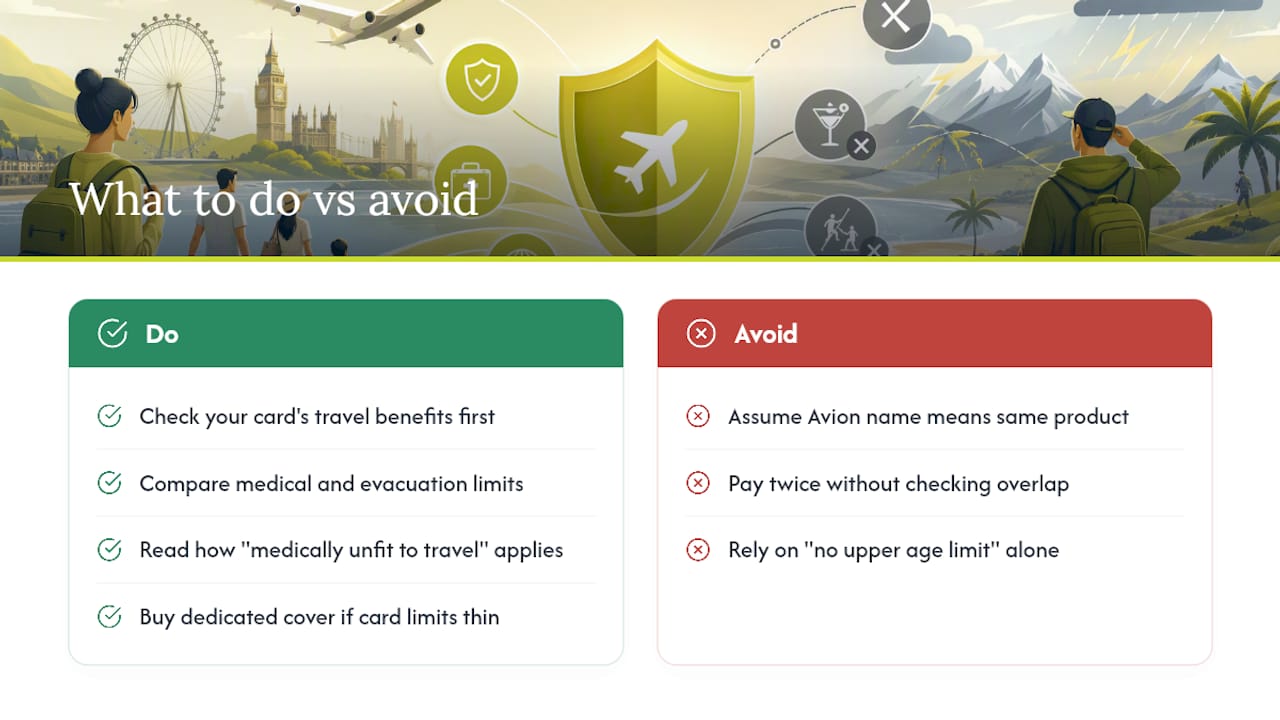
That mix up matters practically. If you already hold a card with travel benefits attached, it’s worth checking what you’re covered for before paying twice for overlapping protection. But don’t let that check talk you out of dedicated cover if your card’s insurance turns out thin on medical or evacuation limits, which is common.
Where I think the conventional advice undersells this policy is on age. Most travel insurance guidance treats “no upper age limit” as a footnote. For a 78 year old UK resident with a stable but declared condition, it’s often the entire decision. The bigger risk isn’t the exclusion itself, it’s buying without reading how “medically unfit to travel” gets applied, because that single phrase does more damage to genuine claims than any age band ever does.
Get a tailored quote through Unparalleledglobalbenefits
Reading a policy table only gets you so far. What you actually need is someone to check your specific trip, your specific conditions, and your specific age against the right tier, and that’s where Unparalleledglobalbenefits earns its keep. We help travellers compare international and travel insurance options directly, including support with declaring pre-existing conditions properly the first time, so you’re not left arguing over wording after something’s already gone wrong.
We also work with specialist partners for cover most standard policies won’t touch. Planning a trip for yourself, a resident, or visiting family? UGB + Ekta can arrange travel insurance for seniors up to 100 years old. If you’re weighing a short trip against something longer term, our guide to international health insurance explains when broader cover makes more sense than a single-trip policy. Watch this short explainer for a quick overview of how travel cover actually works, then request a quote and let us match you to the right plan.
Frequently asked questions
Is Avion travel insurance the same as the RBC Avion credit card benefits?
No. UK Avion Travel Insurance is underwritten by AWP P&C SA and distributed by Just Travel Cover. The RBC Avion card is a separate Canadian product with its own bundled insurance, issued by a different company entirely.
Is there an age limit on Avion travel insurance?
Many Avion policies carry no upper age limit for UK, EU, and worldwide trips, though travel to the USA, Canada, or the Caribbean often comes with separate age restrictions, so check your specific route.
Do I have to declare a pre-existing medical condition?
Yes, always. Declaring it doesn’t guarantee refusal, cover, or extra cost, but not declaring it risks having a related claim thrown out entirely.
Who do I contact if I need emergency help abroad?
Call the 24 hour emergency assistance number listed in your policy documents straight away, before arranging or paying for major treatment where you can.
What if my complaint isn’t resolved by the distributor?
Escalate to the underwriter first, then to the Financial Ombudsman Service if you remain unhappy with the outcome after their final response.
This article is general information, not a substitute for advice from a qualified financial advisor. Consult a qualified financial professional about your own circumstances before acting on anything here.
Sources
- Avion Travel Insurance | Allianz | Just Travel Cover
- RBC Avion Visa Infinite – Premium Travel Credit Card | RBC Royal Bank of Canada
- Travel Insurance – Compare Companies, Quotes & Buy Online
- FCA register
- Financial Ombudsman Service
Recommended
- Flight insurance coverage 2026: Protect against 40% uncovered risks – Unparalleled Global Benefits
- What will travel insurance cover? Your UK guide – Unparalleled Global Benefits
- International cruise travel insurance: your 2026 UK guide – Unparalleled Global Benefits
- International seniors travel insurance: your 2026 UK guide – Unparalleled Global Benefits