
Every J1 exchange visitor and J2 dependant must carry health insurance that meets the Department of State’s minimum standards under 22 CFR 62.14 for the entire length of the programme, with no gaps. That means a policy covering medical benefits, medical evacuation, repatriation of remains, a capped deductible, and patient cost sharing, each meeting or exceeding the regulatory minima.
Check your policy dates now, not later. Coverage must start on or before your DS-2019 programme start date and run without a single day’s break through to the end.
Before you read further, confirm your policy has:
- Medical benefits of at least the Department of State minimum per accident or illness
- Medical evacuation at or above the Department of State minimum level
- Repatriation of remains at or above the Department of State minimum level
- A deductible not exceeding the Department of State maximum allowed per accident or illness
- Patient liability capped at the Department of State maximum allowed percentage of covered benefits
A policy that hits four of these five numbers is still non-compliant. Sponsors check every line, not the overall maximum.
Key Takeaways
Compliant J1 insurance requires five specific numeric minimums met simultaneously, continuous coverage with no gaps, and proof submitted directly to your sponsor.
| Point | Details |
|---|---|
| Five numeric minimums | $100,000 medical, $50,000 evacuation, $25,000 repatriation, $500 deductible cap, 25% patient liability cap. |
| No lapses allowed | Coverage must run continuously from your DS-2019 start date with zero gaps of even one day. |
| Check the underwriter, not the brand | Confirm the insurer holds an A.M. Best A- rating or equivalent, or home-government backing. |
| Structure beats size | A high overall maximum doesn’t offset a non-compliant deductible or missing evacuation line. |
| UGB sources verified plans | Unparalleledglobalbenefits checks underwriter ratings and coverage lines before you submit proof to your sponsor. |
Table of Contents
- What are the J1 visa insurance requirements under 22 CFR 62.14?
- Who needs J1 visa health coverage and when must it start?
- How do you check if a policy actually meets J1 visa insurance requirements?
- Which plan types work for J1 scholars, students and families?
- How do you buy J1 insurance and prove it to your sponsor?
- What does J1 visa insurance typically cost?
- What people get wrong about J1 insurance compliance
- How UGB helps you source compliant J1 cover quickly
- Where to verify J1 insurance rules and find compliant plans
- Frequently asked questions about J1 visa insurance
- Sources
What are the J1 visa insurance requirements under 22 CFR 62.14?
The regulation is specific, and sponsors interpret it literally. It doesn’t just ask for “adequate cover”, it sets five numeric thresholds that a policy must satisfy simultaneously, and Harvard’s International Office confirms these apply identically to every J1 category and to accompanying J2 dependants.
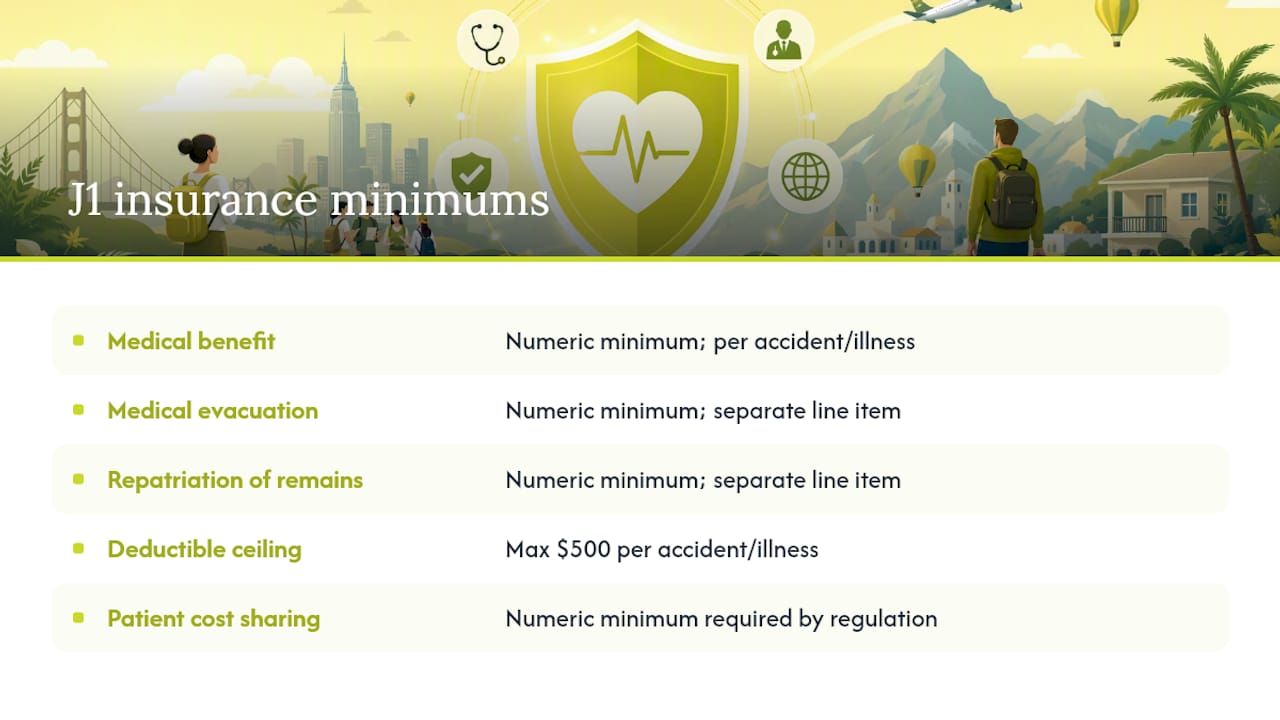
The medical benefit and deductible figures apply per accident or illness, not as a single aggregate cap across the whole programme. So a policy with a $2 million lifetime maximum but a $750 deductible fails the test, because the deductible ceiling of $500 is breached even though the overall limit looks generous. Evacuation and repatriation are usually separate line items on the policy schedule, and they need to be clearly labelled as such rather than folded into a vague “emergency assistance” clause.

Insurer backing matters just as much as the numbers. The Department of State expects underwriters to hold a financial-strength rating of A.M. Best A- or above, or an equivalent from S&P, Weiss, Fitch, or Moody’s, or to be backed by the “full faith and credit” of the exchange visitor’s home government. A plan administered by a well-known company isn’t automatically compliant. It’s the underwriter, not the administrator, whose rating counts.
You can read the regulation’s own wording through BridgeUSA’s sponsor guidance, which is the primary reference sponsors themselves rely on.
Who needs J1 visa health coverage and when must it start?
Every J1 exchange visitor needs compliant cover, whether you’re a student, scholar, intern, trainee, physician, au pair, or camp counsellor. Every J2 dependant travelling with you, spouse or child, needs the same standard of cover too. There’s no tier of the programme exempt from this rule.
Timing is where people slip up. Coverage has to be active from your DS-2019 start date through your programme’s end date, with zero lapses, even a single calendar day. Duke Visa Services confirms sponsors are obligated to verify this and must report a wilful failure to maintain coverage. Once that report reaches SEVIS, your legal status is gone immediately, not after a warning period.
- All J1 categories: students, scholars, interns, trainees, physicians, au pairs, camp counsellors
- All accompanying J2 dependants, without exception
- Coverage runs continuously from DS-2019 start date to programme end
- Renewals must begin the instant the old policy expires, never a day later
One day. That’s all it takes. A single-day gap in coverage is treated as a material violation, and Immigration Start Guide notes it can trigger programme termination with no grace period attached.
How do you check if a policy actually meets J1 visa insurance requirements?
Ask your insurer for a specific document pack before you rely on anything they’ve said over the phone or in a marketing email. Request the declaration page, a certificate of insurance, a summary of benefits, and written confirmation of the underwriter’s name and financial-strength rating. Sponsors want to see effective and expiry dates stated explicitly, plus separate lines for evacuation and repatriation rather than bundled wording.
Read the small print for these specific traps:
- How the deductible applies: per incident, per policy year, or per family member
- Co-insurance percentages after the deductible, and whether they push your total liability past 25%
- Waiting periods for pre-existing conditions, which can leave a real gap in early cover
- Whether the policy still pays out if you travel outside the US during your programme
- How dependants are added, and whether J2 family members need a separate policy number
When you ask for proof of an underwriter’s rating, you want a document that names the insurance carrier, not the plan’s marketing brand or third-party administrator. An administrator can be unrated and still sell a fully compliant policy, because it’s the underwriter standing behind the claims that the regulation cares about.
Pro Tip: Ask your insurer to put “meets 22 CFR 62.14” directly on the declaration page or in a cover letter. It won’t change the policy itself, but it turns a five-minute sponsor review into a thirty-second one.
Which plan types work for J1 scholars, students and families?
Four broad categories cover most J1 situations, and picking the right one depends on your role and your budget as much as the rules themselves.
- Institution-provided plans: universities and host organisations often enrol J1 scholars automatically, and Columbia’s ISSO notes these usually meet the minimums, though evacuation and repatriation lines still need checking individually.
- Dedicated J1 exchange visitor plans: private insurers building products specifically for this visa category tend to state compliance clearly on the summary of benefits, which speeds up sponsor approval.
- Short-term travel medical plans with add-ons: useful for shorter programmes or as a bridge before a long-term policy activates, provided evacuation and repatriation riders are purchased alongside.
- Employer or government plans: allowed in some cases, but need the same line-by-line audit as any other option.
J2 dependants are usually added to the same policy for a per-person premium rather than issued a fully separate plan, though family add-ons vary by insurer. Never assume a high headline maximum guarantees compliance. Structure matters more than size.
How do you buy J1 insurance and prove it to your sponsor?
Buying the policy is the easy part. Proving it to your sponsor in a format they’ll accept quickly is where preparation pays off.
- Compare declaration pages from two or three insurers against the five numeric minimums side by side.
- Confirm the underwriter’s financial-strength rating in writing, not just a verbal assurance from a sales agent.
- Buy cover that starts on or before your DS-2019 programme date, with no gap from any prior policy.
- Save the declaration page, certificate of insurance, and rating confirmation as clearly labelled PDFs.
- Submit the file pack to your international office, referencing 22 CFR 62.14 in the email subject line.
For documents, sponsors typically want a declaration page, a certificate of insurance, and rating verification, all in English and dated. Label the email something like “J1 Insurance Compliance, [Your Name], [Programme ID]” so it’s processed without back-and-forth.
If you arrive without compliant cover already active, a short-term travel medical policy can bridge the gap while your main plan starts, but notify your sponsor immediately so the delay is documented rather than discovered.
What does J1 visa insurance typically cost?
Expect a broad range rather than a single figure. Immigration Start Guide puts compliant monthly premiums somewhere between the tens and low hundreds of US dollars, depending heavily on your circumstances. Adding J2 dependants increases the total, sometimes significantly if you’re covering a spouse and children together.
Premiums move with several factors:
- Age of the insured, with older participants generally paying more
- Overall plan maximum and whether it sits well above the $100,000 floor
- Whether evacuation and repatriation are built in or added separately
- Deductible level chosen, lower deductibles cost more monthly
- Claims history and the geographic scope of the plan
A slightly higher premium that guarantees every regulatory line is met is nearly always the better trade. The cost difference between a borderline policy and a clearly compliant one is usually modest next to the risk of losing your legal status entirely.
What people get wrong about J1 insurance compliance
Most guidance on this topic treats insurance as a box-ticking formality, something to sort out quickly so you can focus on the actual programme. That framing undersells the risk. Unlike a missed course requirement or a late tuition payment, a coverage lapse gives your sponsor no discretion. Immigration Start Guide’s findings make clear this is one of the only compliance failures that triggers termination without a warning stage.
The conventional advice, “get a plan with a high maximum benefit”, is also incomplete and occasionally dangerous. A $1 million policy with a $750 deductible fails just as hard as no insurance at all, because every numeric threshold has to be met on its own terms, not averaged out. I’d tell any scholar or student to read the deductible and the evacuation line before they even glance at the overall maximum.
What should come first is verification, not price. Confirm the underwriter’s rating and the specific coverage lines before comparing premiums, because a cheap non-compliant plan costs you nothing until the day it costs you your visa status. A dedicated J1 exchange visitor plan, sourced through a broker who checks these details for you, removes most of that risk before it becomes your problem.
How UGB helps you source compliant J1 cover quickly
Unparalleledglobalbenefits works with insurers who understand the 22 CFR 62.14 standard in detail, not just the general shape of visa insurance. When you request a quote, our team checks the underwriter’s financial-strength rating and confirms the evacuation and repatriation lines are stated explicitly, so you’re not left guessing whether small print will satisfy your sponsor.
You’ll need your programme start date, your DS-2019, and whether any J2 dependants are travelling with you. From there, turnaround on a compliant quote is typically fast, and you’ll receive the declaration page and certificate of insurance in a format ready to submit. If you’re weighing options beyond the minimum, our international health insurance guide covers broader plan structures worth comparing.
Planning a trip for yourself, a resident, or visiting family? UGB + Ekta can arrange travel insurance for seniors up to 100 years old. Just click here: Ektatraveling and add the promo code “UGB” to receive an additional 10% discount.
Watch this for a walkthrough of how international cover works:
Request a quote today and get your compliance documents sorted before your programme start date arrives.
Where to verify J1 insurance rules and find compliant plans
Confirm rules directly with your sponsor and the Department of State’s sponsor search, which lists numeric minima and documentation formats. University international offices, like Columbia’s ISSO, publish waiver instructions and proof templates too. Screenshot any page you rely on, since guidance pages do get updated.
Frequently asked questions about J1 visa insurance
Does my university’s student health plan automatically meet J1 requirements?
Not automatically. Many university plans meet the minimums, but you still need to confirm the evacuation and repatriation lines are included, since these are sometimes sold as separate add-ons.
Can I use my home country’s national health service instead of buying US insurance?
No. J1 and J2 holders need a policy that meets the specific 22 CFR 62.14 minimums while in the US, regardless of what cover you hold at home.
What happens if my coverage lapses for just a few days?
Even a single-day gap counts as a material violation. Your sponsor is required to report it, and this can lead to immediate termination of your J1 status.
Do J2 dependants need their own separate policy?
Not necessarily. Many insurers add J2 dependants to the same policy for an additional premium, though the exact process varies by provider.
How do I prove my insurance meets the requirements to my sponsor?
Submit the declaration page, certificate of insurance, and written confirmation of the underwriter’s financial-strength rating, ideally referencing 22 CFR 62.14 directly.
This article is general information, not a substitute for advice from a qualified doctor. Consult a qualified healthcare professional about your own circumstances before acting on anything here.
Sources
- How to administer a programme – BridgeUSA Program Sponsors | BridgeUSA
- J Health Insurance Requirements | Harvard International Office
- Required Insurance Specifications Under the J-1 Visa Regulations | Duke Visa Services
- J-1 Visa Health Insurance Requirements: Minimum Standards and What Happens If You Lapse | Immigration Start Guide
- J-1 Scholar Health Insurance | ISSO
Recommended
- Travel Insurance for Visa: Complete Expert Guide – Unparalleled Global Benefits
- TD visa travel insurance for UK trips: what to buy – Unparalleled Global Benefits
- Visa Insurance Explained: Meeting Global Travel Rules – Unparalleled Global Benefits
- Schengen travel medical insurance: what you must buy – Unparalleled Global Benefits