Yes, suitable expat travel insurance for over 70 does exist, and you can get cover that includes pre-existing medical conditions, single trips, and long stays abroad. The key is declaring your conditions fully, choosing a policy designed for expats rather than standard holidaymakers, and working with a broker who understands the underwriting process for older travellers.
Here is what you need to know before you buy:
- Cover exists for ages 70 to 100, including policies that accept many pre-existing conditions after medical screening.
- Single-trip and long-stay options are available, with some policies covering trips of 90 days or longer.
- Pre-existing conditions can be covered, but you must declare them accurately and pass a medical assessment.
- Medical expense limits vary widely across policies, so comparing evacuation and repatriation benefits is as important as comparing price.
- Getting a tailored quote from a specialist broker is the fastest route to finding a policy that fits your health profile and travel plans.
Planning a trip for yourself, a resident, or visiting family? UGB + Ekta can arrange travel insurance for seniors up to 100 years old, with tailored support similar to the compassionate care offered by Seniors Helping Seniors in Tucson. Just click here: Ektatraveling and add the promo code “UGB” to receive an additional 10% discount.
Key takeaways
Suitable expat travel insurance for seniors aged 70 and above does exist, covers pre-existing conditions with full medical declaration, and is available for single trips, long stays, and annual policies up to age 100 with specialist providers.
| Point | Details |
|---|---|
| Cover exists for ages 70–100 | Specialist providers offer single-trip, long-stay, and annual policies well beyond standard age caps. |
| Declare all conditions fully | Non-disclosure is the leading cause of declined claims; honest screening protects your cover. |
| Compare medical and evacuation limits | Forbes Advisor’s analysis of 34 policies found wide variation; price alone is a poor guide to value. |
| GHIC does not replace travel insurance | NHS guidance confirms the card provides limited state care only; it does not cover repatriation or private treatment. |
| Unparalleledglobalbenefits + Ekta | Broker-guided quotes for seniors up to 100, with a 10% discount via Ekta using promo code “UGB”. |
Table of Contents
- What does expat travel insurance for over 70 actually cover?
- What does a senior expat travel policy typically include?
- Which policy types suit seniors, and what are the age limits?
- How are pre-existing medical conditions assessed?
- What drives the cost of senior expat travel insurance?
- How do you choose the right policy and spot the red flags?
- Step-by-step: getting a quote, buying cover, and making a claim
- How Unparalleledglobalbenefits helps UK expats aged 70+ find the right cover
- An experienced broker’s honest take on over-70 expat travel cover
- Get a tailored quote through UGB and Ekta
- Sources
What does expat travel insurance for over 70 actually cover?
The phrase “expat travel insurance for over 70” describes a specialist travel policy designed for UK-based seniors who live abroad permanently or for extended periods, and who need cover for trips taken from their country of residence. It is not the same as a standard UK holiday policy, which typically assumes you are resident in the UK and travelling outward from there.
The target policyholder is a UK national (or long-term UK resident) aged 70 or above who lives in another country, whether that is Spain, France, Portugal, Australia, or anywhere else, and who needs cover for:
- Return visits to the UK or trips to third countries taken from their country of residence.
- Long single stays of 30, 60, 90 days or more in one destination.
- Short holidays taken from the country where they live.
- Medical emergencies that arise while travelling, including those linked to existing health conditions.
Who qualifies? Age 70 and above is the entry point, but many policies extend to age 85, 90, or even 100. Mobility and health profile matter too: a fit 75-year-old with well-managed hypertension will face different underwriting questions than someone with recent cardiac surgery. Both can often find cover, but the terms will differ.
Pro Tip: Travel insurance and international expat medical insurance are different products. Travel insurance covers emergencies and trip disruptions during a specific journey. Expat medical insurance provides ongoing, year-round healthcare cover wherever you live. If you live abroad full-time, you may need both. Check for overlaps before buying, so you are not paying twice for the same benefit. The types of expat insurance guide on the Unparalleledglobalbenefits site explains the distinction clearly.
What does a senior expat travel policy typically include?
Most policies designed for travel medical insurance for seniors share a core set of benefits, though the limits and conditions attached to each benefit vary considerably between providers.

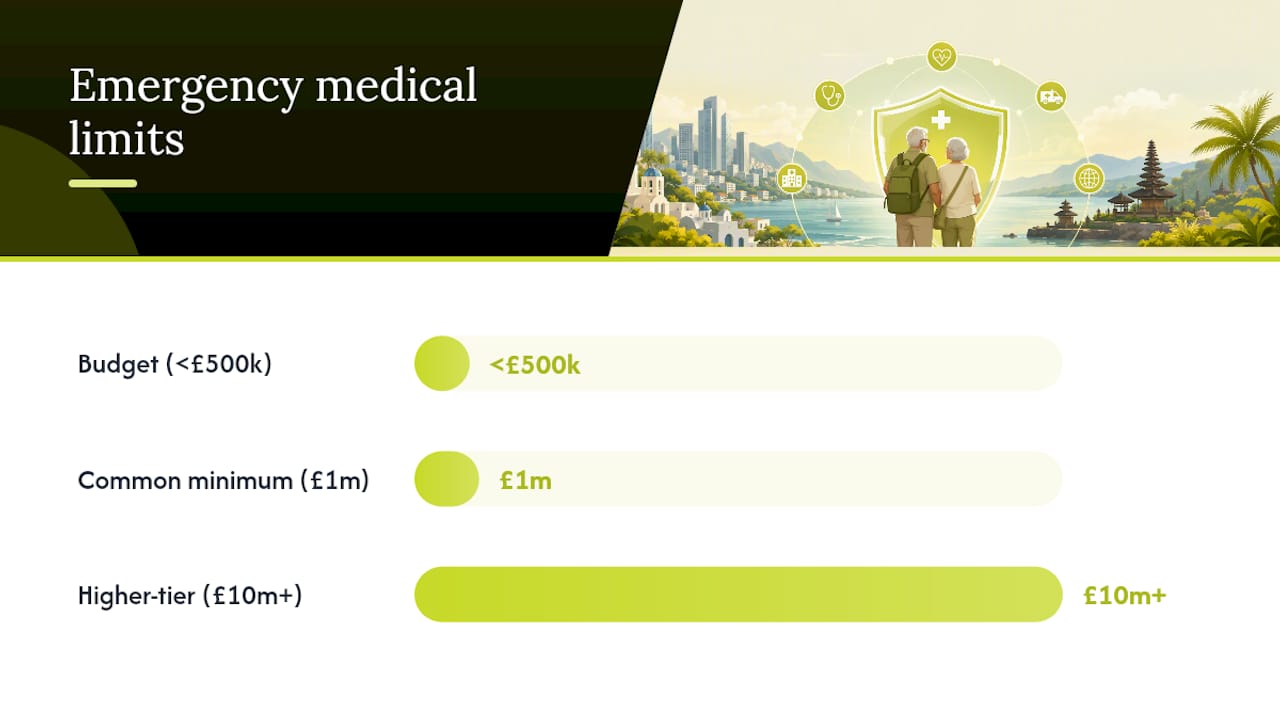
Emergency medical expenses sit at the heart of any worthwhile policy. This covers hospital treatment, surgery, specialist consultations, and prescribed medication needed as a result of an unexpected illness or accident during your trip. Limits range from £1 million to £10 million or more on higher-tier policies, though some budget options sit below £500,000. For travel outside Europe, particularly to the United States, a limit below £1 million is generally insufficient given the cost of private hospital care.
Evacuation and repatriation cover pays for medically supervised transport to the nearest appropriate hospital or back to your home country if local facilities cannot treat you adequately. This benefit is often underestimated. A medical evacuation from a remote location or from a country with limited specialist care can cost tens of thousands of pounds without cover.
Trip cancellation and curtailment reimburses pre-paid, non-refundable costs if you have to cancel before departure or cut a trip short. Whether a pre-existing condition triggers a valid cancellation claim depends on how the condition was declared and whether the policy includes a “cancellation due to pre-existing condition” extension.
Additional standard benefits typically include:
- 24/7 emergency assistance via a dedicated helpline, available around the clock for medical guidance, hospital pre-authorisation, and claims support.
- Baggage and personal effects cover for loss, theft, or damage.
- Personal liability protection if you accidentally injure someone or damage property.
- Optional extras such as winter sports cover, rental vehicle excess, and cruise cover.
Statistic callout: Forbes Advisor analysed 34 policies and 160 quotes for travellers aged 65–80 and found a wide variation in both medical expense limits and prices. Comparing medical and evacuation benefits, not just premium cost, is the single most important step when choosing senior travel cover.
Excess is the amount you pay towards each claim before the insurer pays the rest. A higher voluntary excess typically reduces your premium, but make sure the excess level is one you can comfortably afford to pay in an emergency.
Which policy types suit seniors, and what are the age limits?
Understanding the difference between policy types saves you from buying cover that does not fit your trip. Three main structures apply to senior expat travellers:
- Single-trip policies cover one specific journey from start to finish. They are straightforward and often the most cost-effective option for one planned trip per year.
- Long-stay single-trip policies extend the maximum trip length beyond the standard 30-day cap, typically to 90, 120, or 180 days. These suit expats spending an extended period in one country, such as a winter in the UK or a long visit to family. Unparalleledglobalbenefits has a dedicated single-trip guide for over-70 travellers that covers the underwriting considerations for longer stays.
- Annual multi-trip policies cover an unlimited number of trips within a 12-month period, each up to a maximum duration per trip (commonly 31 or 45 days). They suit frequent travellers but often carry stricter age caps and may not extend to the oldest age bands.
| Policy type | Typical maximum trip length | Typical maximum age |
|---|---|---|
| Single trip | 30–180 days (varies by insurer) | Up to 100 with specialist providers |
| Long-stay single trip | 90–180 days | Up to 85–100 with specialist providers |
| Annual multi-trip | 31 or 45 days per trip | Often 70–80; some extend to 85 |
Age caps are one of the most important practical limits to check. Standard high-street insurers frequently stop offering annual policies at age 70 or 75. Specialist senior and expat insurers extend cover to 85, 90, or 100. The travel insurance for seniors up to 85 guide outlines how limits shift across age bands.
How are pre-existing medical conditions assessed?
You can often get cover for many pre-existing conditions, provided you declare them accurately and complete the insurer’s medical screening process. Non-disclosure is the single biggest reason claims are declined, so honesty at the application stage protects you far more than it costs you.
Here is how the process typically works:
- Complete a medical declaration. The insurer or broker asks you to list all conditions diagnosed or treated within a defined look-back period, commonly 2–5 years. This includes conditions managed by medication, even if they are stable.
- Answer condition-specific questions. For each declared condition, you will answer questions about diagnosis date, treatment history, medication, recent test results, and whether the condition is stable.
- Receive an underwriting decision. The insurer assesses your answers and returns one of four outcomes: full cover at standard terms, cover with an additional premium, cover with a specific condition excluded, or a declined application.
- Review and accept or negotiate. If a condition is excluded, you can ask whether a higher excess or a specialist underwriter would change the outcome. Brokers with access to multiple underwriters can often find a better result than a direct application.
- Purchase and receive your policy documents. Read the full policy wording before you travel, not after. Pay particular attention to the conditions section and any endorsements added to your specific policy.
Documents to prepare before you apply:
- A GP summary or recent medical report covering your active conditions.
- A full list of current medications, including dosages.
- Recent test results relevant to any declared conditions (blood pressure readings, HbA1c for diabetes, ECG results for cardiac conditions).
- Any specialist letters or discharge summaries from the past two years.
Warning: Failing to disclose a condition, even one you consider minor or well-controlled, gives the insurer grounds to void your policy or decline a claim. Gov and consumer organisations consistently highlight non-disclosure as the leading cause of disputed travel insurance claims. If you are unsure whether something needs declaring, declare it.
Pro Tip: Broker-assisted medical screening often produces better outcomes than applying directly. A broker with access to specialist underwriters can match your health profile to the insurer most likely to offer full cover rather than a blanket exclusion. Unparalleledglobalbenefits offers this kind of guided screening for seniors with complex medical histories. See their travel insurance for elderly with medical conditions guide for more detail.
What drives the cost of senior expat travel insurance?
Premium levels for insurance for over 70 expats reflect the insurer’s assessment of risk across several variables. Understanding what moves the price helps you make informed choices about where to adjust.
Key price drivers:
- Age. Premiums increase with age, often in bands (70–74, 75–79, 80–84, and so on). Moving into a new age band at renewal can produce a noticeable jump.
- Declared medical conditions. Each additional condition adds underwriting risk. Conditions that are stable and well-managed typically attract smaller loadings than those that are recent, progressive, or poorly controlled.
- Trip length. Longer trips mean longer exposure to risk. A 90-day policy costs more than a 14-day one, though the cost per day often falls as trip length increases.
- Destination. The USA, Canada, and the Caribbean carry the highest medical cost risk and attract the highest premiums. European destinations with reciprocal healthcare agreements are generally cheaper to insure.
- Chosen excess. Selecting a higher voluntary excess reduces your premium. A £250 excess versus a £50 excess can make a meaningful difference to the annual cost.
- Cover limits and optional extras. Higher medical expense limits, lower excesses, and add-ons such as winter sports or cruise cover all increase the premium.
Statistic callout: Forbes Advisor’s analysis of 34 policies and 160 quotes for travellers aged 65–80 found substantial price variation across providers for equivalent trips. This confirms that shopping across multiple providers, rather than accepting the first quote, can produce meaningfully different results for the same traveller profile.
One factor many seniors overlook: the destination’s healthcare infrastructure matters as much as its geography. A country with limited specialist facilities may require costly medical evacuation even for conditions that would be treated locally in a well-resourced system. Always check gov.uk foreign travel advice for destination-specific health information before you travel.
How do you choose the right policy and spot the red flags?
The best travel insurance for seniors is the one that covers your specific conditions, matches your trip type, and comes from a provider you can reach at 2 AM in an emergency. Here is a practical checklist.
Must-have features for over-70 expat travellers:
- Medical expense limit of at least £1 million (£2 million or more for travel outside Europe).
- Evacuation and repatriation cover included as standard, not as an optional extra.
- Full cover for declared pre-existing conditions, or a clear written exclusion so you know exactly what is not covered.
- 24/7 emergency assistance with a direct phone line, not just an email address.
- Full policy wording available before purchase, not just a summary.
- A UK contact number or regulated broker you can reach for claims support.
Questions to ask before you buy:
- What is the medical expense limit, and does it include evacuation and repatriation?
- How are my declared conditions treated: covered, excluded, or subject to a higher excess?
- What is the claims process, and how long does the insurer typically take to settle?
- Does the policy renew automatically, and will my age affect renewal terms?
- Is there a 24/7 emergency line, and is it staffed by medical professionals?
Red flags to avoid:
- No full policy document available before purchase.
- Vague or absent medical screening process.
- No UK contact number or regulated status.
- Exclusions buried in small print that effectively remove cover for the most common senior health events.
- Poor independent reviews of claims handling.
Which? reviews of travel insurers are a useful independent check on service quality and claims handling. Reading consumer reviews alongside the policy wording gives you a much clearer picture of how a provider actually performs when you need them.
Step-by-step: getting a quote, buying cover, and making a claim
Buying cover: what to do and when
- Gather your information. You will need your travel dates, destination, trip cost (for cancellation cover), and a full list of your medical conditions and medications.
- Complete the medical declaration. Answer every question honestly. If you are unsure about a condition’s status, check with your GP before applying.
- Compare quotes across providers. Use a specialist broker or comparison service that includes senior and expat-specific policies, not just standard holiday cover.
- Read the policy wording. Before paying, read the conditions, exclusions, and claims procedure sections. Check that your declared conditions appear as covered, not excluded.
- Purchase and store your documents. Pay by credit or debit card and save your policy schedule, emergency contact numbers, and claims form to a secure digital location you can access from abroad.
- Notify your insurer of any changes. If your health changes between purchase and travel, contact your insurer. Failing to update them can affect your cover.
In an emergency: immediate steps
- Call the 24/7 emergency assistance line on your policy schedule before seeking non-emergency treatment where possible.
- Follow the medical advice given by the assistance team, including hospital pre-authorisation requirements.
- Keep all receipts, medical reports, and prescriptions. Insurers need documentation to process claims.
- Contact your insurer’s claims team as soon as practically possible, even from hospital.
Pro Tip: Store a digital copy of your policy schedule, emergency contact numbers, and a summary of your medical conditions in a secure cloud folder (Google Drive or iCloud work well) and share the access details with a trusted family member. If your phone is lost or damaged in an emergency, you can still access your policy information from any device.
How Unparalleledglobalbenefits helps UK expats aged 70+ find the right cover
Unparalleledglobalbenefits can arrange specialist travel cover for expats aged 70 to 100, including policies that handle pre-existing conditions and long single trips. Rather than sending you to a generic comparison site, the team works through the medical screening process with you and matches your profile to the underwriters most likely to offer full cover.
What Unparalleledglobalbenefits offers seniors specifically:
- Guided medical screening to help you declare conditions accurately and completely.
- Access to specialist underwriters who cover age bands and conditions that standard insurers decline.
- Policy comparison across single-trip, long-stay, and annual options so you can see the trade-offs clearly.
- Documentation support to help you prepare your GP summary, medication list, and supporting records before applying.
- UK contact and claims assistance throughout the policy period, not just at the point of sale.
The travel insurance for seniors over 70 guide on the Unparalleledglobalbenefits site covers policy types, age limits, and condition-specific underwriting in detail, and is updated for 2026.
For booking, Unparalleledglobalbenefits partners with Ekta Travel. You can arrange cover directly via the Ekta Travel partner link and apply promo code “UGB” at checkout for an additional 10% discount.
Watch this short overview for more guidance on senior travel cover options:
Pro Tip: Before you contact any insurer or broker, prepare a one-page medical summary: conditions, medications, dosages, and the date of your last GP review. Handing this over at the start of the screening call saves time and reduces the risk of accidentally omitting something that matters.
An experienced broker’s honest take on over-70 expat travel cover
The most common mistake I see seniors make when buying travel insurance is treating price as the primary filter. A policy that costs £40 less per year but excludes your most significant health condition is not a saving; it is an uninsured risk.
The second mistake is assuming that a GHIC card removes the need for travel insurance. The NHS GHIC guidance is clear that the card gives access to state-provided healthcare in certain countries at the same level as local residents, which is often limited and rarely covers repatriation, private treatment, or the full cost of a medical emergency. For a 70+ traveller with pre-existing conditions, a GHIC alone is not adequate protection.
The third, and perhaps most overlooked, issue is trip length. Many seniors assume a standard policy will cover a three-month stay with family. Most standard policies cap trips at 30 or 31 days. If you are planning a longer visit, you need a long-stay single-trip policy or an annual policy with an extended per-trip limit, and you need to check that limit before you book your flights.
My practical recommendation: before you start comparing quotes, write down your three most significant health conditions, your current medications, and the longest trip you are likely to take in the next 12 months. Those three pieces of information will tell you immediately whether a standard policy is likely to work or whether you need a specialist route.
Get a tailored quote through UGB and Ekta

Unparalleledglobalbenefits takes the complexity out of finding over 70 travel coverage that actually fits your health profile. Rather than working through a generic comparison tool that was not built for expats or seniors with pre-existing conditions, you get broker-guided access to specialist underwriters who cover the age bands and conditions that matter to you.
The process is straightforward: share your travel dates, destination, and medical summary, and the team identifies the policies most likely to offer full cover at a fair premium. For direct booking, use the Ekta Travel partner link and enter promo code “UGB” at checkout for an additional 10% discount on your policy. Cover is available for seniors up to 100 years old.
For a broader look at your international expat health insurance options beyond travel cover, the Unparalleledglobalbenefits site has detailed guides on year-round expat medical plans as well.
Sources
Before you travel, check these authoritative resources alongside your policy documents:
Check your destination’s specific health and entry requirements every time you travel, not just once. Requirements change, and what applied on your last trip may not apply on your next one.
This article provides general information about travel insurance options and is not a substitute for professional insurance advice. Always read the full policy wording and confirm cover terms with your insurer or broker before travelling.
Recommended
- Single trip holiday insurance over 70: 2026 guide – Unparalleled Global Benefits
- Travel insurance for seniors over 70: your 2026 guide – Unparalleled Global Benefits
- Types of expat insurance: protect health abroad in 2026 – Unparalleled Global Benefits
- International seniors travel insurance: your 2026 UK guide – Unparalleled Global Benefits