You can get affordable travel insurance that covers pre-existing medical conditions. The cheapest safe route is a specialist broker or a policy with a pre-existing condition waiver, and the single most useful next step is to get a specialist quote through Unparalleledglobalbenefits and its partner EktaTraveling. As the ABI confirms, having a medical condition does not automatically prevent you from getting cover. Many specialist policies exist, and a broker that handles underwriting submissions can often negotiate acceptance or lower premiums that a generalist comparison site simply cannot reach. Unparalleledglobalbenefits operates as an FCA-regulated broker with 24/7 emergency assistance, and specialist underwriting for declared conditions is a core part of what it arranges.
Key takeaways
Specialist brokers consistently find more affordable, better-matched cover for travellers with pre-existing conditions than generalist comparison platforms, because they access underwriting panels built for medical risk.
| Point | Details |
|---|---|
| Cover is available | Having a pre-existing condition does not prevent you from getting travel insurance; specialist policies exist for most conditions. |
| Declaration is non-negotiable | Non-disclosure can void your entire policy; always declare every condition, medication, and recent medical activity. |
| Waivers save money | Buying a pre-existing condition waiver within the insurer’s eligible timeframe is the most cost-effective way to secure full medical cover. |
| Excess controls your premium | Choosing a higher voluntary excess is the single most direct lever for reducing your premium while keeping core cover intact. |
| Unparalleledglobalbenefits + Ekta | Unparalleledglobalbenefits arranges specialist cover for declared conditions; use the Ekta partner link with promo code “UGB” for an additional 10% discount. |
Table of Contents
- How to reduce the cost of travel insurance with medical conditions
- What counts as a pre-existing medical condition?
- What a specialist policy for pre-existing conditions should include
- What does travel insurance with medical conditions typically cost?
- How does underwriting and medical screening work?
- How to buy travel insurance with pre-existing conditions: a step-by-step guide
- Why Unparalleledglobalbenefits and EktaTraveling are the right route for travellers with medical conditions
- Sources
How to reduce the cost of travel insurance with medical conditions
Getting the price down is genuinely possible, but it requires a few deliberate choices rather than just picking the cheapest headline quote.
- Use a specialist broker. Generalist price-comparison sites often decline or heavily load premiums for declared conditions. A specialist broker searches panels designed for medical risk and can negotiate terms a standard platform cannot access.
- Accept a higher excess. Choosing a higher voluntary excess (the amount you pay first on any claim) reduces your premium. This approach suits travellers whose declared conditions are stable and who are primarily covering for catastrophic risks rather than minor flare-ups.
- Choose single-trip over annual if you travel infrequently. Annual multi-trip policies spread the underwriting cost across multiple trips, which can be efficient for frequent travellers. For one or two trips a year, a single-trip policy is often cheaper.
- Strip out add-ons you do not need. Winter sports cover, gadget cover, and business equipment extensions all add cost. Buy only what the trip actually requires.
- Declare accurately, then compare. Premiums vary significantly between specialist providers for identical declared conditions. Getting three or more quotes from specialist brokers before buying is one of the most effective cost levers available.
Pro Tip: Buy your policy at or shortly after paying your first trip deposit. Consumer guidance recommends purchasing within the insurer’s allowed timeframe to access a pre-existing condition waiver, which can cover qualifying stable conditions that would otherwise be excluded. Miss that window and the waiver may no longer be available.
The table below shows how the excess choice affects the cost trade-off. These are illustrative ranges, not quoted market prices, because premiums vary by age, destination, and condition.
| Excess level | Typical premium effect | Best suited to |
|---|---|---|
| Low (e.g. £50–£100) | Higher premium | Travellers with frequent, lower-cost medical needs |
| Medium excess | Medium premium | Travellers with stable declared conditions |
| High excess levels commonly reduce premiums and are best for travellers primarily covering catastrophic risks. |
One rule applies regardless of which lever you pull: never omit a condition to save money. Non-disclosure can void a claim entirely, leaving you liable for overseas medical bills that can run to tens of thousands of pounds.
What counts as a pre-existing medical condition?
A pre-existing condition is any illness, injury, or medical concern that has involved examinations, treatments, or changes to medication within a policy-specific look-back period, which commonly runs from 60 to 180 days depending on the insurer. The ABI’s guidance is clear on this point: the definition is tied to recent medical activity, not simply to having a diagnosis.
The concept of a “stable” condition matters here. Many insurers will cover a condition that has been stable for a defined period, meaning no new symptoms, no changes to medication, and no hospital admissions. A condition that was stable six months ago but has recently required a dosage change may fall outside the stable definition and require separate underwriting.
Here are the types of conditions and situations you should declare:
- Ongoing medication for any condition, including controlled hypertension, type 2 diabetes, or thyroid disorders, even if the condition feels well managed.
- Recent surgery or hospital admission within the look-back period, including day procedures and planned operations.
- New symptoms under investigation, such as unexplained chest pain or a recent referral to a specialist, even if no diagnosis has been confirmed yet.
- Changes to prescription within the look-back period, including dose increases, new medications, or discontinued treatments.
- Mental health conditions that have required medication or professional support, including anxiety and depression.
- Cancer diagnoses, whether in active treatment, remission, or monitoring.
Borderline cases are common. Someone who has taken the same blood pressure medication for five years with no changes and no recent GP visits is in a different position from someone whose GP adjusted their dose last month. Both should declare, but the underwriting outcome will differ. Accurate declaration is what keeps your cover valid when you actually need it.
What a specialist policy for pre-existing conditions should include
Emergency medical expenses are the non-negotiable core of any policy for travellers with medical conditions. Without a meaningful limit here, everything else is secondary. Government travel guidance specifically recommends checking emergency medical, repatriation, and declared-condition exclusions before buying.
Beyond emergency medical, a policy worth buying should include:
- Emergency repatriation. The cost of a medically equipped flight home can exceed £50,000. The U.S. Department of State’s travel guidance recommends checking that policies cover medical evacuation and repatriation explicitly, and the same principle applies to UK travellers.
- Cancellation for medical reasons. If your condition worsens before departure, you need cover for pre-paid, non-refundable costs including flights and accommodation.
- Medication cover. Replacement of lost or stolen prescription medication, and in some cases emergency supplies if a prescription runs out abroad.
- Continuation of ongoing treatment. Some policies cover emergency continuation of treatment that cannot safely be interrupted, such as dialysis or chemotherapy.
- Mobility aids. Replacement or repair of wheelchairs, walking frames, or other essential equipment if lost or damaged during travel.
- 24/7 emergency assistance helpline. A direct line to a medical assistance team that can coordinate hospital admission, liaise with local providers, and arrange direct payment to hospitals where possible.
The GHIC (Global Health Insurance Card) is worth having, but it is not a substitute for travel insurance. As the NHS explains, the GHIC provides some NHS-equivalent care in certain countries but does not cover repatriation, private hospital fees, or many travel-specific risks. For more on how private health insurance and the GHIC interact with travel cover, the health insurance for out-of-country travel guide from Unparalleledglobalbenefits explains the gaps clearly.
When comparing quotes, use this checklist:
- Emergency medical expenses limit (look for at least £2 million for most destinations; higher for the USA)
- Repatriation included and limit stated
- Declared condition explicitly covered, not excluded
- Excess amount per claim and per condition
- Named exclusions clearly listed in the policy wording
- FCA-regulated insurer or authorised broker
- Independent ratings or verified customer reviews (Trustpilot, Defaqto-style ratings)
- 24/7 emergency assistance contact details in the policy documents
What does travel insurance with medical conditions typically cost?
Price varies widely, and that is not a vague answer. It reflects genuine variation driven by several factors that interact with each other. Age is the single largest driver: a 35-year-old with controlled asthma travelling to Europe for a week will pay a fraction of what a 72-year-old with heart disease pays for the same trip to the USA.

| Cost driver | Effect on premium | What you can control |
|---|---|---|
| Age | Older age increases premium significantly | Limited, but some specialist providers have no upper age limit |
| Destination | USA, Canada, Caribbean are highest risk | Choose destination carefully; consider GHIC-eligible countries |
| Trip length | Longer trips cost more | Limit trip duration where possible |
| Condition severity | More complex conditions attract higher loading | Accurate declaration; stable conditions cost less |
| Excess chosen | Higher excess reduces premium | Choose the highest excess you can comfortably absorb |
| Single vs annual | Annual costs more upfront but saves on multiple trips | Match policy type to actual travel frequency |
| Waiver purchased | Waiver adds cost but covers declared conditions | Buy within the eligible timeframe to access it |
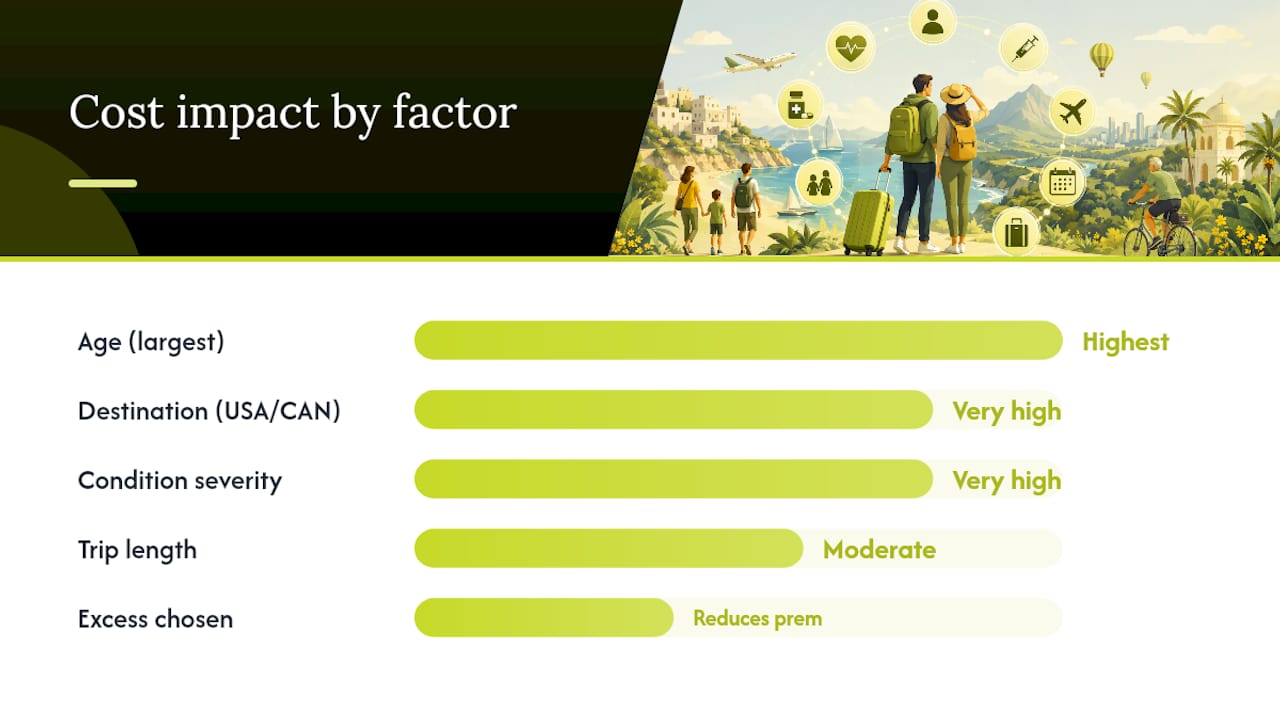
The main factors you can actively control are the excess, the add-ons you include, the policy type (single vs annual), and whether you buy within the waiver window. Destination and age are largely fixed, but choosing a specialist broker means the loading applied to your declared condition is negotiated rather than automatically applied at the highest rate.
For older travellers specifically, age limits vary considerably between providers. Some generalist policies cap cover at 65 or 70. Specialist brokers, including those on the Unparalleledglobalbenefits panel, can arrange cover for travellers well beyond those ages. The travel insurance for elderly travellers guide covers age-limit considerations in detail.
How does underwriting and medical screening work?
Insurers use underwriting to assess the risk your declared conditions represent. That assessment determines whether they accept your application, at what premium, and with what exclusions. Understanding the process removes most of the anxiety around it.
When you apply for a specialist policy, you will typically be asked:
- The name and diagnosis date of each condition you are declaring
- Current medications, doses, and how long you have been taking them
- Whether your condition has been stable (no new symptoms, no medication changes, no hospital admissions) within the look-back period
- Any planned or pending tests, referrals, or procedures
- Whether you have been hospitalised or had surgery in the past 12 to 24 months
- Your GP’s contact details (some insurers request a medical report for complex conditions)
Insurers may also request supporting documents. Preparing these before you apply speeds up the process considerably:
- A current medication list with doses and prescribing GP details
- Discharge letters from any recent hospital admissions
- A GP summary or recent consultation notes if the insurer requests them
- Specialist letters or clinic reports for ongoing conditions
Non-disclosure is the single most damaging mistake a traveller with a medical condition can make. If you omit a condition and then make a claim related to it, the insurer can decline the claim and, in some cases, void the entire policy. The financial exposure from an uninsured overseas medical emergency far exceeds any premium saving from non-disclosure.
How to buy travel insurance with pre-existing conditions: a step-by-step guide
The buying process is straightforward when you know what to prepare. Red flags are equally important to recognise before you commit.
Step-by-step:
- List every condition you need to declare, including medications and recent medical activity.
- Contact specialist brokers rather than generalist comparison sites. Brokers with specialist panels can access underwriting that standard platforms cannot.
- Ask specifically about waivers of pre-existing conditions and whether your conditions qualify.
- Compare at least three quotes, checking the emergency medical limit, repatriation cover, and declared-condition status on each.
- Choose your excess deliberately, balancing premium reduction against the amount you could absorb on a claim.
- Buy within the insurer’s eligible timeframe if a waiver applies, typically at or shortly after your first trip deposit.
- Read the policy wording before paying, specifically the exclusions section and the claims process.
Questions to ask when getting quotes:
| Question | Why it matters |
|---|---|
| Is my declared condition covered or excluded? | Confirms whether the policy actually protects your specific risk |
| What is the emergency medical expenses limit? | Low limits leave you exposed to large overseas bills |
| Is repatriation included, and what is the limit? | Repatriation can cost tens of thousands of pounds without cover |
| Is there a 24/7 emergency assistance helpline? | Essential for coordinating care abroad, especially in a medical crisis |
| Does the insurer pay hospitals directly? | Direct payment avoids you funding costs upfront and claiming back |
| What is the claims process if I need treatment abroad? | Knowing this before you travel reduces stress in an emergency |
Red flags to watch:
- Policy wording that uses vague language around “pre-existing conditions” without defining the look-back period
- No named emergency medical expenses limit, or a limit below £1 million
- No 24/7 emergency assistance helpline listed in the policy documents
- An insurer or broker who suggests not declaring a condition to keep the price down
- An unclear or multi-step claims process with no direct hospital payment option
Gov.uk’s foreign travel insurance guidance recommends checking policy documents carefully, particularly around emergency medical and repatriation cover. That check takes ten minutes and can prevent a very expensive surprise.
Why Unparalleledglobalbenefits and EktaTraveling are the right route for travellers with medical conditions
Using a specialist broker is the fastest way to find competitively priced cover for pre-existing conditions. Brokers search specialist underwriting panels, manage the declaration process, and negotiate terms that a generalist platform applies automatically and often punitively. Unparalleledglobalbenefits does exactly this, with a focus on travellers whose medical history makes standard policies unsuitable or unaffordable.
What Unparalleledglobalbenefits arranges for this audience:
- Specialist underwriting support for declared conditions, including complex and multiple conditions
- Policy comparison across specialist panels, not just generalist aggregators
- Document handling and submission support for medical screening requirements
- 24/7 emergency assistance as a standard feature of arranged policies
- Cover options for older travellers, including those beyond the age limits of standard policies
- FCA-regulated broker status, meaning you have recourse through the Financial Ombudsman Service if something goes wrong
For a practical overview of how to compare travel insurance with medical conditions, the Unparalleledglobalbenefits guide walks through the key comparison criteria in detail.
Planning a trip for yourself, a resident, or visiting family? UGB + Ekta can arrange travel insurance for seniors up to 100 years old. Just click here: Ektatraveling and add the promo code “UGB” to receive an additional 10% discount.
Watch this short guide for more on arranging cover with a pre-existing condition:
The broker route is the one most people with medical conditions overlook
There is a tendency, when searching for cheap travel insurance with medical conditions, to start with a price-comparison site and then feel disheartened when the quotes come back loaded or declined. That experience leads some people to either buy inadequate cover or travel uninsured, both of which are far more expensive outcomes than a slightly higher specialist premium.
The broker route is not a premium product for wealthy travellers. It is simply a more efficient way to access the same underwriting market, with someone who knows how to present your medical history in a way that gets a fair assessment rather than an automatic loading. Prioritise adequate emergency medical cover first, then use the cost levers described above to bring the premium to a manageable level. The two goals are compatible, and a specialist broker is the most reliable way to achieve both simultaneously.
Arrange your specialist cover through Unparalleledglobalbenefits today
Unparalleledglobalbenefits gives travellers with pre-existing conditions a direct route to specialist underwriting, without the frustration of generalist platforms that decline or overload medical risk. Whether you need a single-trip policy for a holiday or longer-term cover as an expat, the team can arrange a policy that actually covers what matters. For those who need broader international cover, the international expat health insurance options are worth reviewing alongside a standard travel policy.
Planning a trip for yourself, a resident, or visiting family? UGB + Ekta can arrange travel insurance for seniors up to 100 years old. Just click here: https://ektatraveling.com/?partner_uid=808 and add the promo code “UGB” to receive an additional 10% discount.
Sources
- Pre-existing medical conditions (ABI)
- Does my health insurance cover international travel? (NHS — GHIC guidance)
- Gov
- Travel insurance for pre-existing conditions (NerdWallet)
- Travel insurance guidance (U.S. Department of State)
Recommended
- Travel medical insurance comparison: UK guide 2026 – Unparalleled Global Benefits
- Compare travel insurance with medical conditions: 2026 guide – Unparalleled Global Benefits
- Go compare travel insurance with medical conditions: 2026 guide – Unparalleled Global Benefits
- Travel Insurance with Medical Conditions – Securing Global Cover – Unparalleled Global Benefits