
The fastest way to make real progress is a small, daily routine that combines comprehensible input, early speaking practice, and spaced review. This guide gives you a six-step week-one plan, three copyable study templates, and a clear map of which tools to use and when, all grounded in educational psychology and Lancaster University research.
Your five-step starter checklist (act on this today):
- Pick one language and write down a single, specific reason you want it
- Download Anki and add your first 20 high-frequency words in your target language
- Find one piece of audio or video content at beginner level (a graded podcast or YouTube channel)
- Book or schedule your first speaking session for day 7, even if it feels too soon
- Set a daily 15-minute calendar block and protect it like a meeting
Pro Tip: Start speaking badly on purpose. A small core of high-frequency words is enough to begin real conversation, and the mistakes you make in week one are the fastest feedback you will ever get.
Key takeaways
The most effective approach to learning a new language combines comprehensible input, spaced vocabulary review, and speaking practice from week one, structured into short daily sessions of 60 minutes or less.
| Point | Details |
|---|---|
| Start SRS immediately | Add your first 20 words to Anki today in batches of seven or fewer for better recall. |
| Speak from week one | Schedule a Tandem or italki session before you feel ready; production builds fluency faster than passive input alone. |
| Use the 15/30/15 template | Split daily sessions into input, structured lesson, and output to cover all three acquisition pillars. |
| Set realistic hour targets | B1 in a Category I language takes roughly 350–400 guided hours; 5–7 hours per week of active practice drives meaningful progress. |
| Track progress monthly | Record yourself speaking for two minutes each month to detect plateaus and measure real gains. |
Table of Contents
- How to start learning a new language: your week-one plan
- Three principles that actually drive language progress
- Techniques mapped to each skill you need to build
- Which tools fit where in your study plan
- Realistic timelines and what language learning costs in the UK
- Common mistakes that stall progress and how to fix them
- How to create immersion and practice opportunities in the UK
- Three study plan templates you can copy today
- What I have learnt about sticking with a language
- If you are heading abroad, sort your cover too
- Sources
How to start learning a new language: your week-one plan
Most people spend the first week downloading apps and reading about methods. Skip that. The goal of week one is to build a repeatable habit and get your mouth moving.
The six-step week-one progression:
- Set a specific goal. “I want to hold a five-minute conversation in Spanish by week eight” is a goal. “I want to learn Spanish” is not. Specific goals help create measurable checkpoints.
- Source your starter vocabulary. Identify a core set of the most common words in your target language. Frequency lists are available for every major language. Add them to Anki in batches of seven or fewer.
- Run your first 15/30/15 micro-session. Morning: 15 minutes of Anki review. Lunch: 30 minutes of graded listening or a Babbel lesson. Evening: 15 minutes of writing three sentences or shadowing a short audio clip.
- Attempt your first speaking session. Use Tandem or italki to find a language partner or tutor. A five-minute voice message counts. The point is production, not perfection.
- Set up your SRS (spaced repetition system). Anki is free and the most widely used option. Configure it to show new cards daily and review due cards before adding more.
- Do a weekly review on day 7. Count how many words you can recall without prompting, record yourself speaking for two minutes, and note what felt hardest.
Sample daily micro-session schedule:
| Time slot | Duration | Activity | Tool |
|---|---|---|---|
| Morning | 15 min | SRS vocabulary review | Anki |
| Lunchtime | 30 min | Graded listening or structured lesson | Babbel / podcast |
| Evening | 15 min | Shadowing or short writing | Audio clip / journal |
On busy days, collapse this to a single 15-minute Anki session. Consistency over volume, always. The measurable outcome for week one: hold a five-minute conversation, even a halting one, by day 7.
According to evidence-based language learning research, short, repeatable study templates like the 15/30/15 format reduce early dropout and accelerate conversational ability compared with longer, irregular sessions.
Three principles that actually drive language progress
Understanding why something works helps you protect it when motivation dips. These three pillars, drawn from second-language acquisition research and educational psychology, explain most of what separates fast learners from slow ones.

Comprehensible input
Language slightly above your current level, what researcher Stephen Krashen called “i+1,” is the primary driver of natural acquisition. Rote grammar study builds rules you can recite; comprehensible input builds patterns you can use. BBC Future’s review of Lancaster University research confirms that statistical learning and graded input are powerful early-stage mechanisms, and that immersion only helps when the learner actively engages with material they can mostly understand.
Comprehensible output
Listening and reading alone will not produce a speaker. Output, attempting to produce language under real communicative pressure, forces your brain to notice gaps between what you want to say and what you can say. That noticing is what drives acquisition forward. The UNC Learning Center’s second-language guidance frames acquisition as three interlocking elements: comprehensible input, comprehensible output, and review with feedback. Remove any one of them and progress slows.
Spaced review and the testing effect
Distributed practice and retrieval practice produce reliably better long-term retention than massed practice or re-reading. Short-term memory has a limited capacity, so chunking vocabulary into small sets and self-testing repeatedly improves retention compared with long, massed study sessions.
Educational psychology meta-analyses place spacing and active retrieval among the top strategies for durable memory across all learning domains. In language learning, this translates directly to daily Anki reviews and self-testing rather than re-reading word lists.
Pro Tip: Begin speaking from week one, not week four. Passive-only study builds recognition but not production. The neural pathways for speaking are formed by speaking, not by listening more.
Techniques mapped to each skill you need to build
Knowing the principles is one thing. Having a menu of specific exercises you can slot into a 15-minute session is what keeps the habit alive.
Listening
- Shadowing: Play a short audio clip (10–30 seconds), pause it, and repeat the exact sounds and rhythm aloud. This trains pronunciation and listening simultaneously.
- Graded podcasts: Choose content at your level, not native-speed radio. Comprehensible input requires you to understand most of what you hear.
- Extensive listening: Background audio in your target language while commuting or cooking. Low-effort but useful for building familiarity with rhythm and phonology.
Speaking
- Script your first five conversations. Prepare phrases for greetings, ordering food, asking for directions, and describing yourself. Scripted practice removes the blank-mind panic.
- Use Tandem for low-stakes text and voice exchanges with native speakers. The asynchronous format suits beginners who need thinking time.
- Book a structured lesson on italki with a community tutor for conversational practice, or a professional tutor for grammar correction.
Reading
- Start with graded readers, not novels. Publishers such as Penguin Readers and Assimil produce level-labelled texts. These give you comprehensible input in written form.
- Extensive reading at a comfortable level builds vocabulary through context, which is more durable than list memorisation.
Writing
- Keep a short daily journal in your target language. Three sentences is enough in week one; expand as vocabulary grows.
- Post short texts in a language exchange app and ask for corrections. Written feedback is easier to process than spoken correction in real time.
Vocabulary
- Add new words to Anki in context-rich sentences, not isolated translations. “El gato bebe leche” is stickier than “gato = cat.”
- Chunk new vocabulary into groups of seven or fewer. Working memory holds roughly seven items, so smaller batches produce better recall during review.
Practical activities including shadowing, micro-conversations, and graded reading produce measurable gains quickly when combined with spaced review and speaking practice.
Pro Tip: When a tutor or language partner corrects you, write the correction down immediately and use the corrected phrase three times in the same session. Error-focused feedback only sticks when you act on it in the moment.
Which tools fit where in your study plan
The question is never “which app is best?” It is “which tool does which job?” Each of the following serves a specific role. Using them all for the same purpose wastes time.
| Tool | Best for | Cost model | Primary skill focus | Role in your study plan |
|---|---|---|---|---|
| Duolingo | Daily habit and first core words | Free; Plus subscription available | Vocabulary, basic grammar | Morning micro-habit anchor; not a standalone method |
| Babbel | Structured grammar and conversation phrases | Subscription (monthly or annual) | Grammar, speaking phrases | Lunchtime structured lesson slot |
| Anki | Spaced repetition vocabulary review | Free (desktop and Android); small iOS fee | Vocabulary retention | Daily SRS review; morning and evening slots |
| italki | Tutor-led conversation and grammar correction | Per-lesson (community tutors from approx. £5–£10; professional tutors higher) | Speaking, listening, grammar | Weekly or fortnightly structured speaking session |
| Tandem | Peer language exchange | Free; premium features available | Speaking, writing | Low-stakes daily or weekly exchange with a native speaker |
| British Council | Structured learning, grammar reference, UK-based courses | Free online resources; paid courses vary | Grammar, all skills | Grammar reference and UK-based classroom options |
Successful self-learners generally use a four-part stack: a content source, spaced review, audio input slightly above level, and speaking practice from week one. Apps are excellent habit anchors but rarely sufficient on their own.
A note for UK readers: If you are a beginner, a free Tandem exchange partner is a good starting point for speaking practice. Move to a paid italki tutor when you need structured feedback on grammar or profession-specific language, such as medical or legal vocabulary. The British Council’s free online grammar resources are worth bookmarking regardless of level.
Realistic timelines and what language learning costs in the UK
How long will this take? The honest answer depends on which language you are learning and how many hours per week you put in.
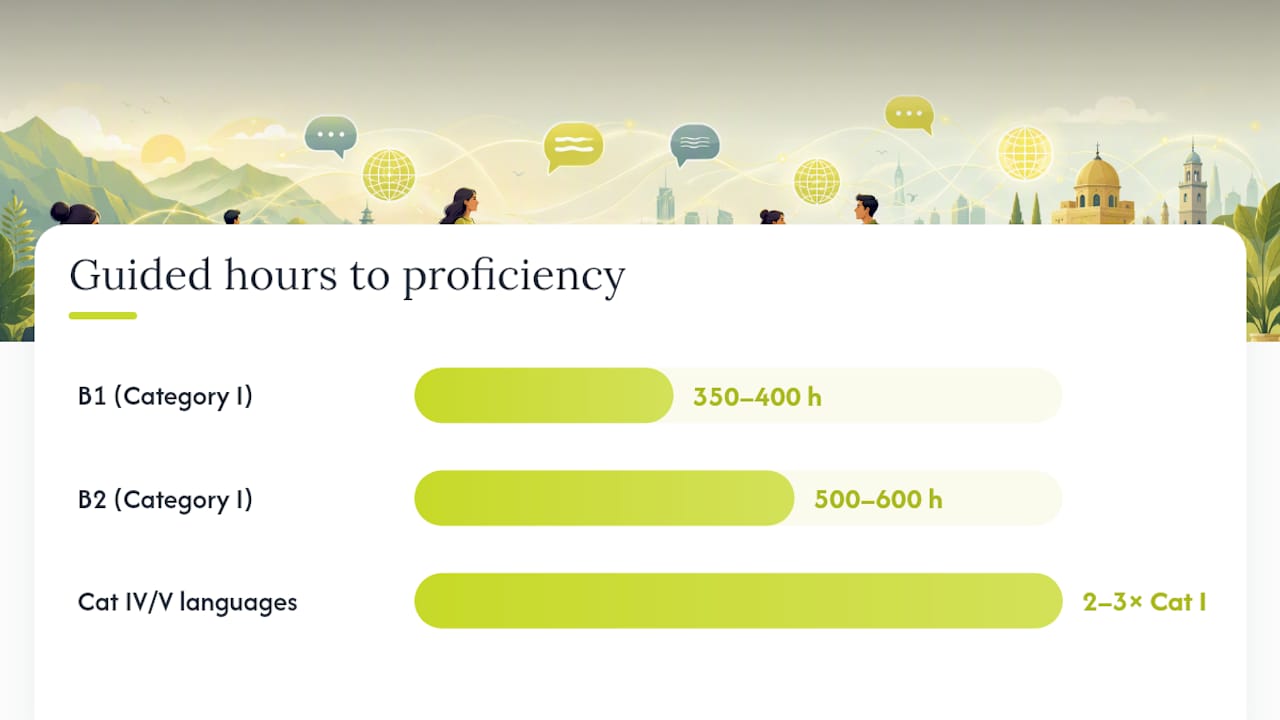
Cambridge-aligned and FSI-style estimates place B1 proficiency at roughly 350 to 400 guided hours are commonly estimated for B1 proficiency, and 500 to 600 guided hours for B2 in Category I languages such as Spanish, French, Italian, and Portuguese, which have significant structural overlap with English. Category IV and V languages such as Arabic, Mandarin, Japanese, and Korean require considerably more time, often two to three times as many hours, because the distance from English is far greater.
Weekly-hour scenarios:
- About half an hour daily on average each week: Expect B1-level conversational ability in a Category I language in roughly 24–30 months of consistent study.
- 60 minutes daily (7 hours/week): The same B1 milestone becomes achievable in approximately 12–15 months. Coursera’s language learning guidance cites 5–7 hours per week of active practice as the minimum for meaningful progress.
Typical UK costs:
- Apps (Duolingo Plus, Babbel): Subscription costs vary; check current pricing directly with each provider as rates change regularly.
- Anki: Free on desktop and Android. A one-off fee applies for the iOS app.
- italki tutors: Community tutors typically charge in the range of £5–£15 per hour; professional tutors generally charge more. Rates are set by individual tutors and vary widely.
- British Council courses: In-person and online course fees vary by level and location; check the British Council website for current UK pricing.
- Graded readers: Typically £5–£12 per book from major UK booksellers.
The most cost-effective stack for a UK beginner is Anki (free) plus one free Tandem exchange per week plus a paid italki session once a fortnight. That covers SRS, peer speaking, and structured feedback for a modest monthly outlay.
Common mistakes that stall progress and how to fix them
Most learners plateau not because the language is too hard, but because of a handful of fixable habits.
Red flags to fix this week:
- Passive-only study. Watching films and listening to podcasts without producing output feels productive but builds recognition, not fluency. Add a speaking or writing task to every session.
- Skipping speaking until you feel “ready.” Readiness never arrives on its own. Schedule a speaking session before you feel confident. Discomfort is the signal that learning is happening.
- Cramming vocabulary in long lists. Working memory holds roughly seven items. Long unstructured lists produce poor recall. Use Anki with small daily batches instead.
- Ignoring feedback. Corrections from tutors or exchange partners are the highest-value input you will receive. Write them down and use them immediately.
- Tool-hopping. Switching between apps every two weeks resets your habit without building depth. Pick your stack and stay with it for at least eight weeks before evaluating.
Pro Tip: Record yourself speaking for two minutes at the end of each month. Play it back. You will notice progress you cannot feel in the moment, and you will spot specific pronunciation or grammar patterns worth targeting next.
How to create immersion and practice opportunities in the UK
You do not need to move abroad to surround yourself with a language. The UK has more resources for this than most learners realise.
Local opportunities:
- Language cafés operate in most UK cities. Meetup.com and local library noticeboards are the fastest way to find them.
- University language departments often run free or low-cost conversation groups open to the public.
- Cultural centres and embassies (the Institut Français, the Goethe-Institut, the Instituto Cervantes) run events, film screenings, and conversation evenings in major UK cities.
- Community centres in areas with large diaspora populations offer informal immersion that no app can replicate.
Building a digital immersion environment:
- Change your phone’s language settings to your target language. Friction creates exposure.
- Follow social media accounts, YouTube channels, and podcasts in your target language. Prioritise content you would watch in English anyway.
- Use a browser extension such as Language Reactor to add dual subtitles to Netflix content.
- Volunteer for community interpreting or translation projects through organisations such as Translators Without Borders, which builds real-world vocabulary fast.
The immersion illusion is worth naming: passive presence in a language environment, background TV, ambient music, does not reliably produce acquisition. Design your immersion with graded, slightly challenging input and active tasks. Passive exposure supplements active learning; it does not replace it.
If your goal is profession-specific language, such as healthcare or legal terminology, a paid tutor with subject-matter knowledge is worth the investment. Understanding how language barriers affect healthcare quality makes clear why precision in professional contexts matters beyond conversational fluency.
Three study plan templates you can copy today
Choose the template that fits your current schedule. Each one distributes time across input, output, and review in a ratio that reflects the research.
The 15/30/15 template (recommended for beginners) runs as: 15 minutes of Anki review, 30 minutes of graded listening or a structured lesson, 15 minutes of speaking or writing output. Total: one hour per day, split into three slots that fit around work.
The 30-minute daily template suits learners who cannot split their day. Use the first 15 minutes for input (graded audio or reading) and the second 15 minutes for SRS review. Add a weekly 30-minute speaking session on top.
The weekend boost template works for learners with demanding weekday schedules. Spend Saturday on input (a film, graded reading, or a long podcast) and Sunday on output (a tutored lesson or a long Tandem exchange). Mid-week, run a 10-minute Anki session only.
When to scale up: if you are completing your daily sessions without effort and your weekly review shows strong recall, add 15 minutes of output.
Regular self-recording and monthly progress checks are reliable, low-cost methods to track speaking progress and detect plateaus early.
What I have learnt about sticking with a language
Language learning is one of the few skills where the gap between knowing what to do and actually doing it is almost entirely psychological. The research is clear: comprehensible input, spaced review, and early speaking produce results. The harder question is why so many people abandon the process in month two.
From what I have seen, the learners who persist are not the ones with the most time or the best apps. They are the ones who accepted early discomfort as evidence of progress rather than evidence of failure. Speaking badly in week one is not a setback. It is the fastest feedback loop available to you. If you are working abroad or planning to, the practical returns on even basic conversational ability are immediate and significant.
The tools in this guide are all real and all useful. But no tool replaces the decision to show up daily, speak imperfectly, and review what you got wrong. That decision is the method.
If you are heading abroad, sort your cover too
Learning a language often goes hand in hand with travel, study, or relocation. If you are planning an immersion trip, a language course abroad, or a longer stay overseas, having the right insurance in place is as important as your study plan.
Unparalleledglobalbenefits specialises in expat, travel, and visitor health insurance for people living, working, or studying internationally. Whether you are a student heading to Spain for a semester, a professional relocating to Germany, or a family planning an extended stay, the right cover protects everything you have worked towards. Explore expat health insurance options or review types of expat insurance to find the cover that fits your plans.
Planning a trip for yourself, a resident, or visiting family? UGB + Ekta can arrange travel insurance for seniors up to 100 years old. Just click here: EKTA travel insurance and add the promo code UGB to receive an additional 10% discount.
Sources
- Educational and cognitive psychology evidence for spacing and testing effects (APA journal DOI)
- Learning a second language — The Learning Center (UNC)
- What’s the best way to learn a new language? — BBC Future
- The Best Ways to Learn a Language in 2026: What the Research Actually Says – HelloTalk Blog
- How to learn a new language — Coursera article
- Morso
Watch this short video for more practical language learning tips:
Recommended
- Guía para aprender idioma en el extranjero: opciones clave – Unparalleled Global Benefits
- Is Learning Another Language Worthwhile Whilst Working Abroad? – Unparalleled Global Benefits
- Understanding Language Barriers in Healthcare: Key Insights – Unparalleled Global Benefits
- Sip, Relax, and Explore: The Expat’s Guide to Enjoying Life Abroad – Unparalleled Global Benefits