TL;DR:
- Medical evacuation involves urgent patient transfer with active medical care when local facilities cannot provide necessary treatment. Acting quickly by contacting your insurer’s assistance center before any arrangement is critical to avoid delays and excessive costs.
Medical evacuation (medevac) is the urgent movement of a patient, with clinical care provided en route, when local facilities cannot deliver the treatment needed. If you or someone you are travelling with needs one, the single most important action is to call your insurer’s 24/7 assistance centre immediately, before anything else.
If you are in an emergency right now:
- Call your insurer or assistance centre using the number on your policy card or app.
- Ask the local hospital to prepare a written medical summary, including diagnosis, current medications and vital signs.
- Have your policy number, passport number and next-of-kin contact ready before the call connects.
- Do not arrange or pay for transport independently until the assistance centre has authorised it.
Table of Contents
- What does medical evacuation actually mean?
- When is medevac the right call?
- How does a medevac actually work, step by step?
- Who pays for medevac, and how much does it cost?
- How do you arrange a medevac from abroad?
- What should you check when assessing an evacuation provider?
- Why early contact with an assistance centre changes everything
- UK consular, legal and regulatory points you need to know
- What happens after the transfer, and how do you make a claim?
- Key takeaways
- The part most people only learn the hard way
- How Unparalleledglobalbenefits can protect you before and during a medevac
- Useful sources and further reading
What does medical evacuation actually mean?
Medical evacuation is the timely movement of a patient using specialised, medically equipped transport staffed by trained clinical personnel. That last part matters. Medevac is not simply moving a patient from one place to another; it is moving them while actively managing their condition. A clinician, paramedic or critical-care nurse travels with the patient, monitors them throughout, and hands them over formally to the receiving team.
This distinguishes medevac from two related but different concepts. Routine patient transport moves a stable patient between facilities with no clinical oversight beyond basic first aid. Medical repatriation returns a patient to their home country once they are stable enough to travel, often on a commercial flight with a medical escort rather than a dedicated aircraft. Medevac sits at the more urgent, more clinical end of that spectrum.
The main transport types
Air ambulances and ground ambulances are the most common medevac vehicles, with maritime transfers used in offshore or island scenarios.
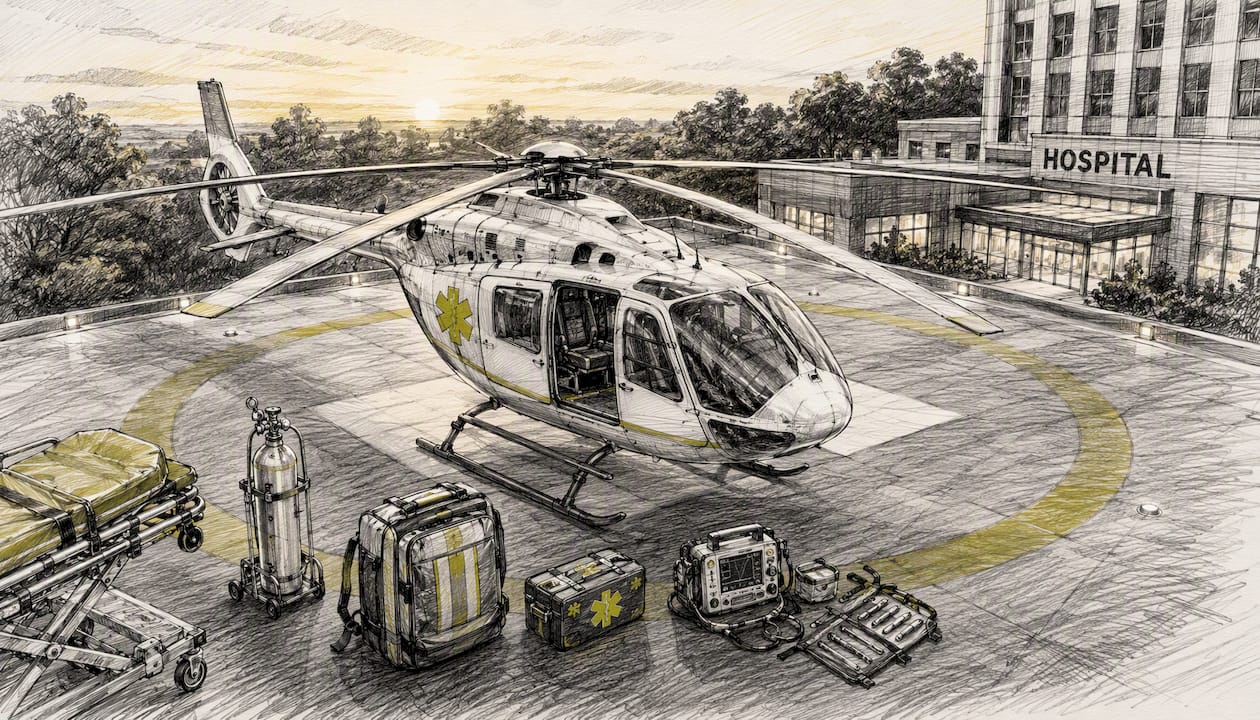
Helicopter: Used for short-range, time-critical transfers, typically within a few hundred kilometres. Helicopters can land at or near the incident site and are the standard choice for trauma, cardiac events and stroke when minutes count. Range and weather are the main constraints.
Fixed-wing air ambulance: The workhorse of international medevac. A pressurised, medically configured aircraft can carry intensive-care-level equipment and a full clinical team across continents. Most long-haul evacuations from remote or under-resourced locations use this type.
Ground ambulance: Used for shorter transfers, for patients who cannot fly due to clinical contraindications, or as the first and last legs of a multi-stage evacuation (hospital to airfield, then airfield to receiving hospital).
Maritime transfer: Relevant for cruise ship passengers, offshore workers and island-based incidents. A patient may be transferred by tender or coastguard vessel to a port before an air leg begins.
The choice of transport is never the patient’s to make. It is determined by clinical need, geography, aircraft availability and, in most cases, the insurer’s medical team.
When is medevac the right call?
Evacuation is a last resort. The priority is always patient stability; medevac becomes appropriate when local care cannot provide the definitive treatment the patient needs. CDC guidance is clear that the decision to evacuate rests with the insurer’s medical team or the assistance centre clinician, in consultation with the treating doctors, not with the patient or family.
Clinical triggers that typically prompt evacuation:
- The local facility lacks the specialist surgeon, equipment or blood products the patient needs.
- The patient’s condition is deteriorating and cannot be stabilised locally.
- Infection-control requirements (isolation for a communicable disease) exceed local capacity.
- Post-operative complications require specialist intervention unavailable in the region.
Operational triggers:
- The patient is in a remote location with no road or air access to adequate care.
- A security or safety situation makes remaining in the area dangerous.
- The evacuation corridor (the route to a capable facility) is impractical without dedicated logistics.
Who actually decides? The treating clinician at the local hospital assesses the patient and communicates their findings to the insurer’s assistance centre. The assistance centre’s own medical team reviews that assessment, considers transport risk, and authorises the evacuation. Family members can advocate, but they cannot override this clinical and contractual process.
Pro Tip: Call the assistance centre the moment a patient is admitted to a foreign hospital, not when things deteriorate. Early notification gives the clinical team time to review the case, pre-position aircraft and begin regulatory clearances, all of which can shorten mobilisation time by hours.
How does a medevac actually work, step by step?
Understanding the sequence helps you know what to expect and what to prepare. Evacuations commonly involve multiple transport legs, and each handoff requires its own coordination, equipment checks and sometimes separate authorisations.
Step 1: Clinical assessment and stabilisation. The local treating team assesses the patient and determines that evacuation is necessary. They stabilise the patient to the extent possible and produce a written medical summary. A “fit-to-fly” assessment confirms the patient can tolerate the transport conditions, including cabin pressure, vibration and duration.
Step 2: Assistance centre activation. You or the hospital contacts the insurer’s 24/7 assistance centre. The centre’s medical team reviews the clinical summary, confirms the evacuation decision, identifies the most appropriate receiving facility, and begins logistics planning. This includes selecting the aircraft type, assembling the medical crew, filing flight plans and obtaining overflight and landing permissions.
Step 3: Transport mobilisation. The medical crew collects specialist equipment (ventilators, infusion pumps, monitoring systems, medications) and travels to the patient’s location. A ground ambulance typically moves the patient from the hospital to the nearest suitable airfield.
Step 4: The air leg. The patient is transferred to the air ambulance with a full clinical handover from the local team. The escort clinician manages the patient throughout the flight, communicating with the receiving hospital as needed.
Step 5: Receiving hospital handover. On arrival, a second ground ambulance transfers the patient to the receiving facility. The escort clinician provides a formal handover, including all clinical notes, medication records and imaging. The receiving team confirms acceptance before the aircraft departs.
Documents to prepare before or during the process:
- Passport and any relevant visa documentation.
- Insurance policy number and assistance centre contact details.
- Written medical summary from the treating hospital (diagnosis, medications, vital signs, imaging reports).
- Full medication list with dosages.
- Next-of-kin contact details and written consent where required.
- Any advance directives or power of attorney documentation.
For a practical checklist you can use when calling an assistance centre, the emergency medical evacuation guide from Unparalleledglobalbenefits covers the key contact templates and documentation steps.
Who pays for medevac, and how much does it cost?
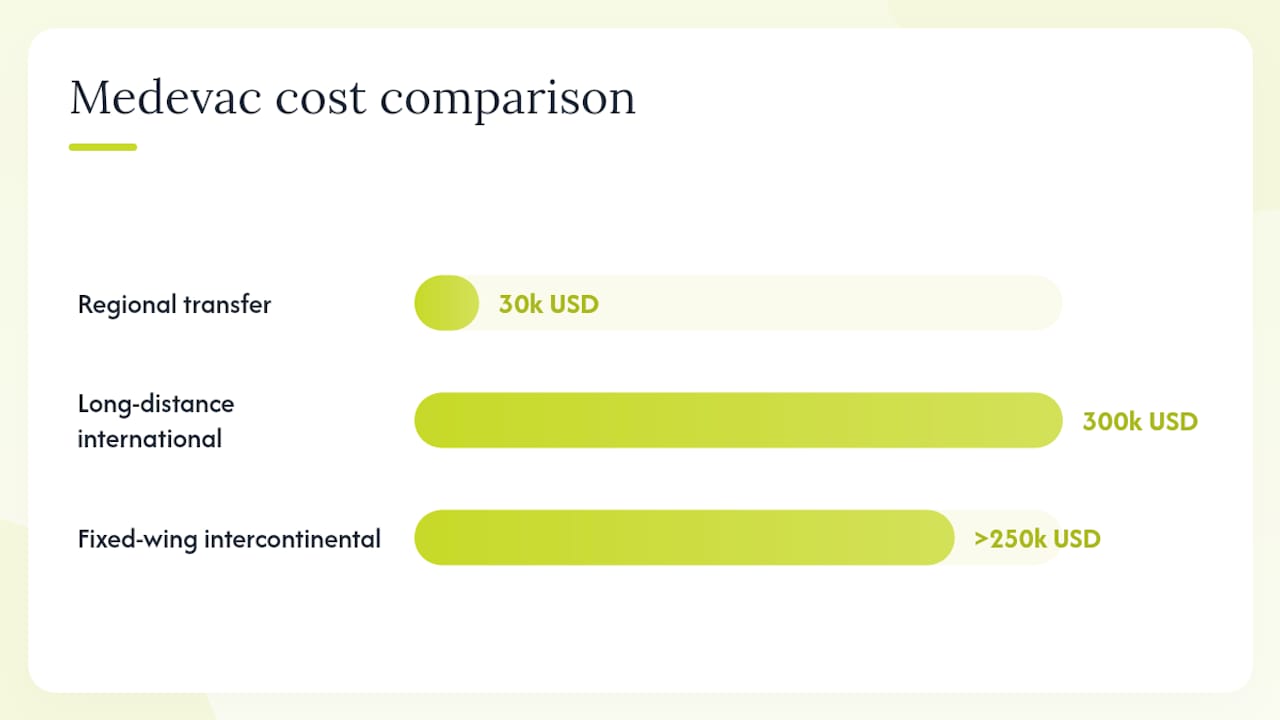
Cost is the most common shock in a medevac situation. According to CDC data, typical medevac costs range from several tens of thousands of US dollars for regional transfers to several hundred thousand US dollars for long-distance international evacuations. Clinical complexity, isolation requirements and the distance involved all push costs upward.
| Transport type | Typical cost range | Key cost drivers |
|---|---|---|
| Ground ambulance (regional) | — | Distance, clinical crew level |
| Helicopter (short-range) | — | Distance, terrain, crew |
| Fixed-wing (regional, e.g. within Europe) | — | Aircraft type, clinical team, permissions |
| Fixed-wing (intercontinental) | more than USD 250,000 | Distance, isolation measures, multi-leg coordination |
Cost reality check: A single long-haul medevac can cost more than USD 250,000. Medical evacuation insurance, by contrast, is typically a fraction of that cost as an annual premium. The financial case for cover is straightforward.
Who actually pays?
In most cases, the insurer pays the provider directly. Direct billing from the medevac provider to the insurer is standard practice because upfront patient payment is often prohibitively expensive. You should confirm your policy includes direct-billing arrangements before you travel.
Some patients pay upfront and seek reimbursement later. This carries risk: reimbursement is not guaranteed if the evacuation was not pre-authorised, and the sums involved can be financially devastating.
Within the UK, NHS transfers between hospitals are arranged and funded through NHS systems. However, the NHS does not cover international evacuations to the UK, and it does not fund repatriation from abroad. That responsibility falls entirely to the patient’s insurer or, in the absence of cover, to the patient.
Key cost factors to understand:
- Distance and number of transport legs.
- Aircraft type and medical configuration required.
- Clinical complexity (intensive care vs. stable monitored patient).
- Infection-control or isolation requirements.
- Overflight and landing permissions (some countries charge significant fees).
- Clinician escort grade (paramedic vs. critical-care physician).
Always request a written quote before any non-emergency transport is arranged. For planned repatriations, a reputable provider will give you a cost estimate in writing before mobilisation. For information on what typical medevac cover includes, the medevac coverage guide from Unparalleledglobalbenefits explains policy wording and direct-billing practices clearly.
Some specialist membership programmes include “evacuation by choice” clauses, allowing repatriation even when local care is available. These are rare in standard travel insurance policies and worth verifying explicitly if you want that flexibility.
How do you arrange a medevac from abroad?
The process differs slightly depending on whether you are the patient, a travelling companion, or a family member calling from the UK.
If you are abroad and the patient has just been admitted:
- Stabilise. Do not move the patient without medical guidance.
- Ask the local hospital for a written medical summary in English if possible, or request a translation service through your assistance centre.
- Call your insurer’s 24/7 assistance centre. Give them: the patient’s full name, date of birth, policy number, current location, hospital name and phone number, and a brief clinical summary.
- Do not arrange or pay for any transport until the assistance centre has reviewed the case and authorised the move.
- Keep a written log of every call, including time, name of the person you spoke to and what was agreed.
If you are calling from the UK on behalf of a family member abroad:
The assistance centre will ask for the same information. They will also ask for written consent from the patient (or next-of-kin authority if the patient cannot consent) before sharing clinical details or arranging transport. Have that documentation ready, or ask the centre how to provide it quickly.
What UK consular services can do:
The UK embassy or consulate in the country where the patient is located can provide a list of local medical facilities and English-speaking doctors, help contact family in the UK, and assist with emergency travel documents if a passport is lost. They cannot pay for medical treatment or evacuation, arrange transport, or intervene in clinical decisions.
Communication tips to speed mobilisation:
- Photograph all prescription labels and medication packaging.
- Send the medical summary by email to the assistance centre as well as reading it over the phone.
- Confirm the receiving hospital’s name and contact details with the assistance centre before the transport departs.
- Keep a family member or friend as a single point of contact with the assistance centre to avoid conflicting information.
What should you check when assessing an evacuation provider?
Whether you are choosing an insurer before travel or assessing a provider mid-crisis, these questions separate operationally capable services from those that look good on paper.
Non-negotiable verification points:
- Does the assistance centre operate 24 hours a day, seven days a week, with a physician available at all times (not just a call handler)?
- Can they provide a clinician escort on the aircraft, and at what clinical grade (paramedic, nurse, physician)?
- Is the aircraft medically configured for the patient’s specific needs (ventilator, isolation pod, neonatal equipment)?
- Do they have documented regional experience in the countries where you will be travelling?
Regulatory and licensing questions:
- Are they licensed to operate air ambulance services in the relevant countries?
- Do they hold the necessary overflight and landing permissions, or do they have a track record of obtaining them quickly?
- Are they registered with relevant UK or international aviation authorities?
Payment and contractual questions:
- Does the policy or membership include direct billing to the insurer, or will you be expected to pay upfront?
- Is a written cost estimate provided before non-emergency transport is arranged?
- What are the exclusions? Does the policy cover pre-existing conditions, adventure activities, or conflict zones?
- Does the policy include an “evacuation by choice” clause, or only medically necessary evacuation?
Pro Tip: Three checks that reveal genuine operational depth: ask whether the provider has formal agreements with hospitals in your destination country (not just a general network); ask how they handle multi-leg evacuations where different aircraft operators are involved; and ask whether their operations centre has multilingual staff. A provider that hesitates on any of these three questions is worth scrutinising further.
Why early contact with an assistance centre changes everything
The most common and most avoidable mistake in a medevac situation is waiting too long to call. International SOS and other assistance specialists consistently emphasise that early notification allows clinical and logistics teams to begin assessment before a situation deteriorates, which can shorten mobilisation time significantly.
Here is what typically goes wrong when people delay:
- The patient’s condition worsens while the family tries to manage the situation locally, making transport riskier and more expensive.
- The patient or family pays cash for local transport or a commercial flight, then discovers the insurer will not reimburse an unauthorised transfer.
- Documentation is incomplete or missing, causing the assistance centre to spend hours gathering information that should have been ready on the first call.
- The family assumes a commercial flight is an option, not realising that most airlines will not accept a patient on supplemental oxygen or with an active IV line without prior medical clearance.
A practical example: a traveller admitted to a regional hospital in Southeast Asia with a cardiac event. The family waits 36 hours before calling the insurer, believing the local hospital can manage the situation. By the time the assistance centre is contacted, the patient’s condition has deteriorated, the required aircraft now needs a higher-grade clinical crew, and the receiving hospital in the UK needs 12 hours’ notice to prepare a cardiac catheterisation suite. Total mobilisation time: 52 hours. Had the call been made on admission, the clinical review would have begun immediately, the aircraft could have been pre-positioned, and the receiving hospital notified within hours of the original admission.
Pro Tip: When you call the assistance centre for the first time, give them five pieces of information immediately: patient name and date of birth, policy number, current hospital name and phone number, the treating doctor’s name, and the working diagnosis. That is enough for them to open a case and begin clinical review while you gather the rest.
UK consular, legal and regulatory points you need to know
What UK consular services can and cannot do
The Foreign, Commonwealth & Development Office (FCDO) provides guidance for British nationals in difficulty abroad, but its role in medevac is limited. Consular staff can provide a list of local medical facilities, help contact family, and assist with emergency travel documents. They cannot fund or arrange medical transport, and they have no authority over clinical decisions.
GOV.UK publishes a list of medical repatriation companies operating in the UK, which is a useful reference point when verifying a provider’s credentials or finding a repatriation service independently. This list does not constitute an endorsement of any company on it.
Regulatory considerations for cross-border transfers
Cross-border medical transfers involve multiple layers of regulation: aviation authority approvals in each country overflown or landed in, customs and import/export rules for medical equipment and controlled drugs, and patient consent requirements that vary by jurisdiction. A competent assistance centre manages all of this, but you should understand it exists so you are not surprised by delays.
Key regulatory points:
- Overflight and landing permissions can take hours or days in some regions. Providers with established relationships in a country can often obtain these faster.
- Controlled medications (opioids, sedatives) carried on the aircraft require specific documentation and may need to be declared at each border.
- Medical equipment crossing borders may require temporary import permits.
- Patient consent for transfer must be documented. If the patient lacks capacity, next-of-kin authority or a legal guardian’s consent is required. The rules on who qualifies as next of kin vary by country.
Practical consent and record-keeping
Keep a copy of any consent forms signed, a log of all clinical communications, and copies of all medical records provided to the transport team. These documents are essential for the insurance claim and may be required if any dispute arises about the clinical necessity of the transfer.
What happens after the transfer, and how do you make a claim?
Arrival at the receiving hospital is not the end of the process. The receiving clinical team will conduct their own assessment, reconcile the patient’s medications with their own formulary, and develop a discharge or ongoing care plan. Expect this to take at least 24–48 hours before any clear picture of ongoing treatment emerges.
Repatriation of personal effects and family travel:
If the patient was evacuated alone, the insurer’s assistance centre can often help arrange travel for a family member to accompany them or meet them at the receiving hospital. Repatriation of personal belongings, a vehicle left abroad, or a pet requires separate arrangements and is not typically covered under a standard medevac benefit.
Claims checklist:
- Itemised invoices from every provider involved (ground ambulance, air ambulance, receiving hospital).
- Transport logs showing dates, times, origin and destination of each leg.
- Clinical handover notes from the transferring and receiving hospitals.
- Written authorisation from the assistance centre for the evacuation.
- Copies of all correspondence with the assistance centre, including reference numbers.
- Your insurer’s claims form, completed in full, with the policy number on every page.
- Submit the claim as soon as possible. Most insurers set a deadline of 30–90 days from the date of the incident.
Key takeaways
Medical evacuation requires immediate insurer contact, clinical authorisation, and thorough documentation to avoid delays, unexpected costs, and claim disputes.
| Point | Details |
|---|---|
| Call first, move second | Contact your insurer’s 24/7 assistance centre before arranging any transport; unauthorised moves may not be reimbursed. |
| Costs can be very high for long-distance international evacuations | Long-distance international evacuations can cost over USD 250,000; insurance cover is the only realistic protection against this. |
| The insurer’s medical team decides | Evacuation is authorised by the assistance centre’s clinicians, not by the patient or family; early notification gives them time to act. |
| Documentation is critical | Prepare your policy number, medical summary, medication list and next-of-kin details before any call to the assistance centre. |
| Unparalleledglobalbenefits can help | Unparalleledglobalbenefits arranges international and expat medical evacuation insurance, with guidance on policy wording and direct-billing cover. |
The part most people only learn the hard way
There is a gap between what people expect from medevac cover and what standard travel insurance actually delivers, and it tends to surface at the worst possible moment.
Most travellers assume that if something goes seriously wrong abroad, their insurer will simply “sort it out.” The reality is more conditional. Standard travel insurance typically covers medically necessary evacuation only, authorised in advance by the insurer’s medical team. It does not cover evacuation because you would prefer to be treated at home, because the local hospital feels uncomfortable, or because a family member is worried. The clinical bar for authorisation is real.
What this means practically: the quality of your assistance centre matters as much as the policy limit. A policy with a high medevac benefit but a poorly staffed assistance centre, one that cannot reach a physician at 3 AM on a Sunday, is worth considerably less than a policy with a lower limit backed by a 24/7 physician-staffed operations centre with regional experience.
The other thing people underestimate is the multi-leg nature of most international evacuations. Ground to airfield, airfield to destination country, airfield to receiving hospital. Each leg is a separate logistical event with its own authorisations, crew, and equipment checks. A provider that has managed hundreds of these sequences in a specific region will handle complications that a less experienced operator will not anticipate.
Choose cover before you travel. Verify the assistance centre’s clinical staffing, not just the policy limit. And call them the moment a patient is admitted to hospital, not when things look serious.
How Unparalleledglobalbenefits can protect you before and during a medevac
When a medevac situation arises, having the right cover in place is what separates a managed crisis from a financial catastrophe. Unparalleledglobalbenefits specialises in international and expat insurance, including policies with direct-billing medevac cover, 24/7 assistance centre access, and clinical escort arrangements built in. Rather than leaving you to navigate policy small print under pressure, the team helps you verify medevac cover, understand exclusions, and confirm direct-billing arrangements before you travel.

Whether you need expat health insurance with medevac cover or a single-trip policy that includes emergency evacuation, Unparalleledglobalbenefits can match you with a plan suited to your destination, health profile and budget. For a deeper look at how medevac insurance works and what to check in your policy, the medical evacuation insurance guide covers the key terms and questions to ask.
Get in touch with Unparalleledglobalbenefits to request a quote or check your existing cover before your next trip.
Please note: Unparalleledglobalbenefits is an insurance broker and may receive commission on policies arranged. Always verify provider credentials, clinical oversight arrangements, and policy exclusions with the insurer directly before purchasing.
Planning a trip for yourself, a resident, or visiting family? UGB + Ekta can arrange travel insurance for seniors up to 100 years old. Just click here: https://ektatraveling.com/?partner_uid=808 and add the promo code “UGB” to receive an additional 10% discount.
For a helpful overview of medevac procedures and what to expect, watch this short guide:
Useful sources and further reading
- GOV.UK: Medical repatriation companies in the UK — Official UK government list of medical repatriation companies; a starting point for verifying provider credentials.
- CDC Yellow Book: Travel insurance, travel health insurance, and medical evacuation insurance — Authoritative guidance on medevac costs, decision authority and insurance considerations for international travellers.
- Medical evacuation — Wikipedia — Clear overview of medevac types, transport modes and clinical definitions.
- WHO: Medical evacuation in emergencies — WHO guidance on medevac standards and protocols in emergency settings.
- Unparalleledglobalbenefits: Medical evacuation insurance guide — Practical guide to policy terms, claims processes and what to check before travel.
- Unparalleledglobalbenefits: Medical evacuation procedures for travellers and expats — Step-by-step procedural overview for arranging evacuation from abroad.
Recommended
- Medical Evacuation Procedures: A Guide for Travelers and Expats
- Medical evacuation insurance: protecting your health abroad – Unparalleled Global Benefits
- What Is Emergency Medical Evacuation? Simple Guide for Travellers
- Medical evacuation and repatriation coverage explained – Unparalleled Global Benefits