

An au pair must hold a long-term travel and health insurance policy that covers medical expenses, medical evacuation and repatriation, and household personal liability that explicitly includes childcare activities. A standard short-term travel policy will not do. Au pair stays are residential and continuous, which means the liability risk is fundamentally different from a two-week holiday. The five non-negotiable clauses your policy must contain are: continuous cover for the full duration of your stay, 24/7 multilingual emergency assistance, repatriation at actual cost, personal liability that names childcare duties, and a visa-compatible insurance certificate you can present to a consulate or host family on request.
Table of Contents
- What does travel insurance for au pairs actually cover?
- Does your GHIC or EHIC cover you as an au pair?
- What proof of insurance do the different countries require?
- Who normally pays for au pair insurance?
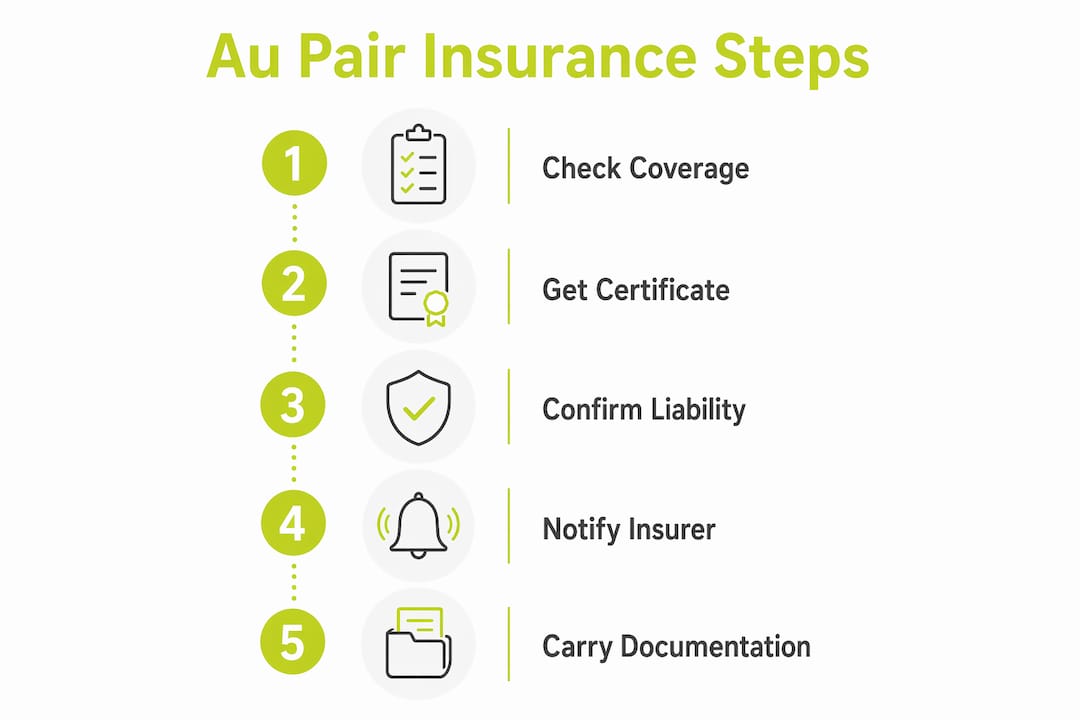
- How to buy the right au pair policy: a step-by-step checklist
- What does au pair insurance typically cost?
- What many insurers miss: childcare liability wording and policy red flags
- What to do if you need to claim or face an emergency abroad
- Key takeaways
- The wording gap that catches au pairs out
- Unparalleledglobalbenefits: au pair cover that covers what matters
- Useful official sources and further reading
What does travel insurance for au pairs actually cover?
A dedicated au pair policy is built around residential risk, not destination risk. That distinction shapes every line of the policy wording.
Core inclusions to look for:
- In-patient and out-patient medical treatment, including hospital stays and specialist consultations
- Emergency dental treatment (not routine check-ups)
- Medical evacuation and repatriation to your home country at actual cost
- 24/7 multilingual emergency assistance with a dedicated helpline number
- Personal liability for incidents arising from household duties and childcare activities
- Accidental injury cover for the au pair
- Luggage loss or damage and travel delay (where included in the plan tier)
The liability clause is the one most au pairs overlook. Childcare liability must explicitly name childcare activities in the wording. A generic “personal liability” clause that covers you as a private individual may not extend to an incident involving a child in your care, because the insurer could argue you were acting in a quasi-professional capacity.
Common exclusions to check:
- Routine dental and optical care
- Pre-existing medical conditions (unless declared and accepted)
- Sporting activities beyond everyday recreation
- Territorial limits that exclude certain countries or regions
- Cover lapses during a host family change if the policy is not portable
| Cover item | What it protects against | Why it matters for au pairs |
|---|---|---|
| In-patient medical | Hospital admission costs | Medical bills abroad can reach tens of thousands of pounds |
| Repatriation | Cost of returning home for treatment | Standard travel policies often cap or exclude this |
| Personal liability (childcare) | Injury or damage caused to a child or third party | Uncovered claims can be financially devastating |
| 24/7 assistance | Emergency coordination and translation | Critical when you do not speak the host country’s language |
| Continuity on family change | Cover gap if you move to a new host family | Gaps expose you to uninsured liability periods |
| Emergency dental | Acute dental pain or injury | Routine dental is almost always excluded |
When you read a policy document, look for the liability section and search for the words “childcare”, “babysitting”, or “household employment”. If none of those words appear, ask the insurer in writing whether an incident involving a child in your care is covered before you sign.
Does your GHIC or EHIC cover you as an au pair?
The short answer is no, not adequately. The UK Global Health Insurance Card (GHIC), which replaced the EHIC for UK nationals after Brexit, gives you access to state-provided healthcare in EU and EEA countries on the same terms as a local resident. That is genuinely useful for a GP visit or an A&E admission in France or Germany. What it does not cover is the full picture of an au pair placement.

GHIC and EHIC provide limited public healthcare access but omit private provider cover, repatriation, and the personal liability that au pair placements require. If the nearest public hospital is two hours away and your host family uses a private clinic, the GHIC will not help. If you need to be flown home, the GHIC will not pay for it. If a child in your care is injured and the family makes a liability claim, the GHIC is entirely irrelevant.
For long stays, there is a continuity problem too. The GHIC is designed for temporary visits, not for someone living and working in a household for six to twelve months. Consulates in Schengen countries, Germany, and Switzerland will not accept a GHIC as proof of insurance for a visa application.
Pro Tip: Carry your GHIC as a supplementary card alongside your dedicated au pair policy. If you need a GP visit in an EU country, using the GHIC first can reduce your out-of-pocket costs. Present the GHIC to the doctor and your private policy to the consulate. They serve different purposes.
What proof of insurance do the different countries require?
Requirements vary considerably by destination, and getting this wrong can mean a visa refusal before you even board a plane.
Country-by-country overview:
- USA (J-1 au pair visa): The US Department of State sets minimum standards for J-1 programme insurance, covering medical expenses, medical evacuation, and repatriation with defined deductible limits. J-1 programmes require these minimums and your sponsoring agency will usually specify an approved insurer.
- Schengen area (France, Spain, Italy, Netherlands): Private insurance covering 100% of healthcare costs is required. Spain’s consulates specifically require a policy covering the full stay. France checks that private liability within the household is included.
- Germany: Health insurance and liability insurance are both mandatory for the au pair visa. Germany is one of the strictest destinations; the consulate will examine the policy certificate closely.
- Switzerland: Swiss health insurance is mandatory and costs are high. A cantonal au pair permit requires proof of cover before arrival.
- Australia and New Zealand: Both require insurance for Working Holiday visa holders. Australia’s medical costs for non-residents are high, and cover is strongly recommended even where it is not legally mandated for every nationality.
- Canada: Healthcare costs are substantial. Health and repatriation insurance is required for the visitor or youth visa category.
What a consulate-ready insurance certificate must show:
- Your full name and passport number
- Continuous cover dates matching your visa application period
- Declared sums for medical evacuation and repatriation
- Explicit liability wording (or a separate liability schedule)
- The insurer’s 24/7 emergency assistance number
When you receive your policy documents, find the one-page summary certificate. That is the document a consulate officer will look at. Check that every item above appears on that single page. If the liability wording is buried in a 40-page policy booklet rather than on the certificate, ask your insurer for a supplementary letter confirming it. For detailed guidance on visa certificate requirements, the Unparalleledglobalbenefits resource on mandatory insurance covers what consulates commonly ask for.
Who normally pays for au pair insurance?
The answer depends on the country, the programme, and what you negotiate before you travel. There is no single universal rule.
In the USA, J-1 programme sponsors typically arrange or mandate a specific insurance plan as part of the programme fee. The cost is often bundled into what the host family pays the agency, so the au pair may not see a separate invoice. Outside formal programmes, the picture is less clear.
Host country practice varies: some EU states expect host families to provide insurance, while others expect the au pair to arrange their own cover. In Germany and the Netherlands, where the programme is tightly regulated and agencies are involved, insurance is usually arranged through the agency. In less regulated markets, the au pair often arranges and pays for the policy independently.
Questions to ask your host family or agency before you travel:
- Who is responsible for arranging the insurance policy?
- Will the host family reimburse the premium, or is it included in the programme fee?
- Can I be added to the family’s existing household liability policy, and does that policy explicitly cover childcare?
- Who holds the original policy document, and how do I access it in an emergency?
- Is the policy portable if I change host families mid-placement?
Whatever you agree, write it into the au pair contract. A verbal agreement that the host family will cover insurance costs is worth nothing if a dispute arises six months into the placement. The contract should name the insurer, the policy number, and who is responsible for renewals.
How to buy the right au pair policy: a step-by-step checklist
Buying au pair cover is not complicated once you know what to ask for. The problem is that most general travel insurance comparison sites do not filter for childcare liability, so you can end up with a policy that looks right but has a critical gap.
- Confirm your destination and visa type. Different countries have different minimum requirements. Start with the consulate’s official website for your destination.
- Check the visa insurance requirements. Note the minimum medical cover sum, whether repatriation must be included, and whether liability is specified.
- Request the full policy wording before you buy. Ask specifically: does the liability clause explicitly include childcare activities?
- Verify repatriation cover. Confirm it is covered at actual cost, not capped at a fixed sum that may be inadequate.
- Confirm continuous dates and portability. Ask whether cover continues uninterrupted if you change host families.
- Obtain the visa certificate. Before you travel, download or request the one-page certificate and check it against the consulate checklist above.
- Save everything with your contract. Store the certificate, policy schedule, and 24/7 assistance number in the same folder as your au pair agreement.
Questions to ask any insurer directly:
- Does the liability clause explicitly include childcare and babysitting?
- Does cover continue if I change host families during the placement?
- Is repatriation covered at actual cost with no cap?
- Is 24/7 assistance included, and is it available in English and the host country’s language?
- How are pre-existing conditions handled, and what must I declare?
Pro Tip: Ask the insurer to send you a sample visa certificate before you purchase. If they cannot produce one, or if the sample certificate does not show liability wording, choose a different provider. Saving that sample alongside your contract before you travel can prevent significant delays at the consulate.
For a practical buying checklist, the au pair insurance guide at Unparalleledglobalbenefits walks through what certificate formats consulates typically accept.

What does au pair insurance typically cost?
Market observation suggests typical au pair policies cost about $35–$40 per month, reflecting residential liability logic rather than destination risk alone. A policy priced significantly below that range is worth scrutinising closely, as very low prices frequently indicate that childcare liability or repatriation has been stripped out.
Factors that affect your monthly premium:
- Liability limits (higher limits cost more but matter most in countries with expensive litigation)
- Evacuation and repatriation limits
- Deductible or excess amount you choose
- Destination (Switzerland is notably more expensive due to mandatory local health insurance requirements)
- Optional extras such as dental cover or luggage protection
Policy length also affects effective monthly cost. A 12-month continuous contract typically works out cheaper per month than two back-to-back 6-month contracts, partly because of risk pooling and partly because short-term policies carry higher administrative costs per period. If your placement is 12 months with a possible 6-month extension, ask your insurer about a long-stay contract with an extension option rather than renewing from scratch.
If you change host families mid-placement, notify your insurer immediately. Some policies require written notification within a set number of days to maintain continuity. A gap in cover, even of a few days, can invalidate a liability claim that arises during that period.
What many insurers miss: childcare liability wording and policy red flags
The most common gap in au pair policies is not the medical cover. It is the liability wording. Industry experts consistently flag that childcare or household personal liability must explicitly include childcare activities, because a generic personal liability clause may be interpreted by an insurer as excluding quasi-professional childcare duties.
Minimum cover checklist to vet any policy:
- Explicit childcare liability named in the liability section
- Repatriation covered at actual cost, not a fixed cap
- 24/7 assistance with a direct emergency number on the certificate
- Continuity of cover if the host family changes
- Visa certificate available as a standalone document
Programme insurance often limits routine care and has exclusions for pre-existing conditions; supplemental international health cover is worth considering if you have a chronic condition or need regular medication.
| Policy clause type | What to look for | Red flag wording |
|---|---|---|
| Liability clause | “Personal liability including childcare activities” | “Personal liability excluding professional or employment duties” |
| Repatriation wording | “Repatriation at actual cost” | “Repatriation up to [fixed sum]” |
| Assistance statement | “24/7 multilingual emergency assistance” | “Office hours assistance” or no helpline number |
For a deeper look at medical coverage options and how policy clauses are structured, the Unparalleledglobalbenefits guide on au pair medical cover is a useful reference.
What to do if you need to claim or face an emergency abroad
Speed and documentation are the two things that determine whether a claim succeeds. Act on both from the first moment.
Immediate actions:
- Call your insurer’s 24/7 assistance line before making any major medical decision. Pre-authorisation for hospital admission or evacuation is often required.
- Follow local emergency procedures (call the local emergency number first if there is immediate danger to life).
- Get an incident or reference number from the assistance team and write it down.
- Keep every receipt, invoice, and medical report from the first day.
- Inform your host family and, if relevant, your placement agency.
Documents to gather for a claim:
- Policy number and insurer contact details
- Medical reports and discharge summaries
- All invoices and receipts for treatment
- Travel tickets and boarding passes
- Police report (if the claim involves theft, accident, or third-party injury)
- Your au pair contract or proof of childcare assignment (essential for any liability claim)
- Written pre-authorisation from the insurer if evacuation was arranged
For a liability claim involving a child or third party, your au pair contract is the document that establishes your role. Without it, an insurer may dispute whether the incident falls within the policy’s scope.
On timelines: notify your insurer of an incident as soon as possible, ideally the same day. Most policies set a claim submission deadline of 30–90 days from the incident. If you are unsure, ask the assistance team for the deadline in writing during your first call.
Key takeaways
A dedicated au pair policy covering medical costs, repatriation, and explicit childcare liability is the single most important document you carry abroad, alongside your passport.
| Point | Details |
|---|---|
| Secure a dedicated au pair policy | Standard travel cover lacks childcare liability and continuity; a long-term au pair policy is required. |
| Verify childcare liability wording | The policy must name childcare activities explicitly, not rely on a generic personal liability clause. |
| Obtain your visa certificate | Check the certificate shows continuous dates, repatriation cover, liability wording, and the 24/7 assistance number. |
| Confirm continuity for family changes | Ask your insurer in writing whether cover continues uninterrupted if you move to a new host family. |
| Save insurer contact details before travel | Store the 24/7 assistance number with your contract and certificate, not just in the policy booklet. |
| Unparalleledglobalbenefits | Offers dedicated au pair cover checks, visa-certificate support, and tailored international health options. |
The wording gap that catches au pairs out
Most au pairs I speak with have the same concern when they first contact us: they want to know whether their policy is “good enough.” The honest answer is that the medical cover is almost always adequate. The gap is almost always in the liability wording.
A policy that says “personal liability for everyday activities” sounds reasonable. But when a child in your care trips on the stairs and the host family’s solicitor writes to the insurer, the insurer’s first question is whether childcare constitutes an “everyday activity” or a “quasi-professional duty.” Without the word “childcare” in the clause, that question can go either way. I have seen policies from well-known insurers that would leave an au pair entirely exposed in that scenario.
The second thing people consistently underestimate is the GHIC. It is a genuinely useful card and you should carry it. But presenting it to a German or Swiss consulate as your primary insurance evidence will result in a visa refusal. It is a supplement, not a substitute.
My advice: read the liability section of any policy before you read the medical section. If you cannot find the word “childcare” or “babysitting” in the liability clause, ask the insurer to confirm in writing that childcare incidents are covered. If they cannot or will not, move on.
Watch this short walkthrough of au pair policy documents for a practical guide to what to look for:
Unparalleledglobalbenefits: au pair cover that covers what matters
When you are arranging cover for an au pair placement, the difference between a policy that works and one that fails you is usually a single clause. Unparalleledglobalbenefits specialises in exactly this: helping au pairs and their families identify policies with explicit childcare liability wording, obtain visa-compatible certificates, and confirm that cover is continuous for the full placement, including any host family changes.

The team at Unparalleledglobalbenefits can review your existing policy wording, flag gaps before you travel, and connect you with international health cover for long-stay placements that meets visa requirements across the USA, Schengen countries, Germany, Switzerland, Australia, and Canada. For a full comparison of long-stay options, the working abroad insurance guide is a good starting point.
Get in touch for a policy review or quote before you travel. Do not wait until the consulate asks for your certificate to discover it is missing the liability wording.
Planning a trip for yourself, a resident, or visiting family? UGB + Ekta can arrange travel insurance for seniors up to 100 years old. Just click here: https://ektatraveling.com/?partner_uid=808 and add the promo code “UGB” to receive an additional 10% discount.
Useful official sources and further reading
| Source | What it covers | Why it is useful |
|---|---|---|
| AuPairWorld insurance guide | Policy requirements, GHIC limits, host country norms | Practical overview of what dedicated cover must include |
| Germany visa health insurance guide | German au pair visa insurance requirements | Specific to one of the strictest host countries for insurance compliance |
| IAPA (International Au Pair Association) | Programme standards and member agency guidance | Sets international standards for au pair programmes including insurance |
| AFJ Au Pair insurance page | French au pair insurance requirements | Useful for placements in France and Francophone countries |
| Unparalleledglobalbenefits au pair cover guide | Policy wording, visa compliance, AU-PAIR24 product details | Detailed internal resource on dedicated au pair cover and certificate service |
| CompareExpatPlans au pair guide | J-1 programme minimums, programme vs supplemental cover | Useful for US-bound au pairs checking Department of State requirements |
This article provides general information only and is not professional legal, medical, or financial advice. Visa rules and insurance requirements change regularly. Always verify current requirements with the relevant consulate or a qualified adviser before you travel.
Recommended
- Essential insurance for au pair visas: coverage guide – Unparalleled Global Benefits
- Insurance for Au Pairs Abroad: Comprehensive Protection with AU-PAIR24
- Understanding medical coverage for au pairs: complete guide – Unparalleled Global Benefits
- Requisitos de seguro para au pairs: Guía completa 2025 – Unparalleled Global Benefits