
Most comprehensive global medical insurance plans do cover cancer diagnosis and treatment for expats, including surgery, chemotherapy, and radiotherapy, but the scope depends heavily on your plan tier, your medical history, and whether you declared any prior conditions at underwriting. Standard travel insurance, by contrast, typically excludes planned cancer treatment and covers only acute complications that arise during a trip. Understanding what is cancer coverage in global medical insurance, and where the gaps sit, is what this article is for.
What’s usually included:
- Inpatient oncology surgery, hospitalisation, and anaesthesia
- Outpatient chemotherapy, radiotherapy, and infusion sessions
- Diagnostic imaging, pathology, and staging investigations
- Targeted therapies and immunotherapy (on comprehensive plans)
- Palliative and supportive care while on cover
What’s usually excluded:
- Cancer diagnosed before the policy started and not declared
- Experimental treatments and clinical trials
- Elective overseas treatment without prior authorisation
- Non-melanoma skin cancers on some plans
- Continuation of home-country oncology without insurer approval
The sections below explain each component in detail, from what a policy should include and what to watch for in the small print, through to how claims and pre-authorisation work in practice.
Table of Contents
- What does cancer cover actually include in a global medical insurance plan?
- Common exclusions, limits, and pre-existing condition rules to watch for
- How cancer cover varies by plan level and what optional upgrades add
- How claims, pre-authorisation, and access to cancer care work for expats
- What cancer treatment costs abroad and how waiting periods affect your timeline
- Questions to ask insurers and red flags to watch for when buying cover
- Why a second medical opinion matters and how international plans support it
- Key takeaways
- A practical note on buying oncology cover as an expat
- How Unparalleledglobalbenefits helps expats navigate cancer cover
- Further reading and useful sources for expats reviewing cancer cover
What does cancer cover actually include in a global medical insurance plan?
Comprehensive international health plans commonly include inpatient, day-patient, and outpatient oncology treatment as core benefits. Surgery, radiotherapy, and chemotherapy appear on most plan summaries at the mid-to-comprehensive tier. Here is what each category typically covers.
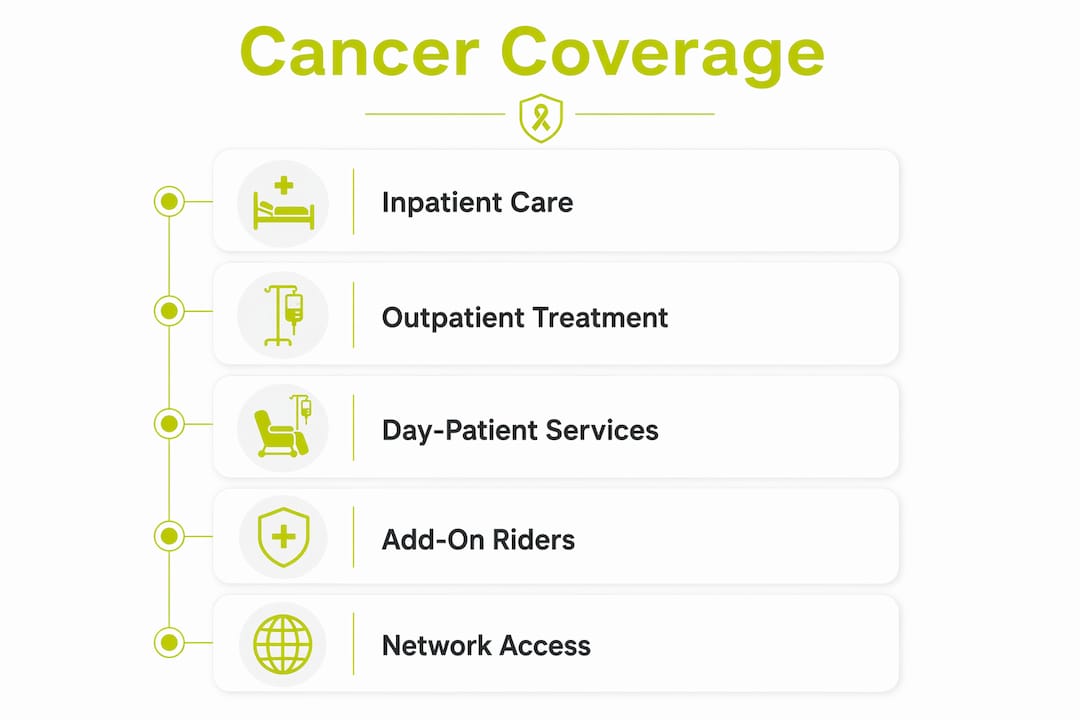
| Benefit category | What it typically pays for |
|---|---|
| Inpatient oncology surgery | Hospital admission, operating theatre, surgeon and anaesthetist fees, post-surgical ward stay |
| Day-patient oncology | Chemotherapy infusions, targeted therapy infusions, and radiotherapy sessions that do not require an overnight stay |
| Outpatient oncology | Oncologist consultations, follow-up appointments, blood tests, and imaging ordered by the treating specialist |
| Diagnostic pathology and imaging | Biopsies, histopathology, CT, MRI, PET scans used for staging and treatment planning |
| Targeted and immunotherapy | Biological agents, checkpoint inhibitors, and monoclonal antibodies (usually on comprehensive plans or with an oncology rider) |
| Palliative and supportive care | Symptom management, pain control, and end-of-life care while the policy remains active |
| Reconstructive surgery | Post-mastectomy reconstruction and related procedures (varies by plan; often requires prior authorisation) |
Inpatient versus outpatient: why the distinction matters
The inpatient/outpatient split is one of the most consequential pieces of policy wording you will encounter. Inpatient means you are formally admitted to hospital overnight. Outpatient means you attend a clinic or day unit and go home the same day. Many chemotherapy and radiotherapy sessions are delivered on a day-patient or outpatient basis, so if your plan only covers inpatient oncology, a significant portion of your treatment costs could fall to you.

Always check whether outpatient chemotherapy and radiotherapy are explicitly listed as covered benefits, not just implied by a general oncology clause.
Add-on services worth asking about
Higher-tier plans and optional oncology riders sometimes bundle services that can make a real difference to your care pathway. These include tumour genomic testing (to identify targeted therapy options), fertility preservation before chemotherapy, formal second-opinion programmes aligned with NCCN guidelines, and reconstructive surgery. Not every plan includes these as standard, so ask your insurer or broker to confirm in writing.
Cashless billing and network access
Most international insurers operate a network of preferred hospitals and oncology centres. When you use a network facility, the insurer pays the hospital directly, known as direct billing or cashless treatment. Outside the network, you typically pay upfront and claim reimbursement. For cancer treatment, which can run to multiple cycles over months, cashless arrangements are worth prioritising. JCI-accredited centres in many countries operate within major insurer networks and follow protocols comparable to US and European standards.
Pro Tip: Before you begin treatment, call your insurer’s pre-authorisation line and ask specifically whether the oncology centre you are considering is on their direct-billing list. Getting this confirmed in writing before your first appointment avoids billing disputes later.
Common exclusions, limits, and pre-existing condition rules to watch for
Knowing what a plan excludes is as important as knowing what it covers. These are the clauses that most often block oncology claims for expats.
- Undisclosed pre-existing cancer. Non-disclosure of pre-existing conditions is one of the most common reasons for claim denial in oncology-related policies. If you had cancer before taking out the policy and did not declare it, the insurer can void the claim entirely.
- Experimental treatments and clinical trials. Most plans exclude treatments that have not received regulatory approval in the country of treatment, including many early-phase clinical trials.
- Continuation of home-country oncology. If you were already receiving treatment in the UK before moving abroad, many plans will not fund the continuation of that regimen overseas unless it was specifically agreed at underwriting.
- Non-melanoma skin cancers. Some policies exclude basal cell carcinoma and squamous cell carcinoma of the skin, treating them differently from other malignancies. Check the definition of “cancer” in the policy wording.
- Elective overseas treatment without prior authorisation. Travelling to another country specifically for planned cancer treatment, without the insurer’s prior written approval, is excluded on most plans.
- Annual or lifetime benefit caps. Many plans impose a per-event or per-year sub-limit for oncology, separate from the overall annual maximum. A plan with a £1 million annual limit might cap oncology at £250,000.
- Drug sub-limits. Targeted therapies and immunotherapies are expensive. Some plans apply a separate, lower sub-limit for cancer drugs, which can be exhausted quickly on modern regimens.
Red-flag clause to watch for: Any policy that uses the phrase “treatment must be received in the country of residence” without a clear prior-authorisation pathway for overseas oncology should prompt an immediate follow-up question to the insurer. This wording can effectively block access to specialist centres abroad, even when the treatment is medically necessary.
For a fuller picture of what international plans typically leave out, the expat insurance exclusions guide at Unparalleledglobalbenefits covers the most common gaps across plan types.
How cancer cover varies by plan level and what optional upgrades add
Not all global medical insurance plans treat oncology the same way. The differences between entry-level, mid-tier, and comprehensive plans can be substantial when it comes to cancer treatment coverage abroad.

Entry-level plans typically cover inpatient oncology surgery and hospitalisation but may exclude outpatient chemotherapy and radiotherapy entirely, or apply tight sub-limits. Targeted therapies and immunotherapies are rarely included at this tier. These plans are designed for younger, healthier expats and are priced accordingly.
Mid-tier plans usually include day-patient and outpatient oncology, giving you access to chemotherapy infusion suites and radiotherapy sessions without an overnight admission. Drug sub-limits are higher, and some plans at this level include a basic second-opinion service. Chronic follow-up care after active treatment may still be subject to a time limit or annual cap.
Comprehensive plans offer the broadest oncology cover: higher or unlimited annual limits, inclusion of targeted therapies and immunotherapies, access to specialist oncology networks, and often a formal second-opinion programme. Long-term follow-up, palliative care, and reconstructive surgery are more likely to be included. These plans carry higher premiums, but the out-of-pocket risk for a serious cancer diagnosis is substantially lower.
What an oncology rider typically adds
An oncology rider (sometimes called a cancer upgrade) is an optional add-on that sits on top of a standard plan. It commonly raises the oncology sub-limit, removes or increases drug caps, adds tumour genomic testing, includes second-opinion services, and extends repatriation or medical evacuation cover specifically for cancer care. If you are buying a mid-tier plan and want oncology protection closer to comprehensive level, a rider is often the most cost-effective route.
Comparing plan tiers and optional riders in detail before you commit is time well spent, particularly if you have a family history of cancer or are moving to a country where oncology care is limited.
Employer group plans and domestic schemes
Some expats receive cover through an employer group plan. These often follow different underwriting rules than retail expat policies, and international oncology benefits may be more restricted. The UK NHS, for example, generally requires prior approval for elective treatment abroad and does not routinely fund overseas oncology. If you are relying on a domestic scheme as a fallback, confirm its overseas oncology rules in writing before you need them.
How claims, pre-authorisation, and access to cancer care work for expats
A cancer diagnosis is stressful enough without a claims process that adds confusion. Here is a clear sequence to follow.
- Notify your insurer or broker immediately. Do not begin treatment and claim later. Most international plans require notification within a defined period of diagnosis, and some require it before any oncology-related investigation beyond the initial GP referral.
- Request pre-authorisation in writing. Submit your oncologist’s proposed treatment plan, staging reports, and pathology results. Pre-authorisation confirms the insurer will fund the treatment before you commit to a hospital or clinic.
- Confirm network and direct-billing arrangements. Ask the insurer to confirm whether your chosen oncology centre is on their direct-billing list. If it is not, clarify the reimbursement process and any fee schedules that apply.
- Gather your documentation. A complete oncology claim file typically includes: the diagnosis letter, staging report, pathology slides or written report, imaging results (CT, MRI, PET), the proposed treatment plan, and signed consent forms.
- Submit claims promptly and keep copies. For ongoing treatment (multiple chemo cycles, radiotherapy courses), submit claims at regular intervals rather than waiting until the end of treatment. Keep copies of every document you send.
- Escalate disputes through the clinical review process. If a pre-authorisation request is declined, ask for a clinical review by the insurer’s medical officer. Most international insurers have a formal appeals process, and a treating oncologist’s letter can carry significant weight.
Practical note on timelines: Pre-authorisation turnaround times vary. Routine requests are often processed within two to five working days, but complex cases involving experimental or high-cost drugs can take longer. Ask your insurer at the point of notification what their standard turnaround is for oncology pre-authorisation, and request an expedited review if your treatment is time-sensitive.
For a step-by-step guide to securing care abroad, Unparalleledglobalbenefits has a detailed walkthrough covering network access and documentation requirements.
What cancer treatment costs abroad and how waiting periods affect your timeline
Indicative cost ranges for common oncology treatments
Cancer medical expenses overseas vary widely by country and treatment type. The figures below are indicative international ranges drawn from published centre and industry data.
| Treatment | Indicative international cost range | Notes |
|---|---|---|
| Chemotherapy (per cycle) | US$3,000–US$30,000 | Wide range depending on regimen and country |
| Major oncology surgery | 60–80% below US prices at leading international centres | India, Thailand, UAE commonly cited |
| Proton therapy (full course) | US$20,000–US$50,000 | Fewer centres globally; prior authorisation essential |
| Formal second medical opinion | US$500–US$3,000 | Remote programmes typically at the lower end |
| PET/CT staging scan | Varies significantly by country | Confirm insurer coverage before booking |
These figures illustrate why a plan with a low oncology sub-limit can leave you significantly exposed. A single course of immunotherapy can exhaust a modest annual cap before the end of the first quarter of treatment.
Waiting periods
Most global medical insurance plans impose a waiting period before oncology benefits become active, typically 90 days from the policy start date for new diagnoses. This is different from a pre-existing condition exclusion. The waiting period applies even to conditions that arise after the policy starts; it simply means you cannot claim for a cancer diagnosis made in the first 90 days. Pre-existing condition exclusions, by contrast, apply indefinitely to conditions known before the policy began, unless the insurer agrees to cover them (usually at a higher premium or with a specific exclusion waiver).
A typical timeline from diagnosis to first treatment
Understanding the sequence helps you plan your insurance and pre-authorisation steps alongside your clinical pathway.
- Week 1–2: Initial GP referral, first specialist consultation, blood tests
- Week 2–3: Biopsy and histopathology (results typically within 5–10 working days)
- Week 3–4: Staging scans (CT, MRI, PET) and multidisciplinary team review
- Week 4–6: Treatment planning, pre-authorisation submission to insurer
- Week 6–8: First definitive treatment (surgery, first chemotherapy cycle, or radiotherapy start)
Pro Tip: Ask your insurer at the point of notification whether they offer an oncology care manager. This is a named clinical coordinator who manages pre-authorisation, liaises with the treating hospital, and coordinates billing. Having one contact point for all oncology-related queries can save considerable time and reduce errors in the claims process.
Questions to ask insurers and red flags to watch for when buying cover
Choosing the right plan before a diagnosis is far easier than trying to upgrade or switch after one. Use this checklist during quote calls and policy reviews.
Essential questions to ask:
- Does the plan cover both inpatient and outpatient chemotherapy and radiotherapy?
- Is there a separate oncology sub-limit, and if so, what is it?
- Are targeted therapies and immunotherapies included, and is there a drug cap?
- Does the plan include a second-opinion service, and is it aligned with NCCN or equivalent guidelines?
- What are the repatriation and medical evacuation provisions for cancer care?
- Which oncology centres are on the direct-billing network in my country of residence?
- What is the waiting period for new cancer diagnoses?
Red-flag policy terms:
- A blanket pre-existing exclusion with no moratorium or underwriting review option
- An oncology sub-limit below the cost of a single treatment cycle for your likely regimen
- “No elective overseas treatment” clauses with no prior-authorisation pathway
- Vague definitions of “experimental” that could be applied to approved targeted therapies
- No named escalation process for disputed pre-authorisation decisions
On underwriting discussions: Be thorough and honest when declaring your medical history. If you have had cancer previously and are in remission, say so. Insurers assess prior cancer on a case-by-case basis: some will cover you with a specific exclusion for recurrence, others will offer cover with a premium loading, and some will decline. Attempting to conceal a prior diagnosis to obtain lower premiums is the single fastest route to a denied claim at the worst possible moment.
When your history is complex, or you want access to treatment at a specific international centre, working with a specialist broker is worth the time. A broker can request sample policy wording, run underwriting enquiries before you commit, and negotiate terms on your behalf. Practical expat insurance guidance from Unparalleledglobalbenefits covers what to expect from that process.
Why a second medical opinion matters and how international plans support it
A second medical opinion is not a sign of distrust in your treating oncologist. It is a clinically recognised step that can change a diagnosis, refine a staging decision, or open access to a treatment option the first team did not consider. Second-opinion programmes at internationally accredited centres are commonly available and are increasingly included as a value-added service by international insurers, often aligned with NCCN guidelines to ensure consistency across jurisdictions.
JCI-accredited centres provide protocols comparable to US and European standards for chemotherapy, radiotherapy, immunotherapy, and targeted agents. Requesting a review from one of these centres, whether remotely or in person, gives you an independent assessment grounded in the same evidence base your home-country oncologist uses.
How to request a second opinion through your insurer
- Contact your insurer or broker and ask whether a second-opinion service is included in your plan.
- If included, request the list of approved centres and the documentation required (pathology slides or digital scans, imaging files, clinical notes, and the original treatment plan).
- If not included, ask whether the cost can be pre-authorised as an outpatient benefit. Many plans will cover it under the outpatient oncology benefit even when a formal second-opinion programme is not listed.
- Submit your documentation to the chosen centre. Remote programmes typically return a written report within one to two weeks.
- Share the report with your treating oncologist before finalising your treatment plan.
Independent pathology review is one component of this process that can be arranged separately from your insurer, particularly when you want an external laboratory to verify a histopathology result before a major treatment decision.
Formal second-opinion programmes typically cost between US$500 and US$3,000, with remote reviews at the lower end of that range.
Before you book a second opinion: Confirm in writing with your insurer that the cost is covered under your policy. A verbal assurance from a call-centre agent is not sufficient. Ask for written pre-authorisation referencing the specific centre and the benefit clause under which the cost will be paid.
Pro Tip: When submitting pathology materials for a remote second opinion, ask the originating laboratory to provide digital whole-slide images rather than physical slides where possible. Digital files can be transmitted instantly and reviewed by the receiving centre without the risk of slides being lost or damaged in transit.
Key takeaways
Cancer coverage in global medical insurance for expats typically includes surgery, chemotherapy, radiotherapy, and supportive care, but the scope, limits, and exclusions vary significantly by plan tier, underwriting history, and whether prior authorisation was obtained.
| Point | Details |
|---|---|
| Core oncology benefits | Surgery, chemo, radiotherapy, and palliative care are standard on comprehensive global plans; outpatient cover must be confirmed separately. |
| Pre-existing conditions | Non-disclosure of prior cancer is the leading cause of claim denial; always declare your full medical history at underwriting. |
| Waiting periods | Most plans impose a 90-day waiting period for new cancer diagnoses, separate from pre-existing condition exclusions. |
| Second opinions | Formal second-opinion programmes cost US$500–US$3,000 and are often included on higher-tier plans; confirm coverage in writing before booking. |
| Unparalleledglobalbenefits | Unparalleledglobalbenefits can compare plan tiers, check oncology sub-limits, and request sample wording before you commit to a policy. |
A practical note on buying oncology cover as an expat
The most common mistake I see expats make is buying a plan based on the headline annual limit without checking the oncology sub-limit or the outpatient chemotherapy clause. A plan with a £2 million annual maximum can still leave you with a six-figure bill if the oncology sub-limit is £100,000 and your treatment runs to multiple cycles of immunotherapy.
The second mistake is assuming that a prior cancer diagnosis automatically means no cover. That is not always true. Insurers assess remission status, time since treatment, and cancer type individually. Some will cover you with a specific exclusion for recurrence of the original cancer while covering all new conditions in full. Others will offer a moratorium period after which the prior condition may be reviewed. The only way to know is to go through a proper underwriting enquiry, ideally with a broker who can run that enquiry across multiple insurers simultaneously.
Practical dos and don’ts after a new diagnosis:
- Do notify your insurer before you book any oncology appointment beyond the initial GP referral.
- Do request a named oncology care manager from your insurer at the point of notification.
- Don’t assume your plan covers outpatient chemotherapy without checking the specific benefit clause.
How Unparalleledglobalbenefits helps expats navigate cancer cover
Choosing a global medical insurance plan with the right oncology protection is not a decision to make on price alone. Unparalleledglobalbenefits specialises in international expat health insurance and can compare plan tiers across multiple insurers, check oncology sub-limits and drug caps, review pre-authorisation workflows, and request sample policy wording before you sign anything. If you have a prior cancer history, the team can run underwriting enquiries on your behalf to identify which plans will offer meaningful cover and on what terms.
Whether you are relocating for work, already living abroad, or reviewing an existing policy after a health change, the right time to check your oncology cover is before you need it. Request a policy review or quote through the international insurance plans comparison page, or speak directly with an adviser about your specific situation.
Planning a trip for yourself, a resident, or visiting family? UGB + Ekta can arrange travel insurance for seniors up to 100 years old. Just click here: https://ektatraveling.com/?partner_uid=808 and add the promo code “UGB” to receive an additional 10% discount.
For a helpful overview of how global medical insurance works in practice, watch this short guide:
Further reading and useful sources for expats reviewing cancer cover
When you are reading through sample policy wording, these are the specific phrases to search for:
- “Pre-existing condition” — check the definition and the moratorium period, if any
- “Experimental treatment” — look for how broadly this is defined; it should not capture approved targeted therapies
- “Out-of-area” or “country of residence” — check whether overseas oncology requires prior authorisation or is excluded outright
- “Outpatient oncology” — confirm it is listed as a covered benefit, not just implied
- “Oncology sub-limit” — find the specific monetary cap for cancer treatment within the policy schedule
- “Evacuation and repatriation” — check whether this extends to planned medical travel for cancer care
Authoritative sources and resources to consult:
- WHO global cancer burden data — for context on cancer incidence internationally
- JCI (Joint Commission International) — for verifying hospital accreditation in your country of treatment
- NCCN (National Comprehensive Cancer Network) — for clinical guidelines your insurer’s second-opinion programme should reference
- Unparalleledglobalbenefits international health insurance guide — for a complete overview of plan types and benefit structures
- Evidence and verification library — for checking hospital accreditation and clinical outcome data when evaluating international oncology centres
Always request a written indemnity extract or benefit schedule for oncology specifically before purchasing any international medical insurance plan. A summary of benefits is not sufficient; you need the actual policy wording for the oncology clause, the outpatient benefit, and the pre-authorisation requirements.
This article provides general information about international medical insurance and cancer coverage. It is not professional medical or financial advice. Always confirm the current terms of any policy with your insurer or a qualified insurance adviser before making a coverage decision.
Recommended
- International Expat Health Insurance: Protecting Your Wellness Abroad – Unparalleled Global Benefits
- Why do expats need health insurance abroad? – Unparalleled Global Benefits
- Healthcare access for expats: Find the best cover abroad – Unparalleled Global Benefits
- Expat health insurance explained: How to secure care abroad – Unparalleled Global Benefits