
TL;DR:
- Most international health insurance plans apply deductibles either once per year or per claim, affecting how costs are managed during healthcare use. Choosing the right deductible type and understanding whether inpatient and outpatient services share one or have separate limits can significantly impact total expenses for expats and travelers. It is essential to read policy details carefully, especially regarding how deductibles interact with out-of-pocket caps and specific coverage modules.
A global medical insurance deductible is the fixed amount you pay out of your own pocket before your insurer starts contributing to a claim. For UK travellers and expatriates, understanding this single figure can mean the difference between a manageable bill and a genuinely painful financial surprise.
TL;DR: Most international health insurance plans apply the deductible either once per policy year (annual) or once per claim. The annual structure is generally more favourable if you make several claims in a year; the per-claim version resets every time you seek treatment for a new condition. Before you buy, check three things:
- Whether the deductible resets per policy year or per claim or condition
- Whether inpatient and outpatient services share one deductible or carry separate ones
- Whether your deductible counts towards your out-of-pocket maximum
Table of Contents
- What is a global medical insurance deductible?
- What types of deductible appear on global health policies?
- Which services count towards your deductible?
- How does your deductible choice affect premiums and total costs?
- Deductible, excess, copay, coinsurance: what is the difference?
- Worked scenarios for UK expats and travellers
- What to check in your policy and what to ask your insurer
- The inpatient/outpatient split: an expert insight worth knowing
- Key takeaways
- Why this matters more than most expats realise
- How Unparalleledglobalbenefits can help you choose the right plan
- Useful sources and further reading
What is a global medical insurance deductible?
The term “deductible” is the standard label in international health insurance, though some policy documents use “excess” or “self-retention” instead. Whichever word appears in your certificate, the mechanism is the same: you absorb the first slice of any covered medical cost, and the insurer pays the rest.
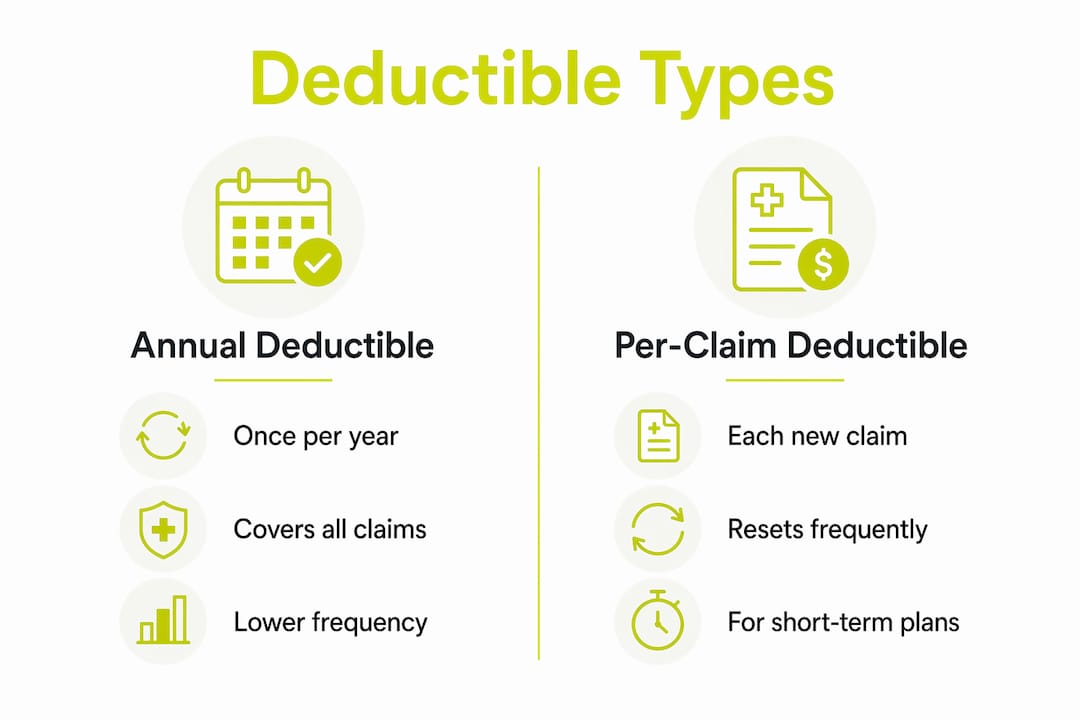
Most international medical insurance plans apply deductibles on either a per policy year or per person basis. Some travel-medical products use a per-claim or per-period deductible, which requires you to pay again for each unrelated condition or certificate period. That distinction matters enormously when you are living abroad and seeing doctors regularly.
The deductible is separate from your premium. Your premium is what you pay monthly or annually simply to hold the policy. The deductible only comes into play when you actually use the cover.
What types of deductible appear on global health policies?
Annual (per policy year) deductible
You pay the deductible once per policy year, regardless of how many separate claims you make. Once you have met it, the insurer covers its share for the rest of that year. This structure suits expats who expect to use their cover more than once.

Per-claim or per-condition deductible
The deductible resets with every new claim or unrelated medical condition. A short-term travel-medical plan bought for a three-month assignment abroad often works this way. If you have a knee injury in February and a respiratory infection in April, you pay the deductible twice.
Per-person vs family deductible
Family plans commonly have individual and family deductibles that interact differently. An embedded family deductible means each family member has their own individual deductible cap, and no single person pays more than that cap even if the family total has not been reached. An aggregate family deductible pools all family members’ costs together; no individual cap applies until the combined total hits the family threshold.
| Deductible type | How often you pay | Typical use case | Best suited to |
|---|---|---|---|
| Annual (per policy year) | Once per year | Long-term expat plans | Expats with regular healthcare needs |
| Per-claim / per-condition | Each new claim | Short-term travel-medical | Infrequent travellers, single trips |
| Per-person (embedded) | Once per person per year | Family expat plans | Families with children using cover |
| Aggregate family | Once the family total is met | Group / family plans | Healthy families with low individual use |
Pro Tip: Marketing brochures often highlight the annual deductible amount in large print but bury whether it is per-claim or per-year in the Schedule of Benefits. Always read the Schedule, not the summary leaflet, before you sign.
Which services count towards your deductible?
Most global health insurance policies apply the deductible to the following:
- Inpatient care: hospitalisation, surgery, overnight stays, and associated specialist fees
- Outpatient services: GP consultations, specialist appointments, diagnostic tests (blood panels, MRI scans), and physiotherapy
- Prescriptions: many plans count prescription costs, though some carve out a separate pharmacy benefit with its own rules
- Mental health treatment: increasingly included under the main deductible on comprehensive expat plans
Some plans pay certain preventive services before the deductible is met, such as routine vaccinations or annual health screenings. Plan documents vary on exactly which services are exempt, so you cannot assume preventive care is always free at the point of use.
Common exclusions from the deductible calculation include cosmetic procedures, experimental treatments, and anything expressly excluded by the policy. Dental and optical cover are often sold as separate modules with their own deductibles.
Two areas worth checking separately: medical evacuation and repatriation. Many policies treat these outside the standard deductible structure, either waiving the deductible entirely for evacuations or applying a separate one. Direct-billing arrangements with hospitals also do not change when the deductible applies; they only change who physically hands over the money at the time of treatment.
For a fuller picture of what global plans typically cover, the global health insurance overview from Unparalleledglobalbenefits explains how core and outpatient modules interact.
How does your deductible choice affect premiums and total costs?
The relationship is straightforward: a higher deductible lowers your premium, and a lower deductible raises it. Deductible amounts on expat plans cover a wide range, and choosing a higher figure can reduce the annual premium sharply. Many insurers allow you to increase your deductible at renewal without requiring new medical underwriting, which makes it a practical lever for managing costs as your circumstances change.

Insurers apply costs in a fixed order: deductible first, then coinsurance or copayment, and finally the out-of-pocket maximum caps your total annual exposure. A common coinsurance split is 80/20, meaning the insurer pays 80% and you pay 20% of costs above the deductible, until you hit the out-of-pocket cap.
The table below uses illustrative GBP figures to show how three deductible levels compare across a year with one hospital claim (£8,000) and one routine outpatient year (£600 in consultations).
| Deductible | Estimated annual premium saving vs £0 deductible | Hospital claim: your share | Outpatient year: your share |
|---|---|---|---|
| £0 | Baseline | £0 (after coinsurance) | £0 (after coinsurance) |
| £500 | — | £500 + 20% of £7,500 = — | £500 (deductible covers full bill) |
| £1,500 | Approx. £500 | £1,500 + 20% of £6,500 = — | £600 (deductible not fully met) |
Premium saving estimates are illustrative; actual figures depend on age, region, and plan.
For a low-claims year, a higher deductible saves money through the premium reduction. For a high-claims year, the break-even point depends on how quickly you meet the deductible. The true cost of global health insurance guide from Unparalleledglobalbenefits walks through this modelling in more detail.
Deductible, excess, copay, coinsurance: what is the difference?
These terms appear throughout policy documents and are often confused. Here is what each one means in practice:
- Deductible / excess / self-retention: the fixed amount you pay before the insurer contributes. All three labels describe the same mechanism; the label used depends on the insurer’s jurisdiction and house style.
- Copayment (copay): a fixed fee you pay at the point of care for a specific service, such as £25 per GP visit, regardless of whether you have met your deductible.
- Coinsurance: a percentage of costs you share with the insurer after the deductible is met. An 80/20 split means the insurer pays 80% and you pay 20% of the remaining bill.
- Out-of-pocket maximum: the annual ceiling on everything you pay, including deductible, copays, and coinsurance. Once you reach it, the insurer covers 100% for the rest of the year.
Whether the deductible counts towards the out-of-pocket maximum varies by policy. Some plans define the cap explicitly as “deductible plus coinsurance maximum,” while others cap only the coinsurance portion. The difference can be hundreds of pounds in a bad year, so look for the exact wording in the definitions section of your policy certificate.
Worked scenarios for UK expats and travellers
These three scenarios use a plan with a £500 annual deductible, 80/20 coinsurance, and a £3,000 out-of-pocket maximum.
-
Single outpatient episode (GP visit and blood test, total cost £180).
You have not yet met your deductible. You pay the full £180. The insurer pays nothing. Your remaining deductible balance is £320. -
Inpatient hospital claim (appendix surgery, total cost £9,000).
You pay the first £500 (deductible). The remaining £8,500 is split 80/20: the insurer pays £6,800 and you pay £1,700 in coinsurance. Your total out-of-pocket for this claim is £2,200. You have not yet hit the £3,000 annual cap, so coinsurance continues on any further claims. -
Family year with multiple small claims (two children, several GP visits and a minor A&E attendance, combined cost £1,400).
Under an embedded per-person deductible of £500, each family member meets their own deductible separately. If the costs are split roughly equally, neither child individually reaches £500, so the family pays the full £1,400 with no insurer contribution. Under an aggregate family deductible of £1,000, once the combined total passes £1,000, the insurer begins contributing for the remainder of the year.
A plan that splits inpatient and outpatient deductibles separately compounds this risk. If your plan carries a £500 inpatient deductible and a separate £300 outpatient deductible, a year with both a hospital stay and regular outpatient visits could cost you £800 in deductibles alone before coinsurance begins.
What to check in your policy and what to ask your insurer
Use this checklist when buying or renewing a global health plan.
- Find the deductible label. Look in the Schedule of Benefits for “deductible,” “excess,” or “self-retention.” These are the same thing under different names.
- Confirm per-year or per-claim. The Schedule should state clearly whether the deductible resets annually or with each new claim or condition.
- Check for an inpatient/outpatient split. Ask: “Does my plan carry separate deductibles for inpatient and outpatient services, or is there one combined figure?”
- Verify the out-of-pocket maximum definition. Does it include the deductible, or does it cap only coinsurance? The exact wording matters.
- Understand family deductible rules. Ask: “Is the family deductible embedded (per-person cap) or aggregate (combined family total)?”
- Ask about evacuations. “Does my deductible apply to medical evacuation and repatriation, or are those treated separately?”
- Check module deductibles. If you have added outpatient, dental, or mental health modules, each may carry its own separate deductible.
Red flags to watch for: ambiguous wording that does not specify per-year or per-claim; separate module deductibles buried in supplementary schedules; exclusions for common conditions listed only in the small print of the definitions section.
The essential tips for comparing international health insurance from Unparalleledglobalbenefits covers additional checklist points for UK residents moving abroad.
The inpatient/outpatient split: an expert insight worth knowing
Some plans split the deductible into inpatient and outpatient components, and that structure can significantly increase your maximum annual exposure. If you have a year with both a hospital admission and several outpatient appointments, you may pay two separate deductibles before the insurer contributes to either category.
The practical consequence: always ask whether the plan uses a single combined deductible or separate ones. A plan with a lower headline deductible but a split structure can cost more in a moderate-use year than a plan with a slightly higher single deductible.
Pro Tip: The Schedule of Benefits is the legally binding document. Marketing summaries and comparison websites may simplify or omit the inpatient/outpatient split entirely. Before you commit, download the full policy certificate and search for the word “outpatient” in the deductible section.
For UK residents, the NHS covers emergency treatment abroad in limited circumstances, but routine and specialist care as an expat falls outside NHS provision. A well-structured international plan with a deductible you can comfortably absorb is the practical alternative.
Key takeaways
A global medical insurance deductible is the fixed amount you pay before your insurer contributes, and choosing the right level requires understanding whether it resets annually or per claim, whether inpatient and outpatient costs share it, and how it interacts with your out-of-pocket maximum.
| Point | Details |
|---|---|
| Annual vs per-claim | An annual deductible resets once per year; a per-claim deductible resets with every new condition. |
| Inpatient/outpatient split | Some plans carry separate deductibles for each, which can stack and increase your total annual exposure. |
| Premium trade-off | A higher deductible lowers your premium; expat plan deductibles cover a wide range. |
| Out-of-pocket maximum | Check whether your deductible counts toward the cap or whether only coinsurance is included in that figure. |
| Unparalleledglobalbenefits | Unparalleledglobalbenefits helps expats and travellers compare deductible structures and find plans suited to their budget and healthcare needs. |
Why this matters more than most expats realise
Most people shopping for international health cover focus on the headline premium and the maximum benefit limit. The deductible gets a quick glance and is forgotten. That is a mistake I see reflected in the questions people ask after their first claim abroad.
The deductible is the number that determines your real cost in any year you actually need care. A £0 deductible plan with a high premium may cost you less overall if you use the cover frequently. A £1,500 deductible plan may save you money for years and then feel punishing the first time you need surgery. Neither answer is universally right. What matters is matching the deductible to your likely usage, your cash reserves, and whether you are covering a family or travelling alone.
UK expats face a specific wrinkle: once you leave the UK and lose routine access to NHS care, the deductible on your international plan becomes your effective first line of cost. There is no GP safety net to absorb the small claims. Every consultation, every prescription, every diagnostic scan potentially counts toward that figure. Choosing a deductible you cannot comfortably pay out of savings is not a cost-saving strategy; it is a risk you are carrying without realising it.
The inpatient/outpatient split is the detail I would urge every reader to check before signing. It is the clause most likely to produce a bill that feels unfair, because nothing in the marketing material warned you it was there.
How Unparalleledglobalbenefits can help you choose the right plan
Sorting through deductible structures, coinsurance percentages, and family plan mechanics across multiple insurers takes time you may not have. Unparalleledglobalbenefits specialises in exactly this: matching UK expats and international travellers with plans where the deductible structure fits their real healthcare habits, not just their budget on paper.
Whether you need expat health insurance with a straightforward annual deductible, cover for a working assignment abroad, or a plan that includes your family under one aggregate threshold, the team at Unparalleledglobalbenefits can walk you through the options. Get in touch for a no-obligation comparison and find a plan whose deductible you will never be surprised by.
Planning a trip for yourself, a resident, or visiting family? UGB + Ekta can arrange travel insurance for seniors up to 100 years old. Just click the link and add the promo code UGB to receive an additional 10% discount.
Watch this short explainer for more on how international health insurance works:
Useful sources and further reading
- NHS: planning your healthcare abroad — official NHS guidance on what UK residents can and cannot access when living or travelling outside the UK.
- GOV.UK: UK residents visiting the EU/EEA and Switzerland — government guidance on healthcare entitlements and the UK Global Health Insurance Card (GHIC).
- HealthCare.gov deductible glossary — clear definition of deductibles and preventive-care exceptions, useful for cross-referencing international plan wording.
- MedlinePlus: understanding your healthcare costs — plain-language explanation of how deductibles, copays, and coinsurance interact, including family plan mechanics.
- Top 5 international health insurance agencies 2026 — independent summary of agencies and the unexpected costs expats encounter, useful for market context.
- How to compare medical insurance plans abroad — Unparalleledglobalbenefits guide covering per-person, per-claim, and annual deductible differences side by side.
- International health insurance explained — comprehensive overview of plan types, modules, and how to read a policy certificate.
- 7 smart ways to find affordable international health insurance — practical cost-saving tactics including deductible strategy and renewal tips.
This article is general information, not professional insurance or financial advice. Confirm the current terms of any policy with your insurer or a qualified adviser before purchasing cover.