
TL;DR:
- Annual travel insurance is most cost-effective for frequent travelers taking three or more trips under 31 days each year, offering convenience and medical protection across multiple destinations. It covers unlimited trips within a 12-month period, with specific per-trip limits, and requires immediate purchase after booking to ensure cancellation coverage begins on the right date. Long trips, high-value holidays, or complex medical needs may be better served by single-trip policies or specialist brokers.
If you take several trips a year and each one lasts under about a month, an annual travel insurance policy will almost certainly save you money and hassle compared with buying cover trip by trip. The maths is straightforward: a single annual multi-trip policy replaces multiple individual purchases, keeps you covered the moment you book, and removes the risk of forgetting to arrange cover before a last-minute weekend away. That said, annual cover is not the right fit for everyone. Long-haul travellers planning one extended eight-week trip, or anyone who needs deep cancellation protection on a high-value holiday, may find a single-trip policy serves them better.
Quick verdict:
- Buy annual cover if: you travel three or more times a year, your trips are typically under 31 days, and you want convenience plus medical protection across multiple destinations.
- Consider single-trip if: you take one or two holidays a year, one trip is unusually long, or you need comprehensive cancellation cover on a very expensive booking.
- One immediate action: buy your policy as soon as you book your first trip. Cancellation cover on annual policies starts from the purchase date, not your departure date.
Table of Contents
- What annual travel insurance actually is
- How an annual policy works in practice
- What does annual travel insurance typically cover?
- Common exclusions that can invalidate your cover
- How much does annual travel insurance cost?
- When to buy and how to declare medical conditions
- Annual vs single-trip: which is right for you?
- How to choose the right annual policy
- How to make a claim and what happens at renewal
- Is annual travel insurance worth it? Your next steps
- Key takeaways
- The mistake most frequent travellers make
- Arrange your annual cover through Unparalleledglobalbenefits
- Useful sources and further reading
What annual travel insurance actually is
Annual travel insurance, also called multi-trip travel insurance, is a single 12-month policy that covers an unlimited number of trips within the policy year. You pay once and travel as often as you like, without arranging separate cover each time.
Territory bands are one of the most important decisions you will make when buying an annual policy. Most UK providers offer three standard options: UK only, Europe (which usually includes countries bordering the Mediterranean), and worldwide. Worldwide policies split further into those that include the USA and Canada and those that exclude them. Including the USA and Canada raises the premium noticeably because US healthcare costs are among the highest in the world. If you never cross the Atlantic, excluding those countries is an easy saving.
A note on UK trips: many annual policies do cover domestic travel, but providers often apply a minimum-stay rule, such as two consecutive nights in paid accommodation, before cover activates. The Global Health Insurance Card (GHIC) covers medically necessary state treatment within the EU, but it is not a substitute for travel insurance. It does not cover repatriation, cancellation, baggage loss, or private treatment.
How an annual policy works in practice
The 12-month policy period begins on the start date you choose when you buy. Cancellation cover, critically, runs from that purchase date. If you book a holiday in January, buy the policy in March, and then need to cancel in April, any cancellation event that occurred before March is not covered.

Each individual trip within the year is subject to a per-trip duration limit. The most common default is 31 days per trip; some providers offer extensions to 45 or 60 days, but these are less common and usually require a policy add-on or separate arrangement. If a single trip exceeds the limit, you are not covered for the days beyond it unless you have purchased an extension add-on before you travel. Some providers allow a specified number of longer trips as an optional extra, but these must be arranged in advance and will increase your premium.
Three scenarios that illustrate the difference:
- Three short European city breaks of five to seven days each: an annual European policy covers all three with no additional steps.
- One eight-week trip to Southeast Asia: a standard 31-day annual policy leaves you uninsured from day 32 onwards. You need either a trip extension or a single-trip policy for that journey.
- A mix of four European breaks and one two-week Caribbean holiday: an annual worldwide policy (excluding US/Canada) covers all five, provided each trip stays within the per-trip limit.
| Policy type | Typical per-trip limit | Best suited to |
|---|---|---|
| Annual European | 31 days (some allow up to 45) | Frequent short European breaks |
| Annual worldwide excl. US/Canada | 31 days (some allow up to 45) | Multi-destination trips, Asia, Caribbean |
| Annual worldwide incl. US/Canada | 31 days (some allow up to 45) | Any travel including North America |
| Single-trip | Up to the trip length purchased | One long trip or high-value cancellation need |
What does annual travel insurance typically cover?
The core of any annual policy is emergency medical cover. Most UK annual plans include hospital treatment, surgical costs, medical repatriation, and a 24/7 emergency assistance helpline. American Express Travel Insurance, for example, covers emergency medical treatment up to £10 million on its annual plans, alongside personal accident cover up to £50,000.
Beyond medical, the standard inclusions vary more than many buyers expect. Cancellation cover, in particular, is less comprehensive on annual plans than on single-trip policies. Annual policies tend to focus on medical emergencies; robust cancellation protection is more reliably found on single-trip or premium annual tiers.
| Cover type | Typically included | Typical limit range |
|---|---|---|
| Emergency medical treatment | Yes | £2 million–£10 million |
| Medical repatriation | Yes | Included within medical limit |
| 24/7 emergency assistance | Yes | Included |
| Baggage loss or damage | Usually | — |
| Baggage delay | Usually | £100 |
| Travel delay | Usually | — |
| Trip cancellation | Often (check depth) | — |
| Missed connections | Sometimes | — |
| Personal liability | Usually | £1 million–£2 million |
| Winter sports | Optional add-on | Varies |
| Cruise cover | Optional add-on | Varies |
Pro Tip: When comparing annual plans, prioritise medical evacuation limits over everything else. A £2 million medical limit sounds substantial, but repatriation from the US or Japan can cost six figures on its own. Look for policies where evacuation is explicitly included within a high overall medical limit, not capped separately at a low sub-limit.
Common exclusions that can invalidate your cover
Knowing what an annual policy does not cover is just as important as knowing what it does. Claims are most commonly refused for a handful of predictable reasons.
- Undisclosed pre-existing medical conditions. Insurers require you to declare any condition diagnosed or treated before the policy starts. Failing to do so is the single most common reason claims are denied. Declared conditions may be covered with a premium loading, excluded entirely, or covered under a specialist policy.
- Certain adventure and winter sports. Skiing, snowboarding, and most adventure activities are excluded from standard annual policies unless you purchase a specific add-on. Activities such as bungee jumping, free diving, or off-piste skiing often require specialist cover regardless of add-ons.
- Alcohol and drug-related incidents. If a claim arises from an incident where you were under the influence of alcohol or drugs, most insurers will refuse it. This applies even to medical claims.
- Travel to countries under UK government advisory. If the Foreign, Commonwealth & Development Office advises against all travel or all but essential travel to a destination, most annual policies will not cover you there. Check FCDO advice before every trip.
- Trips exceeding the per-trip duration limit. As noted above, days beyond the policy’s per-trip cap are simply not covered.
- UK domestic trips that do not meet minimum-stay rules. Some providers apply a 100-mile rule or a two-night minimum in paid accommodation before domestic cover activates. Short local breaks can fall outside cover entirely.
Pro Tip: When reading policy wording, search for the phrases “known condition”, “reasonable care”, and “government advice”. These three clauses are where most grey-area exclusions hide. If the wording is vague about what “known” means or what counts as “reasonable care”, ask the insurer directly before you buy.
How much does annual travel insurance cost?
Premium levels vary considerably depending on your personal profile and the cover you choose. The main cost drivers are:
- Age. Premiums rise steeply from around age 65 onwards. Senior travellers often pay multiples of what a younger adult pays for equivalent cover.
- Destination band. European cover costs less than worldwide; worldwide excluding US/Canada costs less than worldwide including it.
- Declared medical conditions. Each condition you declare can add a loading or trigger a referral to a specialist underwriter.
- Maximum trip length. Policies with a 45-day or 60-day per-trip limit cost more than standard 31-day policies.
- Excess level. Choosing a higher voluntary excess reduces your premium. A £150 excess instead of £50 can make a meaningful difference on the annual cost.
- Add-ons. Winter sports, gadget cover, and cruise extensions all add to the base premium.
Price context: Annual premiums vary widely across the market, from very low-cost basic plans through to several hundred pounds for comprehensive worldwide cover with add-ons. A healthy adult in their thirties seeking European cover with standard limits will typically pay considerably less than a traveller in their sixties seeking worldwide cover with declared conditions. Always compare at least three quotes before buying.
Practical ways to reduce your premium without sacrificing essential protection:
- Choose Europe-only cover if you genuinely never travel outside Europe.
- Raise your voluntary excess to a level you could comfortably pay if you needed to claim.
- If you have a family, check whether adding children to an annual family travel insurance worldwide policy costs less than insuring them separately.
- Review whether you need cancellation cover on every trip or only on high-value bookings. A medical-focused annual policy combined with a single-trip upgrade for one expensive holiday can be the most cost-effective approach.
When to buy and how to declare medical conditions
Buy as soon as you book your first trip. This is the most important timing rule in annual travel insurance. Cancellation cover starts from the policy purchase date, not from when you travel. If you wait until a week before departure, any cancellation event that occurred in the intervening weeks is outside your cover window.
Declaring pre-existing medical conditions: a step-by-step checklist
- List every condition you have been diagnosed with, treated for, or sought medical advice about in the period the insurer specifies (commonly five years, sometimes your lifetime for serious conditions).
- Include conditions that feel minor or well-controlled, such as managed hypertension or mild asthma. Insurers define “pre-existing” broadly.
- Complete the medical screening questionnaire honestly and in full. If you are unsure whether something needs declaring, declare it.
- Review the outcome: the insurer will either cover the condition (sometimes with a premium loading), exclude it from cover, or refer you to a specialist underwriter.
- If a condition is excluded, consider a specialist policy. Unparalleledglobalbenefits provides guidance on travel insurance with medical conditions and can help identify appropriate cover.
- Keep a copy of your completed declaration and the insurer’s written acceptance. If you need to claim, this documentation is your first line of defence.
Failure to declare a condition is not a grey area. Undisclosed conditions are excluded, and insurers can void the entire policy if non-disclosure is found to be material. If your health changes during the policy year, notify your insurer promptly.
Pro Tip: If you have a complex medical history or multiple conditions, speak to a broker before buying online. Automated screening tools are designed for straightforward cases. A broker can access specialist underwriters who may offer better terms than a standard comparison site will surface.

Annual vs single-trip: which is right for you?
The decision comes down to four variables: how often you travel, how long each trip is, how much cancellation cover you need, and where you are going.
| Situation | Annual policy | Single-trip policy |
|---|---|---|
| 3+ trips per year, each under 31 days | Strong fit | More expensive overall |
| 1–2 trips per year | Often not cost-effective | Usually better value |
| One trip over 45 days | Needs extension or not suitable | Better fit |
| Travel to high-cost medical countries (US, Japan) | Viable with correct territory band | Viable |
| High-value trip needing deep cancellation cover | Check annual limits carefully | Often stronger cancellation terms |
| Family travelling together | Annual family policy often saves money | Per-trip cost adds up |
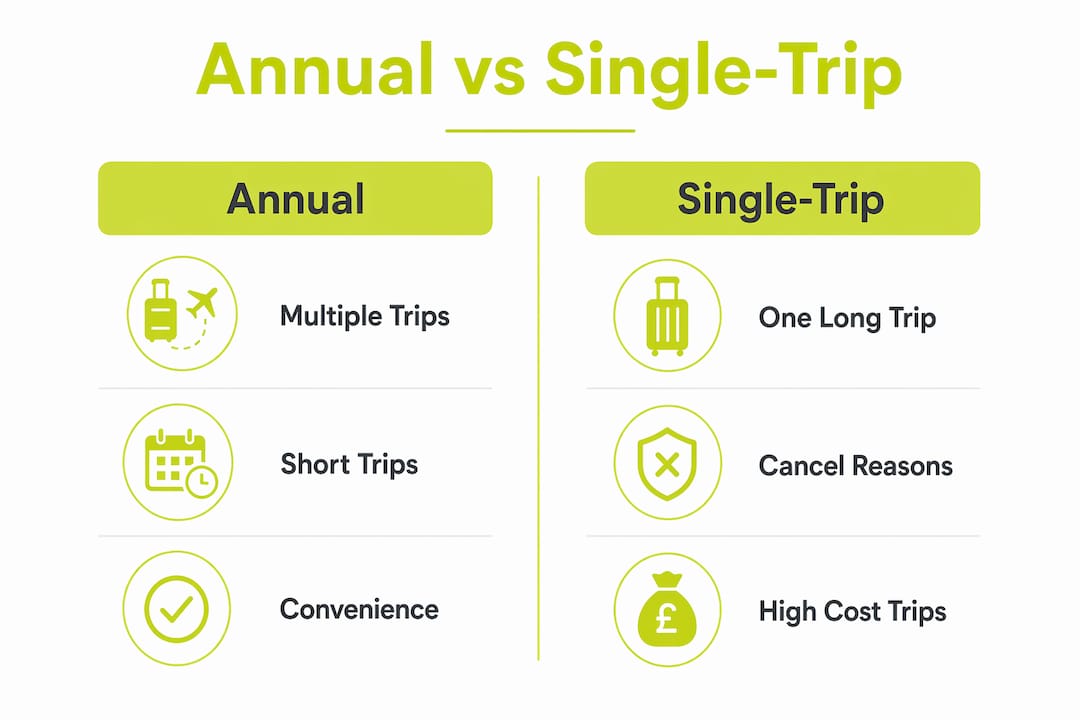
Annual cover tends to win when you travel frequently, your trips are short, and you value the convenience of always being covered. The break-even point against single-trip policies is typically around two to three trips per year for a healthy adult, depending on destinations.
Single-trip cover tends to win when you take one long holiday, need cancel-for-any-reason protection on a very expensive booking, or your travel pattern is irregular. For context, annual plans prioritise medical cover and cancellation terms on single-trip policies are often more generous.
How to choose the right annual policy
Use this checklist when comparing quotes. Do not buy until you can answer every question for each policy you are considering.
| Feature to check | What to look for | Red flag |
|---|---|---|
| Medical limit | £2 million minimum; £5–10 million for US travel | Sub-£1 million limits for worldwide cover |
| Medical evacuation | Explicitly included, not capped at a low sub-limit | Evacuation listed as a separate, low sub-limit |
| Per-trip duration limit | Matches your longest typical trip | 31-day cap if you regularly take longer trips |
| Cancellation cover | Covers your most expensive booking | Very low per-trip cancellation limit |
| Excess | Affordable if you need to claim | Excess higher than the likely claim value |
| Family cover | Children included at no extra cost | Each family member priced separately |
| Sports extension | Available if you ski or do adventure sports | No add-on option at all |
| 24/7 assistance | Dedicated emergency line, not just a claims line | Office-hours-only contact |
| Territory definition | Clear list of included countries | Vague “Europe” definition that may exclude Turkey or Russia |
Questions to ask before you buy:
- From what date does cancellation cover apply?
- What counts as a “trip” for the purposes of the per-trip limit?
- How do I extend cover if a trip runs longer than planned?
- What is the process if I need emergency medical help abroad?
Watch out for policies with vague medical exclusion wording, no 24/7 emergency assistance, or territory definitions that do not explicitly list the countries you plan to visit. Winter sports cover is almost never included as standard, so if you ski, budget for the add-on from the outset.
How to make a claim and what happens at renewal
Making a claim: step by step
- Contact your insurer’s emergency assistance line as soon as a medical situation arises abroad. Do not pay for treatment and claim later unless the insurer specifically instructs you to.
- Gather evidence from the outset: medical reports, hospital invoices, receipts for any out-of-pocket expenses, and written confirmation of any diagnosis.
- For cancellation claims, obtain written proof of the reason: a doctor’s letter, a death certificate, an airline cancellation notice, or an employer’s letter as appropriate.
- For baggage loss or theft, obtain a police report within 24 hours. Most insurers require this for claims above a low threshold.
- Submit your claim form promptly. Most policies set a deadline of 28–31 days after returning home, though some allow longer.
- Keep copies of everything you submit. Follow up in writing if you do not receive acknowledgement within five working days.
Claims checklist to carry when travelling:
- Policy number and insurer’s 24/7 emergency contact number
- Copy of your medical declaration and acceptance
- GHIC card (for EU travel)
- FCDO travel advice for your destination (screenshot before you go)
At renewal, do not simply auto-renew without checking the market. Your travel habits may have changed, your health may have changed, and the market may offer better terms. Review your per-trip limit, territory band, and medical declaration at every renewal. If you have developed a new condition during the year, you must declare it before renewing. Switching providers mid-year is possible but you will lose any unused premium on the old policy unless it has a cancellation clause, so timing the switch at renewal is almost always cleaner.
Is annual travel insurance worth it? Your next steps
For most UK residents who travel three or more times a year on trips of under a month, an annual multi-trip policy is the most practical and cost-effective choice. It removes the risk of travelling uninsured, keeps cancellation cover active from the moment you book, and provides consistent medical protection across all your trips. If your travel pattern is irregular, your trips are long, or you need substantial cancellation cover on one expensive holiday, a single-trip policy remains the stronger option for that specific journey.
Two immediate next steps: First, compare at least three annual policy quotes using your actual travel profile (age, destinations, longest trip, any medical conditions). Second, buy the policy the same day you book your first trip. Waiting costs you cancellation cover for every day between booking and purchase. For specialist needs, including senior cover, complex medical histories, or expat situations, Unparalleledglobalbenefits can help you find appropriate cover through its annual travel insurance guide and broker services.
Key takeaways
Annual travel insurance is the right choice for frequent UK travellers taking three or more short trips per year, provided each trip stays within the policy’s per-trip duration limit and cover is purchased immediately after booking.
| Point | Details |
|---|---|
| Buy immediately after booking | Cancellation cover starts from the purchase date, not your departure date. |
| Check the per-trip duration limit | Most annual policies cap each trip at 31 days; if you plan trips longer than this, look for available extensions or consider single-trip cover. |
| Declare all medical conditions | Undisclosed conditions are excluded; non-disclosure can void the entire policy. |
| Prioritise medical and evacuation limits | Look for at least £2 million medical cover; higher for US or high-cost destinations. |
| Unparalleledglobalbenefits | Offers specialist guidance and broker access for senior travellers, expats, and those with complex medical needs. |
The mistake most frequent travellers make
Most buyers focus on the annual premium and miss the detail that actually determines whether a policy will pay out: the per-trip duration limit. Time and again, travellers book an eight-week trip, assume their annual policy covers it, and discover on return that they were uninsured from day 32 onwards. The insurer is not being unreasonable; the limit was in the policy wording. The buyer simply did not read it.
The second most common mistake is treating the medical limit as the only number that matters. Evacuation and repatriation costs are where policies diverge most sharply. A policy with a £10 million overall medical limit but a £25,000 repatriation sub-limit can leave you badly exposed if you need an air ambulance from a remote destination.
My practical suggestion: if your travel profile is anything other than straightforward short European breaks, speak to a broker before buying online. Automated comparison tools are built for the average case. Complex medical histories, long trips, adventure sports, or senior travellers over 70 all benefit from a conversation with someone who can access the specialist market. The premium difference is often smaller than people expect, and the cover difference can be substantial.
Arrange your annual cover through Unparalleledglobalbenefits
Frequent travellers with straightforward profiles can often find a solid annual policy through a comparison site. But if you have a pre-existing condition, travel regularly to high-cost medical destinations, or need cover for a senior traveller, the standard market rarely offers the best solution. Unparalleledglobalbenefits specialises in exactly these situations: expats, families, senior travellers, and anyone whose needs fall outside the standard online screener.
For senior travellers specifically, Unparalleledglobalbenefits works with Ekta to arrange international health cover for travellers up to 100 years old. That is a ceiling most standard annual policies do not come close to matching.
Planning a trip for yourself, a resident, or visiting family? UGB + Ekta can arrange travel insurance for seniors up to 100 years old. Just click here: https://ektatraveling.com/?partner_uid=808 and add the promo code “UGB” to receive an additional 10% discount.
For a broader look at how annual travel cover fits into a complete protection plan, the Unparalleledglobalbenefits guide to expat health insurance is a useful next read. Request a quote or speak to the team directly through the website.
Watch this short overview for more guidance on arranging the right travel cover:
Useful sources and further reading
The sources below are reliable starting points for comparing policies, checking government travel advice, and understanding your rights as a UK policyholder.
- FCDO Foreign Travel Advice: The official UK government source for destination-specific safety and entry information. Check this before every trip; insurers use FCDO advisory levels to determine whether cover applies.
- ONS Travel Trends 2024: The Office for National Statistics’ annual overview of UK travel patterns. Useful context for understanding how frequently UK residents travel and to which regions.
- Confused.com Annual Multi-Trip Guide: Clear explanation of how annual policies work, per-trip limits, and timing advice for UK buyers.
- Compare the Market Annual Travel Insurance: Covers territory bands, UK trip rules, and the impact of destination on premium. Good for initial quote comparison.
- Squaremouth Annual Travel Insurance: US-focused but useful for understanding how evacuation limits and trip extension options work across the market.
- Unparalleledglobalbenefits: Travel Insurance with Medical Conditions: Practical guidance for travellers who need to declare a medical history and want to understand their options.
- Unparalleledglobalbenefits: Multi-Trip Travel Insurance Market Insights: Data on who chooses annual cover and the travel profiles for which it is most cost-effective.
- Unparalleledglobalbenefits: Cancel for Any Reason Guide: Explains why CFAR cover is rarely available on standard annual policies and when a single-trip upgrade makes sense.
This article is general information, not professional insurance advice. Policy terms, limits, and eligibility vary between providers. Always read the full policy wording and confirm current terms with your insurer or a qualified broker before purchasing.
Recommended
- Annual Travel Insurance Cover 2025: Guide for Global Travellers
- Annual Travel Insurance Including Cruise Cover: Complete Guide – Unparalleled Global Benefits
- Multi-country travel insurance: your 2026 guide – Unparalleled Global Benefits
- Multi trip travel insurance: 12% choose annual cover in 2026 – Unparalleled Global Benefits