
TL;DR:
- An annual multi-trip policy covers all trips within 12 months under a single premium, simplifying travel planning. The key limits include trip duration caps and the start date of cancellation coverage, which often catches travelers off guard. It is most suitable for frequent travelers but may not fully cover expensive single trips or long stays without additional policies.
An annual multi-trip policy covers every overseas trip you take within a 12-month period under a single premium, so you never need to buy separate cover for each holiday or business trip, as explained in comprehensive guidance on assicurazione tirana. The one thing to check before you buy is the per-trip maximum duration: most policies cap each trip at about a month, and if a single trip runs longer, you may not be covered for the days beyond that limit.
Three things to confirm at a glance:
- Per-trip duration cap: typically 31 days, though some policies extend to 45–90 days.
- Cancellation cover start date: protection for cancellations usually begins on the policy start date, not when you book each trip.
- Destination band: policies are priced by region (Europe, worldwide excluding USA/Canada, or worldwide including USA/Canada), so check your destinations fit the band you choose.
Pro Tip: Buy your annual policy as soon as you make your first booking of the year. Cancellation cover runs from the policy start date, so any cancellable event that occurs before that date is not protected.
Table of Contents
- How does annual multi-trip insurance work, step by step?
- What does an annual multi-trip policy typically cover?
- What exclusions and limits should you watch for?
- Who can buy an annual policy, and are there age limits?
- How do insurers price annual multi-trip policies?
- When should you buy, and does it cover trips already booked?
- How do you make a claim on an annual policy?
- Is annual multi-trip insurance worth it for you?
- UK practical checks: policy wording, MoneyHelper, and FCDO guidance
- Key takeaways
- Why the cancellation start date matters more than most guides admit
- Specialist and senior cover: how Unparalleledglobalbenefits can help
- Useful sources for UK travellers
How does annual multi-trip insurance work, step by step?
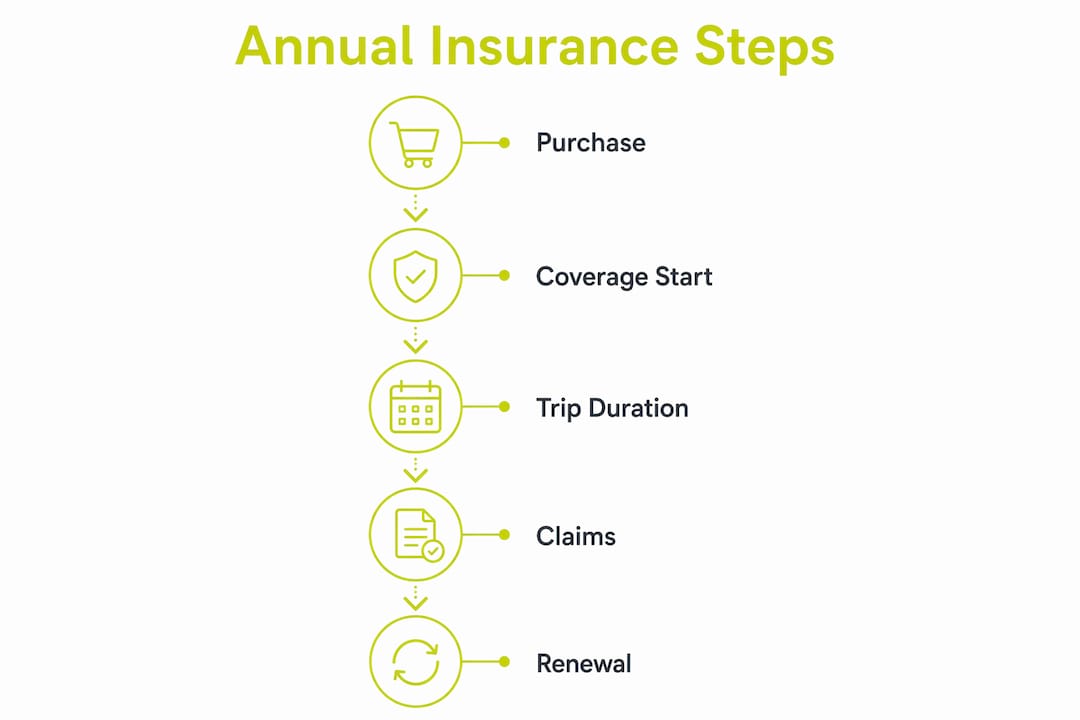
The mechanics are straightforward once you understand the policy lifecycle. Here is how it runs from purchase to renewal.
- Choose your start date. You can set the policy to begin immediately or on a future date. If you have a trip booked soon, starting immediately protects you for cancellation events from that day forward.
- Select your destination band. Europe, worldwide excluding the USA and Canada, or worldwide including the USA and Canada. The band must cover every country you plan to visit during the year.
- Set your maximum trip length. This is the single most consequential choice. Annual trip length restrictions commonly range from 30 to 90 days; pick a cap that comfortably exceeds your longest planned trip, not just your average one.
- Declare pre-existing medical conditions. Most insurers require you to disclose conditions at the point of purchase. Failing to do so can invalidate a claim later.
- Travel as often as you like. The policy allows unlimited trips within the 12-month period. Each trip is covered from the moment you leave home until you return, provided it stays within your chosen duration cap.
- Renew or cancel at the end of the year. Your insurer will usually offer renewal automatically. Review the terms each year, particularly if your health or travel habits have changed.
On cancellation cover specifically: protection starts from the policy start date, not from the date you book each individual trip. If you book a holiday in March but your policy does not start until May, a cancellation event in April is not covered.
Pro Tip: If a single trip looks like it might run close to your duration cap, contact your insurer before you travel. Some will extend cover for that trip for an additional premium rather than leaving you unprotected mid-journey.

One further point on the policy lifecycle: if you permanently change your country of residence during the policy term, many insurers will terminate cover. Always notify your insurer immediately if your residency changes.
What does an annual multi-trip policy typically cover?
Annual policies are built primarily around medical emergencies and travel disruption. The cover types you will find on most plans include:
- Emergency medical treatment: hospital costs, surgery, and outpatient care for illness or injury abroad.
- Medical evacuation and repatriation: transport to an appropriate hospital or back to the UK when local facilities are inadequate.
- Baggage loss, theft, and damage: reimbursement when luggage is lost or damaged by a carrier, or stolen.
- Baggage delay: a daily allowance to buy essentials when your bags are delayed on arrival.
- Travel delay: meals and accommodation costs when a covered delay exceeds a policy threshold (commonly two to four hours).
- Missed connections: costs to rebook when a delay causes you to miss a connecting flight.
- Personal liability: legal costs and compensation if you accidentally injure someone or damage their property abroad.
- Trip cancellation and interruption: available on some plans, but often limited. Many annual plans either lack cancellation cover or cap claims at a policy maximum rather than reimbursing the full cost of each trip. Cancel For Any Reason cover is generally not available on annual policies.
Annual policies tend to focus on medical and evacuation protection; trip cancellation and interruption cover is less comprehensive than on single-trip policies. If you have an expensive single booking that you need fully protected for cancellation, a dedicated single-trip policy may serve you better for that particular trip.
Common add-ons worth considering

| Add-on | When you need it |
|---|---|
| Winter sports cover | Skiing, snowboarding, or any on-piste activity; standard policies exclude these |
| Gadget / business equipment | Laptops, cameras, or specialist kit above standard baggage limits |
| Rental car excess | Covers the excess charged by a hire company after an accident |
| Cruise cover | Missed port departures and cabin confinement, not covered under standard plans |
For winter sports specifically, you can find detailed guidance on travel insurance including winter sports to understand what an endorsement adds to your base policy.
What exclusions and limits should you watch for?
Knowing what a policy does not cover is as important as knowing what it does. The most common exclusions that catch travellers out:
- Hazardous activities: bungee jumping, off-piste skiing, scuba diving beyond certain depths, and similar activities require a specific endorsement or a higher premium.
- High-value items: jewellery, cameras, and laptops above the single-item limit are excluded unless you declare and insure them separately.
- FCDO and war exclusions: if the Foreign, Commonwealth and Development Office (FCDO) advises against travel to a destination, your insurer will typically not pay claims arising from that trip. Always check FCDO advice before you travel.
- Non-declaration of pre-existing conditions: failing to declare a condition can invalidate claims related to that condition, and in some cases the entire policy.
- Residency changes: moving abroad permanently mid-policy usually terminates cover.
- The 100-mile rule: some insurers only activate cover when you travel more than 100 miles from your home address, which can affect domestic trips or short cross-border journeys.
- Long-stay travel: trips that exceed your chosen duration cap are not covered for the days beyond the limit.
How an excess affects your payout
Every policy carries an excess, the amount you pay towards each claim before the insurer contributes. If your excess is £100 and you claim £350 for a stolen bag, you receive £250. On a medical claim of £800, you receive £700. A lower excess usually means a higher premium, so weigh the trade-off against how often you travel and the typical value of what you carry.
Pro Tip: Check whether your policy applies the excess per claim or per incident. A per-incident excess means a single event that triggers multiple claim types (medical treatment plus baggage loss from one accident) may attract only one excess payment.
Who can buy an annual policy, and are there age limits?
Most UK annual policies require you to be a UK resident for the full duration of the policy term. Beyond that, eligibility rules vary by insurer, but the common structures are:
- Single policies: cover one named traveller for all trips within the year.
- Couple or duo policies: cover two named adults travelling together or independently.
- Family policies: cover two adults and their dependent children, usually up to age 18 (or 23 if in full-time education). Many annual policies allow up to 10 people on a single plan, and travellers do not all need to travel at the same time.
Age limits are one of the more variable features across the market. Many standard annual policies set an upper age cap, commonly somewhere between 65 and 75, after which cover either becomes unavailable or requires medical screening and a higher premium. Older travellers often find that specialist senior plans offer better value and more appropriate cover than standard policies with age-related restrictions. The overseas travel insurance for seniors guide covers this in detail.
For travellers with pre-existing conditions, the declaration process is non-negotiable. Insurers may cover the condition for an additional premium, exclude it from cover, or decline the policy altogether depending on its severity. If you have a complex medical history, a specialist broker can help you find a policy that does not simply exclude everything. The travel insurance for health conditions guide explains how to compare policies when your medical history is a factor.
Pregnant travellers should check gestational age limits carefully; most policies will not cover complications arising after a certain week of pregnancy. Students on scholarship or exchange programmes abroad for extended periods may find that a standard annual policy’s per-trip duration cap is too short, making a long-stay or student-specific plan more suitable.
How do insurers price annual multi-trip policies?
Annual premiums are calculated at a flat rate rather than as a percentage of trip costs, so while they may seem costly for a single short trip, they can offer good value for multiple trips. The main variables that move the price:
- Age: the older the traveller, the higher the premium, particularly above 60.
- Maximum trip length: a 45-day cap costs more than a 31-day cap; a 90-day cap more still.
- Destination band: worldwide including the USA and Canada is significantly more expensive than Europe-only, reflecting higher medical costs in North America.
- Medical limits and evacuation cover: higher limits attract higher premiums.
- Pre-existing conditions: declared conditions typically add a loading to the base premium.
- Claims history: a recent travel claim may increase your renewal premium.
- Add-ons: winter sports, gadget cover, and rental car excess each add to the base cost.
When does annual cover save you money? Analysis suggests annual multi-trip cover becomes clearly worthwhile when you travel frequently and for moderate trip lengths. Annual multi-trip insurance can often be more cost-effective for travellers making multiple trips per year, depending on trip length and frequency. For annual multi-trip cover statistics, the value case is strongest for frequent short-haul travellers.
Typical trip-length caps and minimum medical sums to compare
| Maximum trip length | Suitable for | Recommended minimum emergency medical sum |
|---|---|---|
| 31 days | City breaks, short holidays, business trips | — |
| 45 days | Extended European holidays, longer business travel | — |
| 90 days | Long-haul trips, sabbaticals, frequent long stays | — |
These figures reflect standard consumer guidance for UK travellers; always check the specific limits in the policy wording before purchasing.
When should you buy, and does it cover trips already booked?
Timing matters more with annual policies than most people realise. A few practical rules:
- Buy as soon as you make your first booking. Cancellation cover runs from the policy start date. Any cancellable event that occurs before that date, such as a sudden illness or a family bereavement, will not be covered.
- Immediate vs future start dates. You can usually set the policy to start today or on a date up to 30 days ahead. If you have a trip departing soon, an immediate start is safer.
- Trips booked before the policy start date. Medical and travel disruption cover applies to any trip taken during the policy period, regardless of when you booked it. Cancellation cover, however, only applies to events that occur after the policy start date. A trip booked six months ago and cancelled for a reason that arose before your policy started is not covered.
- Trips that exceed your duration cap. If you have a long trip already booked that runs beyond your annual policy’s per-trip limit, consider a single-trip top-up or extension for that specific journey rather than relying on the annual policy alone.
Pro Tip: If you have an expensive holiday already booked and you are buying an annual policy for the first time, check whether the insurer will backdate cancellation cover to the booking date for an additional premium. Some will; most will not, but it is worth asking.
How do you make a claim on an annual policy?
Acting quickly and methodically after an incident gives you the best chance of a full payout. Follow this sequence:
- Call the emergency assistance line immediately for any medical situation. Early contact with your insurer’s 24/7 assistance service can determine where you receive care and whether repatriation is authorised and paid. Do not wait until you return home.
- Report theft or loss to local police within 24 hours and obtain a written police report. Without it, most insurers will not process a baggage or theft claim.
- Keep all original receipts and documents. Medical bills, pharmacy receipts, airline delay certificates, and hotel invoices all form part of your claim evidence.
- Notify the airline or carrier for baggage loss and obtain a Property Irregularity Report (PIR) at the airport before you leave the terminal.
- Submit your claim promptly. Most policies set a time limit for submitting claims after returning home, commonly 28–31 days.
Documents insurers typically require:
- Booking confirmations and travel tickets
- Medical reports, hospital discharge letters, and itemised bills
- Police report (for theft or loss)
- PIR from the airline (for baggage claims)
- Receipts for emergency purchases
- Proof of delay (airline confirmation letter or certificate)
For a broader overview of how travel insurance protects your trip, including what to expect during the claims process, that guide covers the full picture.
Is annual multi-trip insurance worth it for you?
A quick decision guide based on common traveller profiles:
- Frequent city-break travellers (3+ trips per year): annual cover almost certainly saves money and removes the admin of buying separate policies each time.
- Business travellers: annual policies are well suited; trips are often short and frequent, and medical cover is the priority.
- Retirees who travel often: annual cover can work well, but check age limits carefully and consider a specialist senior plan if standard policies cap out at your age.
- Long-stay travellers (single trips of 60+ days): a standard annual policy may not cover the full trip duration; a long-stay or specialist policy is usually more appropriate.
- Infrequent travellers (one or two trips per year): single-trip policies are often cheaper and can be tailored to the exact trip cost for cancellation purposes.
When single-trip cover is the better choice:
- You are taking one expensive trip and need full cancellation protection up to the total booking value.
- Your trip exceeds 90 days.
- You are relocating abroad and will no longer be a UK resident for the full policy term.
- You need Cancel For Any Reason cover, which annual policies do not offer.
The decision comes down to trip frequency, average duration, and how much cancellation protection you genuinely need. Annual cover is primarily a convenience and cost option for frequent travellers, not an inherently superior product for every situation.
UK practical checks: policy wording, MoneyHelper, and FCDO guidance
Before you buy any annual policy, work through this checklist against the policy wording (sometimes called the Policy Document or Summary of Cover):
- Maximum trip length: confirm the cap matches or exceeds your longest planned trip.
- Cancellation start date: verify when cancellation cover begins and what events are covered.
- Pre-existing condition definition: read exactly how the insurer defines a pre-existing condition; some definitions are broader than you might expect.
- Emergency medical limits: check the sum insured is adequate for your destinations, particularly for the USA and Canada.
- Territorial limits: confirm every country on your itinerary falls within the policy’s geographic scope.
- Exclusions list: read the full exclusions section, not just the summary.
MoneyHelper is the UK government-backed consumer guidance service and a reliable starting point for understanding your rights and what to look for in a policy. For country-specific risks, the FCDO travel advice pages are the authoritative source; if the FCDO advises against travel to a destination, your insurer will almost certainly not pay claims arising from that trip.
Always check FCDO travel advice before you travel, not just when you book. Advice can change between booking and departure, and a policy that was valid when you purchased it may not pay out if you travel against an FCDO warning in force at the time of your trip. Check the FCDO page for each destination within 48 hours of departure.
Unparalleledglobalbenefits recommends using MoneyHelper alongside the insurer’s own policy document when comparing plans. Consumer comparison sites are useful for price checks, but the policy wording is the only document that legally defines what you are covered for.
Key takeaways
Annual multi-trip insurance covers unlimited trips within 12 months under one premium, but the per-trip duration cap and cancellation start date are the two details that most often catch UK travellers off guard.
| Point | Details |
|---|---|
| Per-trip duration cap | Most policies cap each trip at 31 days; choose 45–90 days if any trip runs longer. |
| Cancellation cover timing | Cancellation protection starts on the policy start date, so buy as soon as you make your first booking. |
| Territorial limits | Your destination band must cover every country you plan to visit; worldwide including USA/Canada costs more. |
| Medical cover priority | Annual policies prioritise emergency medical and evacuation; cancellation cover is often capped or absent. |
| Unparalleledglobalbenefits | Specialist broker support for senior travellers, expats, and those with pre-existing conditions needing tailored annual or single-trip cover. |
Why the cancellation start date matters more than most guides admit
Most articles about annual multi-trip cover spend their energy on the unlimited-trips headline. The detail that actually catches people out is the cancellation start date, and it is worth being direct about why.
Cancellation cover on an annual policy is calculated against a policy maximum for all trips combined across the year, not against the full cost of each individual booking. If you have a £4,000 holiday booked and your policy’s annual cancellation limit is £3,000, you are already underinsured before anything goes wrong. That gap is not a technicality; it is a real financial exposure that a single-trip policy with full cancellation cover would close.
The other point that gets glossed over: annual policies are genuinely excellent for frequent travellers who need reliable medical cover and travel disruption protection across many short trips. They are not the right tool for protecting one expensive, non-refundable booking. Knowing which problem you are actually trying to solve before you buy is the most useful thing you can take from any comparison.
Specialist and senior cover: how Unparalleledglobalbenefits can help
Standard annual policies work well for straightforward travel profiles. When your situation is more complex, such as a pre-existing condition, a trip that exceeds standard duration caps, or a traveller over 75, a specialist broker adds real value by matching you to a policy that actually fits rather than one that looks right on a comparison site.

Unparalleledglobalbenefits specialises in international insurance for expats, seniors, and travellers whose needs go beyond a standard annual policy. Whether you need international health cover explained or a plan that covers a pre-existing condition without a blanket exclusion, the team can guide you to the right solution. For travellers with medical conditions, the visitors coverage for pre-existing conditions guide is a useful starting point before speaking to a broker.
Planning a trip for yourself, a resident, or visiting family? UGB + Ekta can arrange travel insurance for seniors up to 100 years old. Just click here: https://ektatraveling.com/?partner_uid=808 and add the promo code “UGB” to receive an additional 10% discount.
Watch this short video for a practical overview of how travel insurance works before you compare plans:
Ready to find the right plan? View available cover options and compare plans suited to your travel profile.
This article is general information, not professional insurance advice. Always read the full policy wording and confirm current terms with your insurer or a qualified adviser before purchasing.
Useful sources for UK travellers
When you are ready to compare or verify a policy, these are the sources worth bookmarking:
- MoneyHelper: the UK government-backed consumer guidance service; use it to understand your rights, what to look for in a policy, and how to complain if a claim is refused.
- FCDO travel advice: check country-specific safety and entry advice before every trip; an FCDO warning against travel will typically void your cover for that destination.
- ONS travel trends: useful context on UK travel patterns if you want to understand how your own travel frequency compares with national averages.
- Price comparison sites: useful for initial quotes, but always cross-reference the policy document rather than relying solely on the comparison site summary. The cheapest quote is not always the most appropriate cover.
Use these sources together: check FCDO advice for your destination, use MoneyHelper to understand what a policy should include, get quotes from comparison sites, and then read the actual policy wording before you buy.
Recommended
- How does multi trip insurance work in 2026 – Unparalleled Global Benefits
- Multi trip travel insurance: 12% choose annual cover in 2026 – Unparalleled Global Benefits
- How does multi trip travel insurance work? – Unparalleled Global Benefits
- Single Trip Insurance: Essential Cover for Expats Abroad – Unparalleled Global Benefits