TL;DR:
- A travel itinerary for visa purposes is a detailed day-by-day schedule that confirms your travel plans, accommodations, and transportation to authorities.
- Creating a consistent, realistic, and fully documented itinerary helps avoid delays or refusals in visa applications.
A travel itinerary for visa purposes is a detailed, day-by-day schedule of your entire trip that proves your travel intent, accommodation plans, and transport arrangements to consular authorities. Schengen, UK, and US visitor visa applications all require this document as a mandatory supporting submission. The formal term used by consular officers is a “visa support travel schedule,” though most applicants know it simply as a travel itinerary. Get it right, and it strengthens your entire application. Get it wrong, and it can trigger delays or an outright refusal.

What are the key components of a valid travel itinerary for visa?
A valid visa application travel plan must cover every single day of your trip without exception. Consular officers verify geographic and temporal feasibility, full nightly accommodation coverage, and alignment with your declared visa duration and main destination. Missing even one night is enough to raise a red flag.
Your itinerary must include the following elements:
- Entry and exit dates and cities. These must match your flight bookings exactly. If you fly into Paris on 3 june and depart from Amsterdam on 14 june, both must appear clearly.
- Daily accommodation details. Include the full name, address, and booking reference for every hotel, hostel, or private stay. Vague entries like “hotel in Rome” are not acceptable.
- Flight and transport connections. List flight numbers, train services, or bus routes between cities, including realistic travel times. A flight from Madrid to Lisbon takes roughly two hours; your itinerary must reflect that.
- Consistency with your main destination. For Schengen applications, the main destination is the country where you spend the majority of nights or where your primary purpose lies. Your itinerary must make this clear.
- Alignment with supporting documents. Inconsistencies between your itinerary and your flight tickets, hotel reservations, or travel insurance are the primary cause of visa processing delays or refusals.
- Basic daily activity notes. You do not need a minute-by-minute tourist plan, but a brief note per day (e.g., “Arrive Rome, check in, rest”) shows genuine intent.
Pro Tip: Always cross-check your itinerary against your travel insurance certificate. Your insurance coverage dates must span the full itinerary period, including any buffer days.
How to create a travel itinerary for visa applications step by step
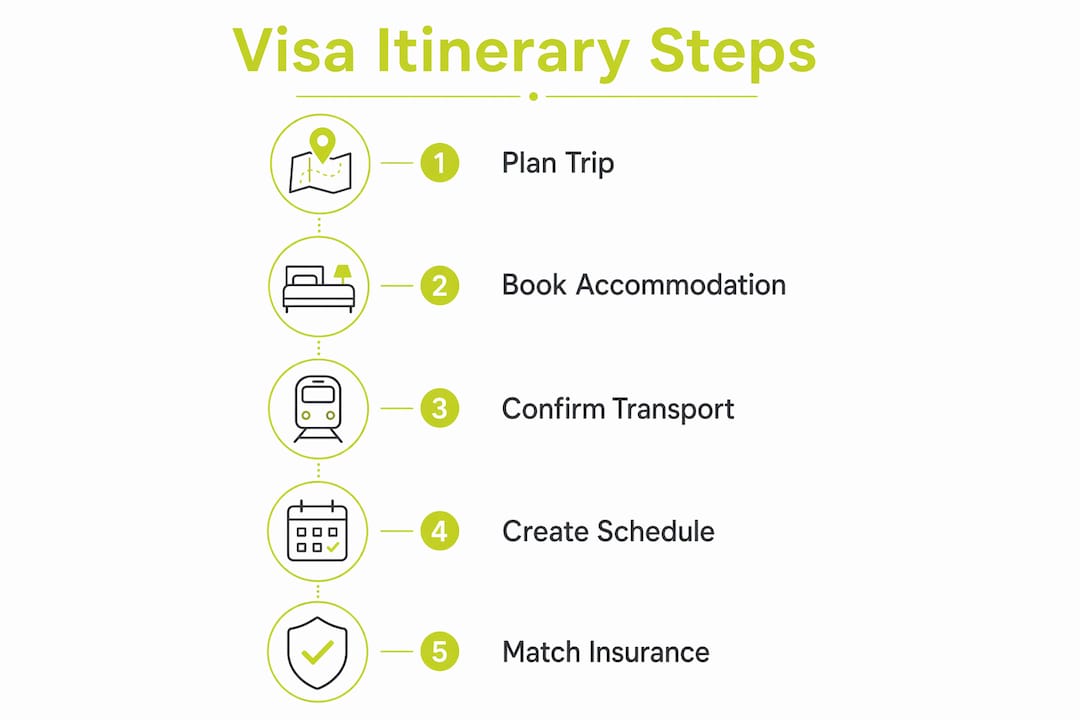
Building a solid itinerary is straightforward when you follow a logical sequence. Starting with anchor points such as entry and exit cities first helps you avoid the timeline inconsistencies that visa officers spot immediately.
-
Fix your entry and exit dates. Decide your arrival and departure cities and dates before anything else. These are your anchors. Everything else builds around them.
-
Map your accommodation for every night. Work through each night of the trip in order. Book or hold refundable accommodation for each location. If you are staying with friends or family, you still need a formal invitation letter with their full contact details. Leaving any single night undocumented is a frequent cause of visa refusals.
-
Add intercity transport. Once accommodation is fixed, add the transport links between each city. Use real flight numbers, train services, or bus routes. Check actual journey times and build them into your day plan so your schedule is physically possible.
-
Write brief daily activity notes. Keep these simple and realistic. “Day 4: Travel by train from Florence to Venice (approx. 2 hours). Check in to hotel. Evening walk along the Grand Canal.” That level of detail is sufficient. You are not writing a travel blog.
-
Use refundable or held bookings for proof. You do not need to pay in full upfront. Most embassies accept refundable flight and hotel bookings with free cancellation as valid proof. Secure these before submitting your application.
-
Verify alignment across all documents. Lay your itinerary, flight bookings, hotel confirmations, and insurance certificate side by side. Every date, city, and name must match. A single mismatch can trigger a request for further documentation.
Pro Tip: Create a simple spreadsheet with columns for date, city, accommodation name, booking reference, and transport. This gives you a single source of truth and makes it easy to spot gaps before submission.
Common mistakes that cause visa itinerary rejections
The most damaging errors are often the simplest ones. Visa officers look for a coherent and geographically logical travel story, not a polished tourist brochure. They are trained to detect manufactured itineraries by spotting impossible city orders or unrealistic schedules.
Watch out for these specific pitfalls:
- Gaps in overnight accommodation. Any night without a confirmed address raises immediate suspicion. An informal note saying “staying with a friend” is not sufficient without an official invitation letter.
- The “Day 3 teleport” problem. Visa officers check for logical errors such as itineraries that place you in two cities on the same day when travel time makes that impossible. If your flight lands at 9 PM, your itinerary should not show a full day of sightseeing on the same date.
- Mismatched documents. Your hotel booking confirmation must show the same dates as your itinerary. Your flight ticket must show the same entry city. Your travel insurance must cover the same period. Any mismatch creates doubt.
- Overly complex or fake-looking itineraries. Simple and clear itineraries that prove your intent to return home and your financial self-sufficiency are favoured over elaborate tourist plans. A 14-day itinerary with 10 cities and 3 countries often reads as fabricated.
- Incomplete form sections. For Schengen visa applications, the VIDEX form requires an accommodation section that must match your travel itinerary exactly. Administrative precision here avoids automatic processing delays.
“Visa officers are not looking for the most impressive travel plan. They are looking for the most believable one. A simple, logical itinerary with consistent supporting documents tells a convincing story. A complex one with gaps tells a different story entirely.”
How to handle bookings without paying upfront
Many applicants worry about paying for flights and hotels before their visa is approved. The good news is that you have legitimate options that protect your money.
| Booking method | Cost | Validity | Risk level |
|---|---|---|---|
| Refundable flight ticket | 30–50% more than standard fare | Until departure | Low, cancel if visa denied |
| Airline fare hold | USD 10–30 per booking | 24–72 hours | Low, small fee lost if unused |
| Refundable hotel booking | Standard rate, free cancellation | Until check-in date | Very low |
| Third-party reservation service | Varies by provider | 24–72 hours typically | Medium, verify consulate acceptance |
Refundable fares cost 30–50% more than standard fares, but they give you a confirmed booking reference that consulates accept. Fare holds cost USD 10–30 and are valid for 24–72 hours, which is enough time to submit your application. Most embassies accept both options as valid proof of travel intent.
The key risk with third-party reservation services is that not all consulates accept them. Always check the specific embassy’s guidance before using one. If a consulate rejects a dummy ticket, it can harm your application.
Pro Tip: When you cancel a refundable booking after your visa is approved or denied, save the cancellation confirmation email. This record proves you acted in good faith and protects you if any query arises later.
Planning a trip for yourself, a resident, or visiting family? UGB + Ekta can arrange travel insurance for seniors up to 100 years old. Just click here: https://ektatraveling.com/?partner_uid=808 and add the promo code “UGB” to receive an additional 10% discount.
Key takeaways
A valid travel itinerary for visa approval requires complete daily coverage, document consistency, and a geographically logical travel story that consular officers can verify at a glance.
| Point | Details |
|---|---|
| Cover every night | Every overnight stay needs a confirmed address or official invitation letter. |
| Anchor dates first | Fix entry and exit dates before building the rest of your itinerary. |
| Match all documents | Flight tickets, hotel bookings, and insurance must align with itinerary dates exactly. |
| Keep it realistic | Simple, logical itineraries with believable schedules are favoured over complex tourist plans. |
| Use refundable bookings | Fare holds and refundable tickets protect your money if your visa is denied. |
What I have learnt from years of reviewing visa travel schedules
The single biggest mistake I see applicants make is treating the itinerary as a formality. They copy a template, fill in a few hotel names, and submit it without checking whether the geography actually works. Then they wonder why their application stalls.
The itinerary is your travel story. Consular officers read it the way a detective reads a statement. They are looking for internal consistency, not impressive detail. I always tell people to read their own itinerary out loud and ask: “Does this sound like something a real person would actually do?” If day five has you arriving in Vienna at 11 PM and then visiting three museums the next morning, that is not a real person’s plan. That is a template.
The other thing I have found genuinely useful is the anchor method. Fix your first night and your last night first. Then fill in the middle. This prevents the most common error, which is building an itinerary from the middle outward and ending up with dates that do not add up at the edges.
One more thing: your tourist visa medical insurance is not just a box to tick. It is a document that must align with your itinerary dates and destination countries. I have seen applications delayed because the insurance certificate covered 12 days but the itinerary ran for 14. That is an easy fix, but only if you catch it before submission.
— Coert
Your travel insurance should match your itinerary
Your itinerary sets the dates and destinations. Your insurance must mirror them precisely.

Unparalleledglobalbenefits specialises in travel and health insurance for international travellers, expats, and visitors. Whether you need coverage for a short tourist visit or a longer stay abroad, the right policy must cover every day and every country listed in your visa support travel schedule. A mismatch between your insurance dates and your itinerary is one of the most common and most avoidable reasons for application delays. Unparalleledglobalbenefits offers essential cover for expats and travellers that aligns with your exact travel dates, giving consular officers the consistent documentation they need to process your application with confidence.
Planning a trip for yourself, a resident, or visiting family? UGB + Ekta can arrange travel insurance for seniors up to 100 years old. Just click here: https://ektatraveling.com/?partner_uid=808 and add the promo code “UGB” to receive an additional 10% discount.
Watch this helpful guide on travel insurance and visa planning:
https://youtu.be/bjzvma7Sh1g
FAQ
What is a travel itinerary for visa applications?
A travel itinerary for visa is a day-by-day schedule of your trip that includes accommodation addresses, transport details, and entry and exit dates. Schengen, UK, and US visa authorities require it as a mandatory supporting document.
Does every night need confirmed accommodation in my visa itinerary?
Yes. Every overnight stay must have a confirmed address, booking reference, or official invitation letter. An undocumented night is a common cause of visa refusals.
Can I use a refundable booking as proof for my visa application?
Most embassies accept refundable flight and hotel bookings with free cancellation as valid proof. Airline fare holds, which cost USD 10–30 and are valid for 24–72 hours, are also widely accepted.
How detailed does my daily itinerary need to be?
A brief note per day is sufficient, such as the city, accommodation, and one or two planned activities. Visa officers prioritise a logical, consistent schedule over an elaborate tourist plan.
What happens if my itinerary does not match my other documents?
Inconsistencies between your itinerary and your flight tickets, hotel reservations, or travel insurance are the primary cause of visa processing delays or refusals. Always cross-check all documents before submission.
Recommended
- Visa travel in 2026: your complete entry guide – Unparalleled Global Benefits
- Travel Insurance for Visa: Complete Expert Guide – Unparalleled Global Benefits
- Travel Insurance for Schengen Visa: Get Approved Easily – Unparalleled Global Benefits
- What does travel health insurance cover: your 2026 guide – Unparalleled Global Benefits