
TL;DR:
- Travel insurance for seniors on Medicare is essential abroad because Medicare offers minimal coverage outside the United States. These policies focus on emergency medical care, evacuation, and pre-existing condition waivers to protect seniors from high international healthcare costs. Relying solely on Medicare or credit card benefits leaves seniors underinsured, making dedicated primary travel insurance critical for safe international travel.
Travel insurance for seniors on Medicare is a medical necessity abroad, not an optional add-on, because Original Medicare covers virtually nothing outside the United States. Most seniors assume their Medicare card travels with them. It does not. Whether you are planning a European river cruise, a visit to family in Australia, or a winter escape to Mexico, you are effectively uninsured the moment your flight leaves American airspace. Dedicated travel health insurance for seniors fills that gap directly. Providers such as Allianz and Medjet offer plans specifically structured for older travellers, with premiums for a single trip typically ranging from $50 to $200, rising steeply for those aged 60 and above.
What does travel insurance for seniors on Medicare actually cover?
Specialised international travel medical insurance for seniors goes well beyond basic trip cancellation. The core of any worthwhile policy is emergency medical care abroad, which pays for hospitalisation, surgery, diagnostic tests, and specialist consultations when you fall ill or are injured overseas. Experts recommend at least $100,000 in emergency medical coverage, with $500,000 advised for complex health profiles or high-cost destinations such as Japan or Switzerland. That figure is not arbitrary. A single night in a private hospital in Germany can cost several thousand dollars, and a cardiac event requiring intensive care can exceed $200,000 before evacuation costs are added.
Medical evacuation and repatriation cover is equally critical. If you suffer a serious stroke in Thailand, the cost of a medically equipped air ambulance back to the United States can reach $100,000 or more on its own. Policies from providers like Medjet include membership-based evacuation that transports you to your preferred home hospital rather than simply the nearest adequate facility. That distinction matters enormously when you have an established cardiologist or oncologist at home.
Pre-existing condition coverage deserves particular attention. Many policies offer a pre-existing condition waiver if you purchase within a set window after your initial trip deposit, often 14 to 21 days. This waiver means that a flare-up of a managed condition such as diabetes, heart disease, or COPD is treated as a covered event rather than an exclusion. Policies addressing chronic conditions offer measurably better protection for the claims seniors actually make abroad.
Key benefits to look for in overseas travel insurance for seniors include:
- Emergency medical treatment abroad, including hospitalisation and surgery
- Medical evacuation and repatriation to your home hospital or country
- Pre-existing condition waiver when purchased promptly after booking
- Trip cancellation and interruption cover for health-related cancellations
- 24-hour assistance lines with direct hospital billing where possible
Pro Tip: Purchase your policy within 14 days of your first trip deposit to qualify for the pre-existing condition waiver on most plans. Waiting until the week before departure often disqualifies you from this benefit entirely.
How do Medicare and Medigap plans interact with travel cover?
Understanding this interaction is the single most important step before you book any international trip. Original Medicare and the majority of Medicare Advantage plans provide effectively zero coverage for non-emergency medical services outside the United States. Medicare Advantage plans are particularly restrictive because they operate within defined network areas, which almost never extend beyond U.S. borders.
Medigap (Medicare Supplement) plans do offer a foreign travel emergency benefit, but the limitations are significant:
- The benefit applies only to Plans C, D, F, G, M, and N. Not every Medigap plan includes it.
- There is a $50,000 lifetime cap covering 80% of costs after a $250 deductible. A single serious emergency can exhaust this limit entirely.
- The emergency must occur within the first 60 days of your trip abroad. Longer journeys receive no Medigap protection at all.
- Medigap functions as secondary coverage, meaning it pays after another insurer has paid first. If no primary insurer exists, claims processing becomes complicated.
- Routine care, elective procedures, and non-emergency consultations are excluded regardless of plan.
“Travelling seniors should treat their travel insurance as their primary medical contract when abroad, because Medicare offers minimal emergency coverage internationally.” — Expert insight on senior travel insurance
The practical implication is clear. Even if you hold a Medigap plan, a major medical event abroad can leave you personally liable for tens of thousands of dollars once the $50,000 cap is reached. Primary travel insurance avoids this entirely by paying the hospital directly without requiring a Medicare claim submission first. That removes administrative delays and the risk of claims rejection at the worst possible moment.
What factors affect the cost of senior travel insurance?
Premium pricing for the best travel insurance for seniors is determined by a combination of factors, not age alone. Comprehensive risk profiles determine pricing, which means two travellers of the same age can receive very different quotes depending on their health history, destination, and trip length.

| Factor | Impact on premium |
|---|---|
| Age | Travellers in their 70s pay roughly 3x base rates; those over 80 pay approximately 5x |
| Pre-existing conditions | Declared conditions increase premiums; undisclosed conditions risk claim denial |
| Destination | High-cost medical systems (USA, Japan, Switzerland) attract higher premiums |
| Trip duration | Longer trips carry greater exposure and higher cost |
| Coverage level | Policies with $500,000 medical limits cost more than $100,000 plans |
To put real numbers to this, typical quotes for a 72-year-old on a 14-day trip valued at $6,000 range from $440 to over $600 depending on the plan and whether a pre-existing condition waiver is included. That range reflects genuine differences in coverage quality, not just price competition.
A few practical approaches help you find affordable cover without sacrificing protection. Annual multi-trip policies work out cheaper per journey if you travel more than twice a year. Raising your excess (deductible) modestly can reduce premiums without affecting major claim payouts. Comparing at least three to four quotes through an independent broker or comparison platform gives you a realistic view of the market. You can find detailed guidance on how insurers calculate premiums based on age, trip duration, and medical history.
Pro Tip: Always disclose your full medical history accurately when applying. Undisclosed conditions are the leading reason claims are denied abroad, and the financial consequences of a rejected claim far outweigh any premium saving.
Which providers are recommended for seniors on Medicare?
The best international travel insurance for seniors on Medicare combines high medical limits, genuine pre-existing condition support, and primary coverage status. Here is how the leading options compare:
- Allianz Travel Insurance offers single-trip and annual plans with emergency medical limits up to $500,000. Their OneTrip Prime and Premier plans include trip cancellation and are widely available to seniors up to age 80.
- IMG iTravelInsured provides plans with primary coverage designation, meaning they pay before any other insurer. Their Travel LX plan covers pre-existing conditions with a waiver and includes up to $1,000,000 in medical evacuation.
- Medjet operates as a membership-based medical transport service rather than a traditional insurer. It complements a medical policy by guaranteeing transport to your home hospital once you are stabilised, with no per-trip cost beyond the annual membership fee.
- GeoBlue specialises in international health coverage for Americans abroad and offers direct billing with a global network of vetted hospitals. Their Voyager plans are designed specifically for travellers who need primary international cover.
Credit card travel benefits are secondary, limited in scope, and rarely address medical evacuation adequately. Seniors who rely on card-linked cover as their primary protection are taking a significant financial risk. Dedicated policies designed for senior medical and evacuation needs are the only reliable solution. For seniors with significant medical conditions, the article on travel insurance for elderly with medical conditions covers recommended minimum coverage amounts in detail.
How to choose the right travel insurance for your trip abroad
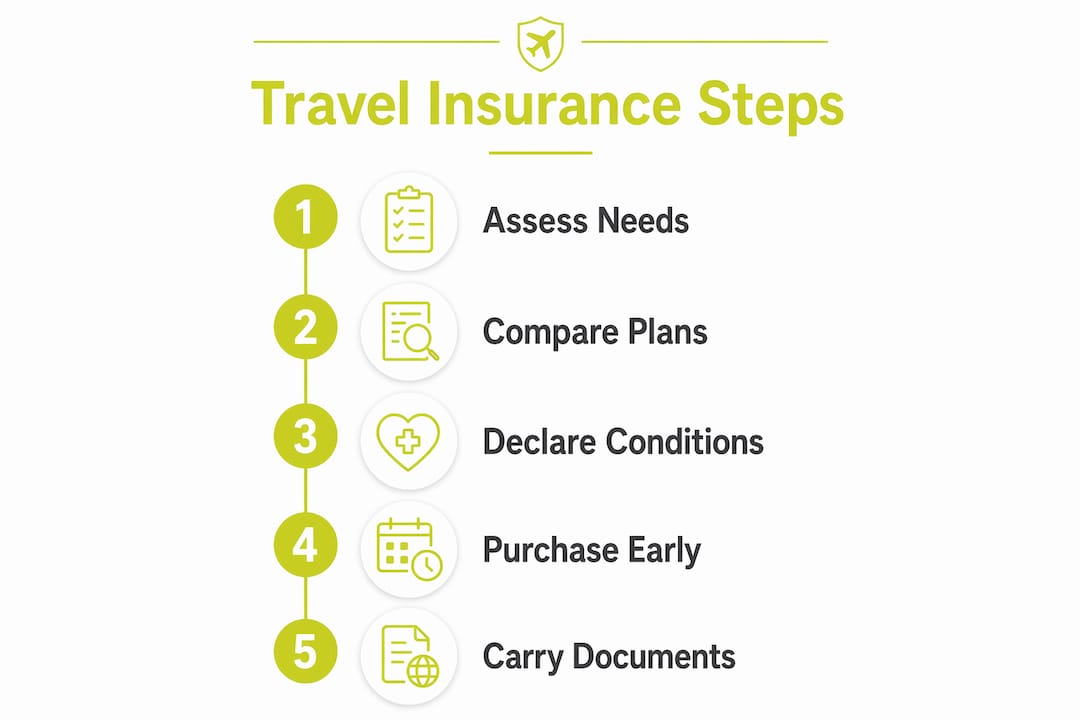
Selecting the right policy requires a structured approach rather than simply choosing the cheapest option available.
- Review your current Medicare and Medigap coverage. Confirm exactly which Medigap plan you hold and whether it includes a foreign travel emergency benefit. Note the $50,000 lifetime cap and the 60-day trip limit so you know precisely where your existing cover ends.
- Assess your health profile honestly. List all chronic conditions, current medications, and any recent hospitalisations. This list determines which policies will cover you and at what premium. Accurate health disclosure is the single most important step in the application process.
- Match coverage limits to your destination. Research the average cost of hospitalisation in your destination country. A $100,000 limit is adequate for most of Europe; destinations with U.S.-level healthcare costs require $250,000 or more.
- Confirm primary coverage status. Ask specifically whether the policy pays as primary or secondary. Primary cover means the insurer pays the hospital directly without waiting for Medicare to process a claim first.
- Compare at least three quotes. Use an independent broker or a comparison platform to review multiple plans side by side. Look beyond the premium to examine exclusions, pre-existing condition terms, and evacuation limits.
Pro Tip: Ask each insurer directly: “Does this policy cover an unexpected flare-up of a managed chronic condition?” If the answer is vague or conditional, request written clarification before purchasing. Ambiguity in policy language always resolves in the insurer’s favour at claims time.
You will find a practical checklist of best travel insurance tips for seniors abroad that covers policy selection and cost management in more detail.
Key takeaways
Seniors on Medicare need dedicated travel insurance because Medicare provides no meaningful international medical coverage, and Medigap’s $50,000 lifetime cap is insufficient for a serious emergency abroad.
| Point | Details |
|---|---|
| Medicare covers almost nothing abroad | Original Medicare and Medicare Advantage plans provide effectively zero international emergency cover. |
| Medigap has a hard cap | The $50,000 lifetime foreign travel limit is exhausted by a single serious medical event in many countries. |
| Primary cover is the priority | Choose policies that pay hospitals directly, avoiding Medicare claim submission delays and rejection risk. |
| Disclose all pre-existing conditions | Accurate disclosure protects your claim; undisclosed conditions are the leading cause of denied payouts abroad. |
| Compare multiple quotes | A 72-year-old’s 14-day trip quotes range from $440 to over $600, so comparison directly affects value. |
Why I think most seniors are dangerously underinsured when they travel
I have worked with enough seniors navigating international insurance claims to say this plainly: the gap between what people assume Medicare covers abroad and what it actually covers is one of the most consequential misconceptions in travel planning. I have seen travellers return from a two-week trip to Italy with a $90,000 hospital bill that their Medigap plan covered only partially, leaving them personally liable for the remainder after the lifetime cap was reached.
The advice I give consistently is this: treat your travel insurance policy as your primary medical identity when you leave the United States. Do not think of it as a backup for Medicare. Medicare is not there. Your travel policy is the only contract that matters the moment you board that international flight.
I am also direct about credit card cover. It is not a substitute. Most card-linked policies are secondary, capped at low limits, and exclude pre-existing conditions entirely. Seniors who rely on them are, in practical terms, uninsured for the scenarios that actually cost money.
The one thing I would add that most articles do not say clearly enough: chronic condition flare-ups are the most common high-cost claim seniors make abroad. A well-managed condition at home can become a medical emergency in a different climate, with different food, different activity levels, and disrupted medication routines. The policy that covers that flare-up is worth every penny of the premium difference. For a deeper look at why traditional Medicare falls short for international travellers, the piece on travel medical insurance for seniors over 70 explains the coverage gap clearly.
— Coert
How Unparalleledglobalbenefits helps Medicare seniors travel with confidence
Unparalleledglobalbenefits specialises in international insurance solutions for seniors who need genuine protection abroad, not a policy full of exclusions. Whether you are 65 or 95, the team can match you with a plan that addresses your specific health profile, destination, and trip length. Explore comprehensive global health insurance plans designed to serve as primary international cover for seniors who need it most.

Planning a trip for yourself, a resident, or visiting family? UGB + Ekta can arrange travel insurance for seniors up to 100 years old. Just click here: https://ektatraveling.com/?partner_uid=808 and add the promo code “UGB” to receive an additional 10% discount. For more guidance on choosing the right cover, watch this short video:
https://youtu.be/bjzvma7Sh1g
FAQ
Does Medicare cover medical emergencies abroad?
Original Medicare covers virtually nothing outside the United States, including most emergency medical services. Dedicated travel health insurance for seniors is the only reliable protection for international medical costs.
What is the Medigap foreign travel emergency benefit?
Medigap plans C, D, F, G, M, and N include a foreign travel emergency benefit with a $50,000 lifetime cap covering 80% of costs after a $250 deductible. This benefit applies only within the first 60 days of a trip abroad and is insufficient for major medical events.
How much does travel insurance for pensioners typically cost?
Premiums for a 72-year-old on a 14-day $6,000 trip range from $440 to over $600 depending on the plan and pre-existing condition terms. Travellers in their 80s pay approximately five times the base rate of younger travellers.
What does primary travel insurance mean for Medicare seniors?
Primary coverage means the insurer pays the hospital directly without requiring a Medicare claim to be submitted first. This avoids administrative delays and the risk of claims rejection, making it the preferred option for seniors travelling internationally.
Should I declare pre-existing conditions on my travel insurance application?
Yes, always. Accurate health disclosure is the most important step in the application process, as undisclosed conditions are the leading reason claims are denied abroad. Full disclosure protects your right to a valid payout when you need it most.
Recommended
- Travel Insurance for Seniors: Coverage Up to 85 Years of Age
- Travel Health Insurance for Seniors: Everything You Need to Know – Unparalleled Global Benefits
- Best cruise travel insurance for seniors: 2026 guide – Unparalleled Global Benefits
- Travel Insurance for Elderly with Medical Conditions: Secure Coverage – Unparalleled Global Benefits