Remote work is changing the way people protect themselves on the job. Traditional insurance models are increasingly obsolete, no longer covering the needs of digital nomads who work from anywhere in the world. Yet it might seem like a solution as simple as a health plan or travel policy would do the trick. The truth is, insurance for remote workers is much more advanced and personal, using smart data to constantly adapt to your style of work and location.
Table of Contents
- What Is Insurance For Remote Workers?
- Why Is Insurance For Remote Workers Important?
- How Does Insurance For Remote Workers Function?
- Key Concepts In Remote Workers’ Insurance
- Real-World Examples Of Insurance For Remote Workers
Quick Summary
| Takeaway | Explanation |
| Insurance is crucial for remote workers | It addresses unique challenges faced by freelancers and digital nomads. |
| Coverage includes health and equipment protection | Ensures access to medical services and safeguards essential devices against damage. |
| Customised policies are essential | Tailored plans adapt to each individual’s work situation and geographical context. |
| Professional liability protection is vital | Shields remote workers from potential legal claims arising from their work. |
| Continuous risk assessment enhances safety | Dynamic evaluations help adjust coverage to reflect changing work conditions. |
What is Insurance for Remote Workers?
Insurance for remote workers represents a specialised coverage designed to protect professionals who work outside traditional office environments. This type of insurance acknowledges the unique risks and challenges faced by digital nomads, freelancers, and global professionals who operate from diverse geographical locations.
Understanding Remote Worker Insurance Coverage
Remote worker insurance goes beyond standard employment protection, offering comprehensive safeguards tailored to modern work arrangements. Unlike traditional workplace insurance, these policies recognize the fluid nature of contemporary professional landscapes.
Key aspects of remote worker insurance typically include:
- Health Protection: Comprehensive medical coverage that works across international borders
- Professional Liability: Protection against potential legal claims related to professional services
- Equipment Insurance: Coverage for technological devices essential to remote work
To help readers quickly grasp the scope of coverage, here is a table outlining the main components typically included in remote worker insurance.
| Component | Description |
| Health Protection | Medical coverage that works across international borders |
| Professional Liability | Protection against legal claims related to professional services |
| Equipment Insurance | Covers technological devices essential to remote work |
| Income Stabilisation | Insures against potential work interruptions |
| Medical Emergency Support | Provides support for emergencies across geographies |
| Modular Coverage | Options to add or remove specific protection elements |
Financial and Professional Risk Mitigation
The fundamental purpose of insurance for remote workers is risk management. Exploring comprehensive protection strategies becomes crucial as professionals navigate increasingly complex work environments. Whether you are a freelance graphic designer in Berlin or a software engineer working from cafes in Southeast Asia, these insurance products offer a safety net against unexpected professional and personal disruptions.
Remote worker insurance recognizes that traditional employment models no longer represent the majority of global professional experiences. By providing flexible, adaptable coverage, these insurance products support the growing trend of location-independent work, ensuring professionals can focus on their careers without constant worry about potential financial vulnerabilities.
Understanding the intricate details of such insurance requires careful consideration of individual work patterns, geographical risks, and specific professional requirements. Professionals must assess their unique circumstances to select the most appropriate insurance protection.
Why is Insurance for Remote Workers Important?
Insurance for remote workers has become increasingly critical in the modern professional landscape, where traditional workplace boundaries have dissolved and professionals increasingly operate across diverse geographical contexts. The importance of specialised insurance protection extends far beyond simple risk mitigation.
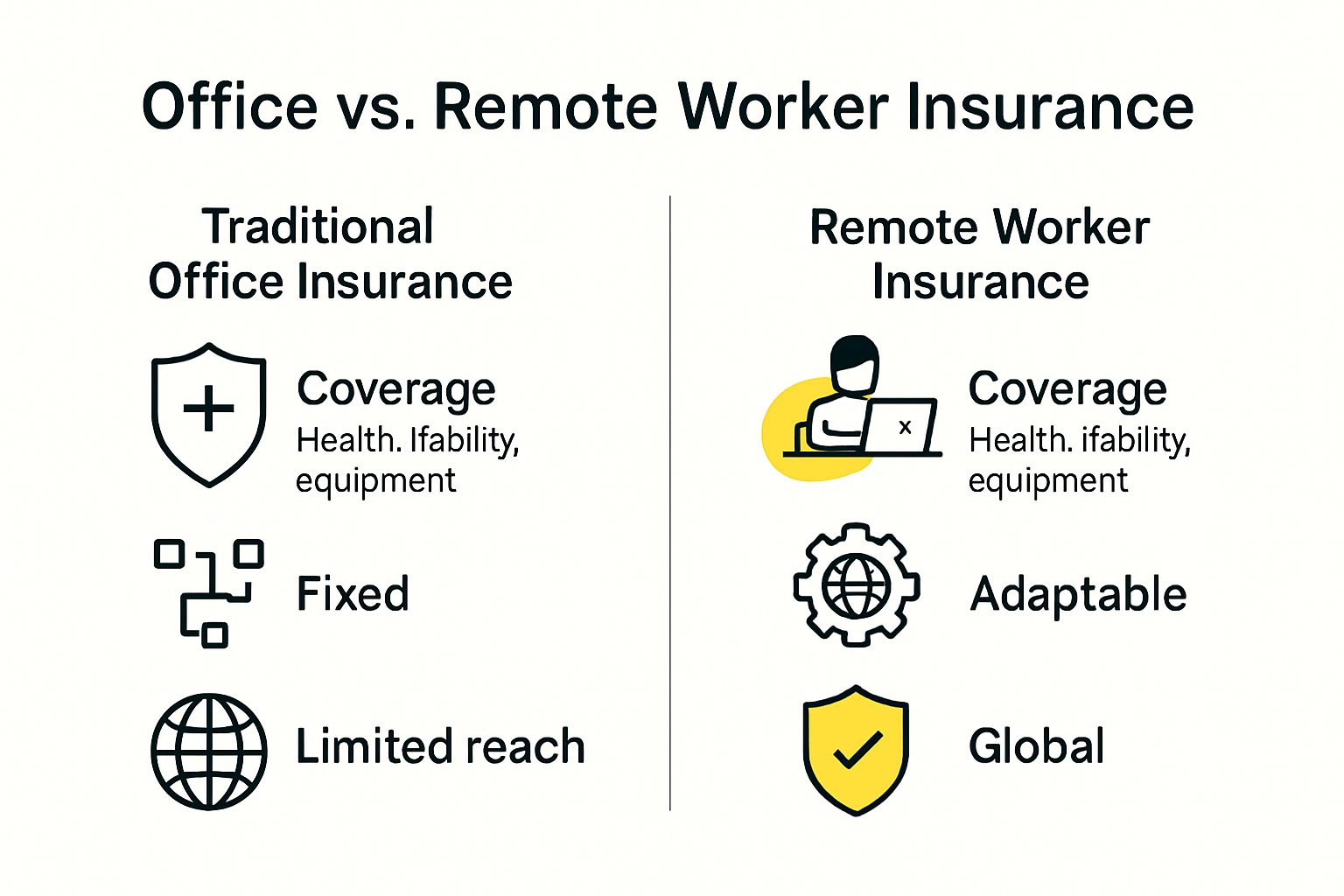
The following table compares traditional insurance models with insurance designed for remote workers, highlighting key differences in approach and protection.
| Feature/Approach | Traditional Insurance | Remote Worker Insurance |
| Coverage Location | Fixed workplace | Global, multi-jurisdictional |
| Risk Assessment | Static, standardised | Continuous, dynamic |
| Policy Adaptability | Limited | High (customisation/modular) |
| Professional Liability Cover | Office-based | Designed for freelancers |
| Equipment Protection | Often excluded | Specifically included |
| Data & Technology Use | Minimal | Advanced (data-driven) |
Comprehensive Financial Protection
Remote workers face unique financial vulnerabilities that standard employment insurance often fails to address. Learn about essential accident coverage to understand the depth of protection required in contemporary work environments.
Key financial protection considerations include:
- Income Stabilization: Coverage against potential work interruptions
- Medical Emergency Support: Comprehensive health protection across international borders
- Professional Liability Shield: Protection against potential legal claims
Professional Risk Management
In an era of global digital connectivity, remote workers are exposed to multifaceted professional risks. These risks range from technological equipment damage to potential legal disputes arising from cross-border professional services. Insurance provides a critical safety net that enables professionals to pursue innovative work arrangements without constant financial anxiety.
The landscape of professional risk has transformed dramatically. Freelancers, digital nomads, and global consultants now require insurance products that match the complexity and dynamism of their professional lives. Traditional insurance models are increasingly obsolete, unable to capture the nuanced realities of location-independent work.
Moreover, insurance for remote workers represents more than a financial product. It is a strategic tool that empowers professionals to embrace flexible work models, providing psychological security and practical support in an increasingly unpredictable global work environment.
How Does Insurance for Remote Workers Function?
Insurance for remote workers operates through sophisticated, flexible mechanisms designed to accommodate the dynamic nature of contemporary professional environments. Unlike traditional workplace insurance models, these specialised products adapt to the unique challenges faced by location-independent professionals.
Policy Customization and Adaptability
Explore comprehensive travel insurance options that reflect the intricate needs of modern remote workers. The fundamental functioning of these insurance products revolves around tailored coverage that responds to individual professional circumstances.
Key functional characteristics include:
- Geographic Flexibility: Coverage that extends across multiple international jurisdictions
- Dynamic Risk Assessment: Continuous evaluation of professional and personal risk profiles
- Modular Coverage: Ability to add or remove specific protection elements
Technical Mechanism of Coverage
Remote worker insurance functions through advanced risk calculation algorithms that assess multiple variables. These systems integrate technological tracking, professional activity monitoring, and predictive analytics to determine appropriate coverage levels and premium structures.
The operational model typically involves real-time data processing, where insurers continuously evaluate an individual’s work environment, geographical location, professional activities, and associated risks. This dynamic approach allows for unprecedented levels of personalization, enabling insurance products to provide precise protection that traditional models cannot match.
Professionals can adjust their coverage parameters based on changing work circumstances, ensuring that their insurance remains relevant and responsive to their evolving professional landscape. The technical infrastructure supporting these insurance products leverages machine learning and data analytics to create a responsive, adaptive protection mechanism that mirrors the fluidity of modern work arrangements.
Key Concepts in Remote Workers’ Insurance
Remote workers’ insurance represents a sophisticated ecosystem of protection mechanisms designed to address the complex risks inherent in modern, location-independent professional environments. Understanding these key conceptual frameworks is crucial for professionals seeking comprehensive coverage.
Contextual Risk Assessment
Explore nuanced travel and health insurance differences to comprehend the intricate landscape of protection for mobile professionals. The fundamental premise of remote workers’ insurance revolves around dynamic, context-specific risk evaluation.
Critical conceptual elements include:
- Geographical Variability: Understanding how professional risks transform across different jurisdictions
- Professional Categorization: Recognizing unique risk profiles based on specific work domains
- Technological Exposure: Evaluating digital infrastructure and cybersecurity vulnerabilities
Comprehensive Protection Frameworks
Remote workers’ insurance transcends traditional coverage models by integrating multiple protection dimensions. These frameworks are not static documents but living, adaptive mechanisms that respond to the evolving nature of global professional landscapes.
The conceptual approach involves holistic risk management that considers interconnected factors such as professional activity, geographical location, technological infrastructure, and individual skill sets. This multidimensional assessment allows insurers to create nuanced, personalized protection strategies that reflect the complex realities of contemporary work environments.
Professionals must understand that insurance in the remote work context is fundamentally about creating a comprehensive safety net that addresses not just potential financial losses, but also provides psychological security and operational resilience in an increasingly unpredictable professional world.
Real-World Examples of Insurance for Remote Workers
Real-world scenarios demonstrate the critical importance of tailored insurance solutions for professionals operating outside traditional workplace environments. These practical examples illustrate how specialised coverage protects individuals across diverse professional landscapes and geographical contexts.
Professional Scenario Illustrations
Discover comprehensive accident coverage strategies to understand the nuanced protection needs of remote workers. The following scenarios highlight the intricate ways insurance adapts to contemporary work arrangements.
Typical remote worker insurance scenarios include:
- Digital Nomad in Southeast Asia: Freelance graphic designer requiring international health coverage and equipment protection
- Software Engineer Working Globally: Comprehensive liability insurance covering potential legal risks across multiple jurisdictions
- Consultant with Frequent International Travel: Integrated coverage addressing medical emergencies, trip cancellations, and professional liability
Practical Protection Narratives
Technological professionals represent a prime example of complex insurance requirements. Consider a software developer who works simultaneously from coffee shops in Berlin, co-working spaces in Bali, and temporary accommodations in Tokyo. Traditional insurance models would struggle to provide consistent, comprehensive protection.
In this scenario, a robust remote workers’ insurance policy would offer seamless coverage that dynamically adjusts to changing geographical locations, technological risks, and professional activities. The policy might include provisions for medical treatment across international healthcare systems, protection against cyber threats, and legal liability coverage for project-related disputes.
These real-world examples underscore that modern insurance is not a static contract but a sophisticated, adaptive mechanism designed to support the complex professional lives of globally mobile workers. The fundamental goal remains consistent: providing professionals with the confidence to pursue innovative work arrangements without compromising their financial and personal security.

Discover True Security for Remote Professionals – Tailor Your Protection
Struggling to find insurance that truly covers the risks of remote work? If you are feeling vulnerable due to gaps in medical, travel or professional liability cover, you are not alone. The world of remote work introduces complex risk factors like unpredictable global medical needs, equipment loss, and shifting legal obligations. Traditional policies often fall short, leaving digital nomads and international freelancers exposed. You deserve a solution as flexible and dynamic as your career.
Take control of your peace of mind today. Visit our Global Expat Medical and Travel Insurance specialists and see how you can secure adaptable, comprehensive cover for your unique lifestyle. Ready to unlock the benefits of a truly global insurance plan? Explore your tailored options now and start protecting your future, wherever your work may take you.
Frequently Asked Questions
What is insurance for remote workers?
Insurance for remote workers is a specialised coverage designed to protect professionals who work outside traditional office environments, addressing unique risks faced by freelancers and digital nomads.
Why is insurance for remote workers important?
It is important because it provides comprehensive financial protection against specific vulnerabilities that remote workers face, such as income stability, medical emergencies, and professional liability.
How does insurance for remote workers function?
Remote worker insurance operates through flexible policies that can be customised, accommodating dynamic professional environments and risks across multiple jurisdictions.
What are the key components of remote worker insurance coverage?
Key components typically include health protection, professional liability, and equipment insurance, tailored to meet the needs of location-independent professionals.
Recommended
- Types of Travel Insurance: Essential Cover in 2025 – Unparalleled Global Benefits
- Understanding the Difference Between Travel and Health Insurance 2025 – Unparalleled Global Benefits
- What Is Accident Coverage? Essential Guide for World Travellers – Unparalleled Global Benefits
- Why Travel Insurance Is Important for Every Traveller – Unparalleled Global Benefits