
The exclusions that trip up most travellers fall into six groups: undeclared pre-existing medical conditions, high-risk activities without an add-on, war and civil unrest, pandemics and government travel advisories, alcohol or drug-related incidents, and elective cancellations that aren’t covered by a “cancel for any reason” upgrade. Every one of the sits in the certificate of insurance, the legal contract, not the marketing page you scrolled through when you bought the policy. If your trip involves remote regions, adventure sports, or a known health condition, a specialist add-on is usually worth the extra premium.
TL;DR:
- Travel insurance generally excludes coverage for undeclared pre-existing medical conditions, high-risk activities without proper add-ons, and incidents related to alcohol or drugs.
- Coverage often does not apply if you travel against government advisories or if a disaster, like a storm or wildfire, was already named or foreseeable when you purchased the policy.
- Many policies have strict limits on baggage, medical sums, and territory coverage, with lower alerts for claims involving unattended belongings or missing receipts.
- Activities such as riding unlicensed vehicles, scuba diving beyond a set depth, or winter sports off marked pistes typically require separate endorsements to be covered.
- Cancelation and change of mind are rarely covered unless a specific, narrow reason occurs before the policy is bought, and comprehensive planning involves declaring conditions and buying activity-specific riders early.
Table of Contents
- What does travel insurance not cover?
- Medical exclusions and pre-existing conditions
- Which activities and sports aren’t covered by default?
- Cancellation, interruption and ‘change of mind’ exclusions
- Policy limits, excesses and territory exclusions that catch people out
- How do you avoid surprises before you travel?
- Practical examples and where to go for tailored cover
- Are natural disasters and severe weather covered?
- What are the limits on lost or stolen property cover?
- Do exclusions apply to mental health conditions?
- Does travel insurance cover quarantine or mandatory isolation?
- Are delayed or missed connections covered?
- When exclusions are tolerable, and when they’re not
- How travel insurance providers help you close the gaps
- Sources
- FAQ
What does travel insurance not cover?
Travel insurance is built around unforeseen events, and insurers write their policies to exclude anything they consider foreseeable, self-inflicted, or already known to you at the time of purchase. That distinction shapes almost every exclusion on the list below.
Government advisories play a bigger role in this than most travellers expect. If a country is under a formal advisory against travel and you go anyway, most standard policies stop covering incidents related to that risk, even if the incident itself seems unrelated to why the advisory was issued.
Here’s what tends to fall outside standard cover:
- War, civil unrest, terrorism and sanctions. Standard policies typically exclude losses tied to armed conflict, coups, or government sanctions on a destination, and some name specific countries outright.
- Pandemics, epidemics and named storms. Cover for these events usually depends on when you bought the policy relative to when the event was declared or named. Buy after a hurricane has a name, and related claims are almost always denied.
- Undeclared pre-existing medical conditions. If you didn’t disclose a condition at purchase and it later triggers a claim, insurers can deny the entire claim, not just the portion related to that condition.
- Elective or planned medical treatment abroad. Medical tourism, cosmetic procedures, and treatments booked before you left home are routinely excluded, since they aren’t unforeseen.
- Alcohol and drug-related incidents. Injuries or losses linked to intoxication or illegal drug use are almost universally excluded, regardless of how minor the connection seems.
- Losses from leaving belongings unattended. Insurers expect “reasonable care.” A phone stolen from an unlocked hotel room or a bag left on a beach chair rarely qualifies for a payout.
Consumer finance sites consistently flag the same pattern: undeclared conditions, unlicensed vehicle use, medical tourism, intoxication, and travel against government advice sit at the top of every insurer’s exclusions list. War and civil unrest exclusions often extend further than travellers expect, too, sometimes covering entire regions rather than just the specific country named in an advisory, according to reporting on common coverage gaps.
Medical exclusions and pre-existing conditions
Insurers define a pre-existing condition broadly, and the definition matters more than most buyers realise. It’s typically any condition you were diagnosed with, treated for, or had symptoms of within a set window before you bought the policy, commonly 60 to 180 days, though this varies significantly by insurer and plan.
Non-disclosure is the single most common reason for a medical claim denial. If you tick “no” on a health questionnaire and later need treatment for something related to an undisclosed condition, insurers can reject the claim in full, and in some cases void the policy entirely.
Several categories of medical cost sit outside standard cover even when a condition is disclosed:
- Routine or elective procedures, including most dental work beyond emergency pain relief
- Follow-up treatment for a condition that was already being managed before departure
- Pregnancy-related care past a certain gestational point, which varies by insurer
- Mental health treatment that isn’t tied to a sudden, diagnosable crisis
Medical evacuation and repatriation cover works differently. Most comprehensive policies include it, but the sums insured and the definitions of “medically necessary” evacuation vary widely between providers. Reading the medical evacuation and repatriation cover section of your policy before you travel tells you whether you’d actually be flown home, or just to the nearest adequate facility.
Pro Tip: Call the insurer before you buy and ask them to confirm your specific condition is accepted in writing. A verbal “that should be fine” from a call centre agent means nothing if a claim goes to dispute.
If you have a known condition, comparing specialist policies designed around disclosed conditions is usually faster and cheaper than trying to get a standard policy to stretch to cover you.
Which activities and sports aren’t covered by default?
Standard travel insurance is priced around a traveller who sightsees, eats out, and maybe hires a bike. Anything riskier than that usually needs a rider, an endorsement, or a dedicated adventure sports policy.
Insurers group activities into risk tiers, and the excluded tier catches more people off guard than any other part of the policy. Common exclusions include:
- Riding a moped or motorcycle, particularly without a local licence for that vehicle class
- Scuba diving beyond a set depth, often varying with the insurer’s terms
- Trekking above a defined altitude, depending on policy details
- Organised extreme sports: bungee jumping, skydiving, white-water rafting above a certain grade
- Winter sports off marked pistes, or skiing without a helmet in some policies
The moped exclusion trips up many travellers, partly because renting one is legal, common, and often the only practical way to get around in a given destination. Legal availability has nothing to do with insurance cover, and industry reporting on frequently overlooked exclusions singles this out as one of the most common surprises when a claim is denied.
If your trip includes any activity from that list, buying a specialist rider before departure is the only reliable fix. These typically require you to state the exact activity, sometimes the exact depth or altitude, and insurers screen against that specific wording when a claim comes in. A winter sports add-on bought two days before you fly is far better than assuming your comprehensive policy already includes it.
Cancellation, interruption and ‘change of mind’ exclusions
Cancellation cover has one of the widest gaps between what travellers assume and what’s actually written into the policy.
- Covered reasons are narrow and specific. Sudden serious illness, a death in the immediate family, jury duty, or your home becoming uninhabitable are typically covered. Getting cold feet, a change in your work schedule you could have anticipated, or simply deciding not to go, are not.
- Timing rules decide storm and event-related claims. If a hurricane is named, or a destination is added to a government advisory, before you bought the policy, related cancellation claims are void. Forbes Advisor’s guidance on cancellation cover notes this catches travellers who buy insurance at the last minute, thinking they’re covering a trip that’s already at risk.
- Cancel For Any Reason (CFAR) fills some of the gap, but not all of it. CFAR add-ons typically reimburse a portion of trip costs, must usually be purchased shortly after the initial trip deposit, and require cancellation within a specified timeframe before departure to qualify.
None of this covers a straightforward change of mind after final payment, which is precisely the scenario most travellers assume is covered until they read the policy wording closely.
Policy limits, excesses and territory exclusions that catch people out
Every travel policy has caps, and the cap is usually far lower than travellers expect until they’re staring at a shortfall.
Baggage cover, for example, often caps out around $1,500 to $2,500 in total, with a per-item sub-limit that can be as low as $250, meaning a stolen laptop rarely gets reimbursed at its full value. Medical sums insured vary hugely by plan tier, and the excess, the amount you pay before the insurer contributes anything, applies per claim, not per trip.
Industry reporting has repeatedly flagged that the definitions inside the certificate of insurance, not the summary brochure, are what determine whether a “grey area” claim like a moped injury or a high-altitude fall actually gets paid.
Territory exclusions follow government advice closely. If your destination is under a formal warning, from GOV.UK, the US State Department, or an equivalent body, cover for that region may be suspended entirely, even for travellers who booked before the advisory was issued.
The claims mistake that come up again and again:
- Not keeping original receipts for lost or damaged items
- Reporting a theft to police more than 24 hours after it happened
- Leaving bags unattended, even briefly, in a public space
- Driving without the licence class required for the vehicle
- Any claim connected to an illicit substance, however tangential
How do you avoid surprises before you travel?
A short, deliberate checklist before departure closes most of the gaps that lead to denied claims.
- Read the certificate of insurance in full, not the summary page, and search it for the exact activities and conditions relevant to your trip.
- Declare every pre-existing condition honestly, even ones that feel minor or unrelated to travel.
- Buy activity-specific riders as soon as you book the activity, not the week before you fly.
- Keep medical records, police reports, and receipts in one place, ideally photographed and backed up digitally.
- Ask the insurer directly about territorial cover, evacuation sums insured, and wording for any specific activity you’re planning.
Pro Tip: Save every email exchange with your insurer, especially anything confirming a condition or activity is covered. A screenshot of a chat confirmation has settled more disputed claims than any amount of arguing after the fact.
Practical examples and where to go for tailored cover
A traveller with a controlled but disclosed heart condition who buys a pre-existing condition policy rather than a standard plan typically finds claims process far faster when something goes wrong, because the insurer has already accepted the risk in writing. The opposite scenario, an undisclosed condition surfacing mid-trip, is the single most common cause of a full claim denial across the industry.
Evacuation cover follows a similar pattern. Travellers heading to remote regions who confirm evacuation limits and definitions before departure avoid the scramble of discovering, mid-emergency, that their policy only covers transport to the nearest hospital rather than home.
If your trip involves a known condition, a high-risk activity, or an unusual destination, Unparalleledglobalbenefits can help you compare specialist policies built around your actual circumstances rather than a generic template.
Are natural disasters and severe weather covered?
Natural disasters sit in a grey zone that depends entirely on timing. If an earthquake, wildfire, or flood happens while you’re already travelling and forces an unplanned itinerary change, most comprehensive policies treat that as a covered interruption.
The exclusion appears when the event was foreseeable before you bought the policy. A named storm is the clearest example: once a hurricane or cyclone has a name assigned by a meteorological agency, purchasing a policy afterwards typically voids any related claim, even if the storm hasn’t reached the destination yet.
Volcanic ash disruption, wildfire smoke closing an airport, or a flood damaging a resort you’d already booked usually fall under “unforeseen event” cover, provided the policy was active before the event became public knowledge. The distinction insurers draw isn’t really about the disaster itself, it’s about whether you could have known and chosen not to travel.
Seasonal risk matters too. Booking a Caribbean trip in peak hurricane season doesn’t void cover on its own, but buying the policy after a storm has already formed in that season does. Checking the date a policy takes effect against any weather system already in the news is worth thirty seconds before you pay.
What are the limits on lost or stolen property cover?
Baggage and personal effects cover exists, but it’s built with caps that rarely match what people actually pack for a trip.
Per-item sub-limits are the most common shock. A policy might insure $2,000 of belongings overall but cap any single item, a camera, a laptop, a watch, at $250 or $300, regardless of what you paid for it. High-value items typically need to be declared separately, sometimes with receipts submitted at the time of purchase, to be covered at full value.
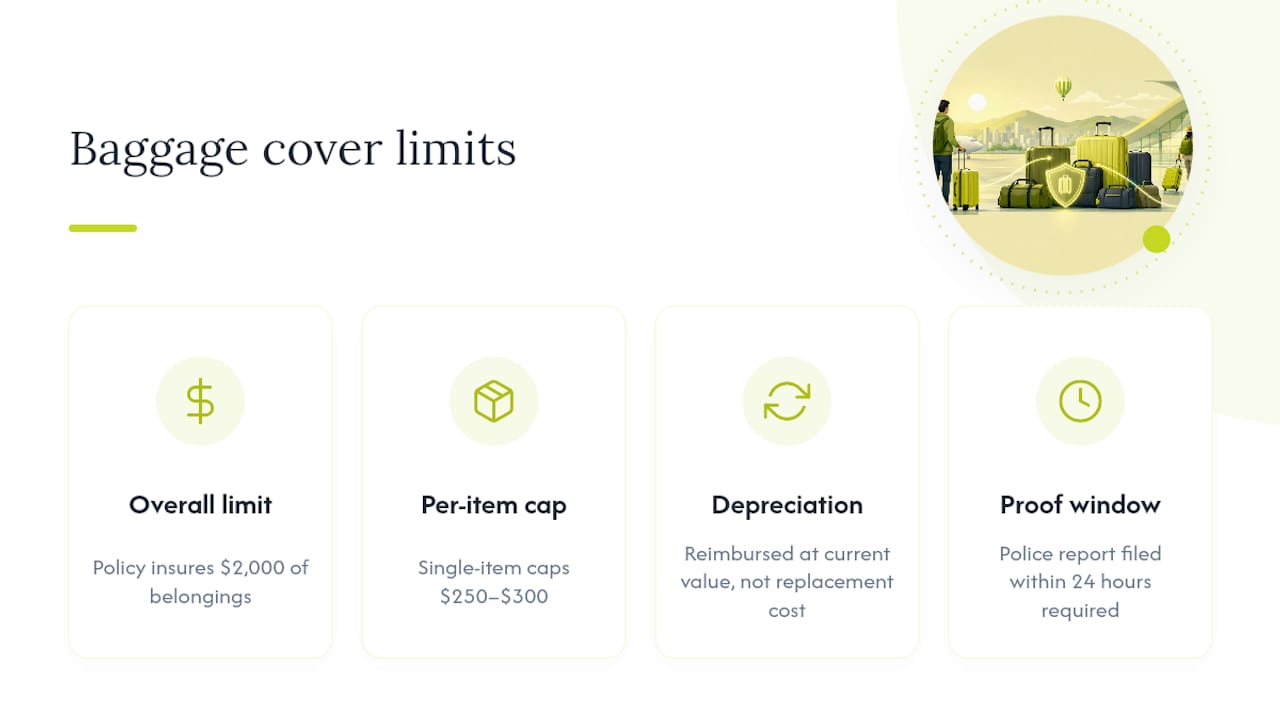
Depreciation is applied to almost every claim. Insurers pay out based on the item’s current value, not its replacement cost, so a three-year-old laptop is reimbursed at a fraction of what a new equivalent would cost.
Reasonable care clauses catch out more travellers than outright theft does. Property left unattended, in a car, on a beach, in a hotel lobby, is routinely excluded from cover, and insurers will ask for a police report filed within a specific window, often 24 hours, as proof the loss wasn’t due to negligence.
Do exclusions apply to mental health conditions?
Mental health cover is one of the more inconsistent areas across the industry, and it’s worth checking explicitly rather than assuming parity with physical health cover.
Many standard policies exclude claims connected to a pre-existing mental health diagnosis unless it’s specifically declared and accepted in writing, the same disclosure principle that governs physical pre-existing conditions. A cancellation triggered by a mental health crisis, for instance, is far more likely to be challenged by an insurer than one triggered by a physical illness, even when the crisis is well documented by a treating clinician.
Some insurers exclude mental health-related claims entirely, regardless of disclosure, while others offer it as an optional add-on with its own separate sum insured. The gap between these two positions is wide enough that assuming standard cover applies is a genuine risk. If mental health history is relevant to your trip, ask the insurer directly whether it’s covered under the base policy or requires a specific rider, and get the answer in writing before you travel.
Does travel insurance cover quarantine or mandatory isolation?
Quarantine cover varies enormously and has become a much more scrutinised area of policy wording. Some comprehensive plans include a daily allowance if you’re placed under mandatory isolation by a local health authority during your trip, covering extended accommodation and meal costs.
The exclusion usually kicks in around the reason for isolation. If you’re quarantined because you tested positive for a contagious illness during a declared outbreak, cover depends heavily on whether that outbreak was already known and named before you bought the policy, the same timing principle that governs named storms.
Quarantine imposed as a border control measure, rather than a personal medical necessity, is treated differently again, and many policies exclude it outright as a “known event” once a government has announced the measure publicly. Checking how your specific policy defines quarantine, and whether it distinguishes between personal illness and blanket government orders, avoids a nasty surprise if travel disruption strikes mid-trip.
Are delayed or missed connections covered?
Travel delay cover exists on most comprehensive policies, but it comes with thresholds that catch travellers who expect immediate reimbursement.
A typical delay clause only activates after a minimum wait, often 6 to 12 hours, and pays a fixed daily allowance toward meals and accommodation rather than covering the full cost of a missed onward booking. Missed connection cover is narrower still: it generally only pays out if the delay was caused by the airline or a covered reason, like severe weather, not if you simply built too little buffer time between two separately booked flights.
Self-inflicted missed connections are excluded almost universally. If you booked two flights on different tickets with a tight layover and missed the second because the first ran late, insurers will often argue the connection risk was yours to manage, not theirs to cover, particularly when the two legs weren’t purchased as a single itinerary.
Some policies also exclude missed connections tied to a strike or disruption that was publicly announced before you booked, applying the same “known event” logic that governs named storms and pandemics. Checking the minimum delay threshold and the definition of a “covered reason” against your actual itinerary is worth doing before you rely on this section of the policy.
When exclusions are tolerable, and when they’re not
For a short domestic trip or a well-trodden destination with reliable local healthcare, standard exclusions are usually a reasonable trade-off against a lower premium. The calculation changes fast once you’re heading somewhere remote, taking up a high-risk activity, or carrying a condition that needs ongoing management.
In those cases, the extra cost of a rider or a specialist policy is small against the financial exposure of a denied claim. For anything involving multiple legs, mixed activities, or a complex medical history, talking to a broker who can compare specialist plans directly is usually faster than trying to piece it together yourself.
— Coert
How travel insurance providers help you close the gaps
Standard travel policies leave real gaps for anyone with a disclosed medical condition, a planned high-risk activity, or a trip that needs guaranteed evacuation cover. Tailored options for pre-existing condition disclosure, appropriate evacuation sums, and specialist add-ons for activities standard policies routinely exclude can help close these gaps.

Watch this short explainer on how travel cover actually works before you buy:
Planning a trip for yourself, a resident, or visiting family? UGB + Ekta can arrange travel insurance for seniors up to 100 years old. Just click here: https://ektatraveling.com/?partner_uid=808 and add the promo code “UGB” to receive an additional 10% discount.
If you want a policy built around your actual trip rather than a generic checklist, request a quote through Unparalleledglobalbenefits’ travel insurance page and get the specific exclusions clarified before you pay, not after something goes wrong.
Sources
- Hidden travel insurance exclusions you should check before your trip
- What does travel insurance cover? – NerdWallet
This article is general information, not a substitute for advice from a qualified financial advisor. Consult a qualified financial professional about your own circumstances before acting on anything here.
FAQ
What are three common exclusions on a typical travel insurance policy?
Undeclared pre-existing medical conditions, high-risk activities like moped riding or diving beyond set depth limits, and losses connected to alcohol or drug use are among the most frequently cited exclusions across standard policy checklists.
What are the disadvantages of travel insurance?
The main drawbacks are the cost relative to how rarely most trips need a claim, the narrow definitions insurers use for “covered reasons,” and the caps and excesses that mean even a valid claim rarely reimburses the full loss. Reading the certificate of insurance before buying reduces most of these surprises.
What medical conditions are not covered by travel insurance?
Undisclosed pre-existing conditions, elective or planned treatment abroad, and routine care unrelated to a sudden medical emergency are typically excluded. Declaring a known condition and getting written confirmation of acceptance, as covered in the medical exclusions section above, is the most reliable way to secure cover for it.
What does travel insurance not cover for cancellations?
Change of mind, known events that occurred before you bought the policy, and named storms purchased after the naming date are not covered. Cancel For Any Reason add-ons close some of this gap but typically reimburse only 50% to 75% of trip costs and carry strict purchase deadlines.
How does travel insurance actually work when a claim is denied?
Insurers assess claims against the exact wording in the certificate of insurance, not the summary marketing page, which is why declaring conditions honestly and keeping documentation, as outlined in the checklist above, makes the biggest difference to whether a claim succeeds.