
The single most important thing to check first is geographic scope, paired with core catastrophic cover: inpatient treatment plus emergency evacuation. Confirm those two things, then check whether pre-existing conditions are handled sensibly and whether the insurer offers direct billing at hospitals near you. If you’re travelling for under 90 days for a holiday, short-term travel insurance usually covers you; if you’re relocating, studying long-term, or on a visa requiring proof of cover, you need a proper international plan. Quotes including full policy wording can be provided once you know what to look for.
TL;DR:
- Confirm that the insurance plan covers inpatient treatment and emergency evacuation in all relevant geographic zones, especially the United States, which significantly affects cost.
- Verify the policy’s schedule of benefits for actual annual limits and sub-limits, rather than relying on marketing summaries, to avoid unexpected caps during claims.
- Choose the right product type based on your situation, with long-term expatriates needing comprehensive international private medical insurance and short-term travelers sticking with travel medical insurance.
- Be aware that plans covering treatment in the US typically cost 40 to 80% more than those excluding the US, so regional plans can offer substantial savings if US treatment isn’t needed.
- Use a weighted scoring matrix to compare quotes, focusing on coverage area, policy limits, network strength, out-of-pocket maximums, and handling pre-existing conditions rather than just premium price.
Table of Contents
- How do you evaluate health insurance plans before buying?
- Which type of cover actually fits your situation?
- What actually drives the price of your premium?
- How do underwriting and pre-existing conditions affect your options?
- What claims and policy fine print should you read now?
- How can you score and shortlist your quotes?
- Explanation of plan types (HMO, PPO, EPO, POS) and how they affect choice
- Does customer service quality matter as much as the premium?
- Should wellness and preventive care influence your decision?
- How do you assess out-of-pocket maximums and total cost?
- How does Unparalleled Global Benefits support your decision?
- Ready to request your quote and full policy wording?
- Sources
- FAQ
How do you evaluate health insurance plans before buying?
Knowing how to evaluate health insurance plans starts with a checklist, not a gut feeling. Every quote you receive should be tested against the same criteria, because insurers structure their marketing summaries to highlight strengths and bury the details that matter when you actually need to make a claim.
Here’s what to check on every single quote, in order of importance:
- Geographic zones: “Worldwide” cover sometimes excludes the United States, or offers it only as an add-on. Confirm the exact list of included and excluded countries, not just the marketing label.
- Schedule of benefits: this document, not the brochure, lists your annual limit, per-condition caps, and sub-limits for outpatient care, dental treatment, and maternity. A plan advertising a £2 million annual limit can still cap dental at a few hundred pounds.
- Network and direct billing: a plan with strong hospital partnerships in your destination means you show a card and walk in, rather than paying upfront and chasing reimbursement for weeks.
- Evacuation and repatriation: essential if you’re heading somewhere with limited local specialist care. Confirm whether it covers transport to the nearest adequate facility or all the way home.
- Core modules: verify inpatient, outpatient, maternity, dental, mental health, and prescription drug cover are actually included, rather than assumed.
Comparing these criteria side by side against two or three quotes takes longer than skimming brochures, but it’s the only way to catch the gaps before they become your problem mid claim.
Which type of cover actually fits your situation?
Assessing health insurance options starts with matching the product type to your actual circumstances, not the cheapest headline premium. Four categories cover almost every expat scenario, and picking the wrong one is the most common mistake international students, au pairs, and new arrivals make.
- Travel medical insurance is short-term, emergency-focused cover designed for trips under 90 days. It handles accidents and sudden illness but rarely covers routine or ongoing care.
- International private medical insurance (IPMI) is comprehensive, multi-country cover built for people living abroad long-term, and typically the right choice if you’re relocating for work, study, or a visa. International expat health insurance covers routine and emergency care across borders and is often necessary once you’re no longer eligible for public healthcare in your home country.
- Local private insurance is country-specific and usually cheaper, but it stops working the moment you cross a border, which matters if your assignment involves regional travel.
- Hybrid nomad plans offer lower-cost, portable cover for people who move frequently between countries without settling anywhere long enough for local plans to make sense.
As a general rule, under 90 days points to travel medical; anything longer, or tied to a visa or ongoing treatment, points to IPMI. Many visa categories specify minimum private cover requirements, so check the official immigration guidance for your destination before assuming any plan qualifies. Our comparison of international insurance plans breaks down how these product types differ in practice.
What actually drives the price of your premium?
Four levers move your premium more than anything else: whether the US is included in your coverage zone, whether you choose worldwide or regional cover, your age, and the deductible you select.
US inclusion is the single biggest cost driver in international health insurance. Plans covering treatment in the United States commonly cost 40 to 80% more than equivalent worldwide-excluding-US plans, because American hospital billing runs far higher than almost anywhere else.
If you rarely visit high-cost countries, choosing a regional plan that excludes the US can be a genuinely sound way to cut costs without meaningfully raising your risk. Market samples suggest individual annual premiums for comprehensive international plans commonly land in the low thousands of US dollars a year, though your age, chosen territory, and optional modules will move that figure substantially in either direction.
Deductible choice is the second major lever. A higher deductible lowers your monthly premium but raises what you pay out of pocket before cover kicks in. Budget sensibly: if you expect to use healthcare rarely, a higher deductible with a lower premium often makes financial sense; if you have ongoing treatment needs, the reverse usually holds.

How do underwriting and pre-existing conditions affect your options?
Underwriting type determines whether an existing health condition gets covered, excluded, or covered only after a waiting period, and getting this wrong is one of the costliest mistakes an expat can make.
Three underwriting approaches dominate the market:
- Full medical underwriting assesses your complete medical history upfront and prices or excludes accordingly, giving you certainty from day one about what’s covered.
- Moratorium underwriting applies a look-back period, commonly 12 to 24 months, during which any pre-existing condition is excluded unless you go symptom-free for a defined stretch.
- Continued personal medical exclusion (CPME) carries forward specific exclusions from a previous policy rather than reassessing your full history.
Timing matters more than most applicants realise. Applying for cover before you move, or while you’re still healthy, often improves your acceptance terms considerably compared with applying after symptoms appear or once you’re already living abroad. If you manage a chronic condition, plan 12 to 24 months ahead and ask your broker for the underwriting outcome in writing before you commit to anything. Securing IPMI while you’re still in your home country and stable can help you sidestep moratorium traps entirely.
What claims and policy fine print should you read now?
Full policy wording, not the brochure, is the document that governs what actually gets paid, and HanaBright’s policy-reading guide rightly treats it as the authoritative source over any marketing summary.
Three clauses cause the most trouble in practice. Pre-authorisation penalties can cut reimbursement to around 80% instead of full payout if you skip prior approval for non-emergency inpatient treatment. Claim submission deadlines are commonly six months as standard practice, with 12 months as an absolute outer limit in many policies. “Reasonable and customary” caps limit reimbursement to what the insurer deems typical for a procedure in that region, regardless of what the hospital actually bills.
Pro Tip: Before you travel, call a hospital near your new home and ask whether they direct bill your specific insurer. A “yes” on paper in the policy wording doesn’t always match reality on the ground.
Also check the renewal clause carefully: can the insurer reprice your premium based on your individual claims history, or only on general age bands and inflation? The former can produce painful premium shocks after a few years of claims, even with no change in your health.
How can you score and shortlist your quotes?
A simple weighted scoring matrix turns a confusing pile of quotes into a clear decision. Reputable guides recommend scoring several axes and weighting them rather than picking on premium alone.
- Set your weights. A workable starting point: coverage area 30%, annual limit 20%, direct billing and network strength 20%, pre-existing condition handling 15%, evacuation cover 10%, price 5%.
- Apply hard-fail filters first. Eliminate any plan that excludes your actual destination, isn’t renewable, lacks evacuation cover if you’re posted somewhere remote, or whose insurer won’t produce full policy wording on request.
- Score what survives. Rate each remaining plan against your weighted axes using the full policy wording, not the summary.
- Pick the highest scorer that passes every hard-fail test. Not the cheapest, not the flashiest brochure. Our step-by-step comparison guide walks through this process with a comparison spreadsheet you can adapt.
Explanation of plan types (HMO, PPO, EPO, POS) and how they affect choice
Domestic US-style plan structures such as HMO, PPO, EPO, and POS occasionally appear inside international policies, particularly for plans that include US treatment, and understanding them helps you read the fine print correctly.
An HMO (Health Maintenance Organisation) structure requires you to use a defined network and get referrals for specialists, which keeps costs down but limits flexibility if you’re travelling frequently. A PPO (Preferred Provider Organisation) gives you more freedom to see out-of-network providers, usually at a higher out-of-pocket cost, which suits people who move around or want choice over which hospital to use. An EPO (Exclusive Provider Organisation) sits between the two: no referrals needed, but no out-of-network cover except in emergencies. A POS (Point of Service) plan blends HMO-style referral requirements with some PPO-style out-of-network access.
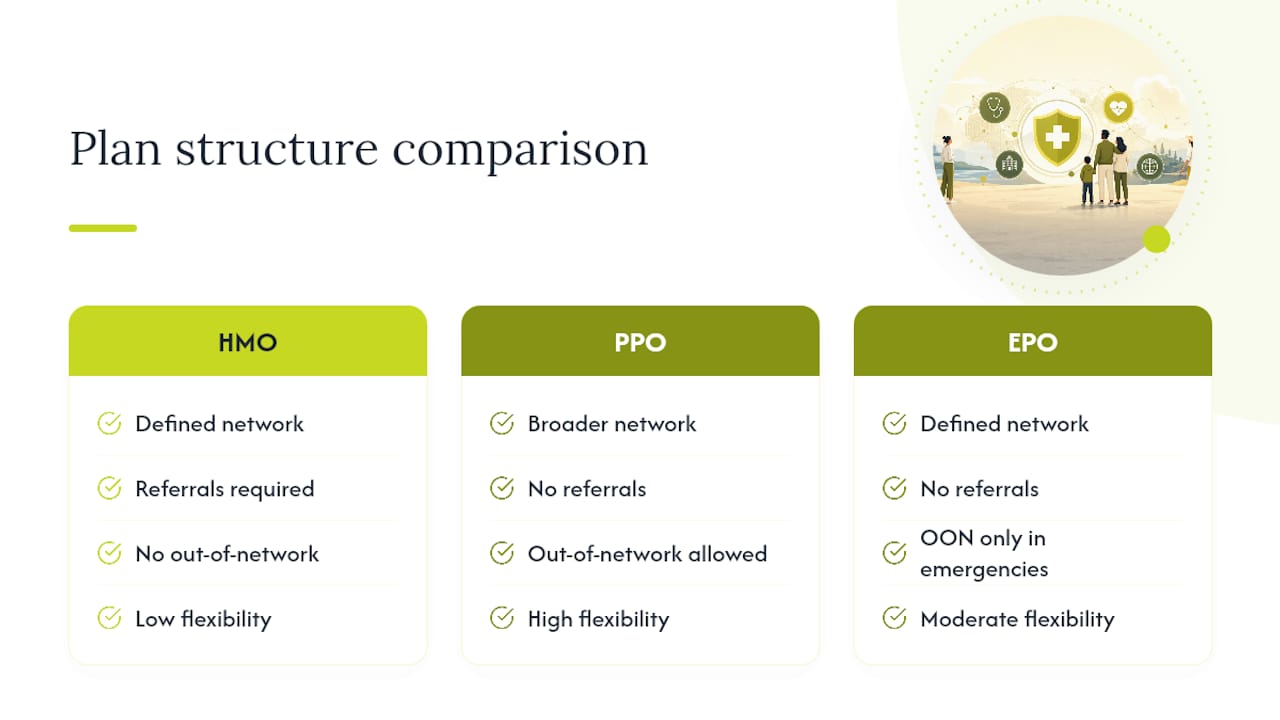
For most expats and international students, these labels matter less than the underlying network strength in your actual destination country. A PPO-style structure with a thin network in your city is worse than an HMO-style structure with strong local hospital partnerships. Ask specifically which structure applies to any US-inclusive module, since it changes how much freedom you have to choose your own doctor.
Does customer service quality matter as much as the premium?
Claims experience and customer service quality often matter more to expats living abroad than shaving a small percentage off the premium, because a slow or unresponsive insurer turns a stressful medical event into a genuine crisis.
Network strength and direct billing reduce both stress and upfront cost when something happens. Before committing, look for indicators beyond the sales pitch: how quickly does the insurer respond to pre-authorisation requests, does it offer multilingual support if you’re not a native speaker of the local language, and can it produce written confirmation of coverage decisions rather than verbal assurances? An insurer that answers these questions clearly and quickly, before you’ve even paid a premium, tends to behave the same way when you actually need to file a claim.
Ask any broker or insurer directly for their average claims turnaround time and their process for emergency cases outside standard office hours. A vague answer here is itself useful information.
Should wellness and preventive care influence your decision?
Wellness and preventive care benefits, such as annual check-ups, vaccinations, and health screenings, vary enormously between international plans and rarely get the attention they deserve during comparison.
Some comprehensive plans include an annual wellness visit or preventive screening allowance at no extra cost, which can be worth genuine money over a policy year, particularly for routine blood work, vaccinations required for your destination, or age-appropriate screenings. Others treat any preventive visit as an outpatient claim subject to your deductible, meaning you pay for it entirely out of pocket unless something is found to be wrong.
If you’re an au pair, student, or younger expat unlikely to need major inpatient care, preventive benefits can carry more practical weight in your day-to-day experience than the headline annual limit. Check the schedule of benefits specifically for a preventive care line item rather than assuming it’s bundled into general outpatient cover.
How do you assess out-of-pocket maximums and total cost?
The premium is only one line in your real annual cost. Total cost of ownership includes the deductible you pay before cover starts, any co-pay percentage on top of that, and the out-of-pocket maximum, which caps how much you’ll ever pay in a policy year regardless of how much treatment you need.
A plan with a lower premium but no defined out-of-pocket maximum can expose you to unlimited co-pay liability if you have a serious or prolonged illness. Calculate your realistic worst-case cost by adding the deductible, the maximum possible co-pay under the out-of-pocket cap, and the premium itself, then compare that total figure across quotes rather than comparing premiums alone. This single calculation often flips which plan looks cheapest once you account for a genuinely bad year rather than an average one.
How does Unparalleled Global Benefits support your decision?
Assistance is available to get past the brochure and into the actual detail: full policy wording, schedules of benefits, and straight answers on underwriting before commitment. Guides on comparing plan types and real-world plan examples exist for this stage of your search. Having your age, destination, planned duration, and any ongoing treatment details ready can speed up the quote and make the underwriting conversation more productive.
— Coert
Ready to request your quote and full policy wording?
Support is offered for access to full policy wording and a genuine quote matched to your actual situation, not a generic estimate based on averages. Before reaching out, gather your dates of travel, ages of everyone needing cover, your destination list, and any relevant medical history to facilitate matching to a plan quickly rather than going back and forth on basics.
Watch this short explainer on what to check before you buy:
Planning a trip for yourself, a resident, or visiting family? UGB + Ekta can arrange travel insurance for seniors up to 100 years old. Just click here: https://ektatraveling.com/?partner_uid=808 and add the promo code “UGB” to receive an additional 10% discount.
Once you’re ready to compare real plans side by side, visit our top insurers page to request a quote and get the full policy wording sent directly to you.
This article is general information, not a substitute for advice from a qualified doctor. Consult a qualified healthcare professional about your own circumstances before acting on anything here.
Sources
- How to read an international health insurance policy (2026) | HanaBright
- International Health Insurance for Expats: Complete Guide (2026) | WhereNext
- Expat health insurance in 2026: costs, coverage, and tips | Expatica
- Prior authorisation: what it is, when you might need it and how do you get it | Harvard Health
- Expat health insurance: Costs, plans & coverage (2026) | Taxes for Expats
FAQ
What’s the first thing to check when comparing health insurance plans abroad?
Confirm the geographic coverage zone and whether inpatient treatment plus emergency evacuation are included, then check pre-existing condition rules and network strength.
How is travel insurance different from international health insurance?
Travel insurance covers short emergency-only trips typically under 90 days, while international health insurance (IPMI) provides comprehensive, ongoing cover for people living abroad long-term.
What is a moratorium underwriting period?
It’s a look-back window, commonly 12 to 24 months, during which a pre-existing condition is excluded from cover unless you remain symptom-free for a set period.
Does excluding the US from my plan actually save money?
Yes. Plans that include US treatment commonly cost 40 to 80% more than equivalent worldwide plans excluding the US.
How can Unparalleled Global Benefits help me compare plans?
Unparalleled Global Benefits can provide full policy wording and a tailored quote once you share your age, destination, duration, and any ongoing treatment needs, letting you apply the evaluation checklist to a real offer rather than a brochure.