

TL;DR:
- VFS travel insurance is a mandatory requirement for Schengen visa applications, with strict minimum coverage and documentation rules. It must provide at least €30,000 in emergency medical coverage, explicitly include hospitalisation and repatriation, and match travel dates precisely. Using an approved independent insurer with correct documentation ensures compliance and reduces visa refusal risk.
VFS travel insurance is the mandatory travel medical insurance required for visa applications processed through VFS Global, particularly for the Schengen Area. Under Regulation (EU) 2019/1155, every Schengen visa applicant must hold a policy providing a minimum of €30,000 in emergency medical coverage, including hospitalisation and repatriation. Getting this wrong is one of the most common reasons visa applications are refused. This guide explains exactly what the rules require, where travellers go wrong, and how to choose a compliant policy with confidence.
What are the exact VFS travel insurance requirements?
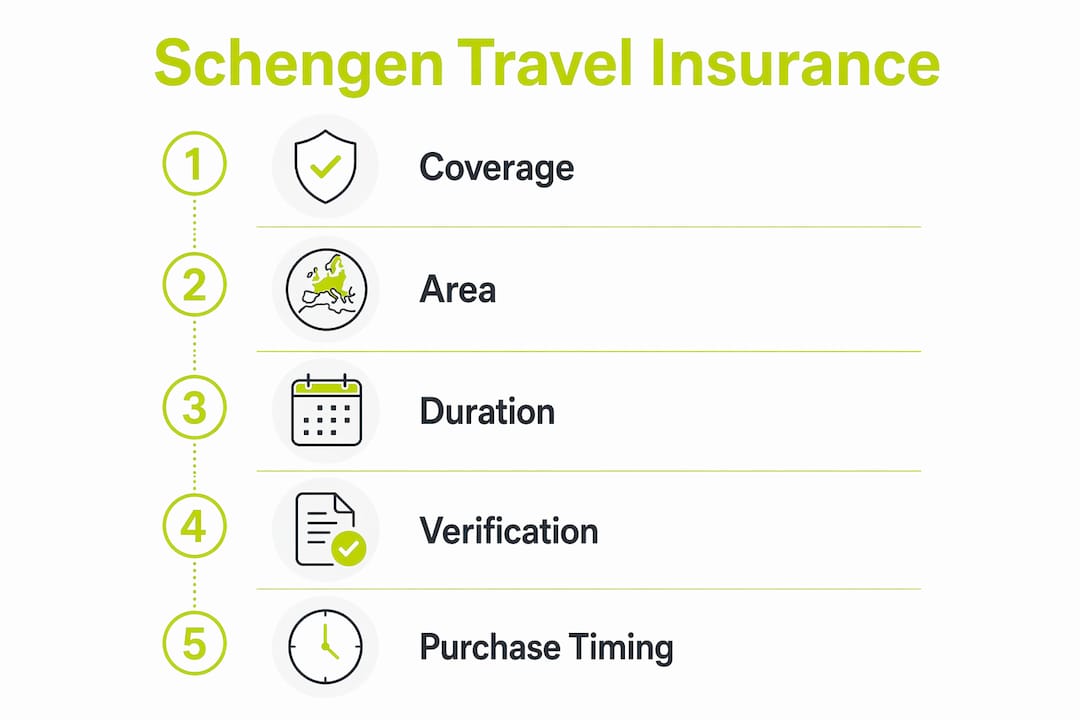
Schengen visa coverage is defined by EU law, not by individual insurers. The minimum standard is clear: your policy must provide at least €30,000 for emergency medical treatment, hospitalisation, and repatriation of remains. These four categories must all appear explicitly in your certificate. Omitting repatriation of remains or emergency hospitalisation risks outright refusal, even when the rest of the policy looks compliant.
Coverage must be valid across the entire Schengen Area, not just the country you plan to visit first. Partial European coverage or wording that says “EU countries only” is insufficient. Switzerland, for example, is a Schengen member but not an EU member. Your policy must name the Schengen Area explicitly, or list all member states.
The certificate itself carries strict formatting rules. It must show your full name exactly as it appears in your passport, the precise dates of cover, the insurer’s contact details, and the policy number. Some consulates go further, requiring zero deductible policies. Spain’s consulates are a well-known example. Always check the specific checklist for your target consulate before purchasing.
Key certificate requirements at a glance:
- Full name matching your passport exactly
- Cover dates spanning your entire trip, plus buffer days
- Minimum €30,000 emergency medical coverage stated clearly
- Explicit mention of hospitalisation, repatriation, and repatriation of remains
- Insurer name, policy number, and contact details
- Schengen Area named as the coverage territory
Pro Tip: Some consulates now use digital verification portals to check policy numbers against insurer databases. Make sure your certificate shows the correct policy number and insurer contact details, or the system may flag your application as unverifiable.
How does VFS Global facilitate travel insurance for applicants?
VFS Global partners with approved insurers to offer travel medical insurance directly at visa application centres. This is convenient, but buying at a VFS centre tends to cost more than purchasing independently online. The range of policies available at the counter is also narrower. Buying directly from an approved insurer gives you more choice and often a lower premium for the same level of cover.

Using an independent policy is fully accepted, provided it meets all the requirements above. The critical step is confirming that your chosen insurer appears on the acceptance list for your specific visa centre or consulate. This list varies. An insurer accepted by one embassy may not be recognised by another. Check before you buy, not after.
What to look for when buying independently:
- Confirm the insurer is on the acceptance list for your consulate
- Verify the policy wording names the Schengen Area explicitly
- Check that all four mandatory coverage categories appear on the certificate
- Confirm the certificate can be printed as an official document without handwritten amendments
Pro Tip: Purchase your insurance after you have confirmed your travel dates but before your visa appointment. Buying too early risks mismatched dates if your itinerary changes.
Planning a trip for yourself, a resident, or visiting family? UGB + Ekta can arrange travel insurance for seniors up to 100 years old. Just click here: https://ektatraveling.com/?partner_uid=808 and add the promo code “UGB” to receive an additional 10% discount.
Common mistakes that lead to visa refusal
Consular officers reject applications when any mandatory coverage category is missing from the certificate. The most frequent errors are not about the policy itself but about the documentation. Here are the pitfalls that catch travellers out most often.
- Coverage below €30,000. Many budget policies advertise broad coverage but fail the €30,000 threshold that consulates check. Always read the schedule of benefits, not just the marketing summary.
- Dates that do not match your itinerary. Policies starting or ending even one day off from your travel dates can cause refusal. Add buffer days at both ends to be safe.
- Name mismatches. Your certificate must show your name exactly as it appears in your passport. A middle name omitted or a hyphenated surname split differently is enough to trigger rejection.
- Relying on credit card insurance. Credit card travel insurance rarely meets Schengen requirements unless the card provider issues a formal certificate listing all mandatory coverage details. A generic card benefit statement is not accepted.
- Handwritten corrections on the certificate. Official printouts must be clean and free of any handwritten amendments. If you spot an error, request a corrected document from your insurer.
- Arriving without a printed copy. Digital copies on a phone are not always accepted at the appointment desk. Carry a printed certificate as well as a digital backup.
Pro Tip: Read the actual policy wording, not just the summary page. The summary may say “medical coverage included” while the wording limits it to accidents only, which does not satisfy the Schengen standard.
How to choose the right policy and prepare your documents
Selecting a Schengen compliant travel medical insurance policy takes about 30 minutes if you follow a clear process. Start with the consulate checklist, not the insurer’s website. The checklist tells you exactly what the officer will look for on the day of your appointment.
Practical steps for choosing and preparing your policy:
- Research the insurer acceptance list for your specific consulate or VFS centre before comparing prices
- Choose a policy with no deductible, or the lowest available, particularly for Spanish, Italian, or French consulates
- Verify that the coverage dates include at least one buffer day before departure and one after your return
- Confirm the policy explicitly names the Schengen Area as the coverage territory, not just “Europe” or “EU”
- Purchase after booking your travel but before your visa appointment to lock in accurate dates
- Request the official certificate immediately after purchase and check every field against your passport
Annual multi-trip policies can work well for frequent travellers, but many annual policies restrict trip duration to 31 or 45 days per visit. If your trip is longer, a single-trip policy is the safer choice. For families, each traveller needs their own certificate, even if you are on the same policy.
| Consideration | What to check |
|---|---|
| Coverage amount | Minimum €30,000 stated on the certificate |
| Coverage territory | “Schengen Area” named explicitly |
| Coverage categories | Medical treatment, hospitalisation, repatriation, repatriation of remains |
| Deductible | Zero or lowest available for strict consulates |
| Policy dates | Match itinerary plus buffer days at both ends |
| Certificate format | Official printout, no handwritten changes, all fields completed |
For a deeper look at what minimum Schengen coverage means in practice for 2026, the Unparalleledglobalbenefits guide breaks down consulate-specific variations in plain language.
Key takeaways
VFS travel insurance is a legally defined standard under EU Regulation (EU) 2019/1155, and meeting it precisely is the single most decisive factor in whether your Schengen visa application succeeds or fails.
| Point | Details |
|---|---|
| Minimum coverage is €30,000 | Your certificate must state this amount for emergency medical treatment, hospitalisation, and repatriation. |
| All four categories must appear | Missing repatriation of remains or hospitalisation is grounds for refusal even if the amount is correct. |
| Dates must match your itinerary | Add buffer days at both ends; a single day’s gap can cause rejection. |
| Independent policies are accepted | Buying online is often cheaper, but confirm insurer approval with your specific consulate first. |
| Credit card insurance rarely qualifies | Only accepted if the provider issues a formal certificate listing all mandatory Schengen coverage details. |
What I have learned from watching applicants get this wrong
Coert’s perspective on the real cost of cutting corners on travel insurance
After years of working with international travellers and families preparing visa applications, I have noticed a consistent pattern. The people who get refused are rarely missing the insurance itself. They have a policy. What they are missing is the right certificate, with the right wording, for the right dates.
The €30,000 figure gets all the attention, but in my experience the repatriation of remains clause is the one that catches people out most often. Budget policies frequently omit it, or bury it in an exclusion. Consular officers are trained to look for it. If it is not there, the application fails.
I also see travellers place too much trust in what their insurer’s website says versus what the actual policy document states. The marketing page may say “full Schengen coverage.” The policy schedule may say “Europe excluding Switzerland.” Those two things are not the same, and the consulate will read the schedule, not the website.
My honest advice: treat the certificate as the most important document in your application folder. Spend 20 minutes reading it line by line before your appointment. Check the name, the dates, the territory, and every coverage category. That 20 minutes is worth more than any amount of time spent comparing premium prices.
— Coert
How Unparalleledglobalbenefits supports your visa insurance needs
Choosing the right policy for a Schengen visa application does not need to be stressful. Unparalleledglobalbenefits offers personalised guidance on visa-compliant travel insurance that meets VFS Global and Schengen requirements, with flexible options for individuals, families, and seniors up to 100 years old.
Whether you need a single-trip policy for a short visit or broader international health cover for an extended stay, the team at Unparalleledglobalbenefits can match you with a plan that satisfies consulate checklists and protects you throughout your trip. The process is straightforward, the support is real, and the certificates are issued in the format consulates accept.
Planning a trip for yourself, a resident, or visiting family? UGB + Ekta can arrange travel insurance for seniors up to 100 years old. Just click here: https://ektatraveling.com/?partner_uid=808 and add the promo code “UGB” to receive an additional 10% discount.
▶️ Watch this short video for more guidance on travel insurance for international trips:
https://youtu.be/bjzvma7Sh1g
FAQ
What is the minimum coverage for a Schengen visa?
The minimum is €30,000, covering emergency medical treatment, hospitalisation, repatriation, and repatriation of remains. This is set by Regulation (EU) 2019/1155 and applies to all Schengen visa applicants regardless of nationality.
Does VFS Global sell travel insurance directly?
VFS Global offers approved travel medical insurance at its visa application centres, but policies purchased there tend to cost more than equivalent cover bought independently online. Independent policies are accepted provided they meet all Schengen requirements and the insurer is on your consulate’s acceptance list.
Can I use my credit card travel insurance for a Schengen visa?
Credit card insurance is rarely accepted unless the card provider issues a formal certificate that explicitly lists all four mandatory Schengen coverage categories. A generic card benefit statement does not satisfy consulate requirements.
How long must my travel insurance be valid?
Your policy must cover your entire trip duration, including at least one buffer day before departure and one after your return date. A policy that starts or ends even one day off your itinerary can result in visa refusal.
What happens if my insurance certificate has an error?
Any error, including a name mismatch or a handwritten correction, is grounds for rejection. Contact your insurer immediately to request a corrected official certificate before your visa appointment.
Recommended
- Cheap Schengen travel insurance: your 2026 compliance guide – Unparalleled Global Benefits
- AXA Schengen visa insurance: your 2026 guide – Unparalleled Global Benefits
- Minimum insurance for Schengen visa: what you need in 2026 – Unparalleled Global Benefits
- Insurance Requirements for Schengen Visa: A Step-by-Step Guide – Unparalleled Global Benefits