

TL;DR:
- Travel insurance for Canadian seniors provides essential medical and trip protection outside Canada due to limited provincial coverage. Premiums increase significantly with age, and accurate disclosure of pre-existing conditions is critical to claim approval. Early purchase and careful planning ensure seniors obtain appropriate coverage and avoid costly gaps.
Travel insurance for Canadian seniors is specialised coverage designed to protect older travellers from unexpected medical costs, trip cancellations, and medical evacuations abroad. Provincial health plans cover very little outside Canada. Emergency medical evacuation can cost between $75,000 and $250,000, a figure that makes dedicated travel health insurance not a luxury but a necessity. Seniors face higher premiums, stricter medical questionnaires, and more complex eligibility rules than younger travellers. Understanding those differences before you book is the single most important step you can take.
What coverage does travel insurance for Canadian seniors typically include?

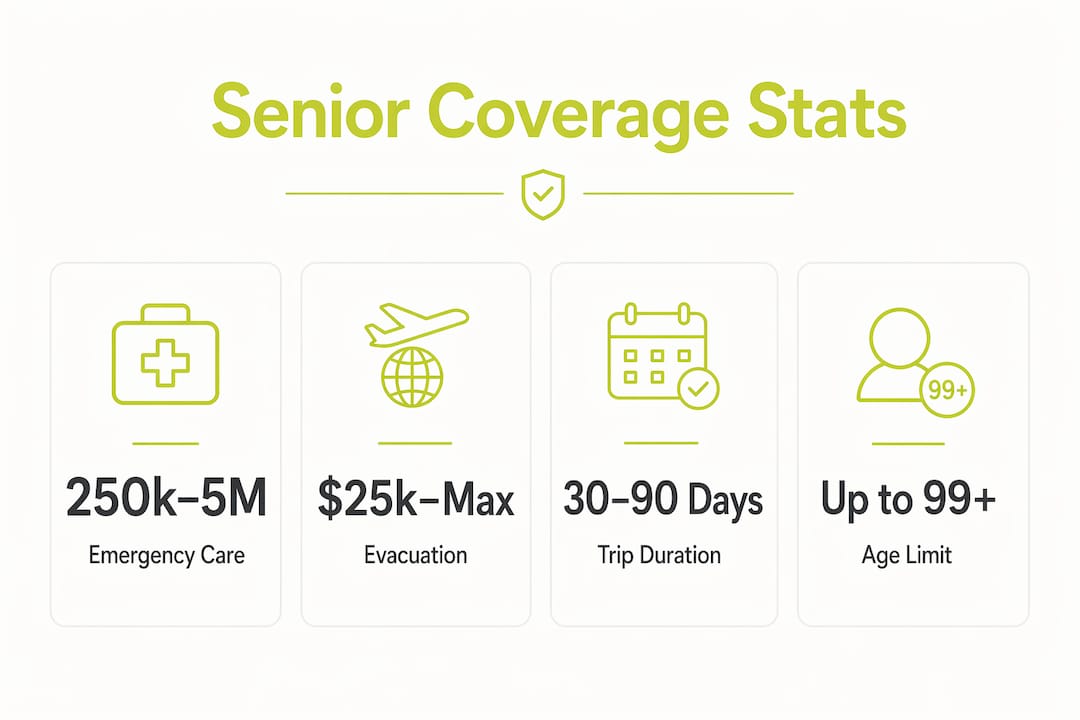
Senior travel insurance, the industry term for what is commonly called travel health insurance for seniors, bundles several protections into one policy. The core component is emergency medical care. Coverage limits for seniors typically range from $50,000 to $250,000 for international trips, rising to $500,000 or more for cruises and remote destinations. A 70-year-old with hypertension travelling to the United States for five months can expect emergency medical coverage up to $5 million CAD from some providers, with annual premiums in the range of $1,900 to $3,500.
Beyond emergency medical care, a solid senior travel policy covers:
- Medical evacuation and repatriation. Evacuation limits typically range from $100,000 to $500,000. Repatriation returns you home if you cannot fly commercially after a medical event.
- Trip cancellation and interruption. This reimburses prepaid, non-refundable costs if you cancel due to illness, a family emergency, or a covered reason before or during travel.
- Baggage and personal effects. Covers loss, theft, or damage to luggage, including mobility aids such as wheelchairs and walkers.
- Medication replacement. Some policies cover the cost of replacing lost or stolen prescription medication abroad.
| Coverage type | Recommended limit for seniors |
|---|---|
| Emergency medical care | $250,000–$5,000,000 CAD |
| Medical evacuation | $100,000–$500,000 CAD |
| Trip cancellation | Full prepaid trip cost |
| Baggage and mobility aids | $1,500–$3,000 CAD |
| Repatriation of remains | Included in most policies |
Pro Tip: Always check whether your policy covers mobility aids separately. A standard baggage limit rarely reflects the replacement cost of a powered wheelchair.
How do pre-existing conditions affect senior travel insurance?
A pre-existing condition is any illness, injury, or symptom that existed before your policy’s effective date. For Canadian seniors, this is the most consequential part of any policy. Insurers apply a stability clause, which requires your condition to have been medically stable for a defined period, typically 90–180 days, before departure. Stable means no new symptoms, no medication changes, no new diagnoses, and no pending investigations.
Non-disclosure of medical conditions can void your coverage entirely. That means a claim for a heart attack abroad could be denied if you failed to mention a recent change in blood pressure medication. Honesty on the medical questionnaire is not just ethical; it is the only way to guarantee your claim will be paid.
Common pitfalls seniors encounter include:
- Forgetting to disclose symptoms currently under investigation, even if undiagnosed.
- Assuming a condition is “minor” and not worth mentioning.
- Missing the purchase window for a pre-existing condition waiver, which typically must be bought within 14–21 days of your initial trip deposit.
- Not re-reading the stability definition each time they renew a policy, as definitions vary between insurers.
Pro Tip: If your medical history is complex, work with a broker who specialises in travel insurance with medical conditions. They can match you to policies with the most favourable stability definitions for your specific conditions.
Why do premiums increase with age, and what do seniors typically pay?
Age is the single largest driver of travel insurance premiums. Premiums rise sharply with each decade: travellers in their 50s pay roughly 10% more than those in their 30s and 40s, those in their 60s pay around 50% more, those in their 70s pay over 300% more, and travellers aged 80 and over pay more than 500% above the baseline. That is not an error. Insurers price based on statistical claim frequency, and older travellers make significantly more claims.
For context, a healthy 70-year-old taking a two-week trip to Europe might pay $300–$500 for a single-trip policy. Add hypertension, type 2 diabetes, or a recent cardiac event, and that figure climbs considerably. A five-month snowbird trip to Florida for a 70-year-old with hypertension typically costs between $1,900 and $3,500 in annual premiums. These are real costs worth budgeting for alongside flights and accommodation.
Several factors determine your final premium:
- Age. The most significant variable.
- Trip length. Longer trips cost more. Many policies cap coverage at 30, 60, or 90 days per trip for seniors.
- Destination. The United States is the most expensive destination due to its healthcare costs.
- Pre-existing conditions. Each disclosed condition adds to the premium.
Choosing the cheapest policy is a genuine risk for seniors. Policies with low premiums often carry strict medical stability clauses that invalidate claims for common conditions like diabetes or heart disease. The price difference between a mid-range and a budget policy is rarely worth the financial exposure.
What are age limits, trip duration rules, and provincial residency requirements?
Most major insurers offer travel insurance for seniors up to age 99 or beyond, though some require a manual medical review for applicants over 75 or 80. Age caps vary by insurer and policy type. If an online quote tool stops at age 75, call the insurer directly. A manual review may still result in coverage.
Trip duration limits are equally important. Many policies restrict seniors to a maximum of 30–90 days per trip. Extended policies exist for snowbirds, but they carry higher premiums and more stringent medical requirements. Always confirm the maximum trip duration before purchasing.
Provincial residency rules add another layer of complexity. Canadian seniors must remain in their home province for approximately 153 to 183 days per year to retain provincial health coverage. Losing provincial coverage has two consequences. First, you lose your public health safety net. Second, many travel insurance policies require you to hold valid provincial coverage as a condition of eligibility.
Pro Tip: Mark your departure and return dates on a calendar at the start of each year. Track your days outside the province carefully. Losing provincial coverage mid-year can invalidate your travel insurance and leave you fully exposed abroad.
The table below summarises key provincial residency thresholds and their implications.
| Province | Minimum days required | Consequence of non-compliance |
|---|---|---|
| Ontario | 153 days | Loss of OHIP coverage |
| British Columbia | 183 days | Loss of MSP coverage |
| Alberta | 183 days | Loss of AHCIP coverage |
| Quebec | 183 days | Loss of RAMQ coverage |
How can Canadian seniors choose the best travel insurance plan?
Selecting the right policy requires comparing more than price. The best travel insurance for seniors matches your health profile, travel frequency, and destination. Here is a practical framework for making that decision.
- Compare multiple quotes. Premiums and stability definitions vary significantly between providers. Reviewing several options gives you a realistic picture of the market.
- Read the Product Disclosure Statement. Every policy has one. Focus on the definitions of “stable,” “pre-existing condition,” and “emergency.” These three definitions determine whether your claim will be paid.
- Check exclusions carefully. Common exclusions include travel against medical advice, adventure activities, and conditions diagnosed within a certain period before departure.
- Consider an annual multi-trip plan. If you travel internationally more than twice a year, annual multi-trip plans are usually more economical than buying separate single-trip policies each time. Confirm the maximum days per trip allowed under the plan.
- Do not rely on credit card insurance. Credit card travel benefits typically cap emergency medical coverage at $50,000 and exclude pre-existing conditions. That is insufficient for most senior travellers.
- Time your purchase to access a pre-existing condition waiver. Buy your policy within 14–21 days of your initial trip deposit to qualify. Missing this window means your pre-existing conditions will likely be excluded entirely.
- Use a broker for complex medical histories. Brokers who specialise in elderly traveller coverage can identify policies with favourable stability clauses that standard comparison sites miss.
Pro Tip: Ask your insurer specifically how they define “change in medication.” Some policies treat a dosage adjustment as a destabilising event. Others do not. That distinction can make or break a claim.
Key takeaways
Travel insurance for Canadian seniors requires early purchase, honest medical disclosure, and careful attention to stability clauses, provincial residency rules, and age-specific coverage limits.
| Point | Details |
|---|---|
| Provincial plans do not cover abroad | Emergency evacuation alone can cost up to $250,000; dedicated cover is non-negotiable. |
| Premiums rise sharply with age | Travellers in their 70s pay over 300% more than younger adults; budget accordingly. |
| Stability clauses determine claim outcomes | Non-disclosure of any medical change, however minor, can void your entire policy. |
| Provincial residency protects eligibility | Spending fewer than 153–183 days at home can strip your provincial health coverage. |
| Annual plans suit frequent travellers | Multi-trip policies are more economical for seniors travelling more than twice a year. |
My honest take on travel insurance for Canadian seniors
I have spent years reviewing insurance policies for older travellers, and the same mistakes appear repeatedly. Seniors buy the cheapest policy available, assume it covers everything, and discover the gaps only when they are sitting in a foreign hospital. That is the worst possible moment to read the fine print.
The stability clause is where most claims fail. A senior changes a blood pressure medication three weeks before departure, does not think to mention it, and then suffers a cardiac event in Florida. The insurer investigates, finds the undisclosed medication change, and denies the claim. The bill arrives. It is devastating, and it is entirely avoidable.
My strongest advice is this: treat the medical questionnaire as a legal document, because it is. Disclose everything. If you are unsure whether something counts, disclose it anyway. The worst outcome from over-disclosure is a slightly higher premium. The worst outcome from under-disclosure is a six-figure bill.
I also see seniors underestimate how quickly provincial residency rules can catch them out. Snowbirds who extend their Florida stay by a few extra weeks, year after year, can quietly tip over the threshold and lose their provincial coverage without realising it. That loss cascades directly into travel insurance eligibility. Plan your calendar before you book your flights.
Finally, do not treat travel insurance as an afterthought. Buy it the day you pay your first trip deposit. That is the only way to access pre-existing condition waivers. Every week you wait narrows your options and raises your risk.
— Coert
How Unparalleledglobalbenefits supports Canadian seniors with travel cover
Canadian seniors deserve coverage that reflects their real health needs, not a generic policy built for 30-year-old backpackers. Unparalleledglobalbenefits works with a network of international insurers to match older travellers with policies suited to their medical profiles, travel destinations, and trip lengths. Whether you need a single-trip policy for a winter in Arizona or an annual plan for multiple international trips, the right cover exists.

Unparalleledglobalbenefits can arrange travel insurance solutions for seniors up to age 100, including those with complex pre-existing conditions. Planning a trip for yourself, a resident, or visiting family? UGB + Ekta can arrange travel insurance for seniors up to 100 years old. Just click here: https://ektatraveling.com/?partner_uid=808 and add the promo code “UGB” to receive an additional 10% discount. For a broader view of international health cover options, the international health insurance guide on the Unparalleledglobalbenefits website is a practical starting point.
Watch this short video for more guidance on protecting yourself abroad:
https://youtu.be/bjzvma7Sh1g
FAQ
What is travel insurance for Canadian seniors?
Travel insurance for Canadian seniors is a specialised policy covering emergency medical costs, evacuation, trip cancellation, and related expenses for older travellers outside Canada. Provincial health plans cover very little abroad, making dedicated cover the primary financial protection for seniors travelling internationally.
Does travel insurance cover pre-existing conditions for seniors?
Many policies cover pre-existing conditions if they have been medically stable for 90–180 days before departure and are fully disclosed on the medical questionnaire. Failing to disclose any condition, including recent medication changes, can void your claim entirely.
How much does senior travel insurance cost in Canada?
A 70-year-old with hypertension taking a five-month snowbird trip can expect to pay between $1,900 and $3,500 in annual premiums. Costs vary by age, destination, trip length, and the number of disclosed medical conditions.
Is there an age limit for travel insurance in Canada?
Most major insurers cover seniors up to age 99 or beyond, though applicants over 75 or 80 may require a manual medical review. Always contact the insurer directly if an online quote tool does not accommodate your age.
What happens if I lose my provincial health coverage while abroad?
Losing provincial coverage, typically by spending fewer than 153–183 days in your home province, removes your public health safety net and can invalidate your travel insurance policy. Track your days at home carefully each year to avoid this outcome.
Recommended
- Holiday insurance for the elderly: 2026 guide – Unparalleled Global Benefits
- Travel Insurance for Seniors: Coverage Up to 85 Years of Age
- Overseas travel insurance for seniors: 2026 guide – Unparalleled Global Benefits
- Travel insurance for seniors on Medicare: 2026 guide – Unparalleled Global Benefits