
If you cannot name the date you are coming home, buy international expat medical insurance, not travel insurance. If you have a fixed return date and it is under 90 days out, short-term travel medical cover usually does the job. That single distinction settles the vast majority of comparison questions before you even open a quote form.
The reasoning holds up under 2026 market conventions:
- Most travel insurers cap a single trip at 90 to 180 days, and claims made once you overshoot that window are routinely denied.
- Subscription nomad products, like SafetyWing, skip medical underwriting entirely and bill month to month, which suits frequent movers without a fixed address but leaves gaps in routine and chronic care.
- Comprehensive international private medical insurance (IPMI) typically runs $150 to $600 a month, with annual limits commonly starting around $1,000,000.
To get a tailored quote from Unparalleledglobalbenefits (UGB), head to the international health insurance guide and request pricing directly, or scroll to the promo section below for the exact next step.
Key Takeaways
Choosing between travel and expat medical cover comes down to one question: can you name your return date, and does your policy’s annual limit and evacuation cover actually match your destination.
| Point | Details |
|---|---|
| Match product to trip length | Use travel medical under 90 days; switch to expat/IPMI cover once your return date is undefined. |
| Check the US surcharge | Including the USA in your coverage zone typically adds 40 to 80% to premiums. |
| Confirm annual limits | Look for limits starting at $1,000,000 rather than lower local-plan caps. |
| Buy before symptoms appear | Pre-existing condition exclusions are avoided by purchasing cover ahead of departure. |
| Compare through Unparalleledglobalbenefits | UGB compares zones, limits and visa wording across insurers so you shortlist on facts, not headline price. |
Table of Contents
- Business health insurance comparison: matching plan types to your situation
- What should you compare on every quote?
- How do you compare quotes in one afternoon?
- What do plans cost, and how long does activation take?
- An expat broker’s honest take on comparison mistakes
- How Unparalleledglobalbenefits helps you get the right cover
- Frequently asked questions
- Sources
Business health insurance comparison: matching plan types to your situation
A proper business health insurance comparison starts by sorting yourself into the right category, because comparing a nomad subscription against a full expat medical plan is comparing apples to oranges. Four product families cover almost everyone in this audience.
Travel medical insurance (single trip or annual multi-trip) handles emergency care and trip-specific risks like cancellation and lost baggage for a defined window. International private medical insurance (IPMI) is built for people actually living abroad, covering outpatient visits, chronic conditions and preventive care with no fixed end date. Subscription nomad products sit in between: no underwriting, monthly billing, but limited depth on pre-existing conditions and routine treatment. Visa or visitor add-ons exist purely to satisfy entry requirements and rarely offer meaningful cover beyond that.
Here is how that maps to real situations:
- Digital nomad moving country every few months: a subscription product or annual multi-trip travel plan, provided you accept the exclusions on routine care.
- Business traveller on a defined six-week assignment: short-term travel medical, since travel insurance is built for exactly this window.
- Long-term expat with family relocating for a job: full IPMI from day one, ideally arranged before departure to avoid pre-existing condition exclusions.
- Someone in a relocation gap, waiting on a visa or housing: expat cover started early rather than travel insurance extended past its intended use.
Pro Tip: If you cannot say with certainty when you are flying home, assume you need expat cover starting today. Waiting until the situation becomes clear almost always means buying after a health issue has already surfaced, which can trigger exclusions.
What should you compare on every quote?
A useful business insurance comparison tool or spreadsheet needs to check the same handful of things every time, regardless of which insurer is quoting. Skip any of these and you risk discovering the gap only when you try to claim.
- Coverage area: worldwide, worldwide excluding the USA, or regional only. Asia-Pacific-only cover can run 40 to 60% cheaper than a plan that includes the United States.
- Annual policy limits: international plans commonly start at $1,000,000 a year, while some local private plans cap a single treatment as low as $15,000.
- Inpatient versus outpatient scope: some cheaper plans only cover hospital admission, leaving GP visits and prescriptions out of pocket.
- Emergency evacuation and repatriation: check the sum insured for evacuation specifically, not just the headline annual limit.
- Direct billing and network size: a large hospital network with direct billing means you are not fronting five-figure bills and waiting for reimbursement.
- Pre-existing condition rules and waiting periods: many insurers exclude them permanently unless you buy before symptoms appear.
- Excess or deductible and co-insurance: higher excess lowers your premium but raises your exposure on every claim.
- Visa acceptance clauses: not every policy that calls itself “international” satisfies embassy wording requirements.
When you call a broker or insurer, ask these directly: What is the annual maximum, and does evacuation draw from the same pot? Is the USA included, and if not, what happens if I transit through it? What is the pre-existing condition waiting period, and does it apply from policy start or from when symptoms first appeared? Does this policy support direct billing at hospitals in my destination country? What is the average claims turnaround time, and can you show me the process?
A policy is only as good as the network and the paperwork behind it. Insurer licences and financial ratings, 24/7 emergency assistance lines, a documented claims process with a realistic turnaround estimate, and plain-English policy wording are the trust signals that separate a reliable international plan from one that reads well but pays slowly.
For a longer walkthrough of these checkpoints, the 7 key factors for effective international health insurance comparison covers each one in more depth.
How do you compare quotes in one afternoon?
You do not need a week of research to make a confident decision. Follow this sequence and you can go from blank page to a shortlisted policy before dinner.
- Gather your details first: passport country, likely destination countries over the next 12 months, ages of everyone to be covered, any existing medical conditions, and a target sum insured (start at $1,000,000 if unsure).
- Request three to five quotes using identical inputs across each, so you are comparing like for like rather than mismatched assumptions.
- Align coverage zones and benefit limits side by side. A cheaper premium with a smaller network or lower evacuation limit is not actually cheaper.
- Run each quote through the checklist above. Anything missing a clear answer gets a follow-up call.
- Ask the broker the red-flag questions below before you commit.
- Buy and confirm activation in writing, including the exact start date and any underwriting conditions attached.
Use this shortlist while you are on the phone or filling in a comparison spreadsheet:
- Does the quote state the USA inclusion or exclusion explicitly?
- Is there a moratorium period for pre-existing conditions, and how long is it?
- Does the broker explain direct billing hospitals by name, or just say “large network”?
- Is the excess and co-insurance structure shown in writing, not just verbally?
Watch for unclear direct billing claims, a US surcharge that is not itemised separately, and vague underwriting timelines that could delay your start date by weeks. The medical insurance comparison guide has a fuller version of this process if your situation involves dependants or existing conditions.
What do plans cost, and how long does activation take?
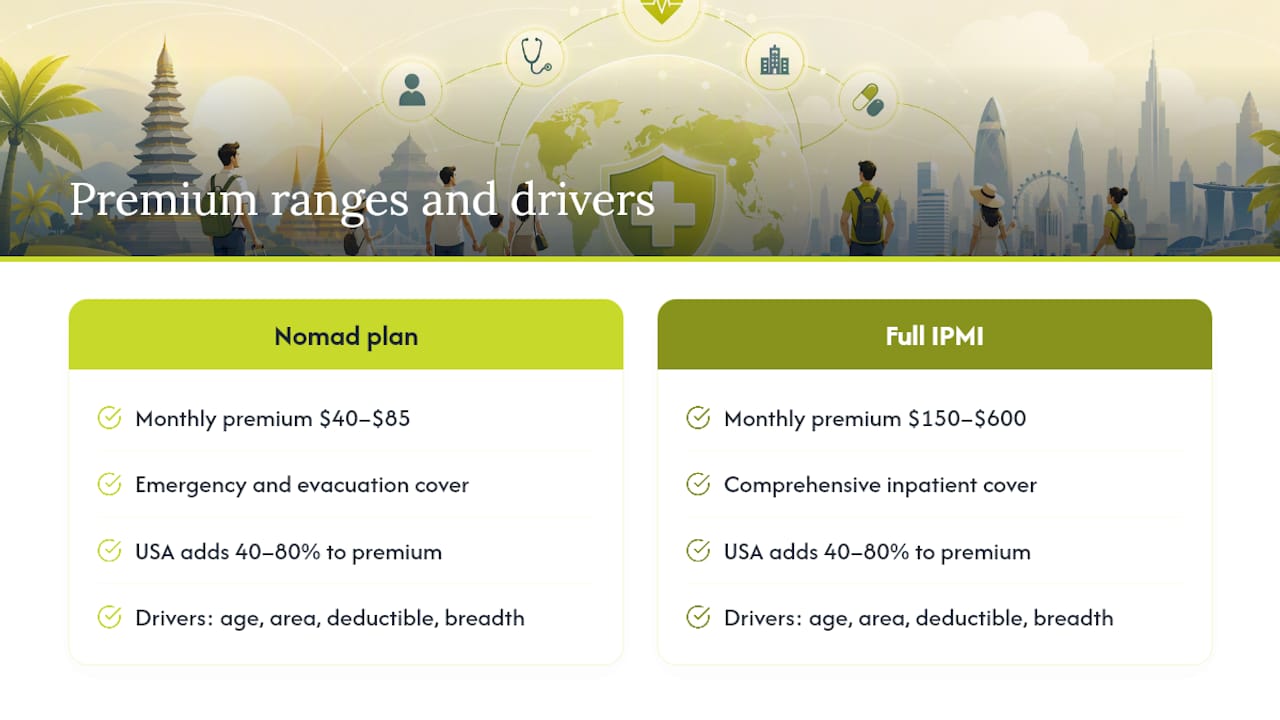
Premiums vary more by region and deductible than most buyers expect. Budget nomad-style plans start around $40 to $85 a month for basic emergency and evacuation cover, while full IPMI runs $150 to $600 monthly. Age, coverage area, deductible level and plan breadth all move the number, and including the USA typically adds 40 to 80% to the premium.
Timelines are usually faster than people assume: quotes come back instantly online for most standard profiles, underwriting for anyone with a health history takes one to three weeks, and activation happens immediately after payment unless underwriting flags something for review.
Pro Tip: Raising your deductible is often the single biggest lever for younger, healthy travellers who rarely claim for routine care. Excluding the USA when you genuinely have no plans to visit can also cut your premium substantially without touching your actual coverage needs.
An expat broker’s honest take on comparison mistakes
The most common mistake I see is people comparing headline premiums instead of coverage zones. A quote that looks 30% cheaper often turns out to exclude the USA, cap evacuation separately from the main limit, or impose a 12-month moratorium on anything pre-existing. None of that shows up until someone actually needs to claim.

The other pattern worth flagging: business travellers who buy expat-grade IPMI for a six-week assignment when a well-chosen travel medical policy with add-ons for trip cancellation would have covered them for a fraction of the cost. Stacking a short-term travel policy on top of existing expat cover, purely for the non-medical trip risks like cancellation or lost luggage, is a trick most people never think to ask their broker about. UGB’s own guides on business travel cover walk through exactly when that combination makes sense.
How Unparalleledglobalbenefits helps you get the right cover
Unparalleledglobalbenefits saves you the afternoon of chasing five separate insurer websites for quotes that all use different definitions of “worldwide”. You tell us your destinations, ages, and any existing conditions once, and we compare across insurers on the exact checklist above, including visa-compliant certificate wording where your entry requirements demand it.
We handle family policies, existing condition disclosures, and the paperwork that satisfies embassy and visa officers, not just the medical cover itself. Whether you are relocating with dependants or covering a single business trip that stretches longer than planned, our best international insurance plans for expats comparison shows exactly what each tier includes, and our team is reachable for support around the clock. For a video walkthrough of how expat cover actually works, watch this short explainer.
Planning a trip for yourself, a resident, or visiting family? UGB + Ekta can arrange travel insurance for seniors up to 100 years old. Just click here: https://ektatraveling.com/?partner_uid=808 and add the promo code “UGB” to receive an additional 10% discount.
Ready to see numbers against your own situation? Request a tailored quote through our insurance for working abroad comparison page and get a personalised shortlist within the day.
Frequently asked questions
Is a business health insurance comparison the same as comparing travel insurance?
Not quite. In this context it means comparing international medical cover for people working or living abroad, which includes both defined-trip travel medical policies and open-ended expat plans, not domestic employer group schemes.
How do I compare business insurance plans when I travel between multiple countries each year?
Request annual multi-trip or subscription nomad quotes using your longest expected single stay, then check whether routine care outside emergencies is included, since many nomad products exclude it.
What is the fastest way to compare group health insurance reviews for a small remote team?
Gather each employee’s age and destination country, request quotes with identical sums insured across providers, then compare annual limits and evacuation cover side by side rather than premium alone.
Can I switch from travel insurance to expat cover mid-trip?
Yes, though switching before any symptoms of a new condition appear avoids waiting periods. Buying expat cover as soon as your return date becomes uncertain is the safer sequence.
Does affordable business health plan pricing mean weaker cover?
Not necessarily. A lower premium often reflects a narrower coverage zone (excluding the USA, for instance) or a higher deductible, rather than a lower annual limit.
This article is general information, not a substitute for advice from a qualified doctor. Consult a qualified healthcare professional about your own circumstances before acting on anything here.
Sources
- International Health Insurance for Expats: Complete Guide (2026) | WhereNext
- How to Choose Expat Health Insurance Before Moving Abroad
- International health insurance: an expat’s guide | Expatica
- Travel Insurance vs Health Insurance: What’s the Difference?
Recommended
- Compare business health insurance for UK expat employers – Unparalleled Global Benefits
- Types of expatriate insurance: smart cover choices abroad – Unparalleled Global Benefits
- Essential expat insurance tips: Protect your health abroad – Unparalleled Global Benefits
- Selecting The Right “Expat Insurance Provider”