

TL;DR:
- Traveling or moving abroad without proper health coverage exposes individuals to high financial risks from unpredictable medical costs. International health insurance offers risk pooling, comprehensive coverage, and access to private care, bridging gaps left by public systems and supporting universal health goals. Choosing the right plan requires careful assessment of needs, destinations, and provider details to ensure dependable protection and peace of mind.
Moving abroad or travelling internationally without proper health coverage is one of the most common and costly mistakes people make. The role of global health insurance goes far beyond a simple safety net. It is the financial backbone that protects you from unpredictable, often devastating medical costs when your home country’s public health system cannot reach you. Whether you are an expatriate settling into a new country, a professional on a long-term assignment, or a frequent traveller, understanding what international health cover actually does, and why you need it, is not optional. It is urgent.
Key takeaways
| Point | Details |
|---|---|
| Financial protection abroad | Without cover, a single medical emergency abroad can cost tens of thousands of pounds out of pocket. |
| Risk pooling reduces costs | Global health insurance converts unpredictable medical bills into affordable, predictable premiums. |
| UHC alignment matters | International cover complements universal health coverage goals, filling gaps where public systems fall short. |
| Plan types vary widely | Expat plans, travel medical, and international health plans each serve different needs and lengths of stay. |
| Proactive selection pays off | Comparing providers on geography, benefits, network, and claims process before you travel protects your finances and health. |
The role of global health insurance: what it is and how it works
Global health insurance, known in the industry as international health insurance, is a policy that provides medical coverage across multiple countries, and sometimes worldwide. Unlike domestic health insurance, which is tied to a single country’s network and legal system, international health cover follows you wherever you go.

The fundamental mechanic behind it is risk pooling. Instead of each policyholder bearing the full brunt of unpredictable costs, premiums from all members are pooled together. When one person faces a major claim, such as emergency surgery or medical evacuation, the pool absorbs the cost. This transforms a potentially catastrophic expense into a manageable, planned outgoing.
It is also worth understanding what separates international health insurance from standard travel insurance. Travel insurance is typically short-term and primarily designed to cover cancellations, lost luggage, and acute emergencies during a holiday. Global health insurance, by contrast, covers ongoing care, chronic conditions, specialist consultations, outpatient treatment, and planned procedures. It is built for people who are abroad for months or years, not just a fortnight.
Typical features you will find in a quality international plan include:
- Inpatient hospitalisation covering surgery, hospital stays, and intensive care
- Outpatient treatment such as GP visits, specialist referrals, and diagnostics
- Emergency medical evacuation to transport you to the nearest appropriate facility or back home
- Chronic condition management for ongoing illnesses like diabetes or heart disease
- Maternity care in many premium plans
- Mental health support, increasingly standard in modern plans
Pro Tip: When reviewing any policy, check whether the plan covers pre-existing conditions and whether there is a waiting period before certain benefits activate. These two factors alone determine the real-world usefulness of a plan.
The financial risks of going without coverage
Think an expensive medical situation abroad won’t happen to you? Consider what worldwide health coverage data actually shows. 1.6 billion people are pushed into poverty or deeper poverty globally due to health costs. Most of them did not plan for it either.
For expatriates and travellers specifically, the exposure is acute. A helicopter evacuation from a remote location can cost £40,000 to £80,000. Emergency cardiac care in the United States routinely exceeds £100,000. Even a broken leg requiring surgery and hospitalisation in Southeast Asia, where costs are often assumed to be low, can reach £10,000 or more once specialist fees and follow-up care are included.
“The share of the global population facing health-related financial hardship due to out-of-pocket spending fell from 34% in 2000 to 26% in 2022, yet millions remain exposed to potentially ruinous health costs.”
That slow progress at a global level matters because it tells us something: the problem is systemic and persistent. You cannot assume the local health system of your host country will protect you. Public hospitals in many countries require upfront payment from foreigners before treatment, regardless of urgency. Without a valid international policy, you may be asked to pay before a surgeon will operate.
The alternative, paying out of pocket, leads to what health economists call impoverishing health expenditure. One unexpected medical event can wipe out savings, force asset sales, or push families into debt. International health cover converts that financial roulette into a fixed, predictable premium. For context on the true cost of international cover versus out-of-pocket risk, the maths almost always favour insurance.
Global health coverage and its link to universal health coverage
Universal health coverage (UHC)) is the WHO’s framework for ensuring every person can access the full range of quality health services they need without facing financial hardship. It spans promotion, prevention, treatment, rehabilitation, and palliative care across a person’s entire life.
The challenge? By 2030, 24% of the global population may still face financial hardship from health spending, and the global UHC service coverage index is projected to reach only 74 out of 100. Public systems alone are not closing the gap fast enough.
This is precisely where private global health insurance plays a complementary role. Here is how the two interact:
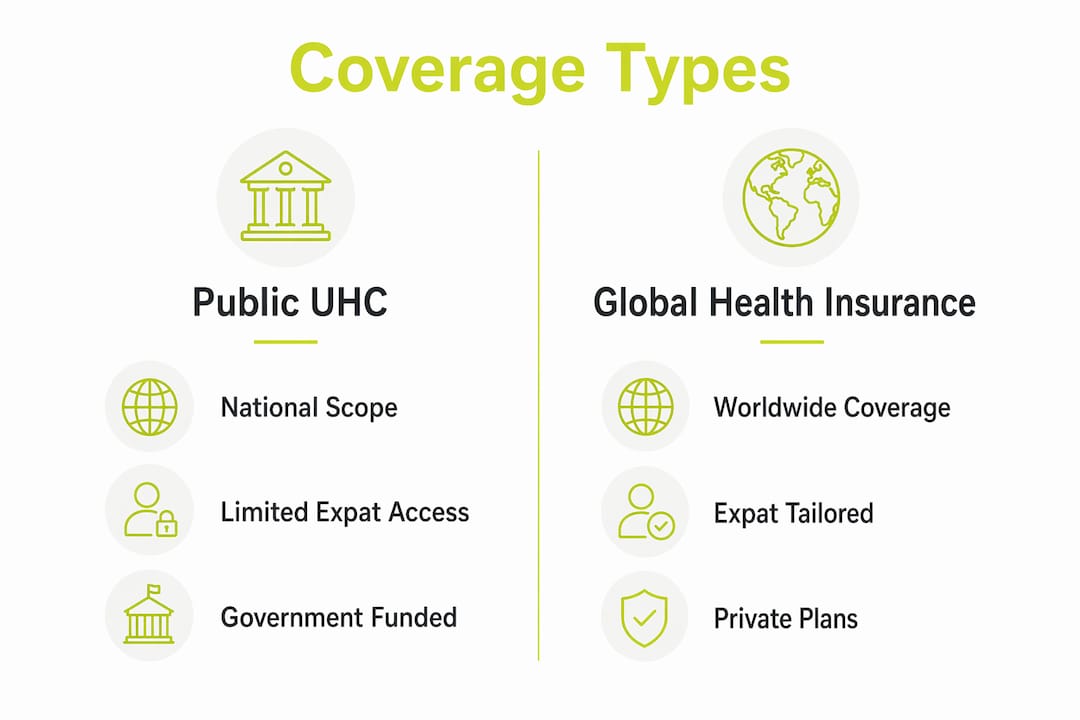
| Dimension | Public UHC systems | Global health insurance |
|---|---|---|
| Geographic reach | Typically national | Cross-border, often worldwide |
| Funding mechanism | Taxation and government budgets | Pooled premiums from policyholders |
| Coverage for foreigners | Often limited or excluded | Designed specifically for non-nationals |
| Chronic and specialist care | Variable by country | Customisable to individual needs |
| Speed of access | Subject to local waiting times | Direct access to private providers |
For expatriates and international workers, relying solely on a host country’s public system is a gamble. Even in countries with good public healthcare, non-citizens may face restricted access, long waiting lists, or no access at all without residency status. International cover for expats fills that gap by providing private access alongside, or in place of, public provision.
Pro Tip: If your host country has a high-quality public system, consider a plan that lets you use public facilities for routine care while providing private cover for specialist treatment and emergencies. This can significantly reduce your premium.
Types of cover and how to choose the right plan
Understanding what is worldwide health coverage means recognising that not all plans serve the same purpose. There are three main categories of international health insurance, and choosing the wrong one is a common and expensive mistake.
International health insurance is designed for long-term residents and expatriates. It provides year-round, renewable cover across borders and typically includes a wide range of benefits from routine outpatient care to complex inpatient treatment. This is the most comprehensive option for anyone living abroad for six months or more.
Expatriate group plans are employer-provided versions of international health insurance, often more competitive in price because of the group risk pool. If your employer offers one, review the benefits carefully before assuming it is sufficient, particularly regarding chronic conditions and evacuation cover.
Travel medical insurance is short-term cover appropriate for trips of days to a few months. It covers emergencies and acute conditions but is not suitable for managing ongoing health needs. If you are travelling for more than three months, or if you have any pre-existing conditions, travel medical insurance is likely to leave you underinsured.
When comparing international health plans, the key selection factors include:
- Geographic scope: Does the plan cover your host country and any countries you travel to frequently? Some plans exclude the United States due to high costs.
- Benefits structure: Are inpatient and outpatient both covered? Is there a cap on specialist visits or diagnostic tests?
- Provider network: Does the insurer have a network of hospitals and clinics in your location, or will you be paying upfront and seeking reimbursement?
- Claims process: Is the process digital and straightforward? How quickly does the insurer process claims?
- Premium relative to coverage: A low premium that excludes evacuation, chronic conditions, or outpatient care can cost you far more in real terms.
A well-chosen policy covers continuity of care for chronic conditions, emergencies, and planned treatments, which is precisely what long-term international residents need.
Practical steps to apply and maximise your cover
Getting the right plan is a process, not a purchase. Follow these steps to protect yourself properly.
- Assess your health profile. List any pre-existing conditions, medications, and anticipated healthcare needs. This shapes which plans are suitable and what exclusions to watch for.
- Define your geographic needs. Where will you be based? Which countries will you visit? Worldwide cover including the US is broader but more expensive. If you will not travel to the US, excluding it reduces premiums substantially.
- Set a realistic budget. Factor in the cost of going uninsured, including the worst-case scenario of evacuation or major surgery. That context usually reframes what counts as an affordable premium.
- Request quotes from multiple providers. Use a comparison approach to evaluate at least three to four providers. Look beyond premium price to benefits, exclusions, and the claims experience of existing customers.
- Read the policy wording. The benefits summary is marketing material. The policy document is the contract. Pay particular attention to exclusions, pre-authorisation requirements, and the definition of emergency.
- Understand how to access care. Know whether your insurer requires pre-authorisation before hospital admission. Save the insurer’s emergency helpline to your phone before you need it.
- Review annually. Your health needs and location may change. What worked last year may leave you underinsured next year. Treat your annual renewal as an active decision, not an automatic rollover.
For professionals working internationally, the stakes are particularly high. Health insurance for remote workers and those on international contracts requires careful attention to cross-border eligibility rules.
My perspective on getting this right
I’ve spent years working with people who arrived abroad confident that “something would be sorted” if they got sick. More often than not, that confidence was misplaced. What I’ve observed consistently is that the biggest coverage gaps don’t come from people who chose no insurance. They come from people who chose the wrong type.
A short-term travel policy taken out for a two-week holiday does not protect a freelancer spending eight months working across Southeast Asia. An employer group plan with a £500,000 inpatient limit sounds substantial until you realise it excludes outpatient care, has a narrow network, and requires you to pay upfront in most countries.
What I’ve learned is that the importance of health insurance for international living is less about the premium and more about the detail. The worst financial shocks I’ve seen people experience weren’t from unexpected illnesses. They were from policies that contained clauses the policyholder never read.
My honest advice: treat your insurance selection with the same seriousness you give your visa application or lease agreement. Read the exclusions. Ask the hard questions before you sign. And if you are unsure, speak to a specialist rather than relying on a generic comparison website. The difference between the right and wrong policy, when something goes wrong at 2am in a foreign hospital, is not marginal. It is everything.
— Coert
Find the right global health cover with Unparalleledglobalbenefits
If you’ve reached this point, you understand that the benefits of international health insurance go well beyond convenience. They are financial protection, continuity of care, and peace of mind wherever life takes you.
At Unparalleledglobalbenefits, the team specialises in matching individuals, families, and professionals with plans that genuinely fit their circumstances. Whether you are an expat starting a new chapter abroad, a contractor moving between countries, or a family relocating long-term, you can explore a full range of international plans or compare top-rated expat options to find the right fit. For professionals, the best insurance for working abroad comparison is a strong starting point.
Planning a trip for yourself, a resident, or visiting family? UGB + Ekta can arrange travel insurance for seniors up to 100 years old. Just click here: https://ektatraveling.com/?partner_uid=808 and add the promo code “UGB” to receive an additional 10% discount.
Watch this short overview to understand your options better:
https://youtu.be/bjzvma7Sh1g
FAQ
What is global health insurance?
Global health insurance, formally known as international health insurance, provides medical coverage across multiple countries. It covers inpatient care, outpatient treatment, emergency evacuation, and often chronic condition management for people living, working, or travelling abroad.
How does global health insurance work?
It works through risk pooling, where premiums from all members are combined to cover claims. This makes large, unpredictable medical costs affordable and predictable for each individual policyholder.
What is the difference between travel insurance and international health insurance?
Travel insurance covers acute emergencies and trip-related issues for short stays. International health insurance provides year-round, renewable cover including ongoing and specialist care, making it the appropriate choice for anyone abroad for more than a few months.
Why is global health coverage important for expats?
Many host countries restrict public healthcare access for non-citizens, and out-of-pocket medical costs can be devastating. Financial hardship from health costs remains a global problem, and expats without proper cover are directly exposed to that risk.
How do I choose the right international health plan?
Start by assessing your health needs, destination, and budget. Then compare providers on geographic scope, benefit levels, provider network, and claims process. A specialist broker like Unparalleledglobalbenefits can help you match the right plan to your specific situation rather than defaulting to the cheapest option.
Recommended
- Global health insurance explained: cover worldwide in 2026 – Unparalleled Global Benefits
- Working Abroad Jobs: Why International Health Insurance is Essential for Global Professionals
- Why International Health Insurance is Essential for Every Global Traveler
- Types of expat insurance: protect health abroad in 2026 – Unparalleled Global Benefits