
TL;DR:
- Running out of medication abroad can threaten your health but is avoidable with proper planning and timely transfers.
- Gather essential details, verify medication transfer rules, and initiate transfers at least three days before refills, prioritizing communication with your doctor.
Running out of medication in a foreign country is one of those situations that feels manageable until it actually happens. Knowing how to transfer prescriptions before you leave home, or while you are already abroad, can be the difference between maintaining your health and scrambling for emergency care. This guide walks you through exactly what information you need, the steps to take, common pitfalls to avoid, and how to verify that your transfer has gone through correctly. Whether you are an expat settling into a new country or a long-term traveller, this is the practical guidance you need.
Table of Contents
- Key takeaways
- How to transfer prescriptions: what to prepare first
- Steps to transfer your prescription when abroad
- Common challenges and how to troubleshoot them
- After the transfer: verifying everything is correct
- My honest experience with prescription transfers abroad
- Protecting your health abroad with the right cover
- FAQ
Key takeaways
| Point | Details |
|---|---|
| Gather information first | Collect your full name, date of birth, Rx numbers, and current pharmacy contacts before initiating any transfer. |
| Controlled substances have strict limits | Schedule III–V medications can only be transferred once; Schedule II typically requires a new prescription entirely. |
| Start early to avoid gaps | Initiate your transfer at least three days before your next refill is due to prevent medication interruptions. |
| International transfers rarely work | Cross-border prescription transfers are generally not possible; carry labelled original packaging and a doctor’s letter instead. |
| Verify everything on collection | Check medication name, dosage, and appearance when you collect, as manufacturers may differ from what you are used to. |
How to transfer prescriptions: what to prepare first
Before you even contact a new pharmacy, you need to have the right information ready. This is the stage most people skip, and it is precisely where delays begin.
Required transfer information includes your full name, date of birth, insurance details, your complete medication list, the Rx number for each prescription, and the contact details of your current pharmacy. If you are living abroad or travelling for an extended period, you should also have a copy of any relevant medical records, particularly if you are managing a chronic condition.
Understanding which medications can actually be transferred is equally important. For controlled substances, the rules are strict. Schedule III, IV, and V medications can typically only be transferred once between pharmacies, while Schedule II drugs such as certain stimulants or strong pain medicines generally cannot be transferred at all and require a new prescription from your doctor.
One detail that catches many travellers off guard is the question of insurance. Verify that your new pharmacy is in your insurance network before initiating the transfer. In 2026, pharmacy benefit changes have resulted in certain medications now requiring pick-up from specific locations, so what worked at home may not apply abroad. If you have expat health insurance, check whether your plan includes pharmacy reimbursement or a preferred pharmacy network in your destination country.
There is also a legal layer to be aware of. International prescription transfers are generally not possible across borders, and some medications that are legal in your home country may be restricted or controlled in your destination. Always carry your medications in their original, labelled packaging along with a signed letter from your doctor explaining your treatment.
Finally, update your preferred pharmacy in your doctor’s patient portal. Failing to update this record is one of the most common causes of prescriptions being sent to the wrong location, which can create serious delays when you are already abroad.
Pro Tip: Make a single-page document listing all your medications, Rx numbers, dosages, and prescribing doctor contacts. Keep a printed copy in your bag and a digital copy in your email. This one habit resolves most transfer complications before they start.
Steps to transfer your prescription when abroad
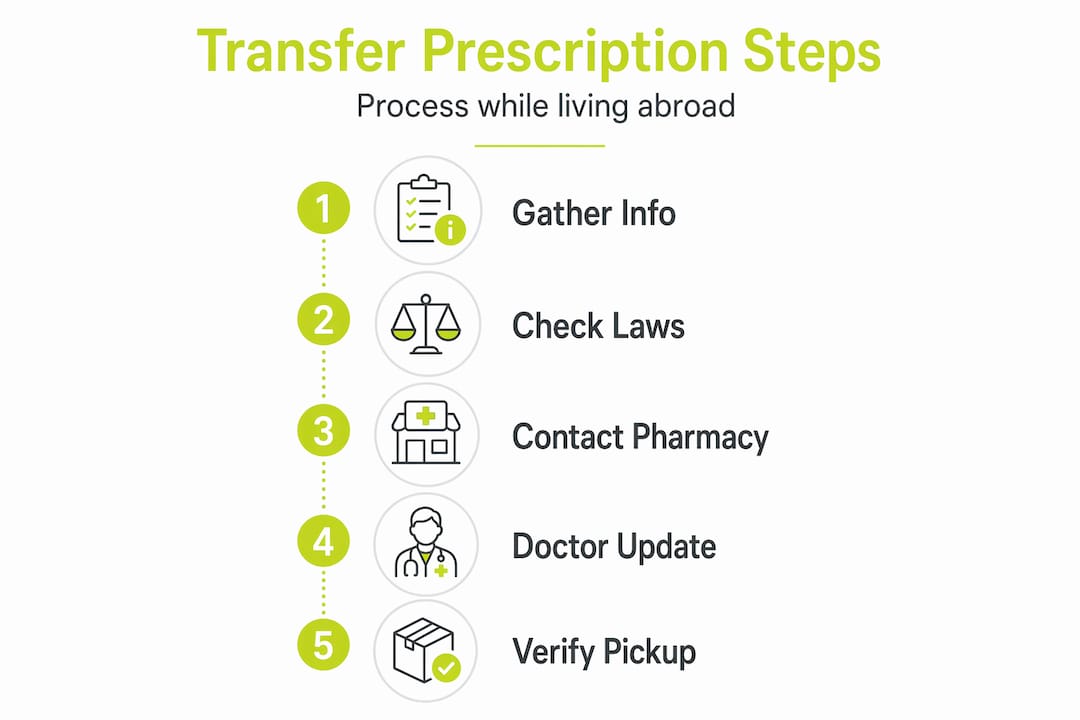
Once you have gathered everything you need, the process of moving prescriptions between pharmacies follows a clear sequence.
-
Choose your new pharmacy. Look for a pharmacy in your destination country that can fulfil your specific medications. Chain pharmacies that operate internationally can sometimes transfer prescription history within their own system near-instantly, simplifying the process considerably. If you are an expat, ask your local expat community or doctor for pharmacy recommendations with English-speaking staff.
-
Contact the new pharmacy directly. In most cases, you do not need to contact your old pharmacy first. The new pharmacy will reach out to your current one on your behalf. This is the recommended approach because it keeps the process cleaner and reduces the chance of communication errors.
-
Provide all required details. Give the new pharmacy your full name, date of birth, the name and strength of each medication, the Rx number, and your old pharmacy’s name and phone number. The new pharmacy handles the rest of the communication.
-
Wait for confirmation. Transfers typically take two to three business days, though some pharmacies can complete the process in a matter of hours if workload permits. Ask for an estimated time when you submit your request.
-
Consider a new prescription as an alternative. If you are encountering obstacles, particularly with controlled substances or if your refills have run out, ask your doctor to send a fresh prescription directly to the new pharmacy. This approach bypasses the transfer process entirely and resets the pharmacy of record without any dependency on your old pharmacy’s cooperation.
-
Use online portals where available. Many pharmacies now allow prescription refill transfers through patient apps or web portals. These can be faster than phone-based transfers and give you a written record of your request.
| Approach | Best for | Typical timeframe | Main limitation |
|---|---|---|---|
| Pharmacy-to-pharmacy transfer | Non-controlled medications with refills remaining | 2–3 business days | One-time limit for controlled substances |
| New prescription from doctor | Controlled substances or expired refills | Same day if sent electronically | Requires doctor availability |
| Same-chain internal transfer | Chains operating in both locations | Often within hours | Only works within the same pharmacy group |
Pro Tip: Start your transfer at least three days before your next dose is due. If you are travelling across time zones or managing a complex itinerary, five to seven days is even safer.
Common challenges and how to troubleshoot them
Even when you follow the steps correctly, things do not always go smoothly. Here is what tends to go wrong and how to handle it.
The most frequent problem is incomplete information. If the new pharmacy cannot verify your identity or locate your prescription record, the transfer stalls. Double-check that every detail you provide matches exactly what is on your original prescription, including the spelling of your name and the precise medication name and dosage.
Controlled substance transfers create a specific category of difficulty. Some states and countries require written requests or additional verification steps before any controlled medication transfer is approved. These extra requirements can add several days to the process, and in some jurisdictions, the transfer may be refused outright. If you depend on a controlled substance, speak to your prescribing doctor before travelling and arrange a fresh prescription in advance.
Outdated pharmacy records in your doctor’s system can also cause problems. If your doctor does not know you have moved to a new pharmacy, any new prescriptions they issue will go to the old location. Updating your preferred pharmacy in your healthcare provider’s portal before you travel is a small step with a significant impact.
Differences in pharmacy regulations between countries add another layer of complexity. A medication available over the counter in one country may require a prescription in another, and vice versa. Some medications are simply not available in certain markets under the same brand name or formulation. In those situations, your best option is to consult a local doctor who can advise on equivalent treatments and issue a local prescription.
If you are refused a transfer or told your refills have expired, do not wait for the situation to resolve itself. Contact your prescribing doctor immediately and ask them to send a new prescription directly to your chosen pharmacy. This is the fastest solution and avoids the need to navigate your old pharmacy’s records at all.
Here are the most important steps to protect yourself when transferring prescriptions abroad:
- Carry at least a 30-day supply of any critical medication when you travel, with extra packaging to allow for delays.
- Bring a signed letter from your doctor detailing your diagnosis, medications, and dosages in both English and, if possible, the language of your destination country.
- Check the customs regulations of your destination country for each medication before you pack.
- Keep medications in their original, labelled bottles rather than pill organisers when crossing international borders.
- Know the generic name of each medication, not just the brand name, as international pharmacies may stock only generic versions.
Pro Tip: If you are a student or younger expat, review your health insurance abroad coverage carefully. Many standard student plans do not cover ongoing prescription costs in another country, which can lead to unexpected out-of-pocket expenses.
After the transfer: verifying everything is correct
You have submitted your transfer request. What happens next, and how do you know when it is complete?
Most pharmacies will notify you by phone, text, or email once your prescription is ready to collect. If you have not heard anything within three business days, follow up directly with the new pharmacy. Be ready to confirm your name, date of birth, and the medication you are waiting for.
When you collect the medication, take a moment to check the label carefully. Transferred medication may look different from what you are used to if the pharmacy uses a different manufacturer. The active ingredient and dosage should be identical, but the tablet colour, size, or packaging may vary. If anything looks unexpected, ask the pharmacist to verify it before you leave the counter.
Here are the steps to take once your transfer is in progress:
- Confirm the number of remaining refills that have been transferred, as not all refills may carry over.
- Ask the pharmacist to confirm your next refill date and whether future refills can be managed at this location.
- Keep a printed or digital record of your current medication list, including the new pharmacy’s contact details.
- Set a reminder to initiate your next refill at least one week in advance if you are in an unfamiliar location or a country with slower pharmacy processing times.
- If the transfer is taking longer than expected, ask your doctor to contact the pharmacy directly, as direct communication between prescriber and pharmacist significantly accelerates resolution.
My honest experience with prescription transfers abroad
I have spoken with many expats and long-term travellers who assume the prescription transfer process will work the same way abroad as it does at home. It rarely does. The official process sounds straightforward on paper. In practice, it depends heavily on which country you are in, what type of medication you need, and whether the pharmacy staff have any experience handling foreign prescriptions.
What I have learned is that the single biggest mistake people make is waiting until they are nearly out of medication before taking any action. By that point, you are under pressure, and pressure turns what should be a two-day process into a week-long ordeal. Planning ahead by at least two weeks gives you options, including the ability to go back to your doctor for a fresh prescription if the transfer hits a wall.
I also think people underestimate how much local knowledge matters. The right pharmacy abroad is not necessarily the most convenient one. It is the one with staff who understand how to handle foreign prescriptions, who speak enough of your language to communicate clearly, and who have a reliable supply of your medication. That kind of pharmacy is worth travelling a bit further for.
The legal dimension surprises people, too. Carrying medication across borders without the right documentation is not just inconvenient if stopped at customs. In some countries, it can lead to confiscation or worse. A doctor’s letter costs nothing to obtain and prevents a great deal of difficulty.
My advice is to treat prescription management as a logistics task that deserves the same attention as your travel insurance or visa documentation. Build it into your pre-departure checklist and revisit it every time your circumstances change.
— Coert
Protecting your health abroad with the right cover
Managing your medication when you are far from home is one of the most practical challenges of expat and international travel life. The right insurance plan can take much of that burden off your shoulders by giving you access to pharmacy networks, covering the cost of medications, and connecting you with doctors who understand international prescription processes.
At Unparalleledglobalbenefits, we specialise in expat health insurance plans designed for people living and working across borders. Our coverage options help with healthcare access, medication reimbursement, and finding trusted local providers wherever you are based. You can also explore our range of expat insurance options to find the right level of protection for your situation.
Planning a trip for yourself, a resident, or visiting family? Unparalleledglobalbenefits and Ekta can arrange travel insurance for seniors up to 100 years old. Just click here: https://ektatraveling.com/?partner_uid=808 and add the promo code “UGB” to receive an additional 10% discount.
For more guidance on managing healthcare costs and coverage while abroad, watch this short video:
https://youtu.be/bjzvma7Sh1g
FAQ
Can I transfer my prescription to a pharmacy in another country?
In most cases, international prescription transfers are not possible. Instead, carry sufficient medication in its original packaging along with a signed doctor’s letter, and consult a local doctor in your destination country for any ongoing needs.
How long does a prescription transfer take?
Standard transfers take two to three business days, though some pharmacies can process a transfer within a few hours depending on their workload and the type of medication involved.
Can I transfer a controlled substance prescription?
Schedule III, IV, and V controlled substances can typically only be transferred once between pharmacies. Schedule II drugs generally cannot be transferred at all and require a new prescription from your prescribing doctor.
What is the fastest way to switch pharmacies if my transfer stalls?
Ask your doctor to send a fresh prescription directly to your new pharmacy. This approach bypasses the transfer entirely and resolves most delays without needing your old pharmacy to act.
How do I avoid gaps in my medication while travelling?
Start the transfer process at least three days before your next refill is due, and carry a minimum 30-day supply when crossing borders. Keeping a written medication list and a doctor’s letter with you at all times reduces the risk of disruption significantly.
Recommended
- How to Get Medical Insurance Abroad: Your Essential Guide for Expats and Travelers
- Navigate medical coverage abroad confidently in 2026 – Unparalleled Global Benefits
- 7 pasos clave del checklist de salud para expatriados europeos – Unparalleled Global Benefits
- Why Do I Need Specific Coverage to Live Abroad? – Unparalleled Global Benefits