

TL;DR:
- Moving abroad or planning an extended stay requires more than travel insurance; it necessitates comprehensive global health coverage to manage ongoing medical needs. International health insurance is designed for long-term expatriates, students, and digital nomads, providing routine and emergency care beyond short trips. Understanding the differences between global health plans and travel insurance, along with legal requirements, helps ensure adequate protection across borders and avoids costly gaps.
Moving abroad or planning a long stay in another country raises one question most people get wrong straight away: is my travel insurance enough? The short answer is no, and that misunderstanding can be costly. Defining global health insurance clearly matters because the gap between what you think you have and what you actually need is where serious financial risk lives. International health insurance generally covers the long term, over a year, and includes routine care plus emergencies, unlike travel insurance which covers mainly emergencies for short trips. This guide covers who needs it, what it includes, and how to choose wisely.
Table of Contents
- What is global health insurance and who needs it?
- Key differences between global health insurance and travel medical insurance
- Global health insurance and legal requirements for long-term stays abroad
- Understanding coverage scope: what global health insurance typically includes
- Limitations of national health plans and implications for international travellers
- Our perspective: why most people buy the wrong plan first
- Find the right global health cover for your situation
- Frequently asked questions
What is global health insurance and who needs it?
Defining global health insurance starts with one key distinction: it is private, international medical coverage designed for people who are living, studying, or spending significant time outside their home country. It is not a holiday product. It does not expire after two weeks. It is designed to function as your primary healthcare cover when your domestic plan no longer applies.
Your national health scheme, whether that is the NHS in the UK or Medicare in the US, is built for residents living at home. The moment you relocate or stay abroad for an extended period, that domestic cover becomes unreliable or simply stops applying. International health insurance covers your health needs when living overseas, offering both emergency and routine care for long periods, unlike travel insurance which is mainly for emergencies during short trips. That distinction matters enormously when you are managing a chronic condition, need a GP referral, or simply require a prescription renewal six months into living in Barcelona or Bangkok.
Who typically needs global health insurance?
- Expatriates relocating for work, retirement, or lifestyle reasons, whether for one year or indefinitely
- International students on programmes lasting one academic year or longer, particularly when studying outside Europe
- Long-term travellers and digital nomads who move between countries and cannot rely on one national system
- Families accompanying an employee abroad, including dependants who need routine paediatric and dental check-ups
- Au pairs and visa holders whose visa category may specifically require proof of adequate health coverage
The common thread is continuity. These are people who need uninterrupted access to healthcare across borders, not just emergency protection for a fortnight. Understanding what international health insurance actually is becomes the first practical step before you book your flight or sign your lease.
Key differences between global health insurance and travel medical insurance
Understanding global healthcare properly means recognising that global health insurance and travel medical insurance are built for entirely different situations. Confusing them is one of the most common and expensive mistakes international travellers make.
Duration is the clearest dividing line. Global health insurance is long-term, typically providing coverage for one year or more, and most plans renew annually as long as you remain abroad. Travel medical insurance is short-term and usually covers emergencies only. If you fall seriously ill on a three-week trip, travel medical cover handles it. If you develop a condition six months into living abroad, you need something more substantial.
Scope of coverage is equally significant. Travel medical cover does not include routine care, physicals, elective treatments, or prescription management. Global health insurance does. That means GP visits, specialist referrals, vaccinations, maternity care, and ongoing prescription needs are included in most global plans but completely absent from travel policies.
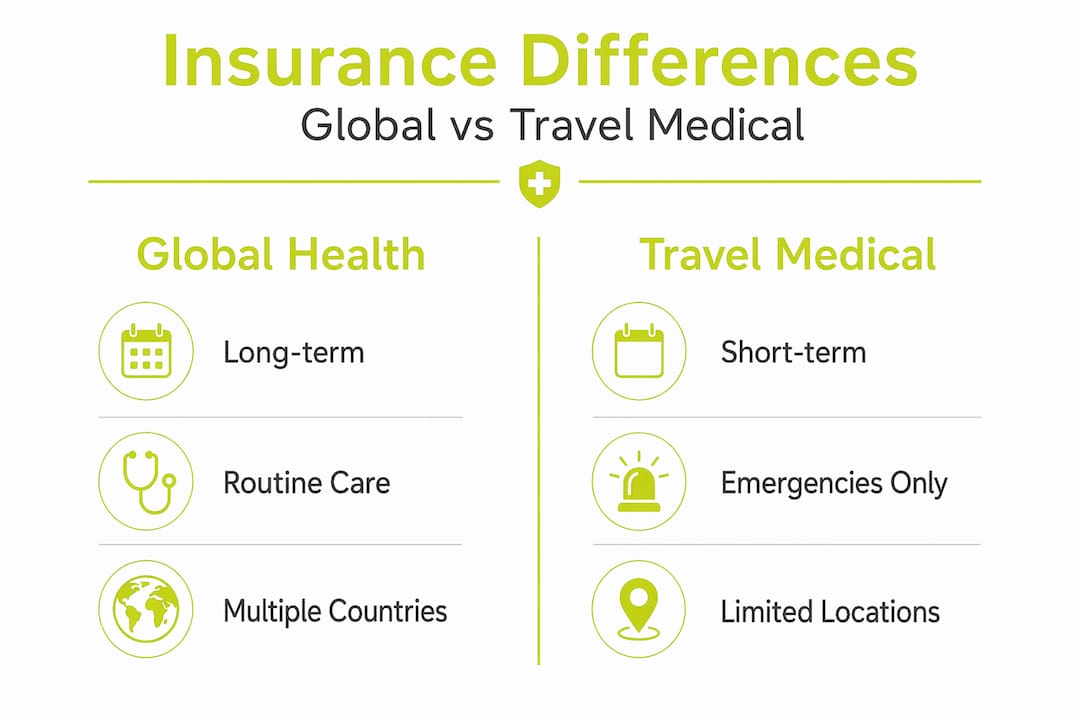
| Feature | Global health insurance | Travel medical insurance |
|---|---|---|
| Duration | 12 months or more | Days to a few weeks |
| Routine care | Included | Not included |
| Emergency care | Included | Included |
| Prescriptions | Usually included | Not included |
| Maternity cover | Optional add-on | Not included |
| Medical evacuation | Often included | Sometimes included |
| Ideal for | Expats, long-term residents | Short-trip tourists |
Key scenarios where this distinction matters:
- A student studying in Germany for a full academic year needs global cover, not a travel policy
- A retiree spending winters in Portugal for five months each year may need global cover depending on residency status
- A contractor on a 12-month assignment in the UAE requires a plan that covers routine appointments, not just hospital emergencies
Understanding the nuances between travel medical and health insurance can prevent costly gaps, and it is worth reading a dedicated comparison before committing to any plan. You might also benefit from reviewing travel insurance versus health insurance as a broader framework.
Pro Tip: Always check the territorial restrictions in your policy documents before purchasing. Some global plans exclude high-cost regions like the United States or Canada unless you pay for an upgraded tier. If you travel between those regions frequently, that exclusion could leave you significantly exposed.
Global health insurance and legal requirements for long-term stays abroad
Having clear global health coverage is not just a personal safety measure. In many countries, it is a legal requirement. This is where global insurance policies overlap directly with visa compliance, and it is an area many expatriates overlook until they reach the application desk.

Governments require proof of health insurance for a straightforward reason: they want reassurance that incoming residents can cover their own medical costs and will not rely on the host country’s public health budget. Some countries require proof of health insurance for visa or residency approval, and international health insurance provides the continuous coverage documentation required for long-term stays abroad.
Countries that commonly require health insurance as part of visa applications include:
- Spain (non-lucrative visa, digital nomad visa, student visa)
- Germany (residence permit applications for non-EU nationals)
- Mexico (retirement and temporary resident visas)
- Thailand (retirement visa, long-stay extensions)
- Schengen Area (short-stay visa applicants must show minimum coverage of €30,000)
- Portugal (D7 passive income visa, NHR residency applicants)
The coverage required is often specific. Authorities want to see continuous coverage, minimum benefit thresholds, and in many cases evidence of medical evacuation benefits. A basic travel policy with a 90-day cap and no evacuation cover will not satisfy these requirements.
For expatriates navigating these requirements, understanding visa insurance and global requirements in advance is far simpler than scrambling to find a qualifying plan after your visa application is already in process. Start with the destination country’s consular requirements and work backwards to find a plan that satisfies them.
Understanding coverage scope: what global health insurance typically includes
Now that the legal context is clear, what does a global health insurance plan actually cover? The answer depends on the tier and insurer you choose, but most well-structured plans include the following.
Standard coverage in most global health plans:
- Emergency medical treatment, including hospitalisation, surgery, and intensive care
- Outpatient routine care, including GP visits, specialist consultations, and diagnostics
- Prescription medications for both acute and chronic conditions
- Mental health support, which is increasingly included in modern plans
- Maternity care, usually available as an optional add-on with a waiting period
- Medical evacuation and repatriation, covering transport to an appropriate facility or home if local care is inadequate
- Dental and optical, often available as bolt-on benefits rather than standard inclusions
Plans often cover emergency treatment, routine care, prescriptions, maternity, and sometimes evacuation, though geographic coverage may exclude high-cost countries like the US unless specifically included.
| Coverage type | Basic plan | Mid-tier plan | Premium plan |
|---|---|---|---|
| Emergency hospitalisation | Yes | Yes | Yes |
| Outpatient/GP visits | Limited | Yes | Yes |
| Prescriptions | Sometimes | Yes | Yes |
| Maternity | No | Add-on | Yes |
| Mental health | No | Limited | Yes |
| Evacuation | Yes | Yes | Yes |
| USA coverage | No | Add-on | Yes |
Understanding why international health insurance is worth selecting carefully helps you match these coverage tiers to your actual lifestyle rather than simply buying the cheapest available option.
Pro Tip: If you are relocating with children, verify whether the plan covers paediatric preventive care such as vaccinations and growth check-ups. These are often grouped under routine outpatient benefits but may have annual limits that are easy to exhaust with a young family.
Limitations of national health plans and implications for international travellers
Understanding global healthcare also means understanding what it replaces. Most people assume their national health plan provides at least some protection when they travel or relocate. For the majority of government-run schemes, that assumption is wrong.
Take Medicare in the United States as one of the clearest examples. Medicare generally does not cover medical services outside the US except in very limited emergency cases, leaving significant gaps in both routine and emergency care abroad. The exceptions are narrow: inpatient care near the Canadian border, care on a ship within territorial waters, and a few other tightly defined scenarios.
“Medicare generally provides no coverage for health care you get while travelling outside the United States. There are a few exceptions, but they are narrow and specific.”
What national plans typically fail to cover internationally:
- Routine GP and specialist visits in the host country
- Ongoing prescription management
- Preventive care and annual health screenings
- Mental health outpatient support
- Emergency medical evacuation to a better-equipped facility
- Repatriation of remains in the event of death abroad
The result is that expats and long-term travellers who rely solely on their home country’s national scheme are, in practice, uninsured for most day-to-day health needs abroad. The financial exposure can be severe. A single night in a private hospital in the United States can exceed $10,000 (approximately £7,900). Medical evacuation from Southeast Asia to Europe can cost upwards of $50,000.
For expatriates specifically, exploring international expat health insurance options built around these gaps is not optional. It is the responsible foundation of any international lifestyle.
Our perspective: why most people buy the wrong plan first
We have helped thousands of expatriates, students, and long-term travellers find the right coverage, and there is one pattern we see repeatedly. People buy what feels familiar rather than what actually fits their situation. They choose a travel policy because it looks like the health insurance they already know. They underestimate how quickly routine health needs add up over a year abroad.
Here is what experience teaches: the most important question is not “how much does this plan cost?” It is “what am I likely to need in the next twelve months?” A 28-year-old digital nomad with no chronic conditions has very different needs from a 55-year-old retiring to Spain with a managed cardiac condition. One may do well on a mid-tier outpatient plan. The other needs a premium plan with no exclusions for pre-existing conditions, a solid evacuation benefit, and ideally, USA coverage included.
The second thing most people get wrong is buying the plan and then assuming they understand it. Insurance documents are written precisely, and what looks like “worldwide coverage” in the headline often means “worldwide, excluding the United States and Canada” in the fine print. Read the territorial scope. Understand what counts as an emergency versus routine care under your specific policy’s definitions. These distinctions matter when you are making a claim.
Affordable global healthcare options exist at every budget level, but affordability is not only about the monthly premium. A cheaper plan that excludes your most likely health needs is not affordable at all when something goes wrong.
Find the right global health cover for your situation
Navigating global health insurance options can feel overwhelming, particularly when every plan looks similar at first glance. The differences that matter are often buried in the details, and that is exactly where having expert guidance makes a real difference.
At Unparalleled Global Benefits, we specialise in matching individuals, families, students, and expatriates with international coverage that actually fits their lives. Whether you need visa-compliant health insurance for a residency application, comprehensive expat cover for a multi-year relocation, or a plan flexible enough to travel with you across multiple countries, we can help you find it. Request a personalised quote today and speak with a specialist who understands your destination, your circumstances, and your budget. Visit Unparalleled Global Benefits to get started.
Frequently asked questions
What is the main difference between global health insurance and travel insurance?
Global health insurance is long-term coverage designed for expatriates and long-term travellers that includes both routine and emergency care, whereas travel insurance typically covers emergency medical issues during short trips only. International health insurance generally covers the long term and includes routine care, while travel insurance usually covers emergencies for shorter trips.
Does Medicare cover healthcare costs when travelling abroad?
Medicare generally does not cover medical services outside the United States except in very limited emergency situations, so most travellers and expatriates require additional international coverage to avoid significant out-of-pocket expenses.
Why do some countries require proof of health insurance for visas?
Countries require health insurance proof to ensure visitors can pay for their own medical expenses and do not place a burden on local healthcare systems. Some countries require this documentation as part of the visa application process, particularly for long-term and residency visas.
What typical coverages can I expect from global health insurance?
Global health insurance commonly covers emergency care, routine medical treatments, prescriptions, maternity care, and medical evacuation, though coverage scope varies by plan tier. Geographic coverage may exclude high-cost countries like the United States unless you specifically select a plan that includes them.
Recommended
- Worldwide health coverage: Your essential guide for expats – Unparalleled Global Benefits
- What does international health insurance cover? 2026 guide – Unparalleled Global Benefits
- Expat health insurance: your complete guide for 2026 – Unparalleled Global Benefits
- Global health insurance explained: cover worldwide in 2026 – Unparalleled Global Benefits