

TL;DR:
- Travel insurance is crucial as domestic policies often don’t cover international emergencies or evacuation costs.
- Many countries, including the Schengen Area from 2025, require minimum coverage for visa approval.
- Choosing the right policy involves verifying coverage details, certificates, and ensuring it meets specific country and activity requirements.
One overlooked detail in your travel insurance policy can unravel an entire trip before it even starts. Imagine arriving at a visa application centre only to discover your policy does not meet the minimum financial threshold, or landing at a foreign airport and being turned away because your insurer’s certificate is non-compliant. These scenarios happen to real travellers every year, and they are entirely avoidable. In 2025, governments around the world are tightening requirements, introducing new mandates, and updating what counts as acceptable cover. This guide cuts through the confusion and tells you exactly what is required, where, and how to stay protected.
Table of Contents
- Why travel insurance matters: Beyond recommendations
- Which countries require travel insurance in 2025?
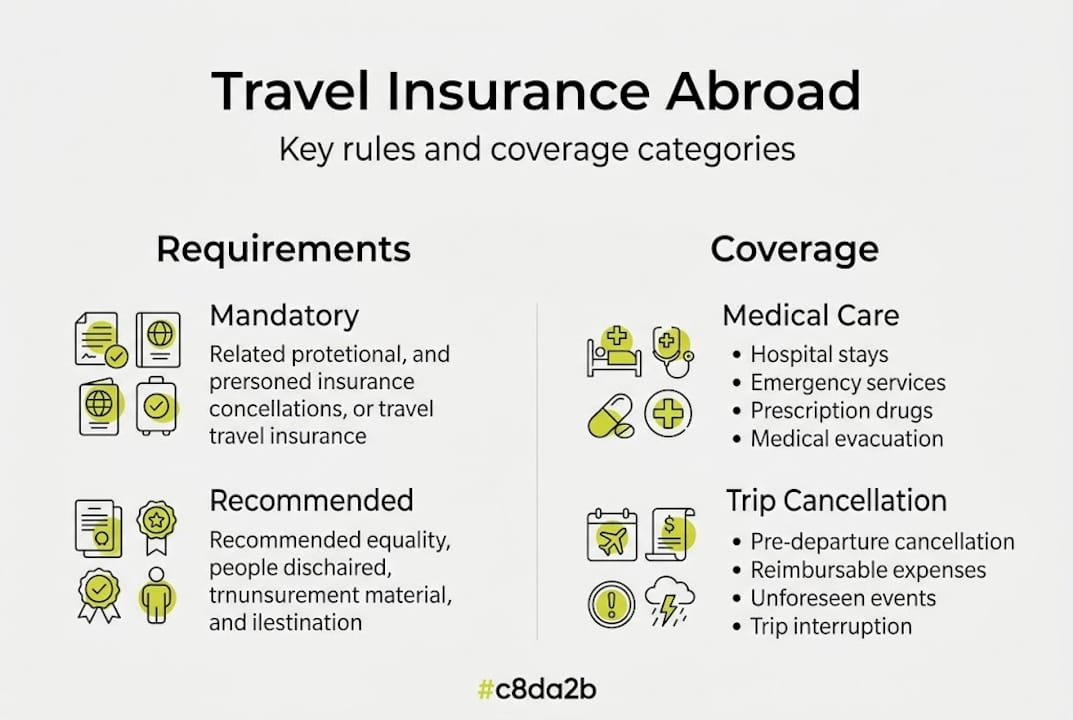
- What must your policy cover? Medical, cancellation, evacuation and more
- Common mistakes and pitfalls: What travellers often miss
- Our perspective: Why one-size-fits-all insurance is a myth
- Explore your tailored travel insurance solutions
- Frequently asked questions
Key Takeaways
| Point | Details |
|---|---|
| Verify country requirements | Not all destinations require insurance but some, like the Schengen Area, set strict rules. |
| Check policy compliance carefully | Look for certified documents, minimum coverage, and exclusions to avoid denied claims or entry. |
| Prioritise emergency cover | Medical evacuation and repatriation are essential and often overlooked in basic policies. |
| Consider personal risks | Activities, health status, and changing rules require more than just a one-size-fits-all approach. |
Why travel insurance matters: Beyond recommendations
Many travellers assume their domestic health policy will protect them wherever they go. This is one of the most costly assumptions you can make. The reality is that most national health schemes stop at the border, and even private health policies often contain clauses that limit or exclude coverage outside your home country. Without the right policy in place, a single medical incident abroad can generate a bill that runs into tens of thousands of pounds.
Consider what a medical emergency actually costs in practice. A hospitalisation in the United States for a cardiac event can exceed £80,000. In Southeast Asia, where costs seem low, emergency air ambulance transport to a facility capable of treating serious injuries can still run to £25,000 or more. Medical evacuation coverage abroad is not a luxury; it is a financial necessity that most people never think about until they need it.
“The U.S. government strongly recommends travel health insurance and medical evacuation insurance for international trips, as Medicare and Medicaid do not provide cover abroad, and domestic health plans often offer only very limited protection.”
There are several persistent myths worth addressing directly:
- “My credit card covers me” — Many cards include basic travel insurance, but the limits are often too low and the certificates may not meet official visa requirements.
- “Reciprocal healthcare agreements protect me” — Agreements such as the Global Health Insurance Card (GHIC) in Europe only cover state-provided care, not private hospitals, repatriation, or evacuation.
- “I’m a healthy, experienced traveller — I don’t need it” — Accidents do not discriminate. A broken leg on a hiking trail or a road traffic incident can happen to anyone, regardless of age or fitness level.
- “My destination is low risk” — Even the safest countries have expensive private healthcare, and travel disruption alone can cost hundreds in last-minute accommodation and rebooking fees.
Pro Tip: Before your next trip, call your domestic insurer and ask two specific questions: “Does my policy cover emergency medical care abroad?” and “Does it cover medical evacuation?” If the answer to either is no or “only partially”, you need dedicated travel cover.
Insurance requirements are not static. Laws and entry conditions change each year, so what protected you on a trip two years ago may not be sufficient today. Staying informed is as important as having cover in the first place.
Which countries require travel insurance in 2025?
Understanding where insurance is mandatory, as opposed to simply advisable, is essential before you book. The rules differ significantly by destination and visa type, and the cost of getting it wrong can range from a rejected visa application to being refused boarding.
The clearest and most established mandatory insurance requirement applies to the Schengen Area. Insurance requirements for Schengen visa applications are non-negotiable across all 29 member states. Schengen visa applicants must hold a minimum of €30,000 in coverage for emergency medical expenses, hospitalisation, and repatriation. The policy must be valid for the entire Schengen Area and cover the full duration of the stay, not just the primary destination country. Understanding what qualifies under the minimum insurance for Schengen visa applications is something every European traveller should know before applying.
Looking ahead, two significant new mandates are approaching. Thailand and Georgia are both introducing compulsory travel health insurance requirements from January 2026. Georgia’s rules specify a minimum coverage amount of 30,000 GEL, which is a concrete threshold you will need to document at entry. Thailand’s forthcoming requirement is expected to align with similar standards. If you are planning travel to either country in late 2025 or early 2026, building insurance into your plans now is wise.
| Country or region | Insurance required? | Minimum coverage | Notes |
|---|---|---|---|
| Schengen Area (29 countries) | Yes, mandatory | €30,000 | Must cover full stay and all Schengen countries |
| Georgia | Yes, from Jan 2026 | 30,000 GEL | Documentary proof required at entry |
| Thailand | Yes, from 2026 | TBC | Watch for official announcement |
| Cuba | Yes, mandatory | Varies | Tourists must show proof at border |
| Russia | Recommended | N/A | Required for visa in practice |
| USA, UK, Australia | No | N/A | Strongly recommended only |
| Most of Southeast Asia | No | N/A | Strongly recommended only |
Beyond mandatory destinations, many countries fall into a “strongly recommended” category. The USA, United Arab Emirates, Canada, and most of Southeast Asia do not require proof of insurance, but medical costs in these regions are high enough that travelling uninsured carries significant financial risk.
Notably, as of 2025, there is no universal global mandate requiring all travellers to hold insurance. Requirements are destination-specific and, in many cases, visa-type-specific. A tourist visa to France demands Schengen-compliant cover; a short business trip to Thailand today does not yet require it, but that will change.
What must your policy cover? Medical, cancellation, evacuation and more
Knowing which countries require insurance is only part of the picture. You also need to understand exactly what a compliant and genuinely protective policy must include. Not all policies are equal, and a plan that satisfies the minimum visa requirement may leave you underprotected in practice.
Here is a clear breakdown of key coverage categories and the recommended limits for 2025:
| Coverage type | Minimum for Schengen | Recommended general limit |
|---|---|---|
| Emergency medical treatment | €30,000 | £100,000 or more |
| Medical evacuation and repatriation | Included in €30,000 | £250,000 or more |
| Trip cancellation | Not required for visa | 100% of pre-paid costs |
| Baggage and personal effects | Not required for visa | £1,500 to £3,000 |
| Travel delay | Not required for visa | £100 to £200 per day |
| Personal liability | Not required for visa | £1,000,000 or more |
Comprehensive travel insurance typically costs between 4% and 10% of your total trip cost, with higher-tier plans covering pre-existing conditions, adventure activities, and higher medical limits. That means a £3,000 holiday would cost between £120 and £300 to insure fully. Considered against the potential cost of an uninsured medical emergency, this is a reasonable investment.
A travel health insurance guide will walk you through the details of each coverage tier, but there are several things worth confirming before you purchase any policy:
- Confirm the medical limit is sufficient for your destination. US and Swiss healthcare costs are among the highest in the world.
- Check evacuation is separate or sufficient — some policies bundle evacuation within the overall medical limit, which can reduce effective cover.
- Read the exclusions section carefully — adventure sports, pre-existing conditions, and acts of war or civil unrest are common exclusions.
- Verify the deductible amount — for Schengen applications, a deductible above €100 to €150 may invalidate your visa application.
- Confirm the policy certificate meets the official format required by the embassy or consulate.
- Note the purchase window for pre-existing condition waivers — these typically require purchase within 14 to 21 days of your initial trip deposit.
Understanding medical evacuation insurance cover is particularly important if you are heading to remote destinations, smaller islands, or developing countries where local hospital facilities may be inadequate.

Pro Tip: When comparing policies side by side, do not just look at the headline medical limit. Ask specifically: “Does this policy include a standalone evacuation benefit?” A policy with £500,000 in medical cover but no evacuation clause could still leave you facing a £50,000 air ambulance bill.
Common mistakes and pitfalls: What travellers often miss
Even travellers who know they need insurance often make choices that leave them exposed. The fine print in insurance policies is where real protection either stands or falls, and the details are rarely obvious at first glance.
Relying on credit card insurance is perhaps the most common trap. Many travel credit cards advertise complimentary travel insurance as a benefit, but the reality is nuanced. Credit card insurance frequently lacks the formal compliance certificate required for Schengen visa applications, and high deductibles of €100 or more can automatically disqualify it. Card-based cover also tends to have lower limits and stricter exclusions than standalone policies.
Missing the certificate requirement is another frequent mistake. Visa applications require documentation in a specific format, and not all insurers provide the right paperwork automatically. You need to request a certificate explicitly and verify it includes your name, policy number, coverage dates, destination, and the confirmed minimum coverage amount.
Here is a checklist of what to verify before buying any policy:
- Coverage meets the minimum financial threshold for your destination’s visa rules
- A compliant certificate can be issued in the correct format for embassy submission
- The deductible is within the acceptable range (below €100 to €150 for Schengen)
- Adventure sports or activities relevant to your trip are not excluded
- Pre-existing conditions are either covered or a waiver is available if purchased promptly
- The policy remains valid if your trip extends beyond the original dates
- The insurer’s emergency assistance line operates 24 hours a day, seven days a week
Getting approved for Schengen visa insurance requires particular attention to policy compliance, so reviewing documentation before submission is essential.
Adventure travellers face specific risks that standard policies do not always address. Activities such as skiing, scuba diving, rock climbing, and motorbike riding typically require add-on riders or specialist plans. An adventure insurance guide can help you identify the right cover, and reviewing adventure insurance tips specifically tailored to active travellers will help you avoid gaps in protection.
One often-overlooked risk involves FCDO (Foreign, Commonwealth and Development Office) travel advisories. If your government issues an “advise against all travel” warning for your destination after you purchase your policy, your cover may be voided entirely. Insuring at the highest compliant level and checking advisories regularly gives you the most options if circumstances change after booking.
Our perspective: Why one-size-fits-all insurance is a myth
Standard advice tells every traveller to “get travel insurance” and check the minimum requirements. That is a good starting point, but it is not nearly enough. The uncomfortable truth is that most off-the-shelf policies are designed around the average traveller, and very few people are average.
A freelancer working remotely from Lisbon for three months has fundamentally different needs to a retiree visiting grandchildren in Toronto, or a gap-year student trekking through Central America. Regulators and standard insurers rarely keep pace with how people actually travel today, and that gap can be costly. The rise of remote work, medical tourism, and extended multi-destination itineraries has created real coverage blind spots that standard annual policies simply do not address.
Our experience working with travellers across every life stage shows that the real risk lies not in failing to buy insurance, but in buying the wrong insurance. International health insurance explained in clear terms shows just how much variation exists between personal circumstances. Always read the exclusions first, not the marketing claims. Ask whether your policy can be extended, upgraded, or adapted. The right insurer will welcome those questions rather than avoid them.
Explore your tailored travel insurance solutions
You now have a clear picture of what is required, where, and why the details matter so much. The next step is matching that knowledge to a policy that genuinely fits your circumstances.
At Unparalleled Global Benefits, we specialise in connecting travellers, expats, and families with insurance solutions designed around real-world needs. Whether you need international expat health insurance for a longer posting abroad, want to understand how travel insurance works before comparing plans, or need clarity on visa insurance global requirements for your specific destination, we are here to help. Explore our resources and request a personalised quote today.
Frequently asked questions
Is travel insurance mandatory for every country in 2025?
No, most countries only recommend travel insurance rather than require it, but it is mandatory for Schengen visa holders across all 29 member states, as well as Cuba and select other destinations. Always confirm requirements for your specific destination and visa type before travelling.
What is the minimum insurance coverage needed for Schengen visa applications?
Schengen visa applicants must hold a minimum of €30,000 in cover for emergency medical expenses, hospitalisation, and repatriation, valid throughout the entire Schengen Area and for the full duration of the stay. Higher limits are possible and often advisable.
Does my credit card travel insurance satisfy visa requirements?
Often it does not, because credit card insurance frequently lacks the formal compliance certificate that embassies require, and high deductibles can also render the policy non-compliant. Always request written confirmation from your card provider before relying on this cover for a visa application.
Can I buy insurance after booking travel?
Yes, you can purchase travel insurance after booking, but to access cover for pre-existing conditions or cancellation for any reason, the pre-existing conditions waiver typically requires purchase within 14 to 21 days of your initial deposit. Waiting reduces your options considerably.
How much does comprehensive travel insurance typically cost?
Comprehensive travel insurance generally costs between 4% and 10% of your total trip cost, meaning a £2,500 trip would cost between £100 and £250 to insure fully. Factors such as age, destination, trip duration, and the inclusion of pre-existing conditions or adventure activities will affect the final premium.
Recommended
- Travel Insurance for Medical Procedures Abroad Explained – Unparalleled Global Benefits
- Essential travel medical coverage checklist: Secure your health abroad – Unparalleled Global Benefits
- Why travel with insurance: Stay safe abroad in 2026 – Unparalleled Global Benefits
- Travel health insurance guide: secure medical cover abroad – Unparalleled Global Benefits