

TL;DR:
- Global health insurance premiums vary widely based on age, coverage, location, and deductibles.
- Higher coverage tiers and US inclusion significantly increase costs, especially for top-tier plans.
- Smart choices like increasing deductibles and excluding US coverage can help control expenses without sacrificing essential protection.
When you start comparing global health insurance quotes, the numbers can feel overwhelming. A monthly premium might sit below £160 for one person on a basic plan, yet climb past £980 for comprehensive worldwide cover. That gap is not a pricing error. It reflects a complex set of variables that most buyers never fully see until they are already committed to a policy. Whether you are an expat relocating to Southeast Asia, a student starting a degree in the United States, or a family moving abroad for work, knowing what drives these costs is the single most practical step you can take before signing anything.
Table of Contents
- What determines global health insurance costs?
- Real-world global health insurance price examples
- How coverage choices and country impact premium rates
- Ways to keep global insurance affordable and pitfalls to avoid
- Why chasing the lowest health insurance cost often backfires
- Find the right global health insurance for your needs
- Frequently asked questions
Key Takeaways
| Point | Details |
|---|---|
| Wide price range | Global health insurance costs can start under £200 per month but exceed £900 at premium levels. |
| Factors matter | Age, coverage, and geographic scope are the main drivers of how much you’ll pay. |
| Real examples help | Using real-world price tables clarifies what you can expect as an expat or student abroad. |
| Affordable strategies | Adjusting excess, comparing essentials versus add-ons, and avoiding exclusions can keep costs down. |
What determines global health insurance costs?
Before you can make sense of any premium figure, you need to understand the variables that insurers use to calculate it. This is where many buyers go wrong. They focus on the headline price without examining what sits beneath it.
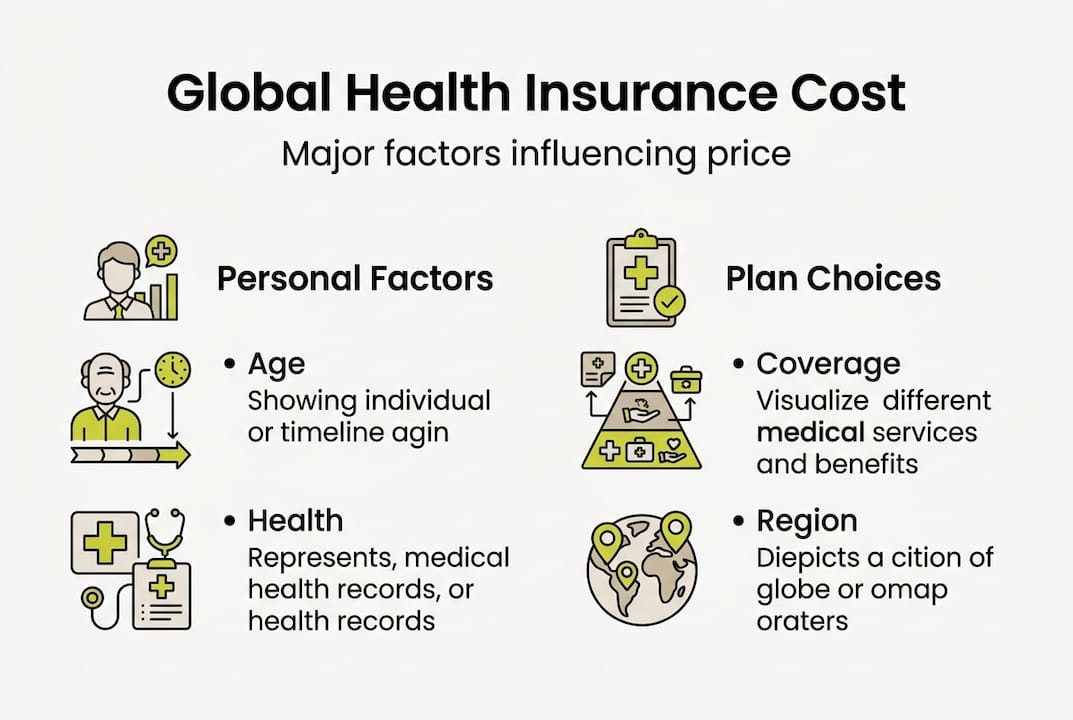
Age is one of the most influential factors. Insurers calculate risk based on how likely you are to need medical treatment, and that likelihood increases with age. A 25-year-old and a 55-year-old requesting identical cover in the same country will receive very different quotes. The difference is often substantial.
Coverage level is equally significant. Most international health insurance providers offer tiered plans, ranging from foundation or essential cover to premium or prestige-tier policies. You can explore the types of expat insurance available to get a clearer picture of how tiers differ in practice. Foundation plans typically cover inpatient hospital care only. Prestige or top-tier plans include outpatient consultations, dental, vision, mental health, maternity, and more.
Geographic scope matters enormously. Policies that include the United States in their coverage area cost significantly more than those that exclude it, because US healthcare is among the most expensive in the world. A plan covering worldwide excluding the USA will consistently be cheaper than one covering worldwide including the USA.
Excess or deductible (the amount you agree to pay before the insurer covers costs) is another lever. A higher excess usually means a lower premium. This is worth considering carefully based on your financial situation.
Here is a summary of the core factors that determine your premium:
- Age at the time of application
- Chosen coverage tier (foundation, standard, comprehensive, prestige)
- Geographic coverage region (Europe only, worldwide ex-USA, worldwide including USA)
- Chosen excess or deductible level
- Whether you are covering an individual, a couple, or a family
- Pre-existing medical conditions and medical history
- Country of residence and local healthcare costs
For context on how dramatically pricing varies, AXA’s monthly premium ranges for a 35-year-old UK resident (worldwide excluding USA) span from approximately £157.50 at Foundation level to £980.31 at Prestige Plus level. That near-sixfold difference comes entirely from coverage tier.
Pro Tip: If you are purchasing a family policy, check whether children are priced individually or whether a family cap applies. Some plans limit charges after a certain number of children, which can represent real savings for larger families. Reviewing plans for expats side by side will reveal these distinctions quickly.
Real-world global health insurance price examples
Understanding the principles is useful, but seeing actual numbers is often more helpful. Here are real-world pricing examples for two of the most common buyer profiles: expats and international students.
Expat pricing: AXA Global Healthcare (UK resident, worldwide excluding USA)
The table below uses sample pricing data for a 35-year-old UK-based policyholder to illustrate how coverage tier affects monthly cost.

| Plan level | Monthly premium (approx.) |
|---|---|
| Foundation | £157.50 |
| Standard | £197.88 |
| Comprehensive | £337.55 |
| Prestige | £690.40 |
| Prestige Plus | £980.31 |
These figures come from AXA’s published pricing and are illustrative of what a mid-career expat might encounter. The jump from Standard to Comprehensive is notable, representing an increase of roughly £140 per month for considerably broader outpatient and specialist benefits. The jump from Prestige to Prestige Plus is even sharper, adding nearly £290 per month for top-tier access and reduced waiting times.
“The difference between a Foundation and a Prestige Plus plan is not just about what is covered. It is about the experience you have when you actually need to use it: direct billing networks, specialist access times, and claims support.”
This is worth keeping in mind when comparing plans purely by price.
International student pricing: USA university-sponsored plans
For students, the pricing picture looks quite different. University-sponsored plans in the United States, often called International Student Health Insurance Plans (ISHIP), are structured around academic-year billing periods. Washington State University’s ISHIP 2025 to 2026 rates show student premiums of $1,360 for the autumn semester (August to December 2025) and $1,885 for the spring and summer period (January to July 2026). Spouse and child rates are also available, with a cap on the number of children charged to manage family costs.
Those numbers sound manageable in isolation, but combined across a full academic year, a student and their spouse could be looking at over $5,000 in insurance costs alone.
For students studying in the US, you can review options through resources on insurance for international students to understand what alternatives to university-mandated plans might exist.
If you are comparing providers more broadly, a review of top insurance plans available in the international market can help you identify where to get more coverage for your budget.
How coverage choices and country impact premium rates
Once you have seen sample prices, the next step is understanding why moving between coverage options or countries changes your cost so significantly. This is not arbitrary. It reflects genuine differences in healthcare costs and regulatory environments around the world.
Country and region of coverage are priced based on the average cost of care in those areas. The United States has extremely high medical costs by global standards, which is why including US coverage in your policy can nearly double the premium compared to a worldwide-excluding-USA plan. Countries in Western Europe tend to sit in the middle ground. Parts of Southeast Asia and Latin America, where medical costs are lower, attract more affordable premiums.
Scope of cover refers to the breadth of what is included in your plan. A basic inpatient-only plan covers hospitalisation, surgery, and intensive care. An enhanced or gold-level plan adds outpatient consultations, diagnostic tests, prescription drugs, physiotherapy, dental care, and mental health support. Each addition represents additional risk for the insurer, which translates directly into a higher premium for you.
Guidance on US-based international student insurance suggests that annual costs generally fall between $1,500 and $4,500, though university Gold plans in some states can reach around $400 per month. That means a Gold plan student policy in the US could cost nearly $4,800 per year on its own.
Here is how coverage scope typically affects pricing:
| Coverage type | What it includes | Relative cost |
|---|---|---|
| Inpatient only | Hospital stays, surgery, ICU | Lowest |
| Inpatient + outpatient | Adds GP visits, specialists, diagnostics | Moderate |
| Comprehensive | Adds dental, vision, mental health | Higher |
| Prestige or Gold | Adds maternity, direct billing, global network | Highest |
Additional factors that influence price by country include:
- Local hospital infrastructure and private care availability
- Government healthcare regulations affecting insurer obligations
- Exchange rate fluctuations where premiums are quoted in a foreign currency
- Whether your plan requires you to use a local network or allows global direct billing
Pro Tip: If your work takes you primarily to one region, ask your insurer whether a region-specific plan (Europe only, or Asia-Pacific only) would be more economical than a worldwide plan. You may be able to compare expat insurance options that are tailored to your specific destinations rather than paying for coverage areas you will never use. An expat insurance comparison by region can reveal meaningful savings.
Ways to keep global insurance affordable and pitfalls to avoid
Understanding how policies are priced gives you real power as a buyer. There are genuine, effective strategies for reducing what you pay each month without stripping away the protection you actually need. There are also traps that catch many buyers off guard.
Here are the most effective strategies for managing your global health insurance cost:
- Increase your excess or deductible. This is the most direct way to reduce your premium. If you can comfortably absorb a $500 or $1,000 excess before your insurer steps in, you will pay noticeably less each month. Only choose an excess level you can genuinely afford in an emergency.
- Choose coverage level carefully. If you are young, healthy, and living in a country with affordable private healthcare, an inpatient-only or standard plan may provide adequate protection at a much lower cost.
- Exclude the USA if you will not be there. For most expats not based in or frequently travelling to the United States, removing US coverage reduces premiums substantially.
- Review add-ons annually. Many policies allow you to add dental, vision, or maternity cover as optional extras. If you do not currently need these, removing them saves money. Add them back when your circumstances change.
- Buy young and maintain continuity. Premiums rise with age. Buying in your twenties or thirties and maintaining your policy without gaps locks in lower base rates and avoids exclusions for conditions that develop later.
Common pitfalls to watch for:
- Cheap policies with long exclusion lists. Some low-cost plans exclude chronic conditions, mental health treatment, or any care related to a pre-existing condition. Read the policy wording carefully, not just the marketing summary.
- Policies that require you to pay upfront and claim back. This can mean fronting large sums in a medical emergency. Direct billing, where the insurer pays the hospital directly, is more practical abroad.
- Annual benefit caps that sound generous but run out quickly. A $250,000 annual limit sounds substantial until you consider that a serious accident in the US can cost more than that in a single hospitalisation.
To understand what good wellness protection abroad actually looks like in practice, it helps to read about tailored insurance examples that reflect real expat and student scenarios. Seeing how others in similar situations structure their cover often clarifies what matters and what you can reasonably set aside.
For reference, AXA’s pricing tiers for a 35-year-old UK expat show that the gap between Foundation at £157.50 and Comprehensive at £337.55 per month is roughly £180. That additional spend unlocks a significantly broader set of benefits. Whether that trade-off suits you depends on your health, location, and risk tolerance.
Why chasing the lowest health insurance cost often backfires
Here is something many buyers discover too late: the cheapest global health insurance policy is not always the most economical one. When you need to make a claim abroad, a plan that looked affordable on paper can reveal itself to be far more limited than you assumed.
Ultra-low premiums almost always signal ultra-narrow coverage. Plans designed to attract buyers purely on price tend to include lengthy exclusion lists, high excess requirements, and limited direct billing arrangements. In practice, this means you pay out of pocket, then wait weeks or months for a partial reimbursement.
Value in global insurance is not just about the premium. It is about whether the insurer answers the phone at 2am when you are in a foreign hospital. It is about whether claims are handled within days rather than months. It is about whether your policy actually covers the scenario you find yourself in. You can find practical expat insurance tips and guidance on how to secure genuine care abroad that goes beyond the headline price. A policy that costs £50 more per month but processes claims reliably is almost always a better decision than one that saves you money until the moment you need it most.
Find the right global health insurance for your needs
Now that you understand the key cost drivers, coverage tiers, and strategies to manage your premiums, the next step is finding a policy that genuinely fits your situation. Not a generic plan, but one matched to your age, health, destination, and budget.
At Unparalleled Global Benefits, we help expats, students, and families navigate international insurance with clear comparisons and personalised guidance. Whether you need expat health insurance for a long-term relocation or want to review all types of expat insurance before making a decision, we provide the information and access you need. You can also browse our network of top global insurers to compare plans from providers with proven claims support and transparent pricing. Your health abroad deserves more than a guess.
Frequently asked questions
What is the average monthly cost for global health insurance for a 35-year-old expat?
A typical monthly premium ranges from approximately £157.50 for basic to £980.31 for top-tier cover, based on AXA’s sample pricing for UK expats with worldwide coverage excluding the USA.
How much do international student health insurance plans typically cost in the US?
University-sponsored plans usually cost between $1,500 and $4,500 per academic year, though university Gold plans in some states can reach approximately $400 per month.
Does the cost change for families compared to individuals?
Yes, family premiums are higher, though some plans cap charges after a certain number of dependants. For example, WSU ISHIP caps children’s premiums at two per family, which benefits larger households.
What factors have the biggest impact on global health insurance price?
Age, coverage level, geographic region, and your chosen excess or deductible amount have the greatest influence on what you pay each month.
Can I lower my global health insurance cost without losing essential cover?
Yes. Increasing your excess amount or removing optional add-ons such as dental or vision cover can meaningfully reduce your premium while keeping core inpatient and medical protection intact.
Recommended
- Global health insurance explained: cover worldwide in 2026 – Unparalleled Global Benefits
- Top 10 International Health Insurance Plans Explained – Unparalleled Global Benefits
- 7 Smart Ways to Find the Cheapest International Health Insurance – Unparalleled Global Benefits
- International Health Insurance Explained: Complete Guide – Unparalleled Global Benefits