

Many doctors relocating abroad assume their expat health plan covers everything. It does not. Standard expat health insurance does not cover medical malpractice, meaning you could face a lawsuit abroad with zero professional protection. As a doctor, your insurance needs split into two distinct pillars: personal health coverage and professional liability. Getting either one wrong can be costly, stressful, and career-threatening. This guide walks you through exactly what you need, what to watch out for, and how to build a properly layered insurance solution that protects both your health and your livelihood wherever you practise.
Table of Contents
- What expat insurance doctors actually need
- Key features of top international health plans for doctors
- Essential cover beyond health: medical liability and exclusions
- How to customise and secure the right cover
- The overlooked truths about expat cover for doctors
- Find your tailored expat doctor cover now
- Frequently asked questions
Key Takeaways
| Point | Details |
|---|---|
| Dual coverage is essential | Expat doctors need both international health and separate liability insurance for true protection. |
| Plan features matter | Compare network size, direct billing, and limits to match your practice and location needs. |
| Address policy exclusions | Be mindful of pre-existing condition rules, waiting periods, and country limitations. |
| Customise for best value | Adjust deductibles and zones to manage premiums while keeping robust medical access. |
| Apply strategically | Apply early and ensure all documentation is in order to avoid claim delays or denial. |
What expat insurance doctors actually need
When you move abroad as a doctor, your insurance needs are more complex than those of most other expats. You carry both personal health risks and professional liability risks, and no single standard policy covers both. Understanding this distinction is the first and most important step.
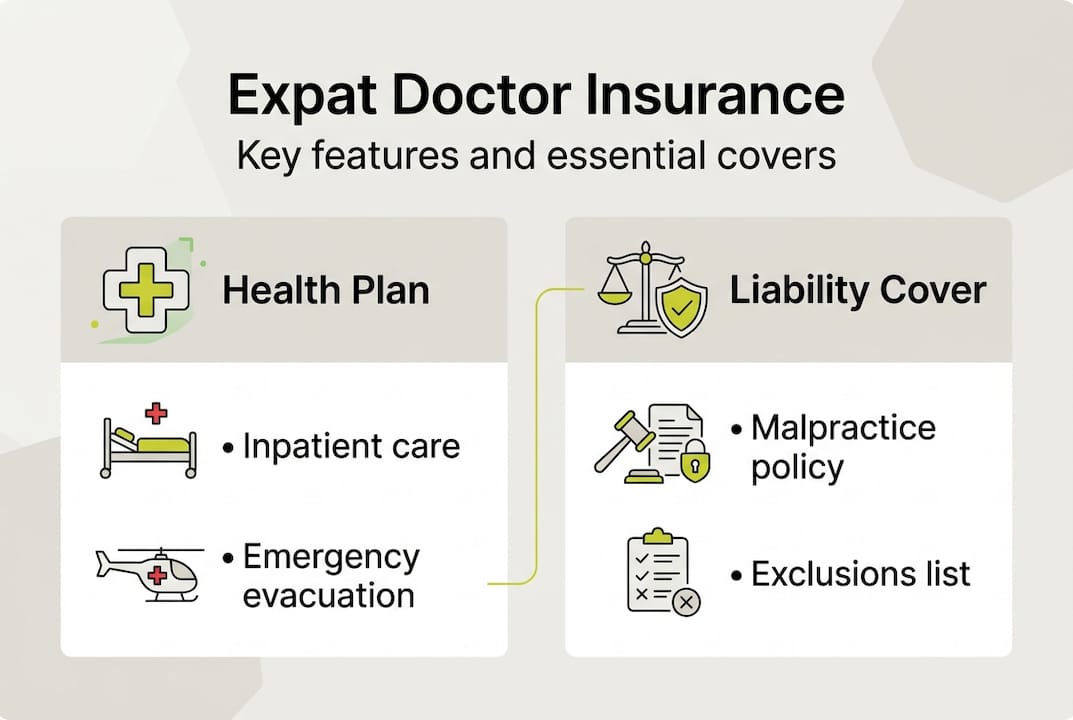
The two pillars of expat insurance for doctors are:
- International Private Medical Insurance (IPMI): This covers your personal health needs, including hospital admissions, outpatient consultations, emergency treatment, specialist referrals, and medical repatriation back to your home country.
- International medical malpractice insurance: This covers professional liability, meaning claims made against you by patients or institutions for alleged errors, negligence, or harm during the course of your medical work.
These two covers are not interchangeable. Your IPMI plan pays for your treatment as a patient. Your malpractice policy protects you when someone else claims you caused them harm. Confusing the two, or assuming one covers both, is the most common and expensive mistake expat doctors make.
A typical IPMI plan will include inpatient hospital care, day-patient procedures, emergency evacuation, outpatient consultations, and sometimes dental and vision. What it will never include is any form of professional indemnity. As noted in guidance on IPMI and liability gaps, malpractice insurance is an entirely separate and essential purchase for any doctor practising abroad.
For a solid grounding in what expat plans generally cover, reviewing expat insurance basics is a useful starting point. You should also familiarise yourself with the full range of types of expat insurance available to professionals living overseas.
Real-world mistakes happen more often than you might expect. Doctors who rely solely on a basic expat plan sometimes discover, after receiving a patient complaint, that they have no professional cover in place. The legal costs alone in many countries can reach tens of thousands of pounds before a case is even resolved.
“Assuming your health plan covers professional risk is one of the most dangerous misconceptions in expat medicine. The two covers serve entirely different purposes and must be purchased separately.”
Pro Tip: When comparing plans, always read the exclusions list first, not the benefits summary. The gaps matter more than the headline features.
With the groundwork laid, let’s now break down the exact policies and providers most relevant to expat doctors.
Key features of top international health plans for doctors
Understanding how IPMI plans actually work in practice will help you make a smarter, more confident choice. Modern plans are more flexible and digital-friendly than they were even five years ago, but the mechanics still require some explanation.
How IPMI plans work: Most top-tier plans operate on a direct billing model, meaning the insurer pays the hospital directly rather than requiring you to pay upfront and claim back. This is particularly valuable in countries where hospital costs are high and upfront payment is expected. Claims are increasingly managed through digital portals or mobile apps, which matters when you are dealing with a health issue in an unfamiliar country.
Deductibles (the amount you pay before your insurer covers costs) are a key lever for managing premiums. Choosing a higher deductible lowers your monthly premium significantly, which can make sense if you are generally healthy and want catastrophic cover rather than routine claims management.
Here is how leading providers compare for doctors in 2026:
| Provider | Annual limit | Network size | Direct billing | Digital portal | US coverage |
|---|---|---|---|---|---|
| Cigna Global | Unlimited | 1.65 million+ | Yes | Yes | Add-on |
| ACS | Up to $2 million | 2 million+ | Yes | Yes | Add-on |
| IMG | Up to $8 million | 17,000+ hospitals | Yes | Yes | Optional |
| GeoBlue | Up to $1 million | 190+ countries | Yes | Yes | Included |
As reviewed in the Cigna plan review, top providers offer $500,000 to unlimited annual cover, direct billing, networks of over two million providers, and customisable deductibles. For doctors, network size and specialist access matter enormously, since you are more likely than the average expat to seek specialist opinions and understand the difference between a quality provider and a mediocre one.

Premiums vary considerably by age, region, and plan limits. A 35-year-old doctor based in Southeast Asia might pay $150 to $250 per month for a solid IPMI plan. The same doctor in Western Europe could pay $300 to $500 per month. Adding US coverage typically increases premiums by 40 to 80 per cent.
For a deeper look at how these plans are structured, the guide on understanding IPMI is worth reading. You can also explore examples of medical covers relevant to medical professionals, and review emergency evacuation steps to understand how repatriation benefits are triggered.
Pro Tip: If you are not planning to work in or visit the United States, exclude it from your coverage zone. This single adjustment can reduce your annual premium by hundreds of pounds without affecting your day-to-day protection.
Now that you know what to look for, let’s zoom into how leading providers and plan features align for medical professionals abroad.
Essential cover beyond health: medical liability and exclusions
Knowing what comes standard in an IPMI plan is only half the picture. Knowing what is left out is where expat doctors most often get into trouble.
Professional liability is always excluded from personal health insurance. Always. There is no workaround, no rider, and no grey area. If you practise medicine abroad, even occasionally or voluntarily, you need a separate international malpractice policy. According to guidance on IPMI exclusions and liability, IPMI typically excludes pre-existing conditions, maternity waiting periods, US and Swiss coverage, and has age entry limitations, with liability always purchased separately.
Here is a summary of common exclusions and their financial impact:
| Exclusion type | Typical restriction | Financial impact |
|---|---|---|
| Pre-existing conditions | Excluded or 12-24 month moratorium | High if condition is chronic |
| Maternity | 10-12 month waiting period | Significant for planned families |
| US/Swiss coverage | Add-on only | Premiums rise 40-80% |
| Age entry limits | Many plans cap new entrants at 65-75 | Limited options at older ages |
| Professional liability | Always excluded | Potentially unlimited exposure |
Steps to ensure you are not missing critical gaps:
- Confirm your IPMI exclusions in writing before signing. Ask specifically about pre-existing conditions and maternity.
- Apply for a separate malpractice policy through a specialist international liability insurer. Review the malpractice insurance guide for guidance on what to look for.
- Check country-specific restrictions. Some plans exclude certain regions entirely, which matters if your work takes you across borders.
- Review your medical evacuation overview to confirm repatriation is included and understand how it is triggered.
- Consult a specialist broker who understands both IPMI and international liability, rather than relying on a general insurance comparison site.
One important statistic worth noting: adding US coverage to a standard international plan typically increases your premium by 40 to 80 per cent. For a 35-year-old doctor, that can mean moving from $200 to $360 per month or more, purely for US access. If you do not need it, do not pay for it.
For practical guidance on securing the right plan, the resource on getting medical insurance abroad covers the application process clearly.
Knowing what is excluded, it is now vital to address how you build the right cover from the ground up.
How to customise and secure the right cover
Once you are clear on what you need and what the gaps are, the process of selecting and applying for cover becomes far more straightforward. Here is a practical, step-by-step approach.
- Define your coverage zone. Are you based in one country or moving frequently? Plans are typically priced by zone: worldwide excluding US, worldwide excluding US and Canada, or full worldwide. Choose the zone that matches your actual movements.
- Decide on deductible level. Higher deductibles mean lower premiums. If you are healthy and want to keep costs manageable, a $500 to $2,500 annual deductible is a sensible middle ground.
- Account for family needs. If your partner or children are joining you, a family IPMI plan is usually more cost-effective than separate individual policies. Check whether dependent children are included automatically up to a certain age.
- Apply early for pre-existing condition cover. The earlier you apply, the sooner any moratorium period begins. Waiting until you need care is the worst time to discover a condition is excluded. The application steps guide explains how applying early for pre-existing moratoriums saves cost and hassle over the long term.
- Prioritise direct billing networks. When you are unwell abroad, the last thing you want is to manage paperwork and reimbursement claims. Choose a plan with a strong direct billing network in your host country.
- Secure your malpractice cover separately. Once your IPMI is in place, contact a specialist international liability insurer. Confirm that your policy covers the specific country and type of medical work you are doing.
“The doctors who fare best abroad are those who treat their insurance portfolio the same way they treat a patient workup: methodically, thoroughly, and without skipping the uncomfortable questions.”
For a clear walkthrough of the full medical insurance application process, and to review insurance basics abroad before you commit to a plan, both resources are worth bookmarking.
Pro Tip: If you are starting your expat career in your early thirties, prioritise plans with lifetime renewability. Locking in good terms young means you are protected as your health needs evolve and premiums naturally rise with age.
The overlooked truths about expat cover for doctors
Having covered the technical roadmap, here is an insider view that few guides give expat doctors.
The most common mistake we see is not choosing the wrong plan. It is choosing a plan that feels comprehensive and then assuming it covers everything. The word “comprehensive” in insurance marketing rarely means what doctors assume it means. A plan can be genuinely excellent for personal health needs and still leave you completely exposed professionally.
We have seen cases where doctors faced patient complaints abroad, only to discover their so-called all-in-one expat policy offered zero professional protection. The legal and reputational costs were significant. As clearly outlined in guidance on separate liability cover, standard policies leave costly gaps that only purpose-built liability cover can fill.
The second overlooked truth is that premium IPMI plans almost always pay for themselves. Doctors who invest in higher-tier plans with strong networks and direct billing consistently report fewer out-of-pocket surprises, faster claims resolution, and better access to quality specialists. The saving made by choosing a cheaper plan rarely justifies the risk or the friction when you actually need care.
Our advice: prioritise risk first, then reputation, then simplicity, then long-term flexibility. Read the advanced expat health cover options available and build your cover layer by layer, not all at once from a single provider.
Find your tailored expat doctor cover now
You now have a clear picture of what expat insurance for doctors actually requires: a robust IPMI plan for your personal health, and a separate malpractice policy for your professional protection. Both are non-negotiable.

At Unparalleled Global Benefits, we work with vetted international insurers who understand the specific needs of medical professionals abroad. You can compare expat insurance types side by side, explore health cover options suited to doctors, and review our top insurer choices to find the right fit for your situation. The right cover is within reach. Let us help you find it.
Frequently asked questions
Is international malpractice insurance included in expat health plans for doctors?
No, standard expat health policies do not cover malpractice. You must purchase separate international liability cover as a practising doctor abroad.
How much does expat insurance for doctors cost per month?
Premiums typically range from $150 to $600 per month for a 35-year-old, depending on the plan tier, coverage zone, and deductible chosen.
Can I get cover for pre-existing medical conditions as an expat doctor?
Pre-existing conditions are usually excluded initially or subject to a moratorium period of 12 to 24 months before they become eligible for cover.
Are US medical costs covered by international plans for doctors?
US coverage is generally excluded from standard international plans or available only as a costly add-on, raising premiums by 40 to 80 per cent.
What is the best way to get comprehensive cover as a doctor abroad?
Combine a robust IPMI plan for your personal healthcare with a tailored malpractice policy to ensure both personal and professional protection are fully in place.
Recommended
- Expat health insurance: your complete guide for 2026 – Unparalleled Global Benefits
- Types of expat insurance: protect health abroad in 2026 – Unparalleled Global Benefits
- How to Get Medical Insurance Abroad: Your Essential Guide for Expats and Travelers
- International Expat Health Insurance: Protecting Your Wellness Abroad – Unparalleled Global Benefits