

TL;DR:
- Travel accident insurance offers fixed benefits for catastrophic injuries or death during travel but does not reimburse hospital bills.
- It covers events like loss of limbs, sight, speech, or hearing, but only for permanent, qualifying losses.
- Combining it with travel medical insurance ensures full protection against both accidents and treatment costs abroad.
Travel accident insurance is defined as a policy that pays fixed, pre-set cash benefits when you suffer a catastrophic injury or die as a result of an accident during a trip. Unlike standard travel medical insurance, it does not reimburse your hospital bills. Instead, it pays a lump sum directly to you for qualifying events such as loss of limb, loss of sight, or accidental death. The industry term for this core benefit is Accidental Death and Dismemberment (AD&D) coverage. Understanding what does travel accident insurance cover before you travel abroad is the clearest way to avoid a costly and stressful surprise at the worst possible moment.
What does travel accident insurance cover?
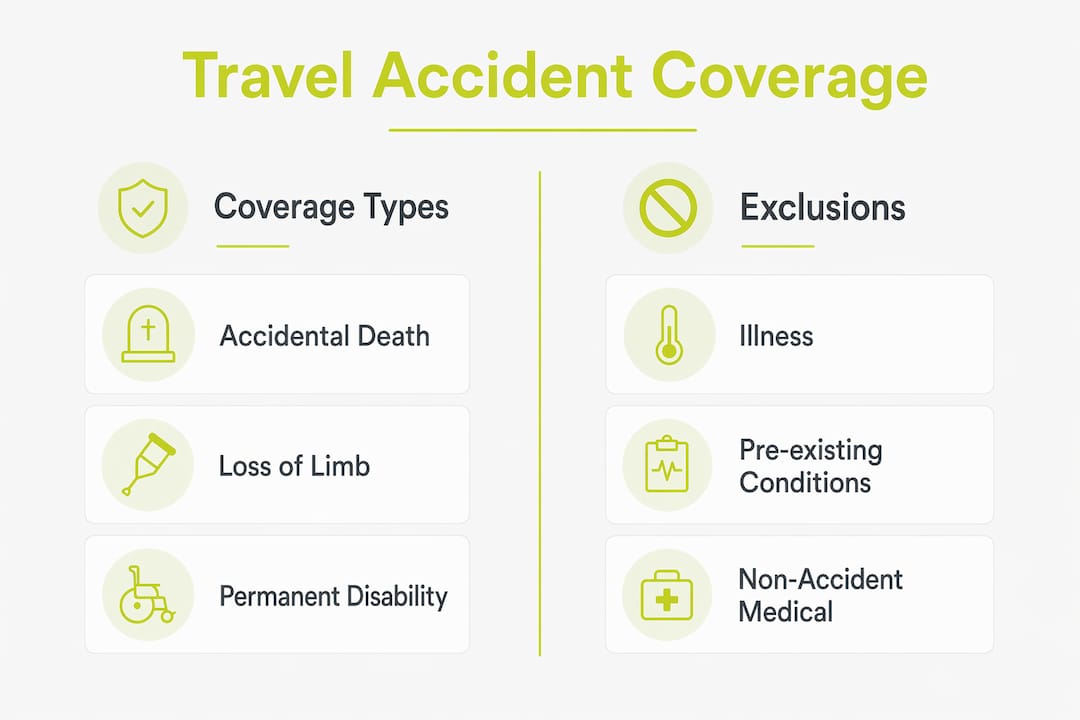
Travel accident insurance covers a defined list of catastrophic events, not the full spectrum of medical mishaps you might encounter abroad. The policy pays out when a qualifying accident results in one of the following:
- Accidental death: A lump sum paid to your named beneficiary if you die as a direct result of an accident during the trip.
- Loss of limb: A fixed benefit if you permanently lose a hand, foot, or arm as a result of an accident.
- Loss of sight: A set payment for permanent, total loss of vision in one or both eyes.
- Loss of speech or hearing: A defined benefit for permanent loss of these senses caused by an accident.
- Paralysis: Some policies extend coverage to permanent paralysis resulting from an accidental injury.
Benefits can reach £50,000 or more depending on the policy, and premium credit card policies may offer limits up to £1,000,000. That range reflects how dramatically plans vary, which is why reading the benefit schedule matters before you travel.
The payout structure is a fixed lump sum, not a reimbursement of your actual medical bills. If you break your arm in a fall, that is not a qualifying event under most travel accident policies. If that same fall results in the permanent loss of your arm, the policy pays the scheduled benefit. The distinction is stark and frequently misunderstood.

Exclusions are equally important to understand. Travel accident insurance does not cover illness, pre-existing conditions, or routine medical treatment abroad. It does not pay for your emergency room visit, your prescription costs, or your physiotherapy sessions. Those costs fall under travel medical insurance, which is a separate product with a different purpose.
What is the difference between common carrier and 24-hour coverage?
Two distinct types of travel accident insurance exist, and confusing them leads to real gaps in protection.
Common carrier coverage applies only when you are travelling on a licensed, scheduled form of transport. Airlines, cruise ships, trains, and coaches all qualify. If you suffer a covered accident while on board one of these vehicles, the policy pays. The moment you step off the plane and into a taxi, common carrier coverage typically stops.
24-hour travel accident coverage applies throughout the entire trip period, not just during transit. You are covered whether you are on a flight, walking to your hotel, or on a guided tour. The trade-off is that 24-hour policies often carry lower maximum benefit limits than common carrier policies.
| Feature | Common carrier coverage | 24-hour coverage |
|---|---|---|
| When it applies | During licensed transport only | Throughout the entire trip |
| Typical benefit limits | Higher (up to £1,000,000 on some cards) | Lower maximum payouts |
| Coverage trigger | Boarding a scheduled carrier | Any qualifying accident during the trip |
| Ground transport | Usually excluded | Included |
| Best suited for | Frequent flyers with card benefits | Travellers wanting broader trip protection |
Policy language around “common carrier” can be surprisingly narrow. Some definitions exclude transit to and from the terminal, meaning a taxi accident on the way to the airport falls outside coverage. Always check whether ground transport to the departure point is included.
Pro Tip: If your travel accident cover comes from a credit card, confirm whether it is common carrier only. Many cards restrict coverage to the time you are physically on board the transport you paid for with that card.
How does travel accident insurance differ from travel medical insurance?
This is the most common source of confusion among international travellers, and the distinction is worth spelling out clearly.
Travel accident insurance pays fixed cash benefits for defined events, independent of what your actual medical treatment costs. Travel medical insurance pays for the treatment itself, reimbursing or directly settling your hospital bills, specialist fees, and emergency care costs abroad.
Here is how the two products behave differently in practice:
- Travel accident insurance: You lose a finger in a machinery accident. The policy pays a scheduled benefit, say £10,000, directly to you. That money is yours to use however you choose, including covering lost income during recovery.
- Travel medical insurance: You break your leg skiing. The policy pays the hospital, the surgeon, and the rehabilitation clinic. You receive treatment; the insurer settles the bill.
Benefits are paid directly to the insured, not to healthcare providers. This gives you financial flexibility during recovery that a standard medical policy does not. You can use the cash to cover lost earnings, adapt your home, or manage living costs while you are unable to work.
The two products are complementary, not interchangeable. A comprehensive travel insurance plan bundles both, along with medical evacuation and trip cancellation benefits. Relying on travel accident cover alone leaves you exposed to the full cost of medical treatment abroad, which can run to tens of thousands of pounds in countries without reciprocal healthcare agreements.
Pro Tip: Check whether your existing employer health insurance covers you abroad before you travel. If it does not, travel medical insurance is not optional. Travel accident cover is an addition, not a substitute.
What practical steps should travellers take to maximise their protection?
Knowing what travel accident insurance covers is only half the task. Applying that knowledge to your own trip requires a few deliberate steps.
-
Review your existing disability and life insurance first. Travellers should check existing disability cover before relying on travel accident benefits, as overlapping claims can create complications. Your primary disability policy may already pay out for loss of limb or permanent injury, which affects how you structure additional cover.
-
Read the benefit schedule carefully. Not all injuries yield the same payout. A policy’s benefit schedule sets out exactly how much each qualifying event pays. Losing one hand may pay 50% of the principal sum; losing both hands may pay 100%. Catastrophic losses trigger the highest sums, but the thresholds are precise.
-
Consider a bundled travel insurance plan. Typical trip insurance costs 4%–10% of your trip cost, with AD&D coverage included at no separate charge within many comprehensive plans. Buying a bundled policy is usually more cost-effective than purchasing accident, medical, and medical evacuation cover separately.
-
Do not rely solely on credit card travel accident insurance. Credit card travel accident benefits often require you to purchase your tickets with that specific card, apply only to common carrier accidents, and carry coverage triggers that many travellers never check. These policies are a supplement, not a foundation.
-
Understand the cash benefit advantage. The fact that accident insurance pays cash directly to you matters beyond healthcare. If a serious injury keeps you off work for three months, your medical bills may be covered by a separate policy, but your mortgage, rent, and daily expenses are not. The lump sum from a travel accident policy fills that gap.
Key takeaways
Travel accident insurance pays fixed lump-sum benefits for defined catastrophic events during a trip, and it does not cover medical treatment costs, which require a separate travel medical insurance policy.
| Point | Details |
|---|---|
| Fixed cash benefits | Payouts are pre-set lump sums for qualifying events, not reimbursements of medical bills. |
| Covered events | Accidental death, loss of limb, loss of sight, and loss of speech or hearing are the core covered losses. |
| Common carrier vs 24-hour | Common carrier cover applies only on licensed transport; 24-hour cover applies throughout the trip but often at lower limits. |
| Complement, not substitute | Travel accident insurance works alongside travel medical insurance; neither product replaces the other. |
| Credit card gaps | Card-based accident cover is usually restricted to common carrier events and requires ticket purchase with that card. |
Why travellers consistently underestimate this cover
I have spent years reviewing international insurance claims and speaking with travellers who were caught off guard. The pattern is almost always the same. Someone assumes their travel accident policy will pay their hospital bills, files a claim, and discovers the policy only covers catastrophic, permanent losses. The frustration is real, and it is entirely avoidable.
The confusion between travel accident and travel medical insurance is not a sign of carelessness. The products are marketed in similar language, often bundled together, and rarely explained side by side. Travel accident insurance is a niche product that most consumers encounter only as a line item in a broader policy, never as a standalone purchase they actively chose.
What I find most undervalued is the cash payout structure. Travellers focus on medical costs because those feel immediate and tangible. But a serious accident abroad can mean months off work, home adaptations, and family disruption that no hospital bill captures. Accident insurance benefits provide liquidity to manage that wider financial impact, and that is genuinely useful.
My strongest advice is this: treat travel accident cover as one layer in a stack, not the whole structure. Pair it with solid travel medical insurance, check your existing disability policy for overlaps, and read the benefit schedule before you travel, not after something goes wrong.
— Coert
Planning your travel insurance with Unparalleledglobalbenefits
Sorting out the right mix of travel accident and medical cover does not need to be complicated. Unparalleledglobalbenefits specialises in international insurance solutions for travellers, expats, and visiting family members, offering plans that bundle AD&D benefits, medical cover, and evacuation protection in one place. Whether you need a single-trip policy or longer-term cover, the team can match you with a plan that fits your destination, budget, and risk profile. Start with the international health insurance guide to understand your full options.

Planning a trip for yourself, a resident, or visiting family? UGB + Ekta can arrange travel insurance for seniors up to 100 years old. Just click here: senior travel insurance and add the promo code “UGB” to receive an additional 10% discount.
For a broader look at how travel insurance protects you from departure to return, watch this short overview:
https://youtu.be/bjzvma7Sh1g
FAQ
What does travel accident insurance cover?
Travel accident insurance covers fixed lump-sum payments for catastrophic events such as accidental death, loss of limb, loss of sight, and loss of speech or hearing. It does not cover medical treatment costs or general injuries that do not result in permanent loss.
Does travel insurance cover accidents abroad?
Comprehensive travel insurance plans typically include an AD&D component that covers qualifying accidents abroad. However, the accident benefit pays a fixed cash sum for defined losses, while a separate medical benefit covers treatment costs.
What is the difference between common carrier and 24-hour accident cover?
Common carrier cover applies only when you are on a licensed scheduled transport such as a flight or cruise. 24-hour cover applies throughout the entire trip period but usually carries lower maximum benefit limits.
Can I use travel accident insurance to pay my hospital bills?
No. Travel accident insurance pays cash directly to you for qualifying permanent losses, not to hospitals or medical providers. You need travel medical insurance to cover actual treatment costs abroad.
Is travel accident insurance included in credit card travel benefits?
Some credit cards include travel accident insurance, but coverage is usually restricted to common carrier accidents and requires you to have purchased the ticket with that card. These benefits are a supplement to, not a replacement for, a dedicated travel insurance policy.