

TL;DR:
- Multi-trip travel insurance is an annual policy allowing unlimited trips within a year, each limited by a set duration. If trips exceed the cap, coverage ends, and travelers must buy separate policies for longer stays. It is most cost-effective for those taking multiple trips annually with shorter durations.
Multi-trip travel insurance is defined as a single annual policy that covers an unlimited number of trips within a 12-month period, as long as each individual trip stays within a set duration limit. Also known as annual travel insurance, it replaces the need to buy separate cover every time you board a plane. Policies from providers such as AA Ireland and those compared on platforms like InsureMyTrip typically cap each trip at 30, 45, or 60 days. The policy covers core risks including emergency medical expenses, medical evacuation, trip cancellation, and baggage protection. For frequent travellers, it is often the most practical and cost-effective way to stay protected year-round.
How does multi trip travel insurance work for unlimited trips?
Multi-trip travel insurance operates on a simple principle: one policy, one annual premium, unlimited departures. You purchase the policy once, and every trip you take during the 12-month validity period falls under that same cover, provided each journey does not exceed the policy’s per-trip duration cap.
Most policies restrict individual trip length to 30, 45, or 60 days. That means you could take 15 separate trips in a year, and each one is covered, as long as none of them runs longer than your chosen limit. If you regularly travel for short breaks, business trips, or weekend city breaks, this structure suits you perfectly.
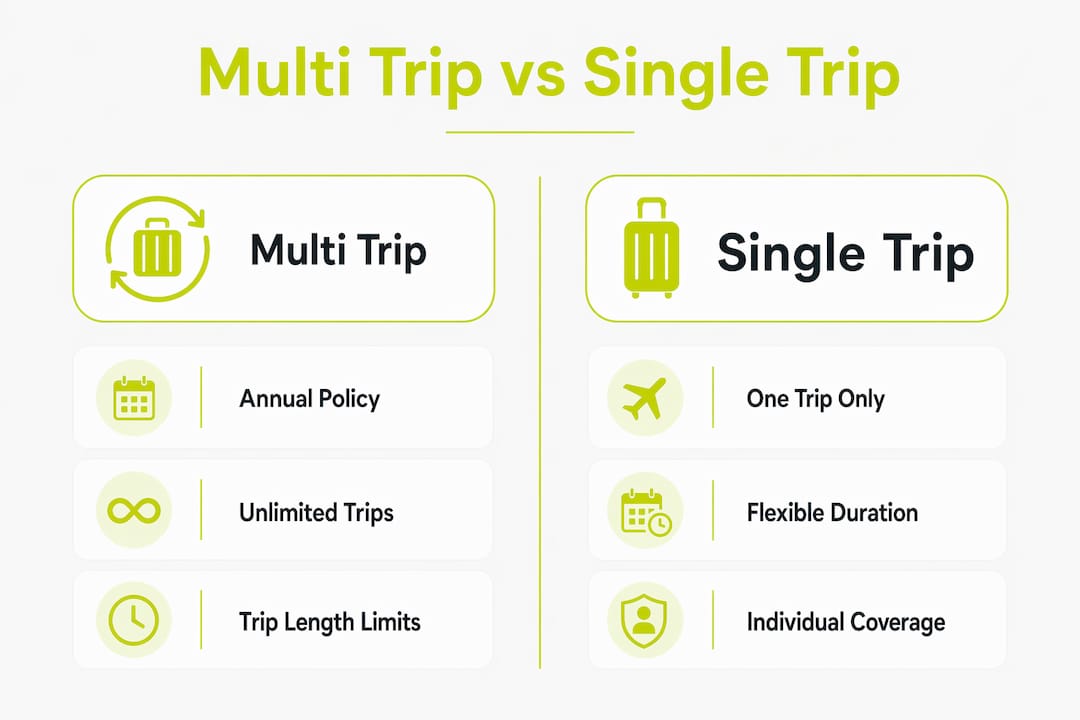
What happens if your trip exceeds the duration limit? Your cover simply stops at the cap date. You are effectively uninsured for the remainder of that journey. Travellers planning a 90-day sabbatical or an extended family visit abroad should purchase a single-trip policy instead, as annual policies provide no coverage beyond their set limits.
Here is what the typical structure looks like in practice:
- Policy period: 12 months from the purchase date
- Number of trips: Unlimited departures within that year
- Per-trip duration cap: Usually 30, 45, or 60 days per trip
- Renewal: You purchase a new annual policy when the 12 months expire
- Activation: Cover begins automatically each time you leave your home country
Pro Tip: Choose the longest trip duration cap your budget allows. Even if most of your trips are short, having a 60-day cap gives you flexibility for that one longer trip without needing a separate policy.
What does multi trip coverage include, and how does it compare to single-trip?
Annual travel insurance emphasises emergency medical care and evacuation above all else. These policies often cover emergency medical treatment up to multi-million euro limits, which is the most critical protection for any international traveller.

Where multi-trip plans differ from single-trip policies is in the breadth of secondary benefits. Single-trip policies typically include broader benefits that reset on each journey, covering trip cancellation, baggage loss, and rental car excess with higher flexibility and limits. Multi-trip plans may treat these as optional add-ons rather than standard inclusions.
| Coverage feature | Multi-trip (annual) | Single-trip |
|---|---|---|
| Emergency medical | High limits, standard | High limits, standard |
| Medical evacuation | Standard inclusion | Standard inclusion |
| Trip cancellation | Often limited or add-on | Usually standard |
| Baggage protection | Often limited | Usually standard |
| Rental car excess | Often optional | Often included |
| Adventure sports | Add-on available | Add-on available |
| Number of trips | Unlimited within year | One trip only |
Multi-trip plans can be customised with add-ons for winter sports, business equipment, wedding cover, golf, car hire insurance, and travel disruption. This flexibility means you can build a policy that matches your actual travel habits rather than paying for cover you never use.
The cost comparison is straightforward. Multi-trip insurance generally offers savings for travellers taking three or more trips per year. Buying three or four single-trip policies in a year often costs more than a single annual premium, and the administration alone is worth avoiding.
Pro Tip: If you ski once a year and travel for business three times, add the winter sports rider and business equipment cover to your annual policy. You pay once and both activities are covered across all trips.
How to choose the right multi trip insurance plan for your travel habits
Selecting the right annual policy comes down to four practical considerations: how often you travel, how long your trips typically run, where you go, and what activities you do.
-
Count your trips honestly. If you take three or more international trips per year, annual cover eliminates repeated administration and usually costs less than buying individual policies. Two trips or fewer, and a single-trip policy may be the better value.
-
Match the duration cap to your longest trip. Review your travel history. If your longest trip last year was 28 days, a 30-day cap covers you. If you occasionally take five-week trips, choose a 45-day cap. Never assume the cheapest option covers your actual travel pattern.
-
Assess your destinations. Travel to the United States, Canada, or Australia carries significantly higher medical costs than travel within Europe. Confirm your policy covers your specific destinations and that medical limits are high enough for those regions.
-
Identify your activities. Standard annual policies exclude adventure sports such as skiing, scuba diving, or mountain trekking. If your trips include any of these, add the relevant rider at purchase. Trying to add cover after an incident is not possible.
-
Evaluate the insurer’s claims process. A policy is only as good as the insurer behind it. Check independent reviews, confirm there is a 24-hour emergency assistance line, and understand the claims submission process before you need it. Platforms like InsureMyTrip allow side-by-side comparisons of insurer ratings alongside policy features.
-
Check pre-existing condition rules. Every insurer handles pre-existing medical conditions differently. Some exclude them entirely; others cover stable conditions with a declaration. Read this section of the policy carefully before purchasing.
Common pitfalls to avoid with multi trip travel insurance
The most costly mistake travellers make is assuming their annual policy covers any trip of any length. Most travellers mistakenly believe annual policies cover any trip duration within the year. The per-trip cap is a hard limit, not a guideline.
Watch out for these specific pitfalls:
- Exceeding the trip duration cap: If your policy caps trips at 30 days and you stay 35 days, you have no cover for the final five days. This applies to medical emergencies, not just cancellations.
- Assuming trip cancellation is included: Multi-trip policies may not include trip cancellation as standard. Check the policy schedule, not just the marketing summary.
- Ignoring the difference in coverage limits: Single-trip policies reset coverage limits on every journey, which matters for expensive or high-risk travel. Annual plans may apply cumulative limits across all trips.
- Overlooking exclusions for specific countries: Some annual policies exclude travel to regions under government travel advisories. Check your destination against the policy’s exclusion list before booking.
- Failing to declare pre-existing conditions: Non-disclosure can void your entire policy, not just the claim related to the condition.
“Choosing between multi-trip and single-trip insurance depends on whether you prioritise always-on coverage for spontaneous travel or comprehensive protection for a specific trip.” — InsureMyTrip
When is a single-trip policy the better choice? When your trip exceeds 60 days, when you need maximum cancellation cover for an expensive holiday, or when you are travelling to a high-risk destination that requires bespoke cover. You can read more about single-trip cover options to compare directly.
Key takeaways
Multi-trip travel insurance covers unlimited trips within 12 months under one policy, but the per-trip duration cap is the single most important detail to verify before you buy.
| Point | Details |
|---|---|
| Annual policy structure | One premium covers unlimited trips within 12 months, with no need to repurchase for each journey. |
| Per-trip duration cap | Most policies limit each trip to 30, 45, or 60 days; exceeding this leaves you uninsured. |
| Medical cover is the priority | Emergency medical and evacuation are the strongest features; trip cancellation often requires an add-on. |
| Add-ons are worth considering | Riders for winter sports, business equipment, and car hire tailor the base policy to your actual travel. |
| Three or more trips per year | Annual cover typically saves money and administration compared to buying multiple single-trip policies. |
Why I think most travellers underestimate the duration cap risk
After years of advising frequent travellers on international insurance, the single issue I see cause the most problems is not the price of the policy. It is the trip duration cap, and specifically the gap between what travellers assume and what the policy actually says.
I have spoken with travellers who booked a seven-week trip to Southeast Asia, confident their annual policy had them covered. It did not. Their cap was 45 days. The final two weeks of that trip were entirely uninsured, and they only discovered this when they tried to make a claim for a hospital visit in Thailand.
The fix is simple but requires discipline. Read the policy schedule, not the product brochure. The brochure tells you what the policy can cover. The schedule tells you what your specific policy actually covers. These are not always the same document.
I also think travellers underestimate the value of customising with add-ons at the point of purchase. A winter sports rider added at the start of the year costs a fraction of what a separate ski trip policy would cost. The same applies to business equipment cover for professionals who travel with laptops and specialist gear.
The market has also shifted since 2020. More insurers now offer Covid-19 related cancellation cover as standard or as an affordable add-on. If pandemic-related disruption is a concern for you, confirm this is explicitly included before you commit. Do not assume it is there because the world has changed.
— Coert
Multi trip insurance solutions for frequent international travellers
Frequent travellers need cover that keeps pace with their schedule, not one that requires a new purchase every time they book a flight. Unparalleledglobalbenefits specialises in international insurance solutions for travellers, expats, and professionals who spend significant time abroad.

Whether you need a flexible annual policy with international health cover or a plan with add-ons tailored to your destinations and activities, Unparalleledglobalbenefits can help you find the right fit. The team works with a range of insurers to match your travel frequency, trip lengths, and risk profile to a policy that actually covers what you need.
Planning a trip for yourself, a resident, or visiting family? UGB + Ekta can arrange travel insurance for seniors up to 100 years old. Just click here: https://ektatraveling.com/?partner_uid=808 and add the promo code UGB to receive an additional 10% discount.
For a broader view of your international cover options, the expat insurance guide on the Unparalleledglobalbenefits website is a practical starting point.
Want a quick visual overview of how travel insurance works? Watch this short guide:
https://youtu.be/bjzvma7Sh1g
FAQ
What is multi trip travel insurance?
Multi-trip travel insurance is an annual policy that covers unlimited trips within a 12-month period. Each trip must stay within the policy’s per-trip duration limit, typically 30, 45, or 60 days.
How many trips can I take on a multi trip policy?
There is no limit on the number of trips you can take within the policy year. The only restriction is that each individual trip must not exceed the duration cap stated in your policy schedule.
Is multi trip travel insurance worth it?
Multi-trip cover is worth it if you take three or more international trips per year. It saves money compared to buying multiple single-trip policies and removes the need to arrange new cover before every departure.
Does multi trip insurance cover trip cancellation?
Trip cancellation is not always included as standard in annual policies. Check your policy schedule carefully, as this benefit may require an add-on or a separate policy depending on your insurer.
What happens if my trip exceeds the duration limit?
Your cover ends at the duration cap. Any medical emergency, loss, or incident occurring after that date is not covered. If you plan a trip longer than your cap allows, purchase a separate single-trip policy for that journey.
Recommended
- How does multi trip insurance work in 2026 – Unparalleled Global Benefits
- Family multi trip travel insurance: your 2026 guide – Unparalleled Global Benefits
- Single Trip Medical Travel Insurance Explained: Global Impact – Unparalleled Global Benefits
- Single Trip Insurance: Essential Cover for Expats Abroad – Unparalleled Global Benefits