

TL;DR:
- Travel insurance offers short-term emergency coverage suitable for trips up to about 90 days, but it does not include routine or ongoing healthcare needs.
- Expat insurance provides comprehensive, long-term health protection for residents abroad, covering chronic conditions, routine care, and family health needs.
Every year, thousands of people move or travel abroad with travel insurance in their bags, only to discover mid-stay that their policy simply does not cover what they need. The assumption that all international insurance works the same way is one of the most costly mistakes you can make. Whether you are relocating for work, studying overseas, or planning an extended gap year, the type of cover you carry can mean the difference between receiving full medical care and facing bills that run into tens of thousands of pounds. This article breaks down exactly what each product covers, where each falls short, and how to make the right choice for your circumstances.
Table of Contents
- What is travel insurance, and when is it suitable?
- What is expat insurance, and who needs it?
- Key differences between expat and travel insurance
- Which coverage is right for your circumstances?
- The reality most people miss about international insurance
- Next steps: secure the cover you need for life abroad
- Frequently asked questions
Key Takeaways
| Point | Details |
|---|---|
| Expat vs travel insurance | Travel insurance is for short-term trips; expat insurance is for long-term stays with ongoing healthcare needs. |
| Coverage differences | Travel policies often exclude ongoing or routine care, while expat insurance covers chronic and preventive treatment. |
| Choosing the right cover | Assess your residency status, trip length, and healthcare needs to pick the right insurance for your circumstances. |
| Avoiding common mistakes | Choosing the wrong policy can leave expats and travellers exposed to expensive medical bills overseas. |
What is travel insurance, and when is it suitable?
Travel insurance is a short-term safety net designed to protect you during a defined period away from home. Travel insurance is designed for short-term trips and emergencies during travel, not for ongoing healthcare management. It handles unexpected disruptions: a sudden illness, a cancelled flight, lost baggage, or a medical emergency that requires hospital admission.
The core features of a standard travel insurance policy typically include:
- Emergency medical treatment for sudden illness or injury
- Medical evacuation to return you home or to a suitable hospital
- Trip cancellation or interruption cover if you cannot travel as planned
- Lost, stolen, or delayed baggage compensation
- Personal liability protection in case of accidental injury to others
- 24-hour emergency assistance helpline access
These features work well for what they are designed to do. A two-week holiday in Spain, a business trip to New York, or a short cultural tour through Southeast Asia are all situations where travel insurance gives you exactly the right level of protection. You pay a relatively low premium for a policy that covers emergencies and inconveniences, and you return home before the policy’s limitations become relevant.
However, the limitations appear quickly when your stay extends beyond a few weeks. For essential travel insurance protection to remain valid, most policies require you to remain in your home country between trips or adhere to a strict maximum number of consecutive days abroad. Policies frequently cap coverage at 30, 60, or occasionally 90 days per trip.
“Travel insurance covers emergencies. It is not designed to replace your healthcare system while you are living abroad.”
Routine check-ups, chronic condition management, dental care, and maternity services fall entirely outside the scope of a standard travel policy. If you develop a condition like high blood pressure during your trip, it may be treated as an emergency once, but any follow-up care or prescription management would not be covered.
Pro Tip: Emergency evacuation is a key feature of travel insurance, but it is typically designed to transport you back home for follow-up care. If you plan to remain abroad for an extended period, this evacuation coverage offers little practical value for your ongoing health needs.
The travel health insurance guide explains this distinction well: the product is genuinely excellent for its intended purpose, but using it as a substitute for resident healthcare cover is a risk that regularly leads to significant financial hardship.
What is expat insurance, and who needs it?
Expat insurance is purpose-built for individuals who have relocated abroad, whether for months or years. Expat insurance provides comprehensive cover for those living or working abroad, including ongoing health needs that travel policies simply do not address.

This type of policy recognises that your healthcare needs do not pause because you are living in another country. Routine appointments, annual health screenings, dental check-ups, specialist referrals, and maternity care are all part of normal life. Expat insurance is structured to function as a full replacement for your home country’s healthcare provision.
Key features commonly included in expat insurance plans:
- Comprehensive inpatient and outpatient care in your country of residence
- Chronic condition management, including prescriptions and specialist visits
- Routine preventive care, such as vaccinations, screenings, and annual physical examinations
- Maternity and newborn cover, often including prenatal visits and delivery costs
- Dental and vision care (depending on the plan tier selected)
- Mental health support, which has become increasingly standard
- Repatriation assistance in serious illness or death
- Cover both abroad and in your home country during visits home
This breadth of cover reflects the reality of living abroad. You are not a tourist. You are a resident, and your insurance should treat you as one. The various expat insurance types available today range from essential plans for healthy young professionals to premium options for families requiring full maternity and paediatric cover.
A significant concern in the expat community is underinsurance. Studies consistently show that a notable proportion of expats rely on travel insurance or their home country’s state health system for extended foreign stays, both of which leave enormous gaps in protection. For instance, families with young children who require regular paediatric care, or professionals managing conditions like diabetes or asthma, face real risks if they attempt to stretch a travel policy across a multi-year assignment.
Pro Tip: Many expat insurance policies are structured so that you can receive care both in your country of residence and in your home country when you visit. This is particularly valuable for families split across borders or for expats who return home regularly.
It is also worth noting that quality dental care for expat families is frequently a deciding factor when choosing between policy tiers, as dental costs in many countries can escalate quickly without adequate cover.
Key differences between expat and travel insurance
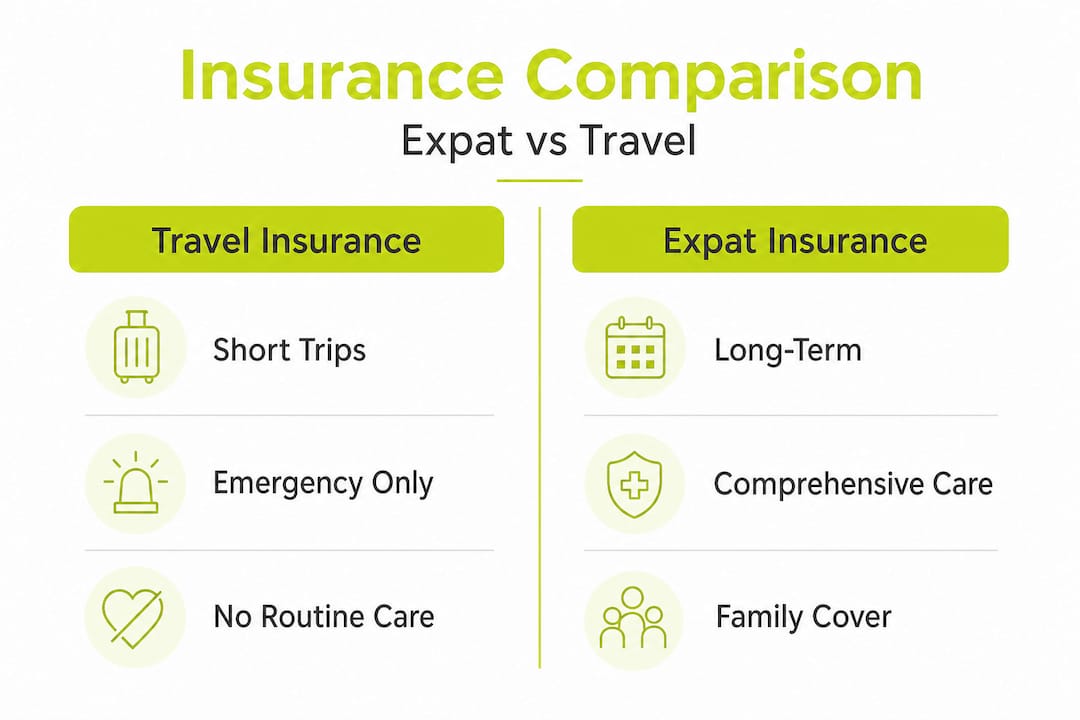
With the basics covered, it is time for a direct, practical comparison. The table below summarises how these two products differ across the most important dimensions.
| Feature | Travel insurance | Expat insurance |
|---|---|---|
| Cover duration | Short-term, typically up to 90 days per trip | Long-term, often annual or multi-year |
| Routine healthcare | Not included | Fully included |
| Chronic conditions | Excluded or severely limited | Covered as standard |
| Maternity care | Not included | Included in most plans |
| Dental and vision | Emergency only | Optional or included |
| Mental health support | Rarely included | Increasingly standard |
| Country of residence care | Not designed for this purpose | Primary function |
| Home country visits | Yes, usually covered | Yes, often included |
| Visa compliance | May not satisfy residency requirements | Often meets visa requirements |
| Cost | Lower premium | Higher premium, reflecting wider cover |
Travel insurance policies typically exclude ongoing medical conditions and routine care, which is the central limitation for anyone staying abroad beyond a short visit. This exclusion is not a flaw in the product; it is simply not what it was designed for.
When thinking about choosing the right cover, the following situations clarify which policy is appropriate:
Travel insurance is suitable when you are:
- Taking a holiday of two to four weeks
- On a short business trip or attending a conference
- Visiting family abroad for a defined period
- Travelling between multiple destinations in a short timeframe
Expat insurance is the right choice when you are:
- Relocating for work on an assignment of six months or longer
- Studying abroad for a full academic year or more
- Moving internationally with your family
- Managing any ongoing medical condition that requires regular treatment
Understanding travel medical benefits for expats also shows that some expat plans include a travel component, so you are not forced to choose between the two in every scenario. These expat insurance tips are especially useful when evaluating combined plans.
Which coverage is right for your circumstances?
Now, here is how you can apply this knowledge to your own situation. Choosing the right policy depends on trip length, residency status, and planned activities. Use the following decision framework to guide your choice.
Step 1: Determine your residency status. Are you a visitor, or will you be establishing residency abroad? Visitors need travel insurance. Residents need expat insurance.
Step 2: Assess your trip length. If your stay is under 90 days with no plans to extend, travel insurance is likely sufficient. For stays longer than three months, expat insurance is the appropriate product.
Step 3: Evaluate your healthcare needs. Do you have a chronic condition, take regular medication, or expect to need specialist care? If so, expat insurance is essential regardless of trip length.
Step 4: Check your visa requirements. Many countries require applicants to hold a valid health insurance policy meeting specific coverage thresholds. Some visa categories explicitly require expat-grade cover rather than a basic travel policy.
Step 5: Consider your family situation. Travelling alone for a short trip is one thing. Relocating with a partner, children, or elderly dependants changes the equation significantly. Family-grade expat insurance offers consolidated cover that protects everyone under a single plan.
| Scenario | Recommended cover |
|---|---|
| Two-week holiday | Travel insurance |
| Gap year student (12 months) | Expat insurance |
| Digital nomad (6+ months per year) | Expat insurance with travel component |
| Corporate international assignment | Expat insurance, employer-arranged or personal |
| Short-term business trip (under 30 days) | Travel insurance |
| Family relocation overseas | Full expat family plan |
For those seeking best healthcare access for expats, understanding local healthcare infrastructure is equally important. Some countries have strong public health systems that expats can access; others require entirely private cover. The difference between health vs travel insurance becomes especially clear in countries where public healthcare is unavailable to foreign residents.
Pro Tip: Always verify your visa requirements before purchasing any insurance product. Many applicants for long-stay visas in countries such as Portugal, Spain, and Mexico are required to show proof of health cover that meets specific financial minimums per year. Travel insurance often falls short of these thresholds.
For a full overview of what insurance for living abroad entails, including lesser-known add-ons like liability cover and life insurance, it is worth taking time to research the full picture before finalising any policy. Specialist clinics offering medical care for travel patients are another resource worth knowing about for specific healthcare needs during international stays.
The reality most people miss about international insurance
Here is an honest assessment that most generic guides overlook. Many expats and long-term travellers do not get the wrong insurance because they fail to research. They get it wrong because they focus on the wrong question. They ask, “What is the cheapest option?” instead of asking, “What cover do I actually need if something goes seriously wrong?”
This distinction matters enormously. A denied claim abroad is not like a denied claim at home, where you have recourse, access to legal support, and a familiar healthcare system as a backup. Abroad, a denied claim can mean paying out of pocket for hospitalisation that runs into tens of thousands of euros, pounds, or dollars. We have seen this pattern repeatedly: someone chooses a travel policy because it costs a fraction of an expat plan, and the saving evaporates the moment they need care that the policy excludes.
The second reality is that why international medical insurance matters goes beyond emergency care. Mental health, dental health, and preventive screening are the areas where expats most commonly experience unpleasant surprises. These are not exotic add-ons. They are standard parts of a healthy lifestyle, and ignoring them in your insurance planning creates cumulative financial exposure over a multi-year stay.
Our advice is simple. Ask yourself three honest questions before buying any international insurance product: How long will I genuinely be abroad? Do I have any health conditions that require regular management? And what would happen to my finances if I needed hospitalisation or specialist care without insurance backing me? The answers will point you towards the right product far more reliably than price comparison alone.
Next steps: secure the cover you need for life abroad
Ready to move from understanding to action? The right insurance policy is not a luxury; it is the foundation of a secure life or experience abroad.
At Unparalleled Global Benefits, we specialise in helping individuals, families, and professionals find cover that genuinely matches their circumstances. Whether you need to review the full scope of international expat health insurance, explore the different types of expat insurance available for your situation, or clarify exactly how travel insurance works as a short-term tool, our team is here to guide you. Get in touch today to request a personalised quote and discover the cover that gives you genuine peace of mind wherever life takes you.
Frequently asked questions
Can I use travel insurance if I plan to stay abroad for over a year?
Travel insurance is designed for short-term trips and may not cover stays exceeding 90 days, making expat insurance the more appropriate and reliable choice for year-long stays.
What does expat insurance cover that travel insurance does not?
Expat insurance provides comprehensive cover for ongoing healthcare needs, including chronic condition management, routine check-ups, maternity care, and family health services that fall entirely outside a standard travel policy’s scope.
Are pre-existing conditions covered by travel insurance?
Travel insurance policies typically exclude ongoing medical conditions and routine care, meaning pre-existing conditions are generally not covered unless a specific and often costly add-on is purchased.
Do I need different insurance if I am studying abroad?
If you are studying abroad for a full academic year or longer, expat insurance is strongly recommended, as comprehensive cover for those living abroad includes the routine and specialist care that student life frequently requires.
Will my home country’s health insurance work overseas?
Most domestic health insurance plans do not extend cover to foreign medical care, particularly for extended stays, leaving you exposed to significant out-of-pocket costs in a country where your plan holds no agreements with local providers.
Recommended
- Travel vs expat insurance: choose the right cover abroad – Unparalleled Global Benefits
- Expat insurance for students: make the right choice abroad – Unparalleled Global Benefits
- Selecting The Right “Expat Insurance Provider”
- Types of expatriate insurance: smart cover choices abroad – Unparalleled Global Benefits