

TL;DR:
- Expat insurance policies often exclude pre-existing conditions, hazardous activities, and elective procedures, which can lead to denied claims.
- Understanding and verifying these exclusions through policy documents and direct insurer clarification is crucial to avoid unexpected costs.
- Optional add-ons may cover some excluded services, but thorough review and comparison of plans are essential for tailored, reliable coverage.
Moving abroad brings genuine excitement, but it also comes with a responsibility many expats overlook: understanding exactly what their insurance will and will not pay for. A surprising number of international residents purchase a policy, assume they are protected, and only discover the gaps when a claim is denied. Exclusions are the specific situations, conditions, and treatments that your insurer will not cover, and they vary enormously between providers and plan types. Knowing them in advance is not just good practice; it is the difference between financial security and a potentially devastating medical bill overseas.
Table of Contents
- Understanding expat insurance exclusions: Why they matter
- Common exclusions in expat insurance policies
- Spotlight on pre-existing conditions and chronic illnesses
- Optional add-ons: When exclusions become choices
- Danger zones: Hazardous activities, experimental and alternative treatments
- What most expats miss about exclusions: A practical view
- Compare your options for better coverage
- Frequently asked questions
Key Takeaways
| Point | Details |
|---|---|
| Pre-existing exclusions dominate | Most expat insurance excludes or limits pre-existing and chronic conditions unless specifically declared. |
| Optional add-ons fill gaps | Dental, vision, and maternity cover are typically excluded but can sometimes be added for an extra fee. |
| Risky activities not insured | Engaging in extreme sports or hazardous pursuits usually voids eligibility for related claims. |
| Policy wording is crucial | Carefully reading the full policy helps avoid surprises and costly claim denials abroad. |
| Customise for your needs | Comparing plans and customising add-ons ensures your insurance suits your unique expat lifestyle. |
Understanding expat insurance exclusions: Why they matter
An exclusion, in insurance terms, is any situation, condition, or type of treatment that a policy explicitly does not cover. Insurers include exclusions for two main reasons: to manage financial risk and to keep premiums at a level that makes policies commercially viable. Without them, the cost of comprehensive cover would be prohibitive for most people.
The practical consequence for you, as an expat or international traveller, is significant. If a condition or situation falls under an exclusion, your insurer can lawfully decline your claim, regardless of how urgent the medical need is. Many policyholders only discover this reality at the worst possible moment, mid-treatment in a foreign country with no local support network.
It is worth noting that exclusions vary considerably by provider and underwriting approach. Insurers using full medical underwriting assess your health history in detail before issuing a policy, while moratorium-based underwriting automatically excludes pre-existing conditions for a set period without requiring upfront disclosure. The essential expat insurance tips you act on now could prevent a denied claim later.
Common categories of exclusions across most expat policies include:
- Pre-existing medical conditions
- Substance abuse and alcohol-related treatments
- Cosmetic and elective surgery
- Hazardous or extreme sports
- Routine dental and vision care
- Fertility treatments
- Experimental or unproven therapies
“Always declare your medical conditions when applying for cover. Failing to disclose known health issues, regardless of how minor they may seem, can result in a claim being voided entirely.”
Understanding why these exclusions exist helps you approach policy comparison with the right mindset. Every exclusion represents a category where the insurer has decided the financial risk is too unpredictable or too high to absorb within a standard premium.
Common exclusions in expat insurance policies
Now that you understand why exclusions exist, it is helpful to see the most frequent ones laid out clearly. The table below summarises the most common exclusions found in expat and international health insurance policies.
| Exclusion category | Typical policy position | Notes |
|---|---|---|
| Pre-existing conditions | Often permanently excluded or under moratorium | May be covered with surcharges after review |
| Substance abuse | Universally excluded | Includes alcohol and drug-related treatments |
| Cosmetic surgery | Excluded unless reconstructive | Must follow a covered accident or illness |
| Hazardous activities | Excluded in standard plans | Optional riders may apply |
| Routine dental and vision | Excluded or optional add-on | Emergency dental may be included |
| Fertility treatments | Excluded in most plans | Rarely available as add-on |
| Experimental treatments | Excluded across nearly all plans | Clinically unproven therapies not recognised |
Pre-existing conditions are the most common exclusion in expat insurance, often permanently excluded, covered with an additional premium, or deferred until after a moratorium period such as 24 months without symptoms. This single category accounts for a large proportion of disputed claims.

Alcohol and substance abuse treatments are universally excluded, which reflects an industry-wide standard. This covers not just addiction treatment but also any medical condition caused or aggravated by substance use, including liver disease arising from chronic alcohol consumption.
Cosmetic and elective surgery is excluded unless it is reconstructive and directly results from a covered medical event such as an accident or cancer treatment. Purely aesthetic procedures, even if your personal physician recommends them, will not be covered.
Pro Tip: Before purchasing any policy, request the full policy wording document, not just the summary of benefits. The exclusions section is often buried but contains the most critical information for your coverage decisions.
When reviewing types of expat insurance, you will notice that each plan type carries its own exclusion profile. A short-term travel policy, for example, will have far more restrictions than a long-term expatriate health plan. Matching your plan type to your actual lifestyle and health needs is essential.
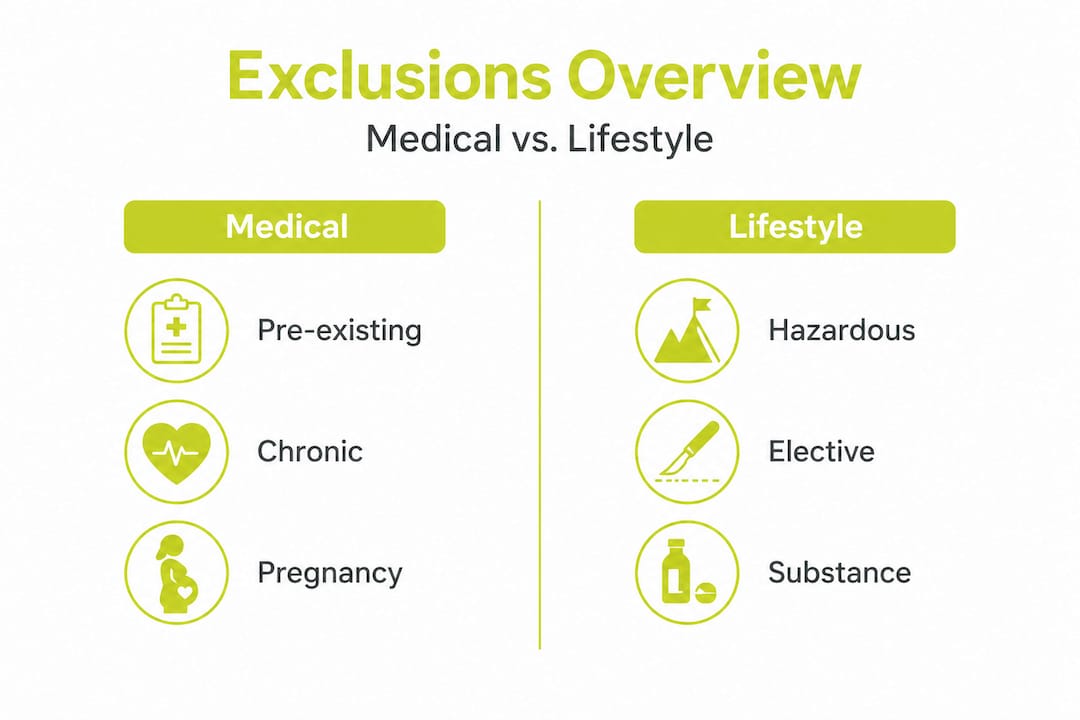
For those focused on maintaining wellness abroad, it is equally important to understand that routine prevention, such as annual health checks or nutritional counselling, may not be included in a standard plan. Some providers also specifically exclude alcohol and substance exclusions related to newer treatments like GLP-1 medications.
Spotlight on pre-existing conditions and chronic illnesses
Pre-existing conditions deserve particular attention because they are so frequently misunderstood and so commonly the source of denied claims. A pre-existing condition is any medical condition that you have been diagnosed with, received treatment for, or experienced symptoms of prior to taking out your insurance policy.
The way different insurers handle these conditions varies widely, as shown in the table below.
| Insurer approach | Description | Typical outcome for policyholders |
|---|---|---|
| Full medical underwriting | Detailed health questionnaire at application | Known conditions excluded or priced in |
| Moratorium underwriting | No upfront declaration required | Conditions excluded for 2 years; covered if symptom-free thereafter |
| Premium loading | Condition covered but at higher cost | Policy valid; insured pays more |
| Permanent exclusion | Condition never covered | Common for serious or chronic conditions |
Pre-existing conditions may be permanently excluded, covered with surcharges, or subject to a moratorium period requiring 24 months without symptoms or treatment before any related claim is considered. This means that if you have managed diabetes, for instance, you may need to wait two years symptom-free before a moratorium policy covers any diabetes-related claims.
Cigna, for example, may exclude a condition for a number of years depending on its severity, while Allianz may apply a premium loading that allows cover to begin sooner. Neither approach is universally better; the right choice depends on your specific health profile.
To protect yourself from unexpected claim denials, follow these practical steps:
- Disclose all known conditions during the application process, even those that seem minor or well-controlled.
- Request written confirmation of how each declared condition will be treated under your policy.
- Clarify the moratorium terms if you are on a moratorium policy, including the exact symptom-free period required.
- Review annually, as your health and your insurer’s underwriting criteria can both change over time.
- Seek independent advice from a broker who specialises in expat insurance if your medical history is complex.
Pro Tip: If you are managing a chronic illness, full medical underwriting often provides greater certainty than moratorium underwriting, because you receive a clear written decision on your condition upfront rather than discovering the outcome at claim time.
For a deeper look at how this works in practice, the guide on pre-existing conditions in expat insurance is an excellent resource.
Optional add-ons: When exclusions become choices
Not every exclusion is permanent. Some of the most commonly excluded services can be added back to your policy through optional upgrades, also known as riders or add-ons. This is an important distinction, because it means certain gaps in your cover are actually within your control.
Services commonly available as optional add-ons include:
- Routine dental care: Cleanings, fillings, and extractions are typically excluded but may be purchased as a dental module.
- Vision care: Eye examinations and prescription lenses are often available as a vision add-on.
- Maternity cover: Standard pregnancy and birth-related costs are excluded or optional, though complications and emergencies may be covered under the core plan.
- Fertility treatments: Rarely available but occasionally offered by premium international health insurers.
- Mental health support: Outpatient therapy and psychiatric consultations may be purchasable as an upgrade.
- Physiotherapy and rehabilitation: Often limited under core plans but extendable with add-ons.
To assess whether an add-on is worth the additional premium, consider three questions. How frequently will you need this service over the next year? What is the typical cost of that service in your host country? And does the add-on premium cost less than paying out of pocket?
For expats planning to start a family abroad, exploring dental cover options and maternity add-ons well in advance is especially important. Maternity cover typically has a waiting period of nine to twelve months before claims can be made, so planning early is essential.
Pro Tip: Never assume that because a service is listed on your insurer’s website it is automatically included in your plan. Always verify which services are in your specific plan tier and which require a separate purchase.
Danger zones: Hazardous activities, experimental and alternative treatments
Some exclusions catch expats completely off guard, particularly those related to lifestyle activities and non-mainstream medical treatments. These danger zones deserve careful attention because they apply in situations where you might genuinely need urgent help.
Activities commonly excluded from standard expat insurance include:
- Skiing and snowboarding
- Scuba diving beyond recreational depths
- Rock climbing and mountaineering
- Motorbike or moped riding (a particular concern in Southeast Asia)
- Paragliding and skydiving
- Marathon or endurance racing
Hazardous activities and extreme sports, including motorcycle accidents, are typically not covered under standard health insurance plans. This is particularly relevant for expats living in countries such as Thailand, Vietnam, or Indonesia, where motorbikes are the primary mode of transport.
Treatment categories that are almost universally excluded include:
- Experimental or clinically unproven treatments
- Homeopathy and herbal medicine
- Traditional Chinese medicine (in most plans)
- Obesity treatments and weight loss surgery
- Acupuncture (unless specifically included)
Experimental and alternative treatments, as well as obesity treatments, are not covered under the vast majority of international health insurance policies. This is because insurers base coverage decisions on treatments with proven clinical efficacy, verified through regulatory bodies and established medical research.
“If your treatment plan includes any form of alternative therapy or an experimental protocol, assume it will not be reimbursed and budget accordingly. Verify with your insurer before beginning treatment.”
For those interested in alternative therapy exclusions and innovative approaches to mental health treatment, it is worth researching which specific therapies may have been reclassified by progressive insurers in recent years.
What most expats miss about exclusions: A practical view
Here is a perspective that goes beyond the standard advice: most expats do not struggle with exclusions because they chose the wrong policy. They struggle because they never read the policy document in full. It sounds obvious, but the reality is that the summary of benefits, which is what most people review before signing, is designed to highlight what is covered, not what is not.
Excluding US coverage can save 30 to 50 per cent on premiums, but it also means you are exposed if you visit the United States for any reason. That kind of trade-off is rarely explained clearly at the point of sale.
The dangerous habit is this: expats shop on price, receive a summary that sounds reassuring, and sign up without reading the 40-page policy wording document. Months later, in a hospital abroad, they discover a clause on page 34 that excludes their specific condition or the treatment they have just received. This is not speculation; it is the experience that insurance professionals encounter regularly.
Our view is direct: saving money on premiums makes sense only when you understand precisely what you are giving up. A lower-cost plan that excludes three categories relevant to your lifestyle or health is not a saving; it is a deferred expense that will arrive at the worst possible time.
The single best habit to develop is to read your policy wording before you need to use it. Check the exclusions section specifically. If any clause is unclear, contact your insurer in writing and request a formal clarification. That record can be invaluable if a dispute arises later.
The insurance basics for expats that matter most are not the headline benefits; they are the quiet clauses that determine whether your claim succeeds or fails.
Compare your options for better coverage
Understanding exclusions is the first step. Taking action to address them is the next one, and it is where many expats gain real peace of mind.
At Unparalleled Global Benefits, we help expatriates and international travellers find plans that align with their actual health needs, lifestyle, and budget. Reviewing your expat health insurance options side by side makes it far easier to spot which exclusions apply to you personally, not just in theory. You can also compare working abroad insurance plans to see which providers offer the add-ons and underwriting approaches that best suit your situation. If you are still building your understanding of what is available, our overview of expat insurance types is a strong starting point. Knowing what you need before speaking to an insurer puts you in a far stronger position.
Frequently asked questions
Are mental health treatments covered in expat insurance?
Most standard expat insurance plans exclude ongoing mental health coverage, though some offer it as an optional add-on or with limitations on the number of sessions per year.
Is pregnancy covered by default in expat health insurance?
Routine pregnancy and maternity care are often excluded or require a separately purchased add-on; only complications or obstetric emergencies may be covered under the core plan.
Can I get coverage for extreme sports?
Most expat insurance excludes hazardous activities and extreme sports as standard, but some specialist insurers offer optional riders for specific activities at an additional premium.
What happens if I don’t declare a pre-existing condition?
Failure to declare pre-existing conditions can result in claim denial, policy cancellation, or the insurer adding permanent exclusions to any future policy it offers you.
Can experimental or alternative medicine ever be covered?
Experimental and alternative treatments are almost always excluded regardless of provider, as coverage decisions are based on clinically proven and regulatorily recognised treatments only.
Recommended
- Essential expat insurance tips: Protect your health abroad – Unparalleled Global Benefits
- Understanding expat insurance: benefits, cover, and what you need – Unparalleled Global Benefits
- Why expats need travel insurance: Essential protection – Unparalleled Global Benefits
- Understand common expat insurance terms for clarity abroad – Unparalleled Global Benefits